
Avionics, Radar & Mission Systems: A Sourcing Guide for Defence Primes
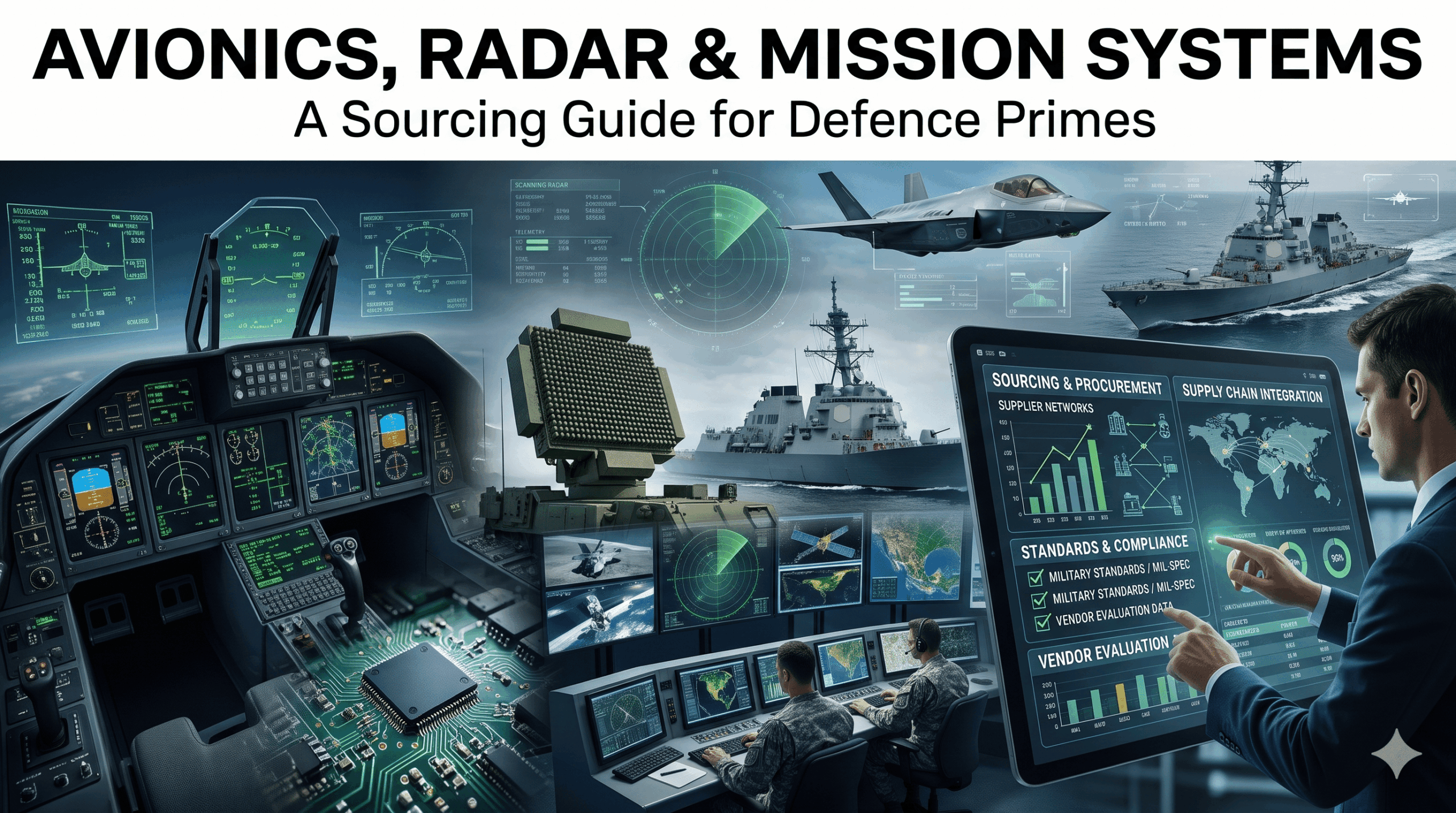
Defence primes sourcing avionics, radar, and mission systems need to balance technical performance, supply chain resilience, regulatory compliance, and long-term support. The right sourcing strategy goes beyond comparing supplier prices. It requires assessing engineering capabilities, qualification requirements, production readiness, and a supplier’s ability to support complex defence programmes throughout their lifecycle.
Why Sourcing These Systems Requires a Different Approach
Avionics, radar, and mission systems sit at the heart of modern defence platforms. They influence flight safety, situational awareness, communications, navigation, surveillance, and mission effectiveness.
For defence primes, sourcing these systems presents a different set of challenges from procuring standard industrial components. A supplier may offer competitive pricing and impressive technical specifications, but still lack the certifications, engineering resources, production capacity, or documentation required for a defence programme.
The stakes are also higher when a component is integrated into an aircraft, naval platform, ground-based surveillance network, or unmanned system. Changing suppliers late in development can trigger additional qualification work, integration changes, schedule delays, and unexpected costs.
A strong sourcing strategy therefore considers five factors from the outset:
- Technical capability: Can the supplier meet the platform’s performance and integration requirements?
- Quality and qualification: Can it demonstrate compliance with the relevant defence and aerospace standards?
- Production readiness: Can it deliver consistent quality at the required production volume?
- Supply chain resilience: Can it manage component shortages, obsolescence, and supplier dependencies?
- Lifecycle support: Can it maintain the system, provide technical assistance, and support upgrades over time?
The objective is to identify suppliers that can support the entire programme lifecycle, not simply deliver a component against an initial purchase order.
Understanding the Three Main Sourcing Categories
Avionics, radar, and mission systems share some sourcing requirements, but each category has distinct technical and commercial considerations.
1. Avionics
Avionics include the electronic systems used for aircraft navigation, flight management, communication, monitoring, and control.
What to evaluate: Environmental qualification, interface compatibility, software assurance, hardware reliability, airworthiness requirements, and long-term component availability.
2. Radar systems
Radar systems support surveillance, target detection, tracking, and situational awareness across airborne, naval, and land-based platforms.
What to evaluate: Radio-frequency engineering expertise, antenna and processing capabilities, thermal management, electromagnetic compatibility, test infrastructure, and system integration experience.
3. Mission systems
Mission systems combine hardware, software, sensors, communications, and processing functions to support a platform’s operational role.
What to evaluate: Systems engineering, interface management, software configuration control, cybersecurity requirements, integration testing, and upgradeability.
The categories often overlap. An airborne mission system, for example, may combine radar data, navigation inputs, communications equipment, and mission computers. Defence primes must therefore evaluate suppliers for both component-level performance and their ability to work within the wider platform architecture.
How to Build a Reliable Supplier Selection Process
Supplier selection should follow a structured process that connects programme requirements to measurable supplier capabilities.
1. Define requirements before approaching suppliers
A sourcing exercise becomes difficult to manage when suppliers receive incomplete specifications or unclear acceptance criteria.
Before issuing a request for quotation (RFQ) or request for proposal (RFP), document the required performance, operating environment, interfaces, qualification obligations, delivery schedule, and expected support period.
Depending on the programme, this may include:
- Mechanical, electrical, and software interface requirements.
- Temperature, vibration, shock, humidity, and electromagnetic compatibility requirements.
- Applicable airworthiness, safety, reliability, and quality requirements.
- Required test reports, inspection records, and configuration documentation.
- Prototype, qualification, production, and acceptance milestones.
- Maintenance, repair, spares, and obsolescence management expectations.
Distinguish mandatory requirements from preferred capabilities. This helps procurement teams compare suppliers consistently without overlooking technical issues that could affect programme acceptance.
2. Assess engineering capability and programme experience
A supplier’s product catalogue is not enough to establish technical suitability. Defence primes need evidence that its engineering team can develop, manufacture, test, and support equipment under the conditions expected by the programme.
Review previous work involving comparable systems, development complexity, operating environments, and qualification demands.
Useful questions include:
- Has the supplier delivered similar equipment for aerospace or defence applications?
- Does it have the engineering resources to support design changes and integration issues?
- Can it provide traceable requirements, test evidence, and configuration records?
- Does it have suitable hardware, software, and environmental test capabilities?
- Can it support technical reviews and resolve non-conformances within agreed timelines?
For complex equipment, examine the supplier’s development process as closely as the finished product. Requirements management, design reviews, independent verification, risk management, and configuration control are important indicators of programme maturity.
India’s DRDO guidance on technical airworthiness requirements highlights supplier quality management and systems engineering as important elements of airborne equipment development.
3. Verify quality systems and qualification status
Quality certification is an important screening criterion, but it does not automatically qualify every product for every defence application.
Defence primes should verify the standards specified in the contract and confirm that the supplier’s actual manufacturing and engineering processes meet those requirements.
Depending on the programme, relevant considerations may include:
- AS9100-based aerospace quality management.
- First Article Inspection and production process verification.
- Product-specific qualification and environmental test evidence.
- Manufacturing process controls and component traceability.
- Inspection and acceptance procedures.
- Corrective action processes and non-conformance management.
- Approval or registration requirements imposed by the customer or relevant authority.
For programmes in India, the Directorate General of Aeronautical Quality Assurance (DGAQA) oversees quality assurance and acceptance activities for military aircraft, avionics, airborne systems, and related equipment. Its published guidance also addresses vendor registration and capacity assessment.
The practical lesson is straightforward: verify the specific approvals, products, sites, and processes relevant to the intended contract instead of relying on a certificate alone.
Evaluating Suppliers Beyond the Initial Price
The lowest quoted price does not always represent the lowest programme cost. In defence electronics, the cost of testing, integration, engineering changes, and lifecycle support can outweigh the initial purchase price.
A supplier evaluation should combine technical, operational, commercial, and compliance considerations.
| Evaluation area | What to assess | Why it matters |
|---|---|---|
| Technical capability | Design expertise, interface compatibility, test evidence | Reduces integration and performance risks |
| Quality assurance | Certifications, traceability, inspection controls | Supports compliance and product consistency |
| Production capacity | Equipment, workforce, throughput, lead times | Helps meet delivery schedules |
| Supply chain | Critical components, sub-tier suppliers, sourcing dependencies | Identifies potential disruptions |
| Commercial viability | Total cost, financial stability, contractual terms | Supports programme affordability |
| Lifecycle support | Repair, spares, upgrades, technical documentation | Protects long-term availability |
| Regulatory compliance | Export controls, licences, security obligations | Reduces legal and delivery risks |
Use a weighted supplier scorecard
A weighted scorecard helps procurement, engineering, quality, and programme management teams make decisions using the same criteria.
The following is an illustrative starting point, not a universal defence procurement standard.
| Criterion | Example weighting |
|---|---|
| Technical capability and integration | 25% |
| Quality and qualification | 20% |
| Delivery and production readiness | 20% |
| Supply chain resilience | 15% |
| Lifecycle support | 10% |
| Commercial competitiveness | 10% |
| Total | 100% |
Score each supplier against defined evidence requirements. A supplier should not receive a high technical score based solely on a presentation or an unverified capability claim.
Some requirements should also be treated as pass-or-fail gates. A supplier that lacks a mandatory approval, cannot meet a critical interface requirement, or fails a required security check should not become eligible simply because it scores well elsewhere.
Managing Supply Chain Risk in Defence Electronics
Supply chain resilience is a central concern for avionics, radar, and mission systems sourcing. Many systems rely on specialised semiconductors, processors, sensors, connectors, power components, and other electronic parts that may have limited alternative sources.
A disruption at the component level can affect an entire production line, particularly when the affected part is already qualified and cannot be substituted without additional engineering work.
Identify single-source dependencies early
Map the supply chain beyond the direct supplier. Identify critical components, sole-source manufacturers, long-lead items, and parts with limited production availability.
For each critical item, assess:
- Whether an alternative manufacturer exists.
- Whether an alternative part would require redesign or requalification.
- The availability of current and forecast production capacity.
- Supplier concentration by country or manufacturing site.
- Whether the component is approaching end of life.
- Whether strategic inventory or a last-time buy is justified.
Second sourcing can reduce dependency, but it should be planned early. Introducing an alternative component late in the programme may create more risk than it removes if it requires extensive qualification and integration work.
Establish an obsolescence management plan
Electronic components can become unavailable while the larger defence platform remains in service. Defence primes should therefore ask suppliers how they monitor product lifecycles and communicate discontinuation notices.
An effective plan covers early-warning processes, approved alternatives, redesign responsibilities, qualification timelines, and long-term spare requirements.
Where justified, lifetime buys or strategic stock can protect programme continuity. These decisions should account for storage conditions, shelf life, demand forecasts, and the risk of holding inventory that may never be used.
Evaluate manufacturing capacity, not just current output
A supplier delivering prototypes successfully may struggle when production volumes increase.
Review the availability of skilled personnel, production equipment, test stations, manufacturing yield data, subcontractor capacity, and realistic lead times. Where appropriate, ask for a capacity assessment and a production ramp-up plan.
In India, DGAQA’s vendor registration framework specifically addresses supplier credentials, manufacturing and quality-control facilities, financial status, delivery performance, and post-procurement performance.
Export Controls, Security, and Regulatory Compliance
Avionics, radar, and mission systems may be subject to export controls because of their military applications, technical performance, software, or associated design information.
Compliance reviews should begin during supplier qualification rather than after commercial terms have been agreed.
Check product classification and licensing requirements
Determine whether the proposed hardware, software, technical data, or services are controlled under the applicable national export control regime.
For Indian programmes and international supply chains, the review may involve India’s SCOMET framework, as well as the rules applicable to the supplier, destination, end user, and technology involved.
For example, India’s export-control guidance identifies categories covering aerospace equipment, electronics, sensors, navigation, and avionics. The applicable classification and authorisation depend on the item and the transaction.
Procurement teams should confirm:
- The export-control classification of the relevant items and technical data.
- Whether export or re-export licences are required.
- Restrictions affecting destination countries or end users.
- Whether technical documentation can be shared across borders.
- Contractual requirements for handling controlled information.
- Any security, confidentiality, or access restrictions applicable to suppliers.
A supplier’s ability to manufacture a component does not necessarily mean it can legally transfer the component, its software, or its technical documentation to every customer.
Review cybersecurity and information handling
Mission systems often exchange data across multiple subsystems, making information security and software integrity important parts of supplier qualification.
Review the supplier’s access controls, secure development practices, vulnerability management, software update procedures, and incident reporting obligations against the programme’s actual requirements.
For software-intensive equipment, also establish who controls source code, software baselines, configuration changes, and maintenance releases. These responsibilities should be explicit in the contract.
Integration and Qualification: Where Sourcing Decisions Have Long-Term Effects
A component can meet its standalone specifications and still create problems when integrated into the wider platform.
Compatibility issues may arise from interfaces, power requirements, electromagnetic interference, thermal constraints, software dependencies, or differences in configuration and data handling.
Defence primes can reduce these risks by involving engineering and integration teams early in the sourcing process.
Define integration responsibilities
The procurement package should specify which party is responsible for interface definitions, integration support, test equipment, technical documentation, and resolving defects.
For complex systems, agree on interface control documentation and change management processes before detailed design work begins.
The contract should also establish how deviations are approved and how changes affecting qualification or safety are reviewed.
Plan qualification milestones before production
Qualification and acceptance requirements should be reflected in the sourcing schedule and commercial agreement.
Depending on the programme, milestones may include design reviews, prototype testing, environmental qualification, first article inspection, system integration testing, and production acceptance.
The exact sequence and evidence requirements must follow the applicable contract and certification framework. A generic test plan is not a substitute for programme-specific approval.
Make test evidence part of the deliverable
Require suppliers to identify the documentation that will accompany each delivery. This may include inspection reports, test results, approved configuration records, traceability information, and records of authorised deviations.
Clear documentation requirements make it easier to investigate failures, manage changes, and maintain the equipment over its service life.
Total Cost of Ownership and Lifecycle Support
The initial procurement price is only one part of the financial commitment involved in sourcing defence electronics.
Total cost of ownership may include:
- Engineering and integration effort.
- Qualification and acceptance testing.
- Production tooling and test equipment.
- Maintenance, repair, and replacement parts.
- Software updates and configuration management.
- Supplier transition and redesign costs.
- Obsolescence mitigation and long-term inventory.
For a system expected to remain in service for many years, the ability to obtain replacement parts and technical support may be more valuable than a small reduction in the initial price.
Clarify intellectual property and support rights
Defence primes should understand what they are purchasing beyond the physical equipment.
The agreement should distinguish supplier-owned intellectual property, customer-owned deliverables, third-party software, technical data rights, and any restrictions on maintenance or modification.
Where continuity of support is critical, consider contractual provisions for repair documentation, access to necessary technical information, software maintenance, and transition support if the supplier exits the market.
These provisions should be negotiated with the relevant legal, commercial, and technical teams rather than left until the system requires an upgrade.
Common Sourcing Mistakes to Avoid
Several recurring mistakes can create avoidable cost and schedule pressure.
Choosing on price alone. A lower quote may exclude qualification work, integration support, documentation, or lifecycle commitments.
Assuming certification guarantees product suitability. Quality certification does not establish that a specific product meets every programme requirement.
Engaging suppliers too late. Late involvement can expose interface problems and long-lead component risks after the design is already constrained.
Ignoring sub-tier suppliers. The direct supplier may depend on a critical component manufacturer with limited capacity or no practical alternative.
Leaving support obligations undefined. Unclear repair, upgrade, and documentation rights can create significant costs after initial delivery.
Treating compliance as a final checkpoint. Export restrictions, security requirements, and approval dependencies can affect supplier selection and programme schedules from the beginning.
A Practical Sourcing Checklist for Defence Primes
Use this checklist before approving a supplier for an avionics, radar, or mission systems programme.
Supplier readiness review
0/12 complete
Technical and engineeringRequirements and interface compliance verifiedRelevant design, development, and integration experience assessedTest capabilities and qualification evidence reviewed
Quality and productionRequired certifications and approvals verifiedManufacturing capacity and lead times assessedTraceability, inspection, and corrective action processes reviewed
Supply chain and commercialCritical components and single-source dependencies mappedObsolescence and continuity plans documentedLifecycle costs, spares, and support terms assessed
Compliance and lifecycleExport controls and licensing obligations checkedSecurity and information-handling requirements reviewedDocumentation, software maintenance, and change responsibilities agreed
Conclusion
Sourcing avionics, radar, and mission systems requires a broader view of supplier performance than price, lead time, or product specifications alone.
Defence primes should evaluate engineering maturity, qualification evidence, manufacturing capacity, supply chain dependencies, regulatory compliance, and lifecycle support as connected parts of the same decision.
The strongest sourcing strategies also bring procurement, engineering, quality assurance, programme management, and compliance teams into the process early. That collaboration helps identify problems before they become expensive changes and gives programme leaders better visibility into delivery risks.
Ultimately, a reliable supplier is one that can demonstrate technical competence, maintain consistent quality, meet its contractual commitments, and support the equipment throughout the programme’s service life.
Frequently Asked Questions
What should defence primes look for when sourcing avionics?
Defence primes should assess technical compatibility, environmental qualification, software assurance, airworthiness requirements, quality management, production readiness, and lifecycle support. The precise criteria depend on the platform, equipment classification, and applicable contract.
How do defence primes qualify radar and mission systems suppliers?
Qualification typically involves reviewing engineering experience, quality systems, production processes, test infrastructure, traceability, and programme-specific approval evidence. Depending on the equipment, additional product testing, integration testing, or customer approval may be required.
Why is supply chain resilience important for defence electronics?
Specialised electronic components can have long lead times, limited alternative sources, or short commercial lifecycles. Mapping critical dependencies and planning for obsolescence helps reduce the risk of production delays and costly redesigns.
Is AS9100 certification sufficient for defence supplier approval?
No. AS9100 can provide evidence of an aerospace quality management system, but it does not automatically establish product qualification, airworthiness approval, export compliance, or acceptance by a particular defence customer. Additional requirements may apply.
How can procurement teams reduce the total cost of defence electronics?
Teams can assess lifecycle costs alongside purchase price, involve engineering early, identify critical supply dependencies, define support obligations, and agree on documentation and qualification requirements before awarding a contract.
What role does export compliance play in avionics and mission systems sourcing?
Export compliance determines whether controlled hardware, software, technology, or technical data can be transferred to particular destinations or end users. Classification and licensing requirements should be assessed early to avoid delays and contractual exposure.