

Grid-Scale Battery Storage Applications: Peak Shifting, Frequency Regulation and More
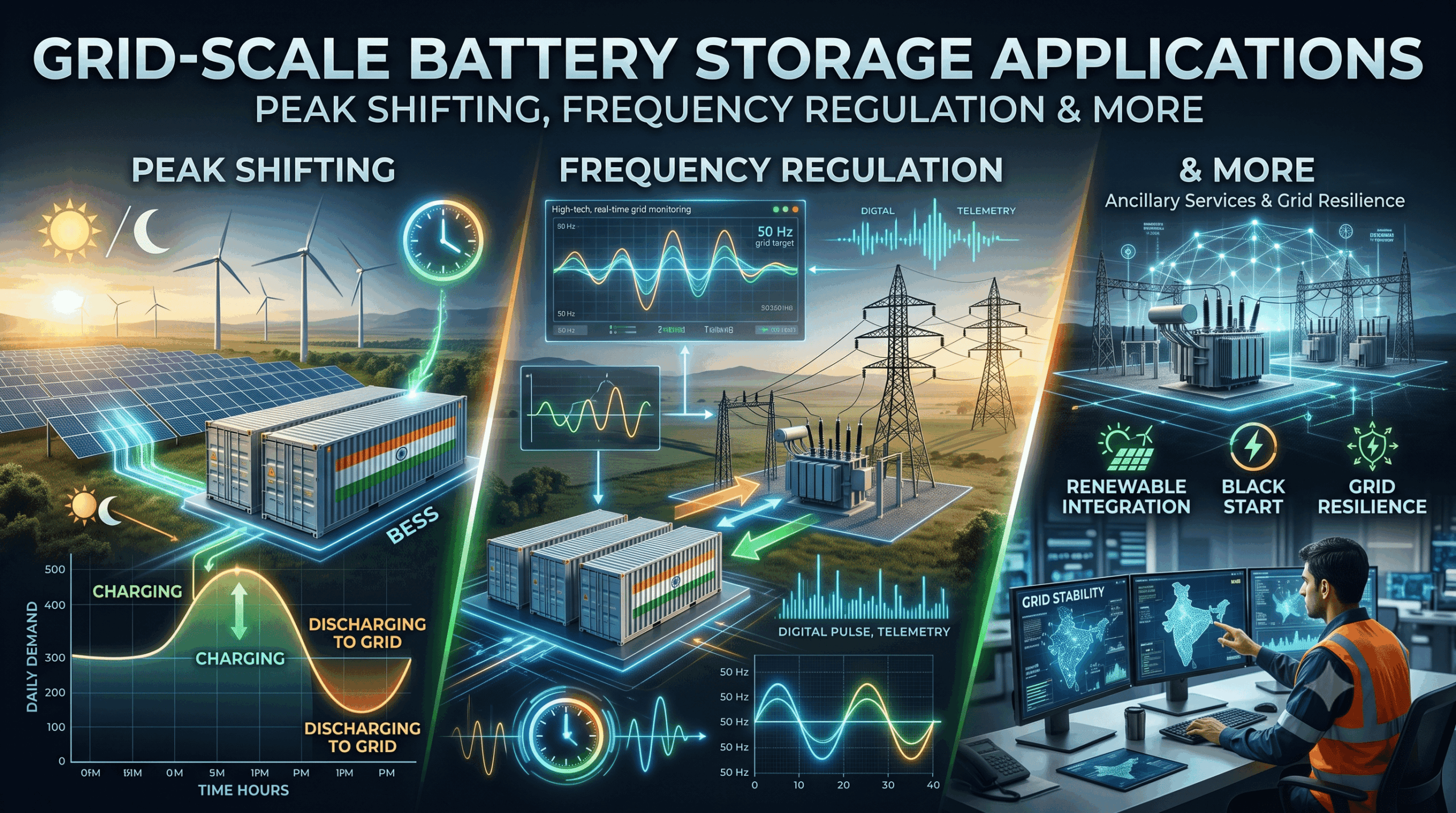
Grid-scale battery storage is becoming an important part of modern electricity systems. As electricity demand grows and renewable energy sources become more common, utilities need flexible ways to balance supply and demand, maintain grid stability, and deliver power when consumers need it most.
Battery energy storage systems (BESS) help address these challenges by storing electricity when it is available and releasing it when needed. Beyond storing energy, they can respond to grid signals, support renewable power generation, reduce peak demand, and provide backup capacity during periods of system stress.
For utilities, independent power producers, and energy developers, the value of battery storage depends on how well a project matches its technical capabilities to the needs of the grid.
What Is Grid-Scale Battery Storage?
Grid-scale battery storage refers to large battery systems connected to the electricity grid or installed alongside power generation assets. These systems typically include battery modules, power conversion equipment, thermal management, safety controls, and an energy management system.
The battery stores electricity in chemical form and converts it back into electrical energy when required. Software and control systems determine when to charge, when to discharge, and how quickly to respond to grid conditions.
Lithium-ion batteries are widely used because of their efficiency, fast response, and established supply chains. Other technologies, including flow batteries and sodium-based batteries, may suit projects with different discharge durations, operating requirements, or cost structures.
The main advantage of grid-scale storage is flexibility. Instead of generating electricity and consuming it at the same time, the power system can store energy and use it at a more valuable or useful moment.
1. Peak Shifting and Peak Shaving
Peak shifting and peak shaving are two closely related applications of grid-scale battery storage. Both help manage periods of high electricity demand, but they focus on slightly different outcomes.
How peak shifting works
Electricity demand changes throughout the day. Demand may be relatively low overnight, rise during business hours, and reach its highest level in the evening.
Peak shifting moves energy consumption from high-demand periods to lower-demand periods. A battery charges when electricity is cheaper or more abundant, then discharges during periods when demand or electricity prices increase.
For example, a battery connected to a solar power plant can store surplus electricity generated around midday and deliver it to the grid during the evening, when solar production falls but electricity demand remains high.
How peak shaving works
Peak shaving reduces the maximum amount of power that the grid must supply during a short period of high demand.
When electricity consumption rises sharply, the battery discharges to supply part of the required power. This can reduce strain on transmission and distribution infrastructure and help defer investments in additional grid capacity where local conditions support that outcome.
Business and operational benefits
Peak-related applications can help utilities and project operators:
- Reduce exposure to high wholesale electricity prices.
- Lower peak demand on constrained grid infrastructure.
- Improve the use of existing generation and transmission assets.
- Shift renewable electricity to periods of higher demand.
- Support capacity planning and reduce the need for some peaking resources.
The financial value depends on the difference between charging and discharging prices, round-trip efficiency, battery degradation, and the rules governing market participation.
2. Frequency Regulation and Grid Stability
Electricity grids must maintain a stable operating frequency. In a system operating at 50 Hz, for example, frequency changes when electricity supply and demand become unbalanced.
If demand exceeds supply, frequency tends to fall. If supply exceeds demand, frequency tends to rise. Significant deviations can trigger protective actions and threaten system reliability.
Grid-scale batteries can respond rapidly to these changes by adjusting their power output or absorbing electricity from the grid.
How batteries provide frequency regulation
A battery energy storage system uses sensors, inverters, and control software to monitor grid conditions or receive dispatch signals from a grid operator.
When the system needs additional power, the battery can discharge. When the grid has excess power, the battery can charge, provided it has sufficient capacity and the appropriate controls.
This fast, bidirectional response makes batteries useful for frequency regulation and other ancillary services.
Why fast response matters
Traditional power plants may need time to change their output. Battery systems can adjust their output much more quickly, depending on their design and control configuration.
This capability is particularly valuable in grids with high levels of wind and solar generation, where output can change with weather conditions and conventional synchronous generation may provide less natural rotational inertia.
However, a battery’s ability to deliver frequency services depends on its state of charge, available power, control settings, and the technical requirements of the relevant grid operator.
3. Renewable Energy Integration
Wind and solar power reduce reliance on fossil fuel generation, but their output varies with weather and time of day. This creates a challenge when renewable generation does not align with electricity demand.
Grid-scale battery storage helps bridge that gap.
Storing surplus solar and wind energy
When renewable generation exceeds immediate demand or available grid capacity, batteries can store some of the surplus electricity rather than allowing it to go unused.
The stored energy can then be delivered when renewable generation declines or demand increases.
For solar projects, this often means charging during daylight hours and discharging later in the day. For wind projects, charging opportunities depend on local wind patterns, demand, and electricity market conditions.
Reducing renewable curtailment
Curtailment occurs when available renewable electricity cannot be used or exported, often because of transmission constraints or excess generation.
A battery can absorb some of this electricity and release it later, provided it has available capacity and the network can accommodate the subsequent discharge.
Storage does not eliminate all curtailment. Transmission upgrades, flexible demand, and improved grid planning may still be necessary.
Improving renewable project economics
Battery storage can give renewable energy developers more control over when electricity reaches the market. This may improve revenue opportunities, support contracted delivery schedules, and reduce exposure to low or negative prices during periods of excess generation.
The result depends on the project’s location, market rules, connection agreement, storage costs, and available charging opportunities.
4. Energy Arbitrage and Electricity Price Optimization
Energy arbitrage involves buying or storing electricity when prices are low and selling or delivering it when prices are higher.
This is one of the most commercially visible applications of grid-scale battery storage, particularly in electricity markets with substantial price variation throughout the day.
How battery energy arbitrage works
Consider a battery operating in a market where electricity prices are low during periods of abundant solar generation and higher in the evening.
The operator can charge the battery during the low-price period and discharge during the higher-price period. The difference between the purchase and sale value creates a potential revenue opportunity.
However, the gross price difference is not the same as profit. The operator must account for energy losses during charging and discharging, battery degradation, market fees, operating costs, and any applicable network charges.
The role of energy management software
An energy management system can use price forecasts, demand data, weather forecasts, and battery operating limits to determine the most appropriate charging and discharging schedule.
Effective optimization balances immediate market opportunities against longer-term battery health and other contractual obligations.
For example, a battery may earn more from frequency regulation during one period and energy arbitrage during another. Whether it can switch between these services depends on market rules and the project’s operating strategy.
5. Spinning Reserves and Contingency Response
Grid operators maintain reserves to respond to unexpected events, such as the sudden loss of a generator, a transmission outage, or an unexpected increase in demand.
Grid-scale batteries can provide some of these reserve services by keeping a portion of their capacity available for rapid deployment.
How battery reserves support the grid
A battery may operate below its maximum discharge power so that it can increase output when needed. Depending on the service, it may also maintain the ability to absorb excess electricity.
If a major generator trips offline, a suitably configured battery can respond quickly while other generation resources increase their output.
The battery’s contribution depends on its available power, stored energy, response requirements, and the duration of the disturbance.
Short-duration support versus sustained backup
Batteries are particularly useful for fast response and short-duration reserve services. Longer disruptions may require additional generation, longer-duration storage, demand response, or a combination of resources.
This distinction matters when planning reserve capacity. A battery that can deliver 100 MW for one hour does not provide the same sustained energy support as a 100 MW resource capable of operating for several hours.
6. Ramp-Rate Control and Load Following
Electricity demand and renewable generation can change quickly. Grid operators need resources that can increase or decrease output to maintain balance.
Battery storage can help manage these changes through ramp-rate control and load following.
Managing rapid changes in renewable output
Cloud cover can cause solar generation to fall quickly, while changes in wind conditions can alter wind farm output. A battery can temporarily compensate for these fluctuations by increasing or reducing its power output.
This helps smooth the combined output delivered to the grid and gives other generation resources more time to adjust.
Supporting changes in electricity demand
Load following involves adjusting supply to track changing electricity demand over time.
Batteries can provide part of this flexibility by charging when demand is lower and discharging when it rises. Their contribution is limited by stored energy and available power, so dispatch must account for expected conditions over the operating period.
These services can improve operational flexibility, particularly in systems with substantial variable renewable generation.
7. Transmission and Distribution Congestion Management
Transmission and distribution networks have physical limits. When electricity flows exceed those limits, grid operators may need to redispatch generation, restrict power transfers, or invest in infrastructure upgrades.
Battery storage can help relieve congestion when it is installed at a suitable location.
How strategically located batteries help
A battery located near a constrained area can charge when the network has spare capacity and discharge when local demand rises or electricity imports become constrained.
For example, a battery near a growing industrial load may reduce the amount of power that needs to pass through an overloaded section of the network during peak hours.
The benefit is highly location-dependent. A battery connected at the wrong point may provide little relief or could worsen congestion under certain operating conditions.
Deferring infrastructure investments
In some cases, targeted battery deployment can defer or reduce the need for immediate investment in transformers, substations, or transmission upgrades.
This is not an automatic outcome. Utilities must compare storage costs, operating life, expected load growth, reliability requirements, and the cost of conventional network reinforcement.
8. Black Start and Grid Resilience
Some grid-scale battery systems can support black-start operations, which involve restoring parts of the power system after a widespread outage without relying on an already energized external grid connection.
A suitably designed battery may supply power to auxiliary equipment, energize selected network sections, and support the startup of other generation resources.
What black-start capability requires
Not every grid-scale battery can provide black-start services. The system needs compatible inverters, controls, protection equipment, auxiliary power, and an operating plan coordinated with the grid operator.
The wider network must also be capable of accepting power safely as restoration progresses.
Supporting resilience
Battery storage can also help manage short-term disruptions, stabilize local supply, and support critical loads when combined with appropriate islanding controls and backup arrangements.
For critical facilities, resilience depends on more than battery capacity alone. The design must account for load requirements, outage duration, charging availability, and the ability to operate independently when necessary.
9. Capacity Firming and Resource Adequacy
Utilities must maintain sufficient dependable resources to meet electricity demand, including during periods of high consumption or unexpected generation shortages.
Grid-scale batteries can contribute to resource adequacy by making stored energy available during designated peak-demand periods.
Turning variable generation into more dependable supply
A solar plant paired with a battery can deliver electricity beyond the hours of direct sunlight, within the limits of the battery’s stored energy and discharge power.
This can make the combined project more useful during evening demand peaks or other periods when the grid needs additional capacity.
However, the dependable capacity credited to a battery depends on its duration, charging opportunities, expected availability, and the reliability standards used by the relevant system operator.
A battery’s nameplate power rating alone does not determine how much dependable capacity it contributes.
10. How to Choose the Right Application for a Grid-Scale Battery
The best application depends on the problem the battery is intended to solve. A project designed for rapid frequency response may have different power, energy, and control requirements from one intended to supply electricity through a long evening peak.
| Application | Primary objective | Important design consideration |
|---|---|---|
| Peak shifting | Move energy to higher-demand periods | Energy capacity and discharge duration |
| Peak shaving | Reduce maximum grid demand | Power rating and peak-demand profile |
| Frequency regulation | Maintain grid frequency | Fast controls and available power headroom |
| Renewable integration | Store surplus renewable energy | Generation profile and charging opportunities |
| Energy arbitrage | Capture electricity price differences | Market volatility and round-trip efficiency |
| Operating reserves | Respond to unexpected supply shortages | Response speed and usable energy |
| Ramp-rate control | Smooth rapid changes in output | Power capability and control performance |
| Congestion management | Relieve local network constraints | Connection location and network conditions |
| Black start | Support grid restoration | Grid-forming capability and restoration procedures |
| Capacity firming | Supply energy during critical periods | Duration, availability, and reliability requirements |
Evaluate power and energy requirements separately
Battery power is measured in megawatts (MW), while stored energy is measured in megawatt-hours (MWh).
A 50 MW battery with 200 MWh of usable energy can theoretically deliver 50 MW for four hours, before accounting for operating limits and losses. The same power rating with only 50 MWh of usable energy would provide roughly one hour at full output.
This distinction is central to project design. Fast-response services may place greater emphasis on power and controls, while peak shifting and longer-duration capacity applications often require more stored energy.
Consider revenue stacking carefully
Revenue stacking means using one battery to provide multiple services, such as frequency regulation, energy arbitrage, and peak capacity.
This can improve project economics, but the services must be operationally compatible. A battery committed to one service may not have enough stored energy or available power to meet another obligation at the same time.
A realistic financial model should include dispatch constraints, degradation, efficiency losses, market participation rules, and expected revenue volatility.
Challenges and Limitations of Grid-Scale Battery Storage
Although battery storage offers several grid benefits, project owners and utilities need to account for practical constraints.
Capital and operating costs: Battery systems require upfront investment in cells, inverters, controls, installation, and grid connections. Maintenance, insurance, replacement planning, and financing also affect project economics.
Battery degradation: Repeated cycling and operating conditions gradually reduce usable capacity. Dispatch strategies must balance revenue generation with long-term performance.
Safety and thermal management: Battery installations require appropriate monitoring, protection, ventilation or cooling, and fire safety measures based on the technology and local requirements.
Interconnection and permitting: Grid studies, connection upgrades, land availability, environmental requirements, and permitting can affect project timelines and costs.
Market and regulatory uncertainty: The value of grid services varies by region. Market access, compensation structures, operating rules, and the ability to combine services can materially affect revenue.
Charging availability: A battery cannot discharge energy it has not stored. Charging restrictions, network congestion, and unexpected demand can limit its ability to deliver contracted services.
Understanding these constraints early helps developers select a suitable technology, avoid unrealistic revenue assumptions, and design systems that meet actual grid requirements.
The Future of Grid-Scale Battery Storage
Grid-scale battery storage is evolving from a resource used primarily for fast-response grid services into a flexible asset capable of supporting multiple parts of electricity system operations.
As renewable generation expands and electricity demand changes, batteries can help shift energy across the day, stabilize frequency, manage congestion, and provide dependable capacity during critical periods.
Longer-duration storage technologies, more advanced energy management systems, and improved forecasting may expand the range of applications that are technically and commercially viable. The pace of adoption will still depend on project costs, grid infrastructure, regulation, and local market conditions.
For utilities and energy developers, the central question is not simply whether to deploy battery storage. It is how to configure, locate, and operate each system to deliver the greatest value over its lifetime.
Frequently Asked Questions
What are the main applications of grid-scale battery storage?
The main applications include peak shifting, peak shaving, frequency regulation, renewable energy integration, energy arbitrage, operating reserves, ramp-rate control, congestion management, black start, and capacity firming.
How does battery storage help with peak demand?
Batteries charge during periods of lower demand or abundant electricity and discharge when demand rises. This can reduce peak grid requirements, shift energy to more valuable periods, and help manage local network constraints.
Why are batteries effective for frequency regulation?
Battery systems can change their power output rapidly and can both absorb and deliver electricity. This allows them to respond to short-term supply and demand imbalances, subject to their operating limits and grid requirements.
Can grid-scale batteries store excess solar and wind energy?
Yes. Batteries can store surplus renewable electricity and release it later when generation falls or demand increases. Their effectiveness depends on available charging energy, storage capacity, efficiency, and grid connection constraints.
How long can a grid-scale battery supply electricity?
Duration depends on the relationship between usable energy capacity and discharge power. For example, a battery with 200 MWh of usable energy supplying 50 MW can theoretically run for four hours at that output, before accounting for losses and operating limits.
Can one battery provide multiple grid services?
Yes. A battery can often provide more than one service over time, a strategy known as revenue stacking. However, simultaneous services must be compatible with its power rating, state of charge, operating limits, and market rules.
What determines the profitability of a grid-scale battery project?
Profitability depends on capital costs, electricity price differences, ancillary service revenues, efficiency, degradation, financing, interconnection costs, operating expenses, and market regulations. Projects should be evaluated using location-specific forecasts and realistic operating assumptions.
Conclusion
Grid-scale battery storage can do much more than store electricity. It can shift energy away from peak periods, support grid frequency, integrate renewable generation, relieve congestion, and provide flexibility when the power system needs it.
The strongest projects begin with a clear operational objective and match battery power, energy capacity, controls, and location to that objective. By evaluating both technical performance and commercial value, utilities and developers can make more informed decisions about where battery storage fits into their long-term energy strategy.