

BESS Procurement Checklist: How to Evaluate Suppliers and Write an RFQ
Buying a battery energy storage system (BESS) is not just a matter of comparing battery capacity and price. A system that looks competitive on paper can carry higher lifecycle costs, weaker warranties, limited integration options, or unclear performance guarantees.
A structured procurement process helps buyers compare suppliers on the factors that actually affect project performance: safety, availability, degradation, efficiency, controls, warranty coverage, service capability, and total cost of ownership.
This checklist explains what to evaluate before sending an RFQ, what information to request from BESS suppliers, and how to compare responses without getting lost in inconsistent specifications.
Start With the Project Requirements
Before approaching suppliers, define what the BESS needs to accomplish.
A supplier cannot provide a meaningful proposal if the RFQ only says something like “100 MWh battery storage system.” The same capacity can support very different applications and operating profiles.
Document at least:
- Required energy capacity, in MWh
- Required power rating, in MW
- Duration at rated power
- Application, such as peak shaving, renewable integration, frequency regulation, or energy arbitrage
- Expected daily cycles
- Operating temperature range
- Site altitude and environmental conditions
- Grid connection requirements
- Expected project life
- Commercial operation date
- Expansion requirements
- Applicable local codes and standards
For example, a 100 MW / 200 MWh system has a different operating profile from a 100 MW / 400 MWh system. Suppliers should be evaluating the same duty cycle when they submit performance and degradation assumptions.
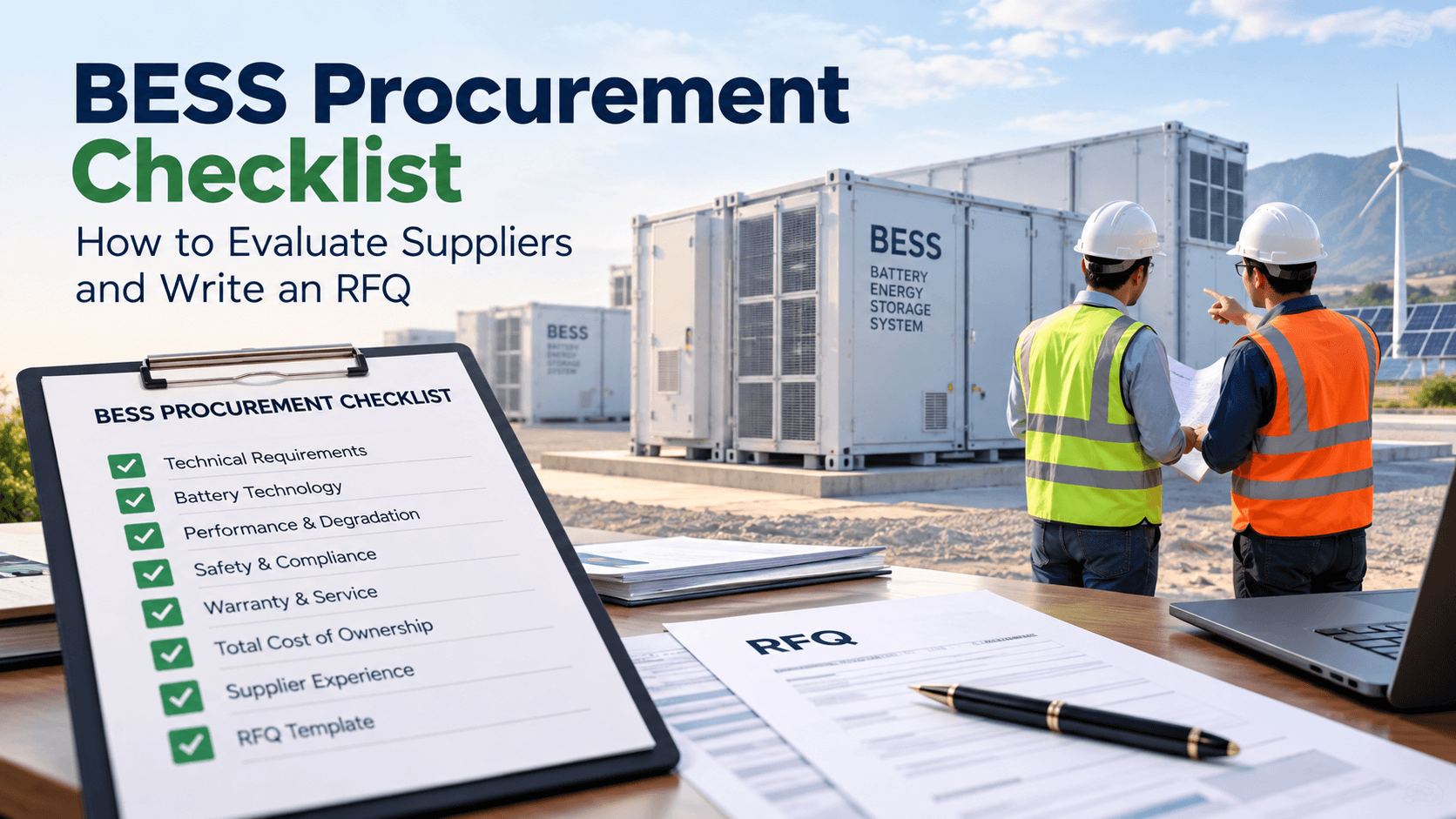
BESS Procurement Checklist
Use the following checklist as a starting point for supplier evaluation.
| Category | What to evaluate |
|---|---|
| System configuration | MW, MWh, duration, AC/DC configuration |
| Battery technology | Cell chemistry, manufacturer, module and rack design |
| Performance | Round-trip efficiency, response time, availability |
| Degradation | Capacity retention assumptions and degradation model |
| Safety | Thermal runaway protection, fire detection and suppression |
| Environmental | Temperature, humidity, altitude and enclosure ratings |
| Controls | EMS, BMS, SCADA and grid integration |
| Warranty | Product, performance, capacity and availability warranties |
| Service | Response times, spare parts and local support |
| Compliance | Applicable grid codes, certifications and standards |
| Commercials | Equipment price, installation, commissioning and exclusions |
| Lifecycle cost | Augmentation, replacement and O&M costs |
| Supplier capability | Experience, references, manufacturing capacity and financial stability |
The goal is not simply to collect more information. It is to make supplier responses comparable.
Evaluate the Battery Technology
Battery chemistry affects safety, performance, degradation, operating conditions, and lifecycle economics.
For lithium-ion BESS projects, ask suppliers to clearly identify:
- Cell chemistry
- Cell manufacturer
- Cell format
- Cell capacity
- Module configuration
- Rack configuration
- Battery container configuration
- Expected operating temperature range
- Recommended state-of-charge range
- Maximum and minimum C-rate
- Expected cycle life
- Degradation assumptions
Do not evaluate chemistry in isolation. A technology may have attractive headline specifications but perform differently under the project’s actual duty cycle.
Ask suppliers to provide performance data under conditions that resemble the planned operation.
Check the Power-to-Energy Ratio
Power and energy capacity should be evaluated together.
A useful starting point is:
Duration = Energy Capacity ÷ Power Rating
For example:
- 100 MW / 100 MWh = 1-hour system
- 100 MW / 200 MWh = 2-hour system
- 100 MW / 400 MWh = 4-hour system
But the nominal duration does not tell the entire story.
Ask suppliers whether the quoted power can be sustained across the full usable state-of-charge range and under the expected operating temperature.
Also clarify whether the stated MWh figure represents:
- Nameplate capacity
- Usable capacity
- AC-delivered energy
- DC battery capacity
- Beginning-of-life capacity
- End-of-life capacity
These distinctions can materially change how proposals compare.
Compare Round-Trip Efficiency Carefully
Round-trip efficiency (RTE) is often included prominently in BESS proposals, but suppliers may calculate it differently.
Ask suppliers to define:
- Measurement boundary
- AC or DC basis
- Auxiliary loads included
- HVAC consumption included
- State-of-charge range
- Charge and discharge power
- Test conditions
- Beginning-of-life or end-of-life performance
A system with a higher headline RTE is not automatically the lower-cost option if its other lifecycle characteristics differ.
For financial modeling, use the same efficiency definition across all bids.
Evaluate Degradation and Capacity Guarantees
Battery degradation is one of the most important long-term procurement considerations.
Ask suppliers to provide a degradation curve rather than a single end-of-life percentage.
The RFQ should specify assumptions such as:
- Cycles per year
- Depth of discharge
- Charge and discharge rates
- Ambient temperature
- State-of-charge limits
- Calendar aging
- Throughput
- Auxiliary consumption
Then ask:
What capacity will the system guarantee after 5, 10, 15, and 20 years under the specified operating profile?
This makes it easier to identify whether a supplier is relying on aggressive operating assumptions to produce a favorable warranty number.
Understand BESS Augmentation Requirements
Some systems require additional battery capacity over time to maintain the contracted output.
If augmentation is expected, suppliers should disclose:
- When augmentation is required
- How much additional capacity is expected
- What equipment will be replaced or added
- Whether augmentation is included in the initial price
- Labor and installation costs
- Expected downtime
- Replacement battery pricing assumptions
- How augmentation affects the warranty
A lower upfront bid can look very different once future augmentation costs are included.
Review the Battery Management System
The BMS is central to battery monitoring and protection.
Your RFQ should request details on:
- Cell-level monitoring
- Voltage and temperature monitoring
- State-of-charge estimation
- State-of-health estimation
- Fault detection
- Alarm management
- Cell balancing
- Communication protocols
- Data logging
- Remote monitoring
- Cybersecurity controls
Ask suppliers to explain how BMS data is exposed to the higher-level control systems.
Evaluate the Energy Management System
The EMS coordinates the BESS with the wider energy system.
Depending on the project, it may need to support:
- Dispatch scheduling
- Renewable energy integration
- Peak shaving
- Energy arbitrage
- Frequency response
- Demand management
- Grid services
- State-of-charge optimization
- Forecast-based dispatch
- Remote control
The RFQ should specify required interfaces and control responsibilities rather than assuming the supplier’s standard EMS will meet the project’s needs.
Define SCADA and Integration Requirements
Integration issues can create significant project delays.
Specify the required interfaces between:
- BESS
- EMS
- BMS
- PCS
- SCADA
- Utility or grid operator
- Site controller
- Renewable generation assets
- Building or plant control systems
Request supported protocols and interface documentation, such as Modbus TCP, IEC 61850, DNP3, or other project-specific requirements.
Also clarify who owns the integration responsibility.
Assess Power Conversion System Performance
The PCS determines how effectively the battery connects to the AC system.
Evaluate:
- Rated AC power
- Overload capability
- Efficiency curve
- Reactive power capability
- Power factor range
- Ramp rate
- Response time
- Grid-forming or grid-following capability
- Harmonic performance
- Fault ride-through capability
- Black-start capability, if required
- Grid-code compliance
Do not assume these capabilities are included simply because the supplier describes the system as grid-connected.
Put the required functions directly into the RFQ.
Make Safety Requirements Explicit
BESS safety requirements should be specific and measurable.
Depending on the jurisdiction and project, request documentation covering:
- Thermal runaway mitigation
- Fire detection
- Fire suppression
- Gas detection
- Ventilation
- Emergency shutdown
- Propagation testing
- Fault isolation
- Electrical protection
- Emergency response procedures
- Container separation requirements
- Site-level fire protection
Ask suppliers to provide relevant test reports, certifications, and compliance documentation rather than simply checking a “compliant” box.
Safety requirements should also cover installation, commissioning, operation, maintenance, and emergency response.
Review Environmental Conditions
Battery performance can change significantly with environmental conditions.
Include site-specific requirements for:
- Minimum and maximum ambient temperature
- Humidity
- Rainfall
- Dust
- Corrosive environments
- Altitude
- Flood risk
- Seismic conditions
- Wind loading
- Solar exposure
Ask suppliers to state what HVAC energy consumption is assumed in their proposal.
This is especially important when comparing projects across different climates.
Examine Availability Guarantees
Availability is different from battery capacity.
A supplier may guarantee that the system retains a certain percentage of its capacity while separately guaranteeing system availability.
Define:
- Availability calculation
- Measurement period
- Planned outage allowance
- Unplanned outage allowance
- Excluded events
- Communication outages
- Grid outages
- Maintenance windows
- Force majeure treatment
- Financial remedies
The RFQ should specify how availability will be measured and what happens if the guarantee is missed.
Review Response Time and Ramp Performance
For grid services, response speed can directly affect project revenue.
Request guaranteed values for:
- Command response time
- Ramp rate
- Full-power response
- Frequency response
- Active power control
- Reactive power response
Make sure the supplier defines the measurement point. A response measured at the battery DC bus is not necessarily equivalent to response measured at the point of interconnection.
Scrutinize the Warranty
Do not treat the warranty as a single line item.
Separate the requirements into:
Product Warranty
Covers defects in equipment and components.
Performance Warranty
Covers metrics such as capacity, efficiency, or availability.
Capacity Retention Warranty
Defines how much usable capacity remains over time.
Availability Warranty
Defines minimum system availability and remedies for failing to meet it.
Ask:
- Warranty duration
- Guaranteed operating conditions
- Required maintenance
- Exclusions
- Replacement obligations
- Response times
- Labor coverage
- Shipping coverage
- Warranty claim process
- Transferability
A warranty only has value if its conditions match the way the system will actually be operated.
Evaluate Supplier Experience
Supplier experience should be assessed against projects similar to yours.
Request:
- Installed BESS capacity
- Number of deployed projects
- Projects using the proposed technology
- Projects with similar duration
- Projects in similar climates
- Grid-service experience
- Local references
- Operating history
- Recent project references
- Manufacturing locations
Ask for references that can speak about long-term operation, not just installation and commissioning.
Check Manufacturing and Supply Chain Risk
Battery projects can be affected by component shortages, manufacturing constraints, shipping delays, and changing trade requirements.
Ask suppliers to identify:
- Cell manufacturer
- Cell manufacturing location
- Battery assembly location
- PCS manufacturer
- Major component suppliers
- Lead times
- Production capacity
- Long-lead components
- Substitute component policy
The RFQ should also require notification if critical components change after award.
Build a Total Cost of Ownership Model
Upfront equipment price is only one part of BESS economics.
Your evaluation should consider:
Total Cost of Ownership = Initial Cost + O&M + Augmentation + Replacement + Energy Losses + Other Lifecycle Costs
Depending on the project, also consider:
- Installation
- Civil works
- Grid interconnection
- Commissioning
- Software licenses
- EMS fees
- Monitoring
- Insurance
- Spare parts
- Decommissioning
- Recycling
- End-of-life transportation
Use a consistent financial model for every supplier.
Make the RFQ Easy to Compare
One of the biggest procurement mistakes is allowing suppliers to submit proposals in completely different formats.
Instead, create a response template.
For each requirement, ask suppliers to provide:
- Requirement
- Supplier response
- Guaranteed value
- Test method
- Supporting documentation
- Exceptions or deviations
- Commercial impact
This makes technical and commercial evaluation much faster.
Include a Clear RFQ Scope
A BESS RFQ should define exactly what the supplier is responsible for.
Depending on the procurement model, the scope may include:
- Battery system
- PCS
- BMS
- EMS
- HVAC
- Fire protection
- Containers or enclosures
- Transformers
- Switchgear
- SCADA integration
- Communications
- Installation
- Testing
- Commissioning
- Training
- Spare parts
- O&M
- Documentation
Clearly identify owner-supplied equipment and interfaces.
Specify Testing and Acceptance Criteria
Factory acceptance testing and site acceptance testing should be defined before contract award.
The RFQ should address:
- Factory testing
- Site testing
- Capacity testing
- Efficiency testing
- Response-time testing
- Availability testing
- Communications testing
- Safety-system testing
- Grid-code testing
- Performance test procedures
Define what happens if the system fails an acceptance test.
Possible remedies may include retesting, corrective work, liquidated damages, or rejection, depending on the contract structure.
Ask Suppliers to Declare Exceptions
Include a mandatory exceptions section in the RFQ.
Suppliers should identify any requirement they:
- Cannot meet
- Can meet only with modifications
- Consider outside standard scope
- Cannot guarantee
- Have priced separately
This prevents important limitations from being buried in technical documentation.
Create a Weighted Evaluation Framework
A structured scoring framework can help procurement teams compare proposals consistently.
For example, evaluate categories such as:
| Evaluation area | Example considerations |
|---|---|
| Technical performance | Power, capacity, efficiency, response |
| Safety | Protection systems and compliance |
| Lifecycle performance | Degradation and augmentation |
| Warranty | Coverage and guarantees |
| Supplier capability | Experience and delivery capacity |
| Integration | EMS, SCADA and grid compatibility |
| Service | O&M and local support |
| Commercials | Price, exclusions and payment terms |
| Lifecycle economics | Total cost of ownership |
| Schedule | Lead time and commissioning plan |
The exact weighting should reflect the project’s objectives rather than using a generic template.
Common BESS Procurement Mistakes
Comparing Only $/kWh
A low equipment price does not necessarily mean a low lifecycle cost.
Ignoring Usable Capacity
Nameplate MWh can obscure the amount of energy actually available for dispatch.
Accepting Undefined Efficiency Numbers
RTE should always have a defined measurement boundary and test condition.
Overlooking Degradation
A battery’s initial capacity tells you little about its economics over a 10- or 20-year project.
Leaving Integration Responsibilities Unclear
Unclear interfaces between BESS, EMS, SCADA, PCS, and grid systems can create costly delays.
Treating Safety as a Checkbox
Safety requirements should be backed by documented testing, certifications, system architecture, and site-specific requirements.
Not Defining the Operating Profile
Warranty and degradation assumptions depend heavily on how the battery will be used.
Comparing Different Commercial Scopes
One supplier may include installation and commissioning while another prices equipment only. Normalize the scope before comparing bids.
Final BESS RFQ Checklist
Before issuing the RFQ, confirm that you have defined:
- Required MW and MWh
- System duration
- Operating profile
- Daily cycling assumptions
- Site conditions
- Battery chemistry requirements
- Usable capacity definition
- Efficiency measurement method
- Degradation assumptions
- Augmentation requirements
- BMS requirements
- EMS requirements
- SCADA interfaces
- PCS performance
- Grid-code requirements
- Safety requirements
- Environmental requirements
- Availability guarantee
- Performance guarantees
- Warranty terms
- O&M scope
- Spare-parts requirements
- Testing and acceptance criteria
- Supplier references
- Delivery schedule
- Commercial scope
- Lifecycle cost assumptions
- Required proposal format
- Exceptions and deviations process
The Goal Is a Comparable, Bankable Proposal
A good BESS procurement process does more than identify the supplier with the lowest bid.
It creates a common technical and commercial framework so every supplier is evaluated against the same requirements. That means defining the operating profile, separating nameplate from usable performance, making degradation and augmentation assumptions explicit, and putting guarantees into measurable terms.
The result is a procurement process that gives project teams a much clearer view of both the system they are buying and the costs they will carry throughout its operating life.