

LRU Repair, Obsolescence Management & Legacy Platform Upgrades
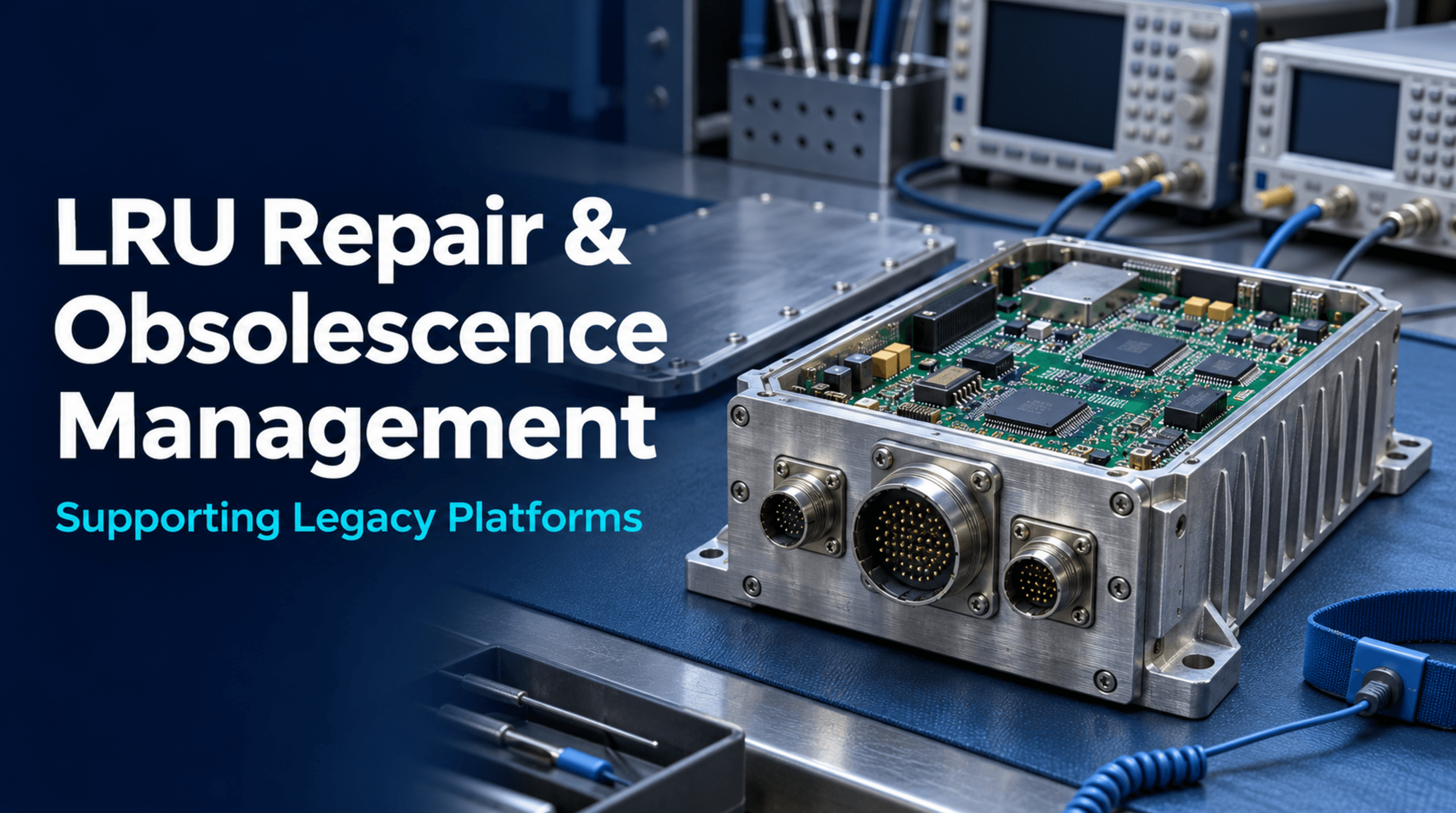
An entire platform can be held up by a component small enough to fit in your hand. The equipment may still meet its operational needs, but a failed electronic unit cannot return to service because one chip is unavailable, its supplier has withdrawn support, or the test system no longer works.
Replacing the whole platform may be disproportionate. Repairing the unit may restore operation without resolving the next shortage. The practical question is which intervention can keep the equipment supportable for as long as it is needed.
This guide explains how LRU repair, obsolescence management, and legacy upgrades fit together. For Indian defence sustainment teams, rail maintenance managers, and engineering and procurement leaders, it provides a framework for comparing options, defining acceptance evidence, and selecting a support partner. International teams can apply the same decision logic while following their own contractual and approval requirements.
What LRUs and SRUs Are, and When Repair Makes Sense
A line-replaceable unit (LRU) is an assembly designed to be removed and replaced at the equipment’s designated line-maintenance level. A control module is a typical example. Replacement restores the platform while the removed unit goes through an authorised repair process.
A shop-replaceable unit (SRU) is an internal assembly or module replaced at the workshop level, such as a circuit card within an LRU. The exact maintenance boundary depends on the platform’s design and approved maintenance arrangements.
Repair makes sense when the fault can be resolved through an authorised process, suitable parts and technical information are available, and the unit can meet the defined acceptance criteria. It can preserve existing interfaces and avoid unnecessary changes elsewhere in the platform.
However, repeated repairs deserve scrutiny when several internal parts are becoming unavailable or the equipment has little remaining support. Compare the repair route with an upgrade using the same operating horizon. A low repair quote and a redesign intended to support many further years are different propositions.
Obsolescence: Causes and Early-Warning Signs
Obsolescence management addresses the risk that an item or its supporting resources will become unavailable while the platform still needs them. It is distinct from ordinary failure: a working component can already be obsolete, while a failed component may remain readily available.
Warning signs include product-discontinuation notices, shrinking authorised supply, loss of repair support, and dependence on ageing software or specialist knowledge. Test instruments, fixtures, licences, and technical records also deserve attention. A stock of spare units has limited value if nobody can assess their condition reliably.
For each warning, establish the affected configuration, operational consequence, available stock, and time needed to implement an alternative. A supplier’s last-order deadline and the operator’s expected stock-out date answer different questions. Both matter when deciding how urgently to act.
Reactive vs Proactive Obsolescence Management
Reactive management starts after a shortage or support failure becomes urgent. Proactive management identifies exposure while there is still time to compare options, obtain approvals, and arrange funding.
The public scope of IEC 62402:2019 treats obsolescence management as a lifecycle process encompassing policy, planning, resolution, and improvement. It supports a broader approach than buying discontinued parts when a breakdown occurs; it does not establish that the standard is compulsory for every Indian programme.
A practical proactive process links supplier information to the actual equipment baseline and assigns an owner to each material risk. Review priority should reflect operational criticality and the time needed to qualify a solution. A low-cost part with no approved substitute can deserve more attention than an expensive assembly with dependable alternatives.
Choosing a Mitigation Route
The objective is to preserve a supportable, validated platform over its remaining service life, rather than simply restore one failed unit. Start with the required operating horizon, then compare technically viable routes against that horizon.
| Route | When It May Fit | Main Questions Before Commitment |
| Repair the existing unit | The design remains supportable, and the fault is recoverable | Can approved parts, repair information, and acceptance testing remain available? |
| Last-time buy | A final ordering window offers enough suitable material for a defined need | Are demand, storage, provenance, and uncertainty adequately addressed? |
| Qualify an alternative part | Another component could meet the application’s requirements | What differences affect behaviour, integration, and qualification? |
| Reverse engineer or redevelop | Existing supply or design information is inadequate, but redevelopment is feasible | Are permissions, requirements, test evidence, and future production support sufficient? |
| Redesign or upgrade the unit | Several obsolescence issues or support limitations justify engineering change | What interfaces, software, tests, and approvals will the change affect? |
| Replace the wider platform | Sustaining or upgrading the existing system no longer meets the need | How do transition costs, operational needs, training, and future support compare? |
Last-time buys need a demand and storage case
A last-time buy is a final procurement before a supplier closes its ordering window. It may cover remaining demand or provide a bridge to a planned redesign. The quantity decision should reflect the installed fleet, usable stock, expected consumption, repair yield, and uncertainty.
Buying more than necessary ties up funds and creates storage responsibilities. Buying too little can postpone the same problem. Specify provenance, inspection, preservation, and periodic stock assessment alongside quantity. Material advertised as available is not automatically acceptable for the application.
Alternative parts need engineering approval
Matching a package, connector, or headline rating is only a starting point. Depending on the application, differences in timing, electrical behaviour, thermal performance, software interaction, or environmental suitability can be important.
Define the comparison and approval route before procurement. An apparently inexpensive substitute may need substantial engineering work before it can be used responsibly.
Reverse engineering and redesign solve different problems
Reverse engineering helps establish how an existing item is constructed or behaves; redesign develops a changed implementation. The activities can overlap, but neither should be presented as permission to reproduce protected material or bypass approval.
Before commissioning either, establish access rights, functional requirements, interfaces, and acceptance evidence. Recreating visible geometry alone cannot establish equivalent behaviour. A repair or controlled stock purchase may also serve as a bridge while a longer-term solution is developed.
The LRU Repair Workflow and ATE Testing
A useful repair specification defines what the supplier must establish and record, rather than only requesting a functioning unit. An illustrative workflow is:
- Identify the unit: Record its serial number, hardware and software configuration, reported fault, and previous repair history.
- Establish the fault: Assess the reported behaviour using the applicable procedures and appropriate diagnostic equipment.
- Approve the intervention: Confirm the repair scope, replacement material, and any proposed departure from the existing configuration.
- Repair and verify: Complete authorised work and test against defined criteria, retaining the relevant results.
- Release with records: Provide the repair report, component traceability, configuration status, and required acceptance documentation.
Automated test equipment (ATE) can apply repeatable checks and support diagnosis. Its usefulness depends on the test procedures, interfaces, instruments, software, and coverage available for the unit concerned.
Ask what a test pass establishes and what remains outside its scope. Functional bench tests may not demonstrate performance under every relevant operating or environmental condition. A repaired unit and a redesigned unit may also need different evidence. The authorised acceptance process should settle that distinction before release.
Legacy Platform Upgrades and Technology Insertion
A legacy upgrade changes selected equipment while retaining useful parts of the wider platform. Technology insertion introduces a newer capability, potentially alongside an obsolescence solution. Define whether the aim is to maintain existing functionality, improve capability, or achieve both, because the evidence needed may differ.
Map the upgrade boundary before comparing proposals. Relevant dependencies can include power supplies, connectors, communications protocols, cooling, software, operator interfaces, and maintenance tools. A change within one unit can create work outside it.
For Indian rail projects, distinguish between routine, acceptance, and type tests, as each serves a different purpose. Confirm the testing and approval requirements against the current specification and instructions applicable to the particular item.
Defence, aerospace, and international programmes likewise need their own applicable design-control and acceptance arrangements. Establish who approves changes, what evidence is required, and when integration testing can occur. Schedule planning should include that work rather than end at prototype completion.
Building an Obsolescence Management Plan
An obsolescence management plan turns monitoring into accountable decisions. Keep it usable by linking each significant issue to a configuration, an owner, and an action deadline.
Include these elements:
- Equipment baseline: Units, internal assemblies, parts, software versions, interfaces, and supporting test resources.
- Risk assessment: Operational criticality, source availability, stock position, repairability, and time to implement a solution.
- Monitoring arrangements: Supplier notices, lifecycle information, repair trends, and responsibility for checking alerts.
- Mitigation decisions: Options assessed, assumptions, funding, approval requirements, and the selected route.
- Implementation records: Engineering changes, qualification evidence, configuration updates, and acceptance status.
- Review triggers: New discontinuation notices, changing fleet plans, unexpected consumption, and loss of support capability.
Choose obsolescence management tools based on the decisions they enable. Useful selection questions concern part-number matching, information provenance, alert handling, configuration links, and the ability to retain a decision history. A lifecycle-status database cannot, by itself, establish that a proposed component is suitable.
For example, in a hypothetical fleet approaching retirement, controlled stock may justify a different response from that chosen for a platform facing a long service extension. Document the assumed retirement or upgrade date and revisit the decision if it changes. Otherwise, a sound original plan can become an unsuitable current one.
Evaluating a Repair and Upgrade Partner
Give prospective partners a clear problem statement: affected configurations, reported failures, required operating horizon, available technical data, and the authority responsible for acceptance. This makes proposals easier to compare and exposes missing inputs early.
Ask each partner to explain:
- Which work is performed directly and which depends on other organisations.
- How technical-data access, usage rights, and configuration changes will be controlled.
- How replacement components will be sourced and traced.
- Which faults and operating conditions the proposed tests cover.
- What qualification and integration work is included, excluded, or dependent on customer action.
- Which repair records, test results, and updated documents will be delivered.
- How the proposed solution itself will remain supported.
Compare prices against the same deliverables. A repair-only quotation, a qualified redesign, and a longer-term support arrangement contain different work. Separate engineering charges, recurring unit costs, stock commitments, test development, and acceptance dependencies before selecting a supplier.
Final Thoughts: Preserve Platform Supportability
The best intervention is the one that keeps the required platform dependable and supportable for its intended remaining life. A successful repair is valuable, but the next component shortage, unavailable test system, or unsupported software can reopen the problem. Assess the unit along with its support arrangements.
Contact ZETWERK’s aerospace and defence manufacturing experts to discuss your obsolescence management and legacy-platform support requirements. Explore how its manufacturing, sourcing, and support services could help address your programme’s needs, with attention to traceability, quality, and component availability.
Frequently Asked Questions (FAQs)
What is the difference between an LRU and an SRU?
An LRU is replaced at the designated line-maintenance level; an SRU is an internal assembly replaced at the workshop level. A control unit may be an LRU, while a replaceable card inside it may be an SRU. The platform’s maintenance arrangements determine the actual boundaries.
Does an obsolete component mean the entire platform must be replaced?
No. Repair, suitable stock, a qualified alternative, or a controlled redesign may sustain the existing platform. Replacement becomes a stronger option when those routes cannot meet the operating need or their overall cost and support burden are no longer justified.
When does a last-time buy make sense?
A last-time buy makes sense when a final ordering opportunity can cover a defined remaining need or bridge the period before an upgrade. Assess demand uncertainty, provenance, storage, and funding before choosing quantities. A final purchase does not remove the need to maintain repair and test capability.
Can an alternative component be used without further qualification?
Sometimes, if it is already approved for the exact application and configuration. Otherwise, an engineering assessment must establish the evidence and authorisation required. Matching dimensions or a datasheet rating alone does not establish suitability, and an existing approval elsewhere may not cover the intended use.
Is reverse engineering always a suitable option?
No. Suitability depends on technical feasibility, rights and permissions, available requirements, and the ability to validate the result. It may be disproportionate for a short remaining service life or inadequate where critical behaviour cannot be established. Compare it with other mitigation routes before commissioning work.
Does passing an automated test prove readiness for service?
Not necessarily. It proves that the unit met the criteria covered by that test under the tested conditions. Release may require additional evidence concerning configuration, integration, environmental performance, or safety, depending on the application. Define acceptance requirements before treating an ATE pass as sufficient.
How often should an obsolescence management plan be reviewed?
Review it at a frequency matched to the programme’s risk and decision lead times, with additional reviews when material changes occur. Discontinuation notices, altered service-life plans, unexpected stock consumption, and loss of repair support should trigger reassessment rather than wait for the next scheduled review.