China Plus One Strategy: Why India Is the Smartest Manufacturing Bet in 2026
Introduction
Every CFO has heard the phrase “China Plus One”. Most have a slide in the board deck. Fewer have a qualified second source. The gap between strategic intent and operational reality is where supply chain risk lives. China+1 is not a trend – it is a structural shift driven by four converging forces: US-China trade tensions, pandemic-era supply chain fragility, ESG-driven supply chain transparency demands, and China’s own rising wages. India has emerged as the leading China+1 destination not by default but by deliberate policy, demographic advantage, and a manufacturing ecosystem that is maturing rapidly. This guide gives you the strategic rationale, the sector-by-sector fit assessment, the honest challenges, and a practical four-step implementation roadmap.
What Is China Plus One?
China Plus One (C+1) is a business strategy where companies diversify manufacturing operations by adding a second country to their supply chain rather than relying solely on China. The “plus one” is not a replacement – it is a risk hedge and a cost diversification play.
The strategy gained urgency after four shocks:
- US Section 301 tariffs (2018-2019): 25% duties on $250B+ of Chinese goods created immediate cost disadvantage for China-sourced products exported to the US.
- COVID-19 (2020): Factory shutdowns in Wuhan and Guangdong exposed single-geography concentration risk across every global supply chain simultaneously.
- Suez Canal blockage (2021): Six days of canal blockage disrupted 12% of global trade and exposed logistics concentration risk.
- Taiwan Strait tensions (2022-present): Semiconductor supply chain concentration in Taiwan forced board-level scenario planning across every electronics-dependent industry.
Why India – And Not Vietnam, Mexico, or Bangladesh?
Vietnam: Strong for garments, footwear, and simple electronics assembly. But Vietnam’s working-age population is 56 million – India’s is 940 million. Vietnam will run out of low-cost labour. India will not.
Mexico: Compelling for US nearshoring on logistics grounds. But Mexico’s manufacturing ecosystem is largely US-captive (automotive, aerospace Tier-1) and capacity is constrained. Mexico and India are not competing – they serve different buyer profiles.
Bangladesh: Dominant in garments, very limited in electronics or precision manufacturing. No credible play for complex industrial manufacturing.
India’s differentiated advantages:
- Scale: 940M working-age population, 1.5M engineering graduates/year
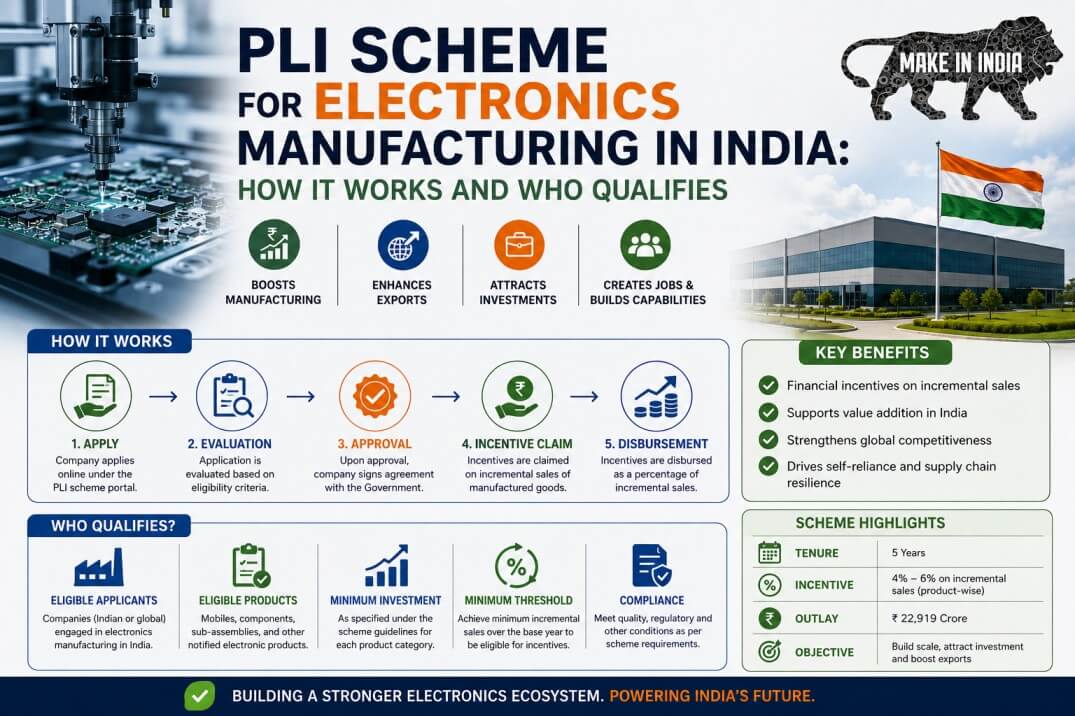
- Policy: PLI schemes (Rs 2 lakh crore), ECMS 2025 (Rs 22,919 Cr), India Semiconductor Mission (Rs 76,000 Cr)
- Ecosystem: 5,400+ Zetwerk-network suppliers; Jabil, Flex, Foxconn, Tata Electronics all operating
- Geopolitics: Democratic, rule-of-law, no Section 301 tariff exposure, strong US/EU relationships
- Language: English-medium engineering education; no communication barrier
India’s Cost Advantage: The Numbers
Labour cost comparison (2026 estimates, including statutory benefits and PF):
Assembly Operator: China coastal $4.50-6.00/hr | India Tier-1 $1.20-1.80/hr | India Tier-2 $0.80-1.20/hr
CNC Machinist: China coastal $7.00-9.00/hr | India Tier-1 $2.50-3.50/hr | India Tier-2 $1.80-2.50/hr
Quality Inspector: China coastal $5.50-7.50/hr | India Tier-1 $2.00-2.80/hr | India Tier-2 $1.40-2.00/hr
India Tier-2 cities (Pune, Coimbatore, Hosur, Vadodara) deliver 60-75% labour cost savings over Chinese coastal manufacturing. Even against Chinese interior factories, India Tier-2 saves 40-55%.
Tariff advantage: US Section 301 tariffs on Chinese goods range from 7.5% to 145% depending on HTS code. India faces standard MFN rates (0-5%). For tariff-impacted categories, India’s effective cost advantage can reach 20-30 percentage points.
Sector-by-Sector India Fit Assessment
Electronics / EMS – High Fit
Apple’s iPhone 14, 15, and 16 are assembled in India. Foxconn, Tata Electronics, Pegatron all operate India EMS plants. Samsung’s Noida facility is the world’s largest mobile phone factory by volume. India’s PLI smartphone scheme has created a credible EMS ecosystem that handles SMT assembly, systems integration, and product testing to IPC-A-610 Class 2/3 standards.
Automotive Components – High Fit
India is the world’s 3rd-largest automobile market and exports $21.2B in auto components (2023-24). IATF 16949-certified suppliers cover forging, casting, stamping, machining, plastics, and electronics across Pune, Chennai, and Gurugram clusters.
Aerospace Structures – Medium-High Fit
Bangalore’s KIADB Aerospace Park hosts Airbus, Boeing, Safran, and Honeywell. Tata Advanced Systems produces Airbus H125 helicopter structures and C-295 airframes. India’s offset obligation policy (35% indigenous content on defence contracts above Rs 300 Cr) creates captive demand.
Industrial Manufacturing – High Fit
Precision machined components, fabricated structures, forgings, castings, pumps, and compressors from India supply European and US industrial OEMs at 30-40% lower cost. Clusters in Pune, Coimbatore, Rajkot, and Ludhiana are established and export-oriented.
Pharmaceuticals – High Fit
India is already the world’s third-largest pharmaceutical producer by volume. With 3,000+ FDA-approved facilities and deep generics expertise, shifting API sourcing and formulation manufacturing to Indian CMOs is low-risk and high-reward.
Semiconductors – Developing (High Potential)
India Semiconductor Mission (Rs 76,000 Cr) has attracted Micron, Tata Electronics, and CG Power. OSAT facilities coming online 2026-2027; full-stack fab is a 5-7 year story.
Honest Challenges to Plan For
1. Component Ecosystem Depth
China’s component supply chain is unmatched – resistors, capacitors, connectors, PCB substrates are available within hours. In India, most components are still imported, adding 4-8 weeks to BOM lead times for electronics. Mitigant: use India for assembly-heavy, component-light products first while the ecosystem matures.
2. Logistics Infrastructure
Port dwell times at JNPT average 3-4 days vs 1 day at Shenzhen Yantian. Dedicated freight corridors (Delhi-Mumbai Industrial Corridor, Chennai-Bengaluru Corridor) are operational and improving. Mitigant: use bonded warehousing and dedicated logistics corridors.
3. Skilled Labour at Scale
India has 1.5M engineering graduates per year but hands-on manufacturing talent (CNC operators, SMT line technicians) is thinner. Mitigant: partner with manufacturers that have existing trained workforces rather than trying greenfield.
4. Regulatory Timelines
Factory approvals can take 6-18 months for greenfield. Mitigant: use contract manufacturers (like Zetwerk’s 5,400-supplier network) that absorb regulatory overhead.
5. Power Reliability
Uninterrupted power remains patchy outside industrial parks. Mitigant: specify industrial zones with captive power guarantees in RFQs.
How to Implement China+1 in India: A Practical Roadmap
Step 1 – Segment Your BOM (Weeks 1-4)
Not every component should move. Rank by: China supply concentration risk x lead time criticality x India capability readiness. Start with high-risk, India-ready items.
Step 2 – Identify Qualified Suppliers (Weeks 4-12)
Issue RFQs to vetted Indian contract manufacturers. Require: ISO 9001 as baseline, IATF 16949 or AS9100 for automotive/aerospace, factory audits with PPAP/FAI requirements. Platforms like Zetwerk aggregate pre-qualified suppliers with capability data, reducing discovery time from months to weeks.
Step 3 – Run Parallel Production (Months 3-9)
Overlap India ramp with China production. Validate quality through IPC-A-610 or equivalent inspections, DfM reviews, and first article inspection (FAI) sign-off before cutting China volumes.
Step 4 – Scale and Localise (Month 9+)
Once quality is validated, shift volume. Invest in localising the BOM – work with your Indian CM to identify Indian-sourced component substitutes to reduce import dependency and unlock PLI benefits.
Key Takeaways
- China+1 is now structural, not optional – trade policy, ESG, and supply chain resilience are converging forces.
- India is the leading China+1 destination for labour-intensive manufacturing, precision engineering, electronics EMS, and pharmaceuticals.
- The cost advantage is real: 30-40% savings in direct labour over Chinese coastal manufacturing.
- Government policy (PLI, ECMS 2025, India Semiconductor Mission) is materially de-risking the transition.
- Challenges exist in component ecosystems and logistics – plan for them rather than be surprised.
- The fastest path to India manufacturing is through an established contract manufacturing platform, not greenfield entry.
FAQ
Q: Is China+1 really necessary if my China supply chain is working fine?
A: A supply chain that “works fine” today was stress-tested in 2020, 2022, and 2024. The question is not whether disruption will happen again but whether your supply chain can absorb it. Diversification is insurance – the cost is low, the downside protection is significant.
Q: Does India have the manufacturing quality to match China?
A: For the sectors covered above – yes, with the right supplier selection. India’s top-tier CMs hold AS9100, IATF 16949, and IPC-A-610 certifications and supply to Boeing, Apple, and global automotive OEMs. Quality is a supplier-selection question, not a country-level question.
Q: How long does it take to qualify an Indian supplier?
A: For a standard industrial product: 3-6 months from RFQ to production-ready qualification including DfM, tooling, first article inspection, and PPAP. For aerospace/defence: 12-18 months. Electronics EMS with mature BOM: 2-4 months.
Q: What is the minimum order size that makes India viable?
A: There is no hard minimum. Economically, India contract manufacturing becomes compelling at annual spend above ~$250K per part family where labour intensity is high.
Q: Can I manage Indian manufacturing remotely?
A: Yes – with the right partner. Platforms with digital order management, real-time production tracking, and integrated quality reporting allow remote oversight. On-site visits are recommended at qualification stage; ongoing production can be managed digitally.