Prototyping Methods: From 3D Printing to CNC Machined Samples
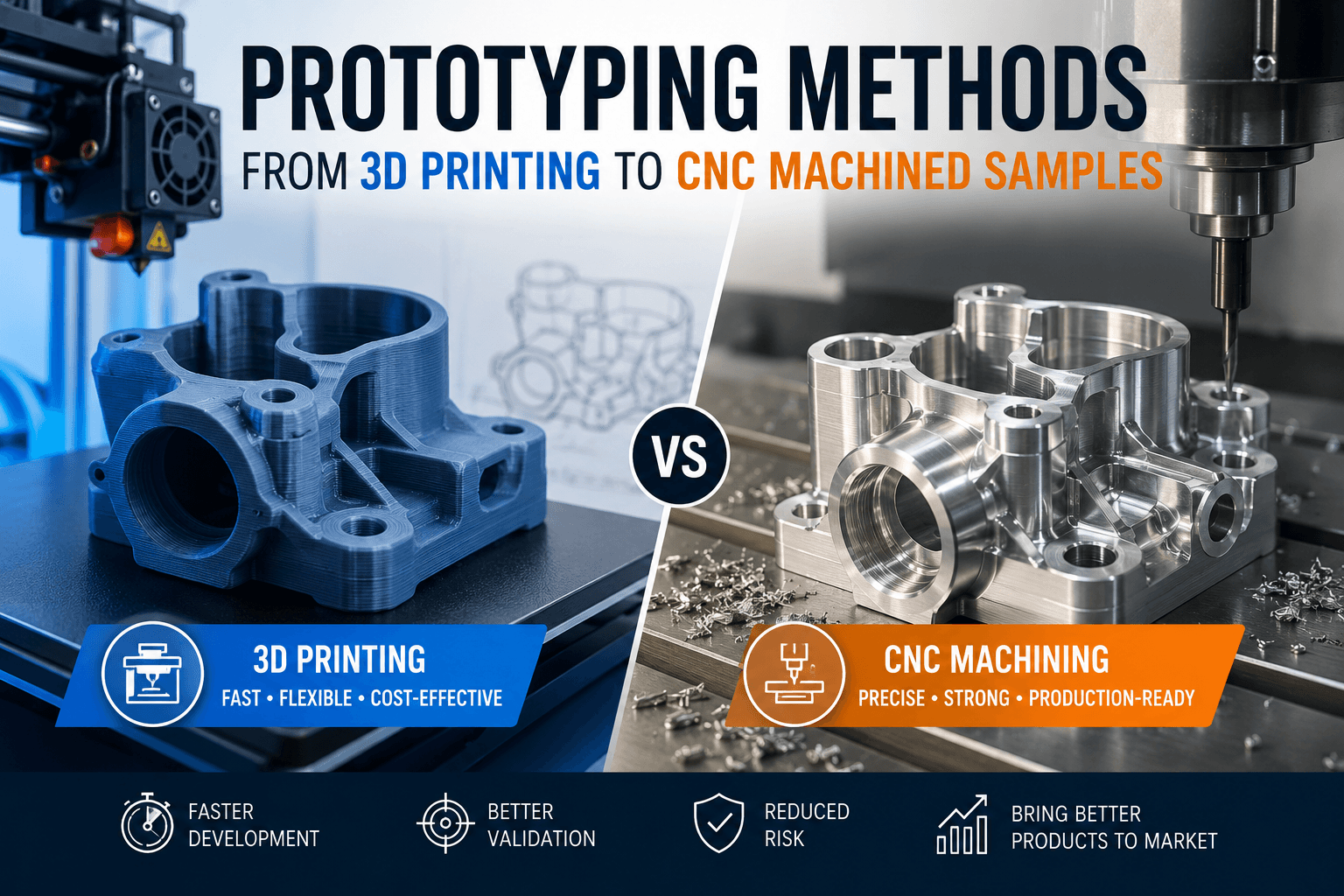
Building a great product starts with testing ideas quickly. For startups, every prototype is a chance to validate a concept, gather user feedback, and reduce costly design mistakes before moving to production.
Choosing the right prototyping method can significantly impact your development timeline, budget, and product quality. Two of the most widely used approaches are 3D printing and CNC machining. While both help turn digital designs into physical parts, they serve different purposes during product development.
This guide explains how each method works, when to use it, and how combining both can help startups move from concept to production with greater confidence.
Why Prototyping Matters for Startups
Launching a hardware product without proper testing is risky. A prototype helps answer important questions before investing in tooling or manufacturing.
Prototyping allows you to:
- Validate product functionality
- Test ergonomics and user experience
- Detect design flaws early
- Demonstrate products to investors and customers
- Reduce development costs
- Speed up product iterations
The earlier issues are discovered, the less expensive they are to fix.
Understanding 3D Printing
3D printing is an additive manufacturing process. Parts are created layer by layer from a digital CAD model.
Because there is no need for molds or custom tooling, 3D printing is one of the fastest ways to create prototype parts.
Best Applications
- Early concept models
- Design verification
- Form and fit testing
- Functional prototypes
- Custom components
- Low-volume production
Advantages
- Fast turnaround
- Low initial cost
- Complex geometries without additional tooling
- Easy design revisions
- Minimal material waste
Limitations
Although modern 3D printing materials are increasingly durable, they often do not fully match the strength, surface finish, or precision of machined components. Depending on the printing technology, additional finishing may also be required.
Understanding CNC Machining
CNC machining is a subtractive manufacturing process. Material is removed from a solid block using computer-controlled cutting tools until the final part is produced.
Because CNC machining uses production-grade materials, it creates prototypes that closely match the final manufactured product.
Best Applications
- Functional testing
- Engineering validation
- Mechanical assemblies
- Production-ready prototypes
- Low-volume manufacturing
- Customer demonstration units
Advantages
- Excellent dimensional accuracy
- Tight tolerances
- Superior surface finish
- High mechanical strength
- Wide selection of engineering plastics and metals
Limitations
Compared to 3D printing, CNC machining generally has higher material costs and longer machining times for highly complex geometries. Certain internal features may also require design modifications to remain machinable.
3D Printing vs CNC Machining
| Feature | 3D Printing | CNC Machining |
|---|---|---|
| Manufacturing Process | Additive | Subtractive |
| Speed | Very fast | Moderate |
| Cost for Early Prototypes | Lower | Higher |
| Material Options | Plastics, resins, some metals | Engineering plastics and metals |
| Dimensional Accuracy | Good | Excellent |
| Surface Finish | Moderate | Excellent |
| Mechanical Strength | Moderate to high | Production grade |
| Ideal Stage | Early development | Final validation |
When Should Startups Use 3D Printing?
3D printing is ideal when speed matters more than perfect material properties.
For example, if your team is still refining the product shape or testing multiple concepts, printing several versions in a few days allows rapid iteration without large manufacturing costs.
It is also useful for investor presentations, customer feedback sessions, and internal product reviews where appearance and functionality matter more than production-grade performance.
When CNC Machining Becomes the Better Choice
As product development progresses, testing becomes more demanding.
If your prototype must withstand mechanical stress, tight tolerances, or real-world operating conditions, CNC machining becomes the preferred option.
Machined prototypes are commonly used for:
- Engineering verification
- Functional testing
- Assembly validation
- Regulatory testing
- Pilot production
- Customer qualification samples
Using production-grade materials provides a much clearer picture of how the final product will perform.
Why Many Successful Startups Use Both
Rather than choosing one process over the other, many startups use both at different stages of development.
A typical workflow looks like this:
- Create initial concepts with 3D printing.
- Gather feedback and improve the design.
- Produce functional prototypes using CNC machining.
- Complete engineering validation.
- Move into low-volume or mass production.
This approach balances speed, cost, and quality throughout the product development cycle.
Choosing the Right Prototyping Partner
The quality of your prototype depends not only on the manufacturing process but also on the expertise behind it.
An experienced prototyping partner can help you:
- Select the most suitable manufacturing method
- Optimize designs for manufacturability
- Recommend appropriate materials
- Reduce unnecessary costs
- Accelerate product development
- Prepare designs for production
Having access to both 3D printing and CNC machining under one roof also simplifies project management and shortens lead times.
Final Thoughts
There is no single best prototyping method for every project.
3D printing excels during the early stages of development, where rapid iteration and affordability are the priority. CNC machining becomes invaluable when precision, durability, and production-grade materials are required.
For startups developing new products, combining both methods often delivers the best results. Rapid 3D printed models allow quick learning and design refinement, while CNC machined samples provide the confidence needed for functional testing, investor demonstrations, and production readiness.
Working with a manufacturing partner that offers both prototyping services gives you the flexibility to move from concept to market faster while reducing development risks and avoiding unnecessary redesigns.
Key Takeaways
- 3D printing is best for rapid design iterations and concept validation.
- CNC machining produces accurate, production-quality functional prototypes.
- Most successful hardware startups benefit from using both methods throughout product development.
- Choosing a partner that offers both services streamlines the transition from prototype to production.
Frequently Asked Questions
Q. Is 3D printing cheaper than CNC machining?
In most early-stage projects, yes. 3D printing typically has lower setup costs and is ideal for quickly producing multiple design iterations.
Q. Can a 3D printed prototype be used for functional testing?
Yes, depending on the material and application. Many engineering-grade printing materials are suitable for functional testing, although they may not fully replicate the properties of production materials.
Q. Why use CNC machining before mass production?
CNC machined prototypes closely match final production parts in terms of material, strength, accuracy, and finish. This makes them ideal for engineering validation and customer approval.
Q. Should startups use both prototyping methods?
For many hardware startups, using 3D printing during early design stages and CNC machining for final validation provides the fastest and most cost-effective path to production.