
Robotics and Automation Manufacturing: Sourcing Precision Parts at Scale
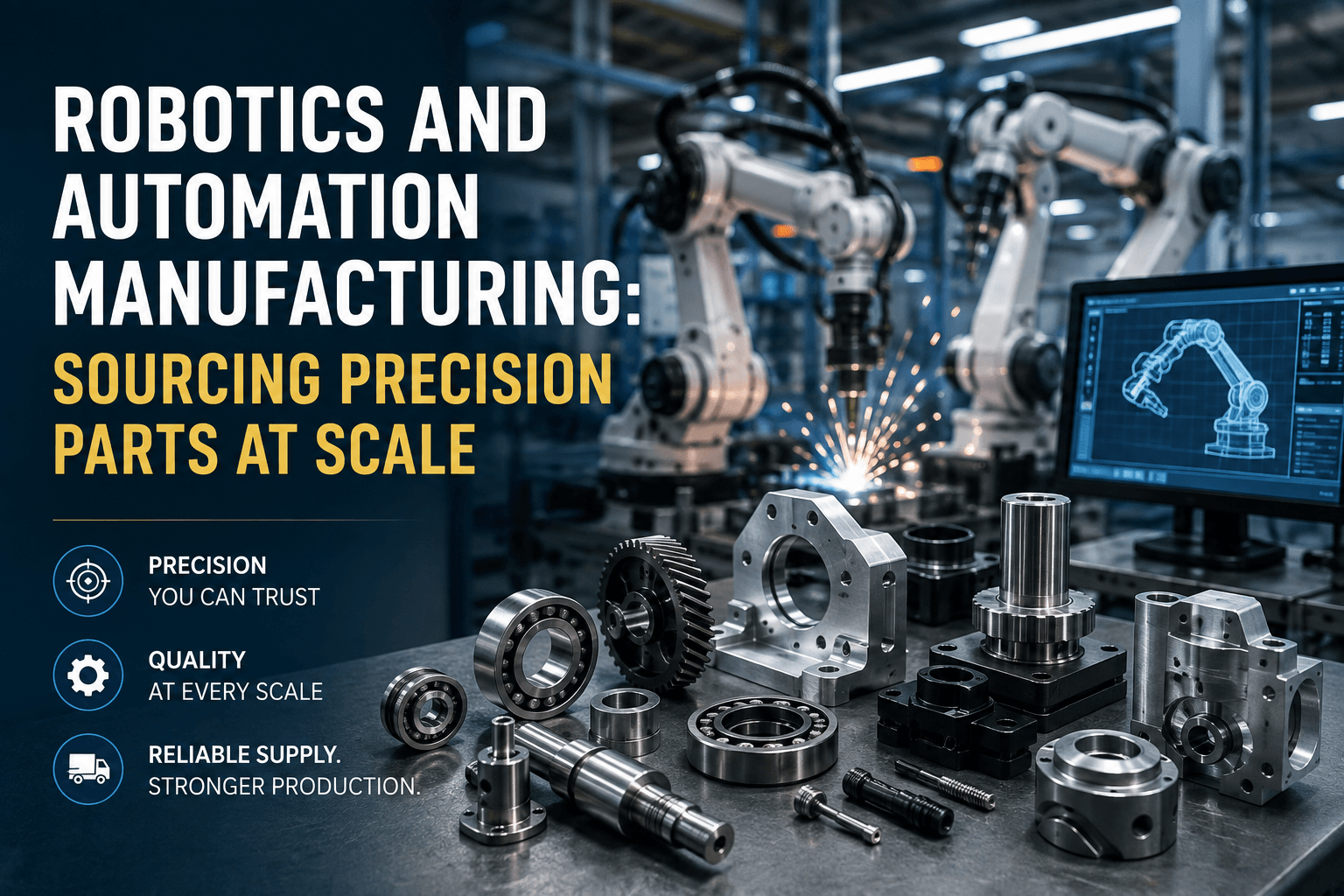
The robotics and automation industry depends on precision. Whether you’re building industrial robots, autonomous mobile robots (AMRs), collaborative robots (cobots), or automated production equipment, every component must meet tight tolerances and consistent quality standards.
As demand for automation grows across manufacturing, healthcare, logistics, agriculture, and electronics, sourcing precision parts at scale has become both a competitive advantage and a major operational challenge. Manufacturers must balance speed, quality, cost, and supply chain resilience without compromising product performance.
This guide explores the key challenges of sourcing precision components for robotics manufacturing and practical strategies for building a scalable procurement process.
Why Precision Parts Matter in Robotics
Unlike many mechanical products, robotic systems rely on hundreds or even thousands of interconnected components. A small variation in a machined housing, gear, or mounting bracket can affect alignment, accuracy, and long-term reliability.
Common precision components include:
- CNC machined aluminum and steel parts
- Precision gears and gearboxes
- Linear rails and motion components
- Custom shafts and bearings
- Sheet metal enclosures
- Injection molded plastic components
- Fasteners and specialty hardware
- Sensor mounts and electronic housings
Because these parts work together in highly engineered systems, consistency across production batches is essential.
The Challenge of Scaling Production
Moving from prototype development to full-scale manufacturing introduces new sourcing challenges.
Early-stage robotics companies often work with local machine shops capable of producing low-volume custom parts. As production grows, those suppliers may struggle to deliver larger quantities while maintaining the same quality standards and lead times.
Scaling production requires manufacturers to answer several important questions:
- Can suppliers consistently meet tolerance requirements?
- Will production capacity support future demand?
- How quickly can engineering changes be implemented?
- Can quality remain consistent across every production run?
- Is the supply chain resilient enough to handle disruptions?
Finding suppliers that can answer “yes” to all these questions is often the biggest challenge.
Quality Cannot Be an Afterthought
In robotics manufacturing, defective parts create far more than simple replacement costs.
Poor-quality components can lead to:
- Assembly delays
- Increased rework
- Robot calibration issues
- Premature wear
- Product recalls
- Warranty claims
- Customer dissatisfaction
Robotics manufacturers typically require rigorous inspection processes, including first article inspections, dimensional verification, material certifications, and ongoing quality audits.
Working with suppliers that maintain robust quality management systems reduces production risks significantly.
Building a Scalable Supplier Network
Relying on a single supplier for every precision component creates unnecessary risk.
Instead, successful robotics manufacturers build supplier networks that combine specialized expertise with manufacturing flexibility.
A diversified sourcing strategy may include:
- Regional suppliers for rapid prototyping
- High-volume production partners
- Specialists for complex machining
- Secondary suppliers for critical components
- Contract manufacturers for complete assemblies
This approach improves resilience while reducing the impact of unexpected disruptions.
Managing Tight Tolerances Across High Volumes
Precision machining becomes more challenging as production volumes increase.
Robotics applications frequently require tolerances measured in microns, especially for motion systems, actuators, and precision assemblies.
Maintaining these tolerances at scale depends on several factors:
Advanced Manufacturing Equipment
Modern CNC machining centers with automated tool monitoring help maintain dimensional consistency over long production runs.
Process Control
Statistical Process Control (SPC) enables manufacturers to detect process variations before defective parts reach assembly.
Material Consistency
Variations in raw material quality can affect machining accuracy, surface finish, and long-term durability.
Inspection Technology
Coordinate Measuring Machines (CMMs), optical inspection systems, and automated measurement tools ensure every batch meets engineering specifications.
Reducing Lead Times Without Sacrificing Quality
Long lead times can delay product launches and reduce manufacturing flexibility.
Companies are reducing procurement delays by:
- Standardizing commonly used components
- Forecasting demand earlier
- Sharing production schedules with suppliers
- Holding inventory for high-risk parts
- Using digital procurement platforms
- Qualifying backup suppliers before they’re needed
These practices improve responsiveness while helping manufacturers avoid costly production interruptions.
Digital Procurement Is Transforming Manufacturing
Traditional procurement often relies on emails, spreadsheets, and manual quotation processes.
Modern sourcing platforms streamline purchasing by allowing engineering and procurement teams to:
- Upload CAD files
- Request instant quotations
- Compare supplier capabilities
- Track production status
- Manage quality documentation
- Monitor supplier performance
Digital workflows reduce administrative overhead while improving visibility across the supply chain.
Cost Optimization Beyond Unit Price
The lowest-priced supplier does not always provide the lowest overall manufacturing cost.
Robotics manufacturers increasingly evaluate suppliers using total cost of ownership, including:
- Quality performance
- On-time delivery
- Shipping costs
- Inventory requirements
- Engineering support
- Communication efficiency
- Production flexibility
A supplier with slightly higher pricing may deliver greater long-term value through improved reliability and fewer production issues.
Sustainability Is Becoming a Procurement Priority
Many robotics manufacturers are also considering environmental performance when selecting suppliers.
Key evaluation criteria include:
- Efficient material utilization
- Recycling programs
- Energy-efficient manufacturing
- Sustainable packaging
- Reduced transportation emissions
- Compliance with environmental regulations
These initiatives support corporate sustainability goals while strengthening supplier relationships with environmentally conscious customers.
Future Trends in Precision Parts Sourcing
The robotics industry continues to evolve rapidly, and sourcing strategies are evolving alongside it.
Emerging trends include:
- AI-assisted supplier selection
- Predictive demand forecasting
- Increased manufacturing automation
- Digital quality traceability
- Greater regional diversification
- Cloud-based supplier collaboration
- Smart factory integration
Organizations that adopt these capabilities early will be better positioned to scale production while maintaining quality and operational efficiency.
Conclusion
Precision parts are the foundation of every reliable robotic system. As robotics manufacturers expand production, sourcing strategies must evolve beyond simply finding the lowest-cost supplier.
Building strong supplier partnerships, investing in quality assurance, adopting digital procurement tools, and diversifying supply chains enable manufacturers to scale confidently without sacrificing precision.
Companies that treat sourcing as a strategic capability rather than a purchasing function will be better equipped to meet growing demand, accelerate product development, and deliver dependable robotic systems in an increasingly competitive market.
Key Takeaways
- Precision components directly affect robot performance and reliability.
- Scaling production requires suppliers with consistent quality and sufficient capacity.
- Quality assurance should include inspection, certifications, and process control.
- Diversified supplier networks improve resilience and reduce operational risk.
- Digital procurement tools simplify sourcing and increase supply chain visibility.
- Total cost of ownership is a better purchasing metric than unit price alone.
- Sustainable sourcing is becoming an important competitive differentiator.
Frequently Asked Questions
Q. What are precision parts in robotics manufacturing?
Precision parts are components manufactured to extremely tight tolerances, including machined parts, gears, shafts, bearings, and custom assemblies that ensure robotic systems operate accurately and reliably.
Q. Why is sourcing precision parts challenging?
Manufacturers must balance quality, cost, lead time, production capacity, and supply chain reliability while maintaining strict engineering specifications.
Q. How can robotics manufacturers reduce supply chain risk?
Companies can reduce risk by qualifying multiple suppliers, using digital procurement systems, forecasting demand, and maintaining contingency plans for critical components.
Q. What should manufacturers look for in a precision parts supplier?
Important factors include manufacturing capabilities, quality certifications, inspection processes, production capacity, engineering expertise, on-time delivery performance, and responsiveness to design changes.