
AI-Driven Production Scheduling: How ML Optimizes Shop-Floor Throughput
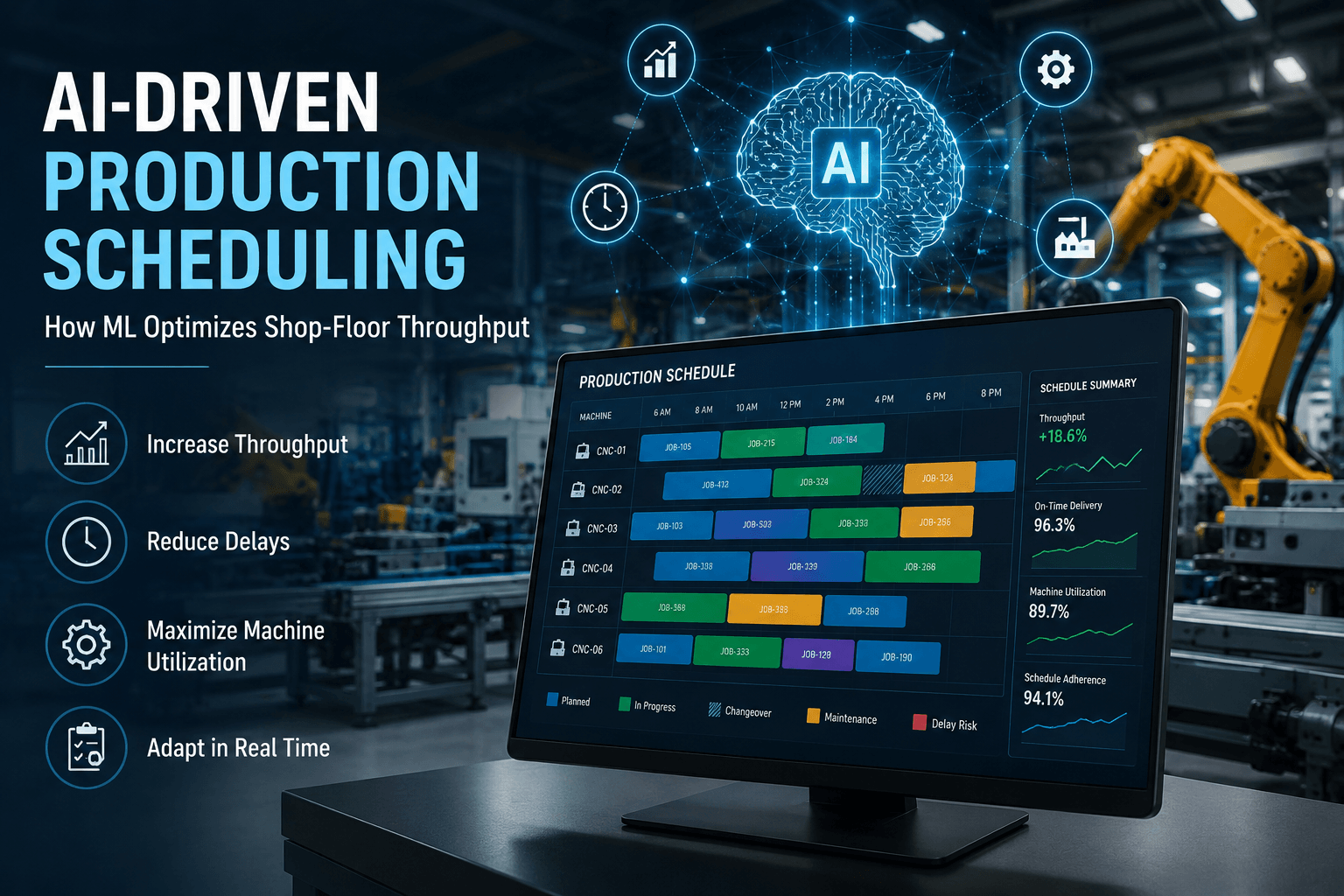
Production scheduling looks straightforward on paper. Decide what needs to be made, assign jobs to machines, set priorities, and determine when each order should run.
On a real shop floor, that plan can become outdated within hours.
A machine goes down. A rush order arrives. Material is delayed. An operator is unavailable. A setup takes longer than expected. One late job creates a chain reaction across the rest of the schedule.
This is where AI-driven production scheduling can make a practical difference.
Instead of relying only on fixed rules and manually maintained schedules, machine learning can analyze historical production data, current shop-floor conditions, machine capacity, material availability, and order priorities to recommend better scheduling decisions.
The goal is not simply to automate scheduling. It is to create schedules that respond intelligently to changing production conditions and keep work moving.
What Is AI-Driven Production Scheduling?
AI-driven production scheduling uses artificial intelligence and machine learning to determine how and when production jobs should be completed.
Traditional scheduling often depends on predefined rules such as:
- Earliest due date
- First-in, first-out
- Shortest processing time
- Fixed machine priorities
- Manually defined production sequences
These rules can work well in stable environments. They become less effective when a factory has frequent changes, complex dependencies, multiple machines, or competing priorities.
An ML-based scheduling system can consider many variables at the same time. Depending on the manufacturing environment, these may include:
- Machine availability
- Production capacity
- Historical cycle times
- Changeover requirements
- Material availability
- Operator availability
- Order due dates
- Work-in-progress
- Machine downtime
- Maintenance schedules
- Production priorities
The system can then evaluate possible schedules and identify options that better balance throughput, delivery performance, utilization, and other operational objectives.
Why Traditional Production Scheduling Struggles
The biggest challenge is not creating a schedule. It is keeping that schedule useful after production begins.
Imagine a plant with 20 machines and hundreds of active production orders.
The original schedule assumes that Machine A will complete a batch by 10:00 a.m. At 8:30 a.m., the machine experiences an unexpected stoppage.
That single event can affect:
- The job running on Machine A
- The next job waiting for that machine
- Downstream assembly
- Material allocation
- Delivery commitments
- Other machines waiting for intermediate parts
A planner can manually rebuild the schedule, but doing this repeatedly consumes valuable time.
This is especially difficult when planners need to consider thousands of possible combinations of jobs, machines, sequences, and constraints.
AI-driven scheduling can help by continuously evaluating production conditions and recommending adjustments as those conditions change.
How Machine Learning Improves Production Scheduling
Machine learning is particularly useful when the scheduling problem depends on patterns that are difficult to capture with simple rules.
1. Predicting Actual Production Times
Planned cycle times are not always the same as actual cycle times.
A job might be estimated at 30 minutes but regularly take 38 minutes on a particular machine. Another machine may complete the same job faster depending on tooling, material, or operator experience.
ML models can learn from historical production data to identify these patterns.
Instead of scheduling every job using a generic standard time, the system can estimate more realistic processing times.
Better estimates lead to better schedules.
2. Identifying Bottlenecks
A production bottleneck limits the output of the entire process.
Traditional reports may tell a planner that a machine has high utilization. An ML system can go further by analyzing relationships between jobs, machines, queues, and production delays.
For example, it might identify that:
- A particular machine frequently becomes overloaded
- Certain jobs create unusually long queues
- Specific product combinations cause excessive changeovers
- A downstream process regularly waits for one upstream operation
This information can help planners address the constraint rather than simply reacting to late orders.
3. Optimizing Job Sequences
The order in which jobs run can have a significant impact on throughput.
Consider a machine that needs 20 minutes to change tooling between two product types. If five jobs requiring the same tooling are scheduled together, the plant may avoid several unnecessary changeovers.
An intelligent scheduling system can evaluate these sequencing decisions while still considering due dates and production priorities.
The objective is not always to minimize changeovers. A schedule that minimizes changeover time but causes customer orders to ship late is not necessarily a good schedule.
ML-based optimization can balance competing objectives.
4. Responding to Disruptions
Shop floors are dynamic environments.
When conditions change, a schedule needs to change with them.
AI-driven scheduling can incorporate new information such as:
- Machine downtime
- New customer orders
- Material shortages
- Quality holds
- Maintenance requirements
- Changes in production priority
Rather than rebuilding the entire plan manually, planners can receive revised scheduling recommendations.
This turns scheduling from a static planning exercise into a more responsive process.
AI Scheduling vs. Rule-Based Scheduling
AI does not necessarily replace traditional scheduling rules.
In many manufacturing environments, the strongest approach combines both.
Rule-based logic is useful for hard constraints. For example:
- A job cannot run without the required material.
- A machine cannot process a product it is not configured for.
- A maintenance window cannot be ignored.
- A job requiring a specific certification must be assigned appropriately.
Machine learning can then help optimize decisions within those constraints.
For example, several machines may be technically capable of running an order. An ML system can evaluate historical performance, expected cycle time, current workload, changeover impact, and delivery requirements to recommend the best option.
This combination gives manufacturers the control of explicit rules with the adaptability of data-driven optimization.
What Data Does AI Scheduling Need?
The quality of an AI scheduling system depends heavily on the quality and availability of production data.
Common data sources include:
| Data Type | Examples |
|---|---|
| Orders | Due dates, quantities, priorities |
| Machines | Capacity, availability, capabilities |
| Production | Cycle times, quantities, scrap |
| Downtime | Failures, duration, causes |
| Materials | Inventory, availability, lead times |
| Labor | Skills, shifts, availability |
| Maintenance | Planned maintenance, machine restrictions |
| Processes | Routing, dependencies, setup requirements |
This data may come from ERP, MES, manufacturing planning software, machine monitoring systems, inventory platforms, or other operational systems.
Integration is therefore a major consideration when evaluating AI scheduling software.
A Practical Example of ML-Based Scheduling
Consider a manufacturer producing three product families: A, B, and C.
Product A has a tight delivery deadline. Product B requires a long setup. Product C can run on several machines but has historically experienced variable cycle times.
A basic scheduling system might prioritize A because of its due date and then schedule B and C based on predefined machine rules.
An ML-powered system can consider additional information.
It may recognize that:
- Machine 2 consistently produces C faster than Machine 4.
- Running B immediately after another B job avoids a lengthy setup.
- Product A is at greater risk of becoming late if it is assigned to Machine 1.
- Machine 3 has scheduled maintenance later in the shift.
The resulting schedule may look different from a manually created schedule, but it can better account for the actual operating conditions.
The important point is that the value comes from better decisions, not from the label “AI.”
Measuring the Impact of AI-Driven Scheduling
Manufacturers should evaluate scheduling technology against operational outcomes.
Useful metrics include:
Throughput
How much finished product does the operation produce within a defined period?
Higher throughput can indicate that available production capacity is being used more effectively.
On-Time Delivery
How consistently are customer orders completed by their promised dates?
A scheduling system should improve production flow without sacrificing delivery performance.
Machine Utilization
How effectively are available machine hours being used?
Higher utilization can be useful, but maximum utilization is not always the goal. Excessive utilization can create queues and reduce flexibility.
Changeover Time
How much production capacity is lost during machine or tooling changes?
Better sequencing can reduce unnecessary setup time.
Schedule Adherence
How closely does actual production follow the planned schedule?
Frequent deviations can indicate that the schedule does not reflect real operating conditions.
Work-in-Progress
How much inventory is sitting between production stages?
Better scheduling can help reduce unnecessary WIP by improving flow between processes.
The Business Case for AI Scheduling
The business case usually comes down to making better use of existing production capacity.
Manufacturers do not always need more machines to increase output. Sometimes the constraint is how existing capacity is scheduled.
If a scheduling system can reduce avoidable idle time, unnecessary changeovers, bottleneck congestion, and production delays, the plant may be able to produce more without adding equivalent physical capacity.
That can affect several areas of the business:
- Higher production output
- Better delivery performance
- Lower overtime
- Reduced WIP
- Better machine utilization
- Faster planner response times
- More predictable production operations
The actual impact will vary by factory, process complexity, data quality, and implementation. AI scheduling should therefore be evaluated using measurable baseline metrics rather than broad claims about automation.
How to Introduce AI Scheduling on the Shop Floor
Manufacturers do not need to automate every scheduling decision immediately.
A phased approach is often more practical.
Start With One Scheduling Problem
Choose a specific production area where scheduling creates measurable friction.
For example, a plant might focus on reducing changeover time on a bottleneck machine group.
Establish a Baseline
Measure current performance before introducing the system.
Track metrics such as throughput, schedule adherence, machine utilization, setup time, and late orders.
Connect the Required Data
Identify which systems contain the information needed for scheduling.
This may include ERP, MES, inventory, maintenance, and machine data.
Keep Planners in the Loop
AI recommendations should initially support planners rather than eliminate their role.
Experienced planners understand operational constraints that may not exist in historical datasets.
Their feedback can also help identify incorrect assumptions in the scheduling model.
Test Against Real Production Conditions
A schedule that looks optimal in a simulation may behave differently on the shop floor.
Run controlled pilots and compare results against the existing process.
Expand After Proving Value
Once the system demonstrates measurable improvement in one area, manufacturers can expand it to additional machines, production lines, or plants.
Challenges to Consider
AI-driven production scheduling is not a magic solution.
Several challenges can affect implementation.
Poor data quality can produce unreliable recommendations. Missing cycle times, inaccurate machine status, or inconsistent production records can limit model performance.
Changing processes can also affect historical patterns. If a factory introduces new equipment or changes its routing, older production data may no longer represent current conditions.
Human adoption matters just as much. Planners and supervisors need to understand why the system is recommending a particular schedule and have a way to override decisions when necessary.
Finally, scheduling objectives need to be clearly defined. Maximizing throughput, minimizing inventory, improving on-time delivery, and reducing changeovers can sometimes conflict.
The system needs clear priorities.
The Future of Production Scheduling
The next generation of production scheduling will likely be increasingly connected to real-time manufacturing data.
Instead of creating a schedule once per shift, manufacturers can move toward continuously updated scheduling recommendations.
Machine status, production progress, inventory changes, maintenance events, and new orders can all feed into the scheduling process.
This creates a more adaptive operating model:
Plan → Monitor → Predict → Adjust → Execute
The planner remains responsible for important decisions, while AI helps process the growing volume of information required to make those decisions quickly.
For complex manufacturing operations, that ability to respond can be just as important as the original schedule.
Conclusion
AI-driven production scheduling is ultimately about making better use of constrained production capacity.
Machine learning can help manufacturers predict realistic production times, identify bottlenecks, optimize job sequences, and respond to disruptions faster than traditional manual scheduling processes.
But successful implementation starts with the fundamentals: reliable production data, clearly defined objectives, strong system integration, and measurable operational targets.
The most valuable AI scheduling system is not the one that produces the most sophisticated schedule. It is the one that helps the shop floor consistently produce more, deliver on time, and adapt when reality changes.