Critical Minerals & Rare Earth Magnets for Clean Energy: India’s Supply Chain Roadmap
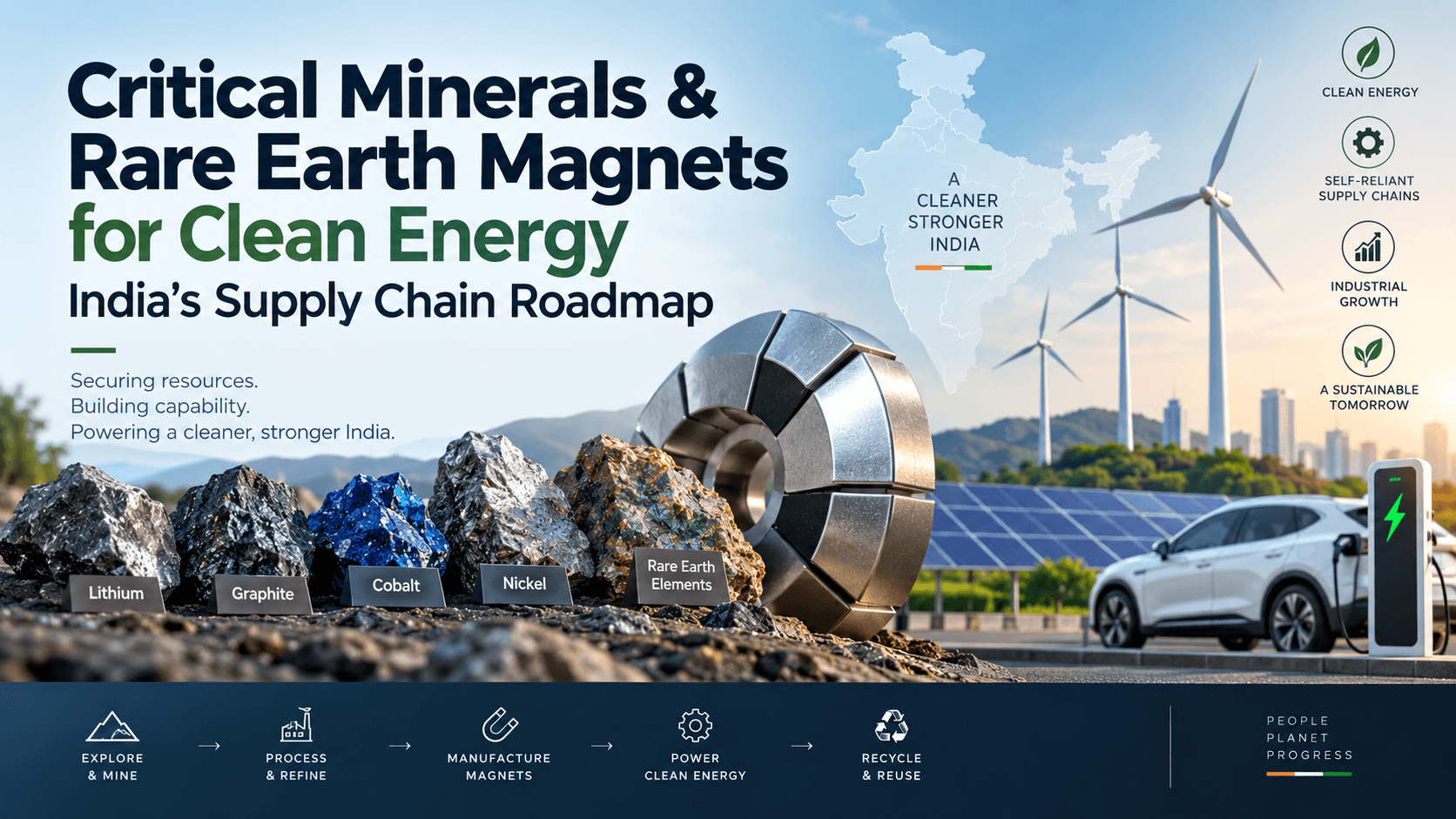
India’s clean energy transition depends on more than solar panels, batteries, electric vehicles, and wind turbines. It also depends on the minerals and advanced materials that make these technologies work.
Critical minerals such as lithium, graphite, cobalt, nickel and rare earth elements sit at the foundation of modern energy and manufacturing systems. Among them, rare earth elements have a particularly important role in high-performance permanent magnets used in electric motors, wind turbines, industrial equipment, electronics, aerospace and defence.
For India, the challenge is no longer simply securing mineral resources. The bigger question is whether the country can build a complete domestic value chain, from exploration and mining to separation, refining, metals, alloys, magnets, recycling and advanced manufacturing.
That shift is already underway. India’s National Critical Mineral Mission is designed to strengthen the entire critical-mineral value chain, while a dedicated ₹7,280 crore scheme aims to establish 6,000 metric tonnes per annum of integrated sintered rare earth permanent magnet manufacturing capacity.
Why Critical Minerals Matter to India’s Clean Energy Transition
The energy transition is creating a new form of resource dependency.
Fossil-fuel systems depend heavily on continuous supplies of coal, oil and gas. Clean-energy technologies, by contrast, require large amounts of minerals, metals and specialized materials during manufacturing.
Electric vehicles need battery materials and powerful permanent magnets. Wind turbines can require rare earth magnets for high-efficiency generators. Solar and grid infrastructure rely on materials such as copper, silicon and other critical inputs.
This means India’s clean-energy strategy and mineral strategy can no longer be treated as separate policy areas.
A disruption in the supply of a key mineral or processed material can affect vehicle production, renewable-energy projects, electronics manufacturing and strategic industries.
For India, building resilience means securing supply at multiple levels:
- Domestic mineral exploration
- Responsible mining
- Mineral beneficiation and separation
- Chemical processing and refining
- Metal and alloy production
- Permanent magnet manufacturing
- Recycling and recovery
- International sourcing and strategic partnerships
The National Critical Mineral Mission explicitly takes this broader approach, covering domestic production, overseas asset acquisition, recycling, research, financing, skills and international collaboration.
Rare Earth Elements and the Permanent Magnet Bottleneck
Rare earth elements are a group of 17 elements with specialized magnetic, optical and chemical properties.
For clean-energy applications, neodymium and praseodymium are particularly important because they are used to produce NdFeB, or neodymium-iron-boron, permanent magnets.
These magnets offer very high magnetic strength relative to their size. That makes them valuable when engineers need smaller, lighter and more efficient motors and generators.
The supply chain, however, is much more complicated than simply mining rare earth ore.
A typical pathway looks like this:
Ore → Concentrate → Separated rare earth oxides → Metals → Alloys → Magnet powder → Sintered magnet → Motor or generator
India has capabilities at several upstream stages, but the midstream and downstream portions of the chain remain a major weakness.
Government data published in 2026 states that India currently imports all of its sintered NdFeB REPM demand for downstream applications, highlighting the gap between having mineral resources and producing finished high-value magnet products.
That distinction is crucial.
Having resources underground does not automatically create supply-chain security.
India’s Rare Earth Resource Base Is Significant, But Resources Are Not Enough
India has substantial rare earth resources.
The Geological Survey of India has reported cumulative rare earth element ore resources of approximately 767 million tonnes across the country when evaluated at different cut-off values and grades. Government assessments also identify significant resources associated with monazite-bearing beach sands and hard-rock deposits.
Major resource-bearing areas include parts of:
- Andhra Pradesh
- Odisha
- Tamil Nadu
- Kerala
- Gujarat
- Rajasthan
- West Bengal
- Jharkhand
- Maharashtra
Yet India’s rare earth resources present technical and economic challenges.
Many deposits are relatively low grade, while monazite-bearing resources can be associated with radioactive thorium. Extraction, separation and processing therefore require specialized technology, infrastructure and environmental controls.
Coastal regulations, land constraints and environmental considerations can also limit the scale and speed at which some deposits can be developed.
This is why India’s roadmap needs to focus on the complete value chain rather than simply increasing mining.
The Midstream Gap Is India’s Biggest Strategic Challenge
The most important gap may sit between mining and manufacturing.
India can extract rare earth-bearing minerals and produce certain rare earth compounds, but converting those materials into high-purity oxides, metals, alloys and finished NdFeB magnets requires sophisticated processing capabilities.
This midstream segment determines whether India captures meaningful economic value from its mineral resources.
Without it, the country can remain a raw-material supplier while continuing to import high-value components.
A stronger domestic ecosystem should therefore connect:
Mining → Separation → Oxide refining → Metal production → Alloy manufacturing → Magnet production → Motor manufacturing → Recycling
Each stage creates industrial capabilities, skilled jobs and opportunities for technology development.
It also reduces the risk that a disruption at a single point in the global supply chain can stop downstream manufacturing.
India’s ₹7,280 Crore Push for Rare Earth Magnets
India has now moved beyond broad policy objectives and introduced a dedicated manufacturing intervention.
The Union Cabinet approved the Scheme to Promote Manufacturing of Sintered Rare Earth Permanent Magnets in November 2025, with a financial outlay of ₹7,280 crore.
The programme aims to establish 6,000 MTPA of integrated REPM manufacturing capacity.
It includes sales-linked incentives of ₹6,450 crore over five years and capital support for manufacturing facilities. The programme is structured around a two-year gestation period followed by five years of incentive support.
The government’s global tender attracted 20 bids by August 2026, indicating significant interest from Indian and international companies in building domestic magnet manufacturing capacity.
The important point is that the programme is intended to support integrated manufacturing rather than simply magnet assembly.
That distinction matters because the real strategic value lies in building capabilities across the NdPr oxide-to-magnet chain.
Demand Could Outpace India’s Initial Magnet Capacity
The scale of future demand is another reason the supply-chain question matters.
An assessment by IREL, DMRL and BARC estimates India’s 2030 REPM requirement at approximately 8,220 MTPA.
Electric vehicles are projected to account for about 3,250 MTPA, while wind turbines could require around 1,800 MTPA. Other significant applications include BLDC fans, smartphones and computers, industrial motors, solar pumps and elevators.
That creates an important strategic observation.
The government’s planned 6,000 MTPA capacity would represent a major improvement, but it would not necessarily cover the entire projected domestic requirement on its own.
India will therefore need to think beyond the first manufacturing wave.
The long-term objective should be a scalable ecosystem that can expand capacity as electric mobility, renewable power, industrial automation and electronics manufacturing grow.
Rare Earth Corridors Could Connect Resources With Manufacturing
The Union Budget 2026-27 announced dedicated Rare Earth Corridors in Odisha, Kerala, Andhra Pradesh and Tamil Nadu.
The objective is to connect mining, processing, research and manufacturing capabilities within regional industrial ecosystems.
This corridor approach could help solve one of India’s structural problems: fragmented supply chains.
Instead of treating mining, chemical processing, R&D and magnet manufacturing as independent projects, India can build clusters where companies, research institutions, infrastructure providers and downstream manufacturers operate closer to one another.
For example, existing rare earth processing capabilities in Odisha and Kerala can provide a foundation for broader industrial development, while Andhra Pradesh and Tamil Nadu offer opportunities to connect materials processing with electronics, automotive and advanced manufacturing ecosystems.
The success of these corridors, however, will depend on execution.
Infrastructure alone will not create a competitive industry. India will also need reliable feedstock, competitive power, skilled workers, advanced processing technologies, quality standards and predictable regulations.
Recycling Could Become a Second Source of Rare Earth Supply
Mining is only one part of the long-term solution.
Millions of electric motors, electronic devices, industrial equipment and other products will eventually reach the end of their useful lives. Many of these products contain valuable rare earth magnets.
Recovering those materials can create a secondary source of supply while reducing pressure on new mining.
India is already supporting research into rare earth recovery from end-of-life permanent magnets and electronic waste. Current government-supported projects include work on recovering rare earth elements from NdFeB magnet waste and e-waste.
A mature circular supply chain could eventually look like:
Used motor or electronics → Collection → Magnet recovery → Demagnetisation and processing → Rare earth separation → Oxides/metals → New magnets
This will require better collection systems, recycling economics, product design standards and specialized processing facilities.
Recycling should therefore be treated as strategic infrastructure, not simply as a waste-management activity.
International Partnerships Will Still Matter
Self-reliance does not mean producing every mineral entirely within India.
Some critical minerals have uneven global geological distribution. Developing overseas assets, forming partnerships with resource-rich countries and establishing diversified import channels can reduce concentration risk.
The National Critical Mineral Mission recognizes this by combining domestic exploration with overseas asset acquisition and international cooperation.
For India, the goal should be diversification rather than replacing one dependency with another.
A resilient supply chain could combine:
- Indian mineral resources
- Overseas mining assets
- Multiple international suppliers
- Domestic processing
- Strategic stockpiles where appropriate
- Recycling
- Material-efficiency research
- Alternative technologies
This approach provides more flexibility when geopolitical or market conditions change.
Technology Will Determine How Competitive India Becomes
Policy support can accelerate investment, but technology will determine whether Indian production becomes globally competitive.
Rare earth processing is technically demanding. Producing consistent high-performance NdFeB magnets requires control over composition, particle characteristics, sintering, heat treatment, microstructure and other manufacturing parameters.
India therefore needs investment in both industrial capacity and R&D.
Research priorities should include:
More Efficient Rare Earth Separation
Improving separation processes can reduce energy consumption, waste and processing costs.
Lower-Impact Extraction
New approaches can help improve recovery from lower-grade resources while reducing environmental impacts.
Magnet Recycling
Better methods for recovering NdFeB magnets from end-of-life products can create valuable secondary feedstock.
Material Efficiency
Using less rare earth material per motor or generator can reduce supply pressure without reducing performance.
Magnet Substitution
Alternative motor designs and magnet chemistries can provide additional flexibility where high-performance rare earth magnets are not essential.
Process Automation
Advanced sensors, process control and data analytics can improve consistency and reduce manufacturing losses.
What India Needs to Build a Resilient Critical Mineral Supply Chain
India’s roadmap should focus on six priorities.
1. Move From Resource Security to Value-Chain Security
The objective should not simply be to increase mineral production.
India needs to measure success across the complete chain, from ore to finished component.
2. Accelerate Midstream Capabilities
Metal, alloy and magnet production deserves as much attention as mining.
This is where India currently has one of its most important strategic gaps.
3. Build Regional Industrial Clusters
Rare Earth Corridors can bring together processing, R&D, manufacturing, logistics and downstream industries.
4. Make Recycling Commercially Viable
Government support can help establish collection and processing infrastructure until recycling reaches sufficient scale.
5. Invest in Processing Technology
Domestic R&D should focus on technologies that reduce cost, improve recovery and make Indian resources economically viable.
6. Diversify Global Supply
India should combine domestic production with overseas assets and multiple international partnerships rather than relying on a single geography.
What This Means for Clean Energy Companies
For electric vehicle manufacturers, renewable-energy developers, motor companies and electronics manufacturers, critical minerals are becoming a strategic procurement issue.
Companies should begin looking beyond the immediate price of components.
Questions worth asking include:
- Where does the magnet material originate?
- Which country performs the separation and refining?
- Is the magnet manufacturer dependent on a single supplier?
- How exposed is the supply chain to export restrictions?
- Can the supplier provide traceability?
- Is recycled material available?
- Are alternative motor technologies commercially viable?
- Can the company establish long-term offtake agreements?
Companies that understand these dependencies early will have more options when supply becomes constrained.
India’s Opportunity Goes Beyond Import Substitution
Reducing imports is only the first economic opportunity.
A competitive domestic critical-minerals ecosystem could create new industries in advanced materials, chemical processing, magnet manufacturing, electric motors, recycling and industrial equipment.
It could also strengthen India’s position in global clean-energy manufacturing.
If India can move from exporting or processing raw materials to producing high-value components, a larger share of the economic value created by the clean-energy transition can remain within the country.
That is the bigger opportunity behind the critical-minerals strategy.
The Road Ahead
India has many of the ingredients required to build a competitive critical-minerals ecosystem: significant mineral resources, a large domestic market, established scientific institutions, growing electric mobility and renewable-energy industries, and increasingly targeted government support.
But resources alone will not create supply-chain resilience.
The next phase will depend on execution.
India needs to turn mineral resources into reliable feedstock, feedstock into refined materials, refined materials into magnets, and magnets into globally competitive products.
The ₹7,280 crore REPM manufacturing scheme and the planned Rare Earth Corridors are important steps in that direction. The 6,000 MTPA target also creates a foundation for a domestic magnet industry. At the same time, projected demand of roughly 8,220 MTPA by 2030 shows that capacity will need to expand as the clean-energy economy grows.
The strategic goal should therefore be bigger than self-sufficiency.
India’s opportunity is to build a resilient, technology-driven and globally competitive critical-minerals supply chain that supports electric mobility, renewable energy, advanced manufacturing and national security for decades to come.
Key Takeaways
- Critical minerals are becoming strategic infrastructure for India’s clean-energy transition.
- Rare earth permanent magnets are particularly important for EV motors, wind turbines, electronics and other high-performance applications.
- India’s challenge is less about geological potential and more about developing midstream and downstream capabilities.
- The ₹7,280 crore REPM scheme targets 6,000 MTPA of integrated magnet manufacturing capacity.
- Government estimates put India’s 2030 REPM demand at approximately 8,220 MTPA.
- Rare Earth Corridors in Odisha, Kerala, Andhra Pradesh and Tamil Nadu are intended to connect mining, processing, R&D and manufacturing.
- Recycling, overseas sourcing and technology development will be essential alongside domestic mining.
- The long-term opportunity is to build a globally competitive advanced-materials ecosystem, not simply replace imports.
FAQs
What are critical minerals?
Critical minerals are minerals considered strategically important because of their economic or national-security value and the risk of supply disruption. India’s current critical-mineral framework covers 24 minerals, including rare earths, lithium, cobalt, graphite, nickel and several other materials.
Why are rare earth magnets important for clean energy?
Rare earth permanent magnets provide high magnetic strength in relatively compact designs. They are used in applications such as electric vehicle motors and wind turbine generators, where efficiency, weight and size can be important design considerations.
Does India have rare earth resources?
Yes. India has significant identified rare earth resources across several states. However, geological resources do not automatically translate into commercially available material because extraction, separation, processing and environmental constraints can make development complex.
Does India manufacture NdFeB magnets?
India has historically had limited downstream capability and has depended heavily on imports for sintered NdFeB permanent magnets. The government’s new REPM manufacturing scheme is intended to establish integrated domestic capacity and reduce this dependency.
How much REPM capacity is India planning to build?3wq
The government-approved qREPM manufacturing scheme targets 6,000 metric tonnes per annum of integrated sintered rare earth permanent magnet capacity.2q
Why is recycling important for rare earth supply?
Recycling can recover rare earth materials from end-of-life magnets and electronics, creating a secondary source of supply. It can also reduce dependence on newly mined material and support a more circular materials economy.