US Tariffs 2026 and Manufacturing Relocation: Which Categories Should Move to India Now
Introduction
In 2026, the us tariff calculus for US importers has been reset again. The re-escalation of Section 301 tariffs under the new US trade policy framework – with effective rates on Chinese electronics now exceeding 145% on selected HTS codes – has eliminated the economics of China-origin sourcing across a broad set of product categories. The question facing every procurement team, CFO, and supply chain executive is no longer “should we diversify?” but “which categories should move now, to where, and how fast?”
This guide maps the highest-impact tariff categories, scores India’s readiness for each, and gives you a practical relocation decision framework for 2026.
The 2026 Tariff Landscape: What Changed
The 2025-2026 tariff escalation built on the Section 301 framework but added new product-level specificity. Key changes impacting manufacturing sourcing decisions:
- Electronics and semiconductors: Effective rates on Chinese-origin electronics assemblies now range from 25% to 145% depending on HTS classification and product category.
- Industrial machinery: Broad tariff application to CNC machine tools, motors, pumps, and compressors from China at 25% base rates.
- Automotive components: 25% duties on most Chinese-origin auto parts, adding $300-800 per vehicle on China-sourced BOM.
- Textiles and apparel: Sector-specific rates targeting garments, technical textiles, and industrial fabrics.
- Medical devices: New tariff scrutiny on Class I and Class II Chinese-origin medical devices and sub-components.
The net effect: for any product where China-origin tariffs exceed 15-20%, the TCO advantage of Chinese manufacturing is partially or fully offset. At 25%+ tariffs, India is decisively cheaper on total landed cost for labour-intensive categories.
Category-by-Category Relocation Assessment
Electronics Assembly and EMS – Move Now
Tariff exposure: 25-145% on Chinese-origin electronics. India readiness: High. India’s EMS ecosystem (Foxconn, Tata Electronics, Jabil India, Zetwerk-network CMs) handles SMT assembly, system-level integration, and testing to IPC-A-610 Class 2/3 standards. Apple’s India-origin iPhone now accounts for over 18% of global production. The ecosystem is validated, scalable, and tariff-advantaged.
Decision: Immediate qualification of Indian EMS suppliers for any electronics assembly with 2026 China tariff exposure above 20%.
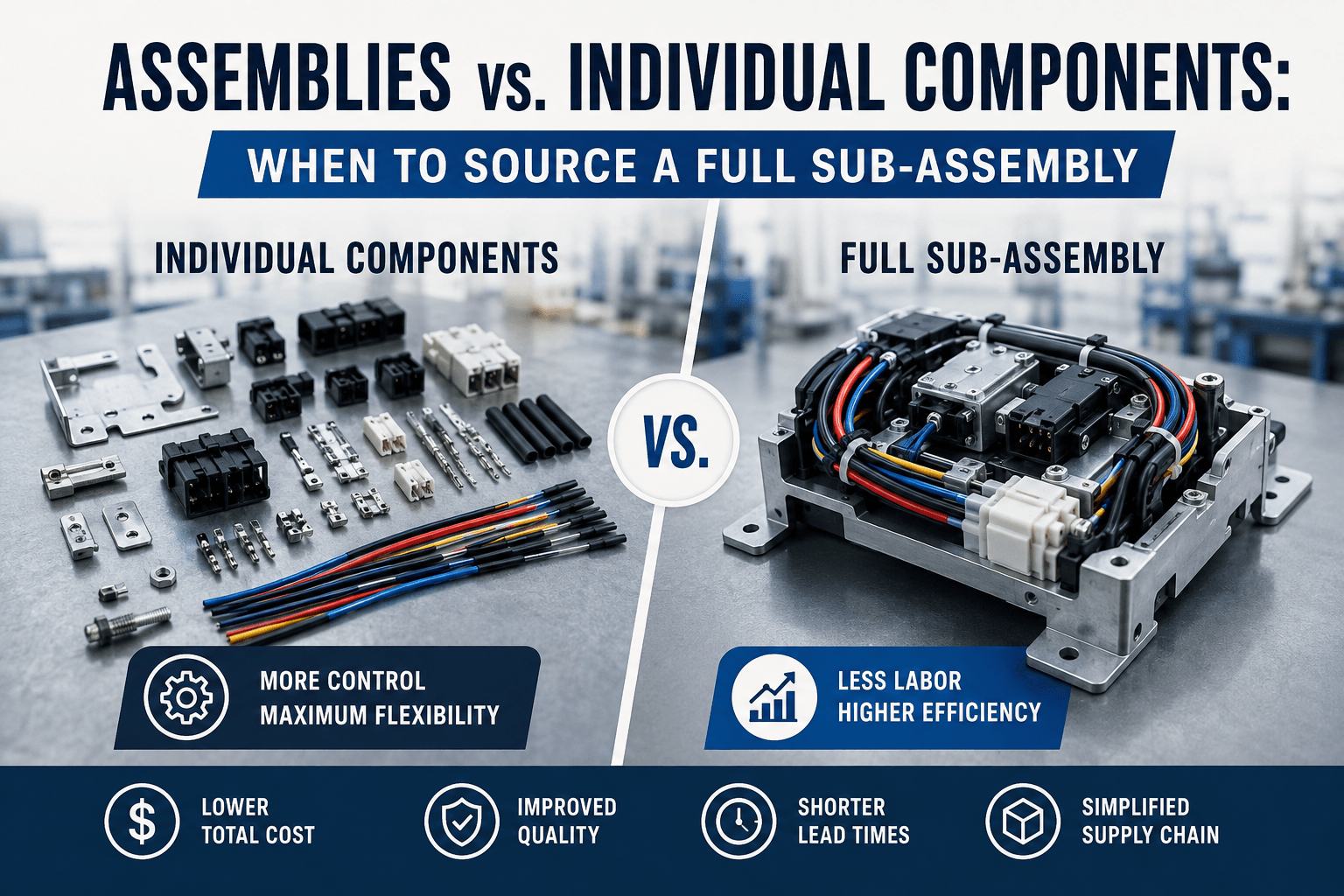
Wire Harnesses and Cable Assemblies – Move Now
Tariff exposure: 25% Section 301. India readiness: Very High. Wire harness manufacturing is the most labour-intensive automotive sub-assembly – and India’s wage advantage is most decisive here. Major automotive wire harness manufacturers (Motherson, Pricol, Minda) have established, export-oriented facilities. India is already a global wire harness export hub; the question is only supplier selection.
Forged and Cast Components – Move Now
Tariff exposure: 25% on most ferrous forgings and castings. India readiness: Very High. India is the world’s second-largest forging producer. Rajkot, Ludhiana, and Pune clusters supply European and US industrial OEMs. Investment casting, sand casting, and die casting ecosystems are export-mature. No ramp risk for qualified buyers.
Precision Machined Components – Move Now
Tariff exposure: 25% on most CNC-machined components. India readiness: High. Tier-2 and Tier-3 precision machining clusters in Pune, Coimbatore, and Bengaluru supply to aerospace, automotive, and industrial OEMs. AS9100, IATF 16949, and ISO 9001 certification coverage is strong.
Injection Moulded Plastic Parts – Move with Qualification
Tariff exposure: 25%. India readiness: Medium-High. India has a growing injection moulding industry but limited cosmetic-grade mould capability for consumer electronics. For industrial and automotive plastic parts, India is competitive. For high-gloss consumer-grade plastics, some tooling may still run in China with India assembly.
Semiconductor Devices – Move in 2-3 Years
Tariff exposure: Up to 145% on Chinese-origin semiconductors. India readiness: Developing. Micron’s OSAT facility in Gujarat (operational 2025) and Tata’s planned semiconductor fab (Dholera, 2026-2027) are progressing. OSAT and packaging is available now for qualifying programmes; full-stack fab capability is 2027+. For immediate needs, diversify to Taiwan, South Korea, and Malaysia for device sourcing.
Industrial Motors and Drives – Move with Qualification
Tariff exposure: 25%. India readiness: Medium. India has motor manufacturing capability (Bharat Bijlee, ABB India, Siemens India) but for custom specifications and specialised drive systems, qualification timelines of 6-12 months apply.
The 2026 Tariff-Adjusted TCO Model
Updating the TCO framework for 2026 tariff reality (representative electromechanical assembly, $500K annual spend):
China with 25% Section 301: Direct labour $180K + components $300K + logistics $22K + tariffs $125K + quality $12K = Total $654K
India with 0% tariff: Direct labour $72K + components $330K + logistics $20K + tariffs $0 + quality $10K = Total $450K
India TCO advantage: 31% lower landed cost. For HTS codes with 50%+ tariffs, India’s TCO advantage exceeds 45%.
How to Execute Relocation in 2026: A 90-Day Sprint
Days 1-15: BOM Triage
Pull every China-origin line item. Map each to its HTS code. Apply 2026 tariff schedule. Rank by: (annual China spend x tariff rate) to get dollar tariff exposure per part. This is your relocation priority list.
Days 15-45: Indian Supplier RFQ
For top 20% of tariff exposure (typically 80% of dollar impact), issue simultaneous RFQs to 3-5 Indian suppliers per category. Require: DFM review within 2 weeks, tooling quote within 3 weeks, first article timeline within 60 days of PO.
Days 45-75: Qualification
Run parallel India qualification against existing China production. FAI sign-off required before volume transfer. Do not cut China production until India qualification is complete and buffer stock covers lead time gap.
Days 75-90: Volume Transfer Plan
Commit volume transfer schedule. Build 8-12 weeks of India safety stock. Notify China suppliers of volume reduction with contractual notice period. Begin localising BOM where India-sourced components are available.
Key Takeaways
- The 2026 tariff escalation has made China-origin sourcing economically indefensible for electronics, forgings, castings, precision machining, and wire harnesses.
- India is the primary beneficiary: zero tariff exposure, established supplier ecosystem, and PLI-backed manufacturing investment.
- The TCO advantage of India over China for tariff-exposed categories ranges from 25% to 45% on total landed cost.
- The highest-readiness categories for immediate India sourcing are: EMS/electronics assembly, wire harnesses, forgings, castings, and precision machining.
- A structured 90-day sprint can move the highest-tariff-exposure items to India qualification without production disruption.
FAQ
Q: Are the 2026 tariffs permanent or could they reverse?
A: The bipartisan consensus in the US on China trade policy makes full tariff reversal unlikely in any near-term scenario. Supply chain decisions made for 2026 should assume at least 3-5 year tariff persistence. The optionality cost of not diversifying – measured in tariff dollars paid – is higher than the qualification cost of India sourcing.
Q: Which Indian states offer the best incentives for manufacturing relocation investment?
A: Tamil Nadu (electronics, automotive), Gujarat (chemicals, semiconductors, EV batteries), Maharashtra (precision engineering, automotive), and Karnataka (aerospace, electronics) have the most active state-level incentive programmes in 2026, including land subsidies, power tariff concessions, and employment generation incentives layered on top of central PLI.
Q: How quickly can Indian suppliers be qualified for aerospace-grade components?
A: For AS9100-certified Indian suppliers with existing aerospace customer references, qualification timelines of 6-12 months are achievable for new Tier-2 components. First article inspection (FAI) and production part approval process (PPAP) are the primary timeline drivers.
Q: What about intellectual property risk in India vs China?
A: India is a common-law jurisdiction with robust IP protection mechanisms, a functioning court system for IP disputes, and TRIPS-compliant patent law. India’s IP risk profile is significantly lower than China for precision manufacturing, electronics, and pharmaceutical programmes.