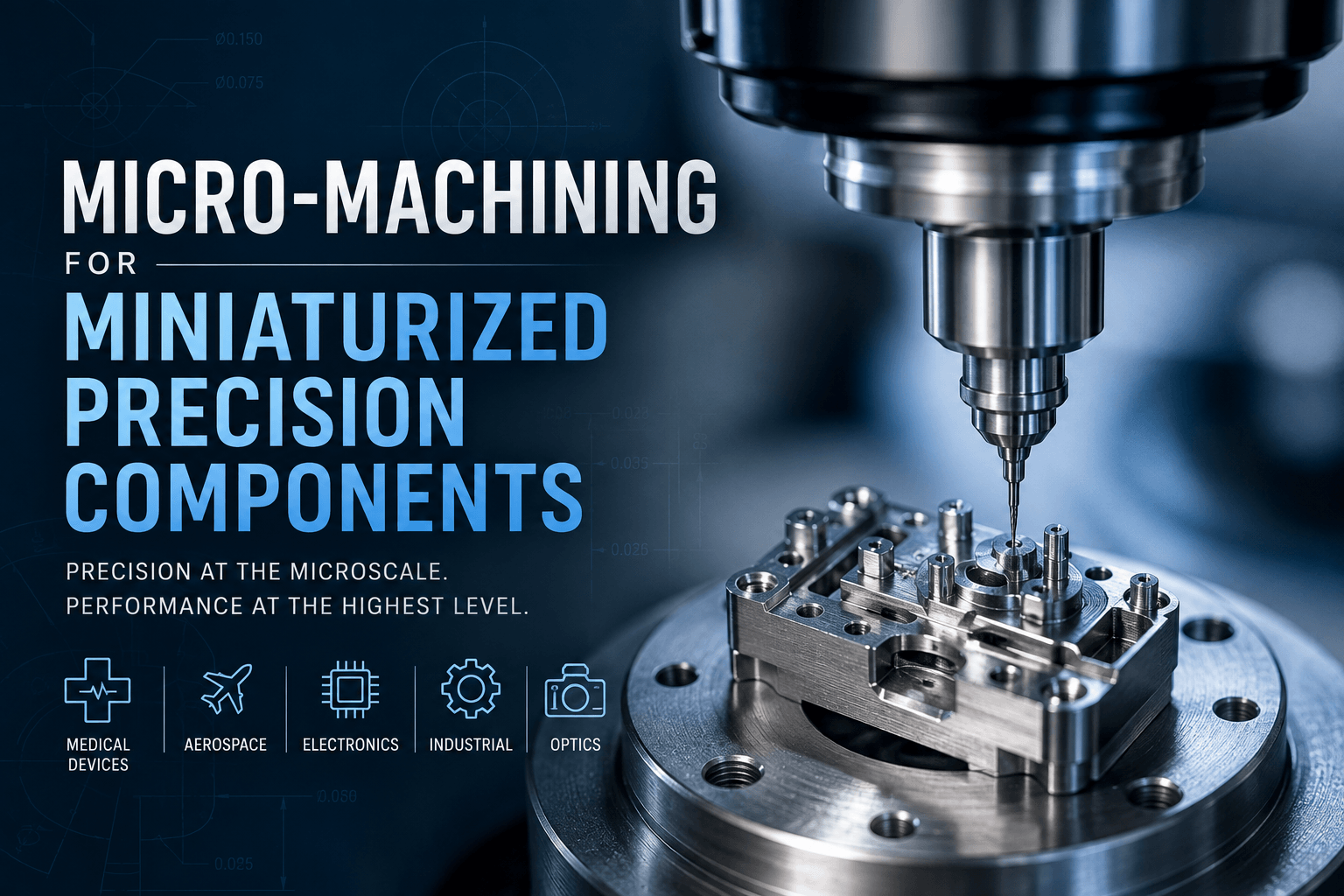
Micro-Machining for Miniaturized Precision Components
Introduction
As products become smaller, the components inside them must become smaller and more precise too. From medical devices and miniature sensors to aerospace systems and electronics, manufacturers increasingly need parts with extremely tight tolerances, complex geometries, and consistent performance.
Micro-machining addresses this challenge by using highly controlled machining processes to manufacture very small components with exceptional dimensional accuracy. Unlike conventional machining, micro-machining requires specialized equipment, tooling, materials, and process control because even minor variations can affect the performance of a miniature part.
What Is Micro-Machining?
Micro-machining is a manufacturing process used to produce very small components and features, often at dimensions measured in millimeters or micrometers.
Depending on the application, manufacturers may use processes such as:
- Micro milling
- Micro turning
- Micro drilling
- Micro grinding
- Electrical discharge machining (EDM)
- Laser micromachining
The right process depends on factors such as material, component geometry, required tolerances, surface finish, production volume, and application requirements.
Why Miniaturized Components Require Specialized Machining
Manufacturing a smaller version of a conventional component is not always straightforward. As dimensions decrease, factors that may be negligible in conventional machining can become significant.
Tool wear, vibration, thermal expansion, spindle accuracy, material behavior, and even burr formation can influence the final component.
For example, a small dimensional deviation that would have little impact on a large mechanical part could prevent a miniature component from fitting correctly into an assembly.
This makes process stability and repeatability just as important as achieving the initial dimensional specification.
Key Benefits of Micro-Machining
High dimensional precision
Micro-machining allows manufacturers to create intricate features and maintain tight dimensional tolerances when conventional machining methods may not be suitable.
Complex geometries
Miniature components often require tiny holes, slots, channels, grooves, and other intricate features. Specialized micro-machining techniques can produce these geometries with greater control.
Compatibility with advanced materials
Many precision applications use materials such as titanium, stainless steel, ceramics, and specialized alloys. Selecting the appropriate machining process helps manufacturers work with these materials while maintaining component quality.
Consistent production
For industries producing large quantities of miniature components, repeatability is critical. Stable machining parameters, accurate tooling, and rigorous inspection can help maintain consistency across production runs.
Applications of Micro-Machining
Micro-machining is particularly valuable in industries where component size and precision directly affect product performance.
Medical devices: Miniature surgical instruments, implants, diagnostic components, and fluid-handling parts can require highly precise features.
Aerospace: Lightweight systems and compact mechanisms may depend on small, precision-machined components that must perform reliably under demanding conditions.
Electronics: Connectors, housings, heat-management components, and miniature mechanical parts often require tight dimensional control.
Optics and photonics: Micro-machined components can support miniature optical systems, positioning mechanisms, and precision assemblies.
Automotive and industrial systems: Sensors, fuel-system components, valves, and other compact mechanisms can benefit from precision micro-machining.
Challenges Manufacturers Need to Control
Micro-machining introduces several challenges that require careful process engineering.
Tool wear can have a disproportionate effect when cutting tools are extremely small. A small change in tool geometry can alter the finished feature.
Vibration can affect surface finish and dimensional accuracy, making machine rigidity and spindle stability important.
Heat generation must also be managed. At miniature scales, thermal effects can influence both the workpiece and cutting tool.
Burr formation is another concern. Even a very small burr can interfere with assembly or affect the function of a miniature component.
For these reasons, manufacturers typically combine precise machining with inspection and quality-control processes designed specifically for miniature parts.
Choosing the Right Micro-Machining Process
There is no single process that works for every miniature component. Manufacturers should evaluate:
- Component dimensions and tolerances
- Material and hardness
- Required surface finish
- Feature geometry
- Production volume
- Tool accessibility
- Inspection requirements
- Total manufacturing cost
The most effective approach balances precision with manufacturability. Designing a component around the capabilities of the selected machining process can reduce production difficulties and improve consistency.
The Role of Inspection and Quality Control
Producing a miniature component accurately is only part of the challenge. Manufacturers must also verify that the finished part meets its specifications.
Depending on the component, inspection may involve coordinate measuring machines, optical measurement systems, microscopy, surface measurement equipment, or other high-resolution metrology tools.
For critical applications, documenting dimensional results and maintaining process controls can also provide greater traceability and confidence in production quality.
Designing Components for Micro-Machining
Design decisions have a major impact on whether a miniature component can be manufactured efficiently.
Engineers should consider achievable tolerances, minimum feature sizes, tool access, corner radii, material behavior, and inspection requirements during the design stage.
A design that looks simple in CAD may be difficult or expensive to manufacture once the physical dimensions become extremely small.
Early collaboration between design and manufacturing teams can help identify these issues before production begins.
The Future of Micro-Machining
Demand for smaller and more capable products is likely to keep micro-machining important across advanced manufacturing.
Improvements in machine tools, cutting tools, automation, metrology, and process monitoring are making it possible to manufacture increasingly complex miniature components.
At the same time, manufacturers are placing greater emphasis on repeatability, automation, and data-driven quality control as production requirements become more demanding.
Conclusion
Micro-machining enables manufacturers to produce miniature components that would be difficult or impossible to manufacture economically using conventional machining alone. Its value goes beyond simply making parts smaller. The process combines precision equipment, specialized tooling, material knowledge, process control, and high-resolution inspection to achieve reliable results.
For industries developing smaller medical devices, electronics, aerospace systems, sensors, and precision mechanisms, choosing the right micro-machining approach early in the product-development process can make a significant difference in component quality, manufacturability, and overall production efficiency.
If you want, I can also turn this into a 1,500 to 2,000-word SEO blog post with FAQs, internal-link suggestions, and a more technical manufacturing-industry tone.