

Injection Molding for Consumer Electronics: Materials, Tolerances, and Cost Drivers
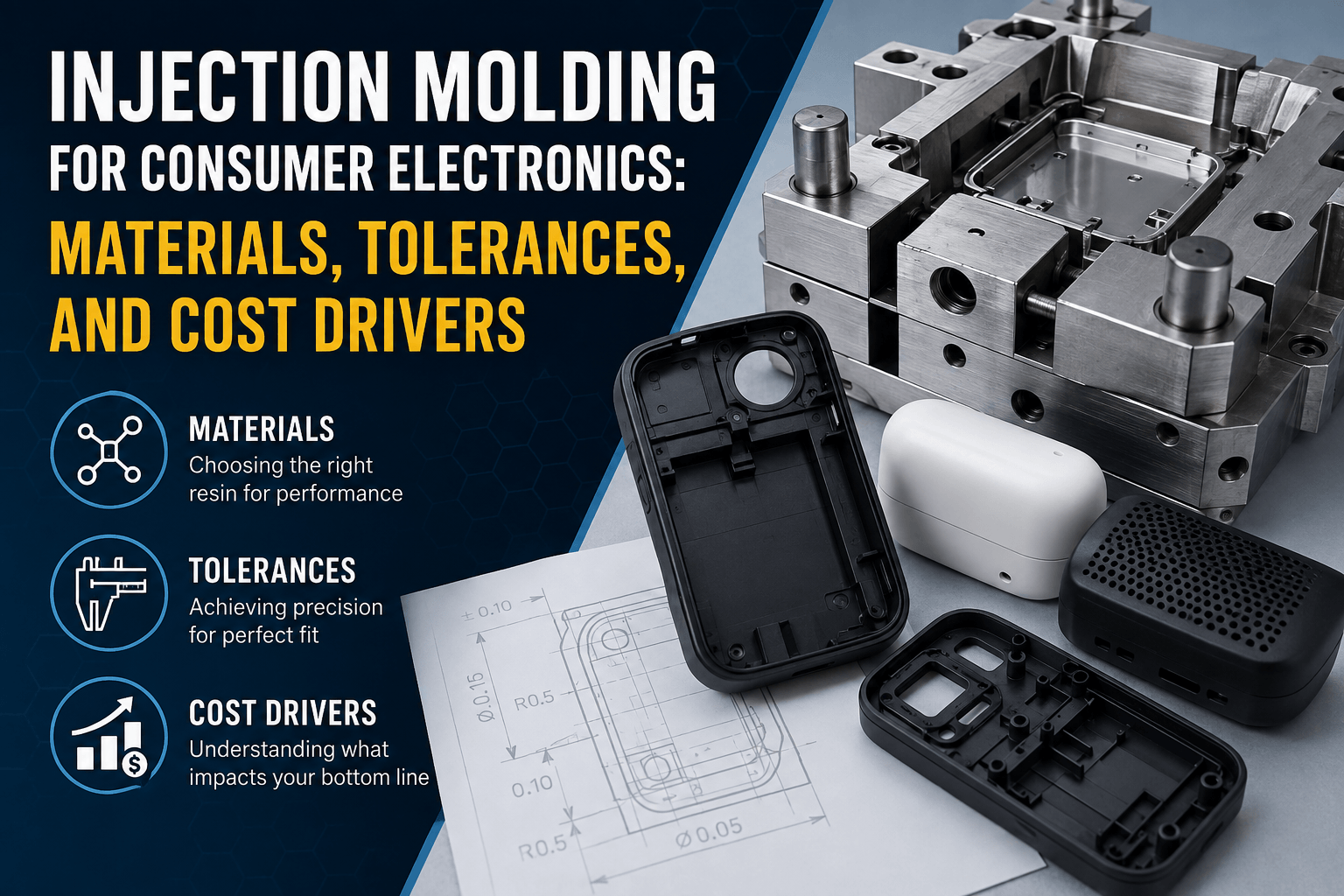
Injection molding is the manufacturing process behind many of the plastic parts found in consumer electronics. Smartphone housings, wearable device enclosures, laptop components, router casings, and remote controls all rely on precision molded parts that combine durability, appearance, and cost efficiency.
Success depends on more than choosing a plastic resin. Material selection, dimensional tolerances, mold design, and production volume all influence product quality and manufacturing costs. Understanding these factors early in product development helps companies reduce delays, improve yields, and control production budgets.
Why Injection Molding Is Ideal for Consumer Electronics
Consumer electronics require parts that are lightweight, durable, visually appealing, and consistent across thousands or even millions of units. Injection molding delivers these advantages while supporting complex geometries that would be difficult or expensive with other manufacturing methods.
Key benefits include:
- High repeatability across large production runs
- Excellent surface finishes suitable for consumer products
- Tight dimensional control
- Fast production cycles after tooling is complete
- Compatibility with automation and high-volume manufacturing
- Lower per-part cost at scale
These advantages make injection molding the preferred manufacturing process for everything from internal structural components to premium exterior housings.
Choosing the Right Material
Material selection affects product performance, manufacturing efficiency, appearance, and overall cost. Different applications require different mechanical, thermal, and electrical properties.
ABS
ABS (Acrylonitrile Butadiene Styrene) is one of the most common materials used in electronics.
Advantages include:
- Good impact resistance
- Attractive surface finish
- Easy processing
- Cost-effective production
Common applications include remote controls, gaming accessories, speaker housings, and printer components.
Polycarbonate (PC)
Polycarbonate offers higher strength and better heat resistance than ABS.
It is commonly selected for:
- Transparent covers
- Medical electronics
- Protective enclosures
- Components exposed to higher temperatures
Although more expensive than ABS, it provides superior durability where performance is critical.
PC-ABS Blends
PC-ABS combines the toughness of polycarbonate with the processing advantages of ABS.
Manufacturers often choose this material for:
- Laptop enclosures
- Automotive electronics
- Premium consumer devices
- Wearable products
The blend balances appearance, strength, and manufacturability.
Nylon (PA)
Nylon is valued for its mechanical strength and wear resistance.
Typical applications include:
- Internal gears
- Hinges
- Structural brackets
- Moving mechanical components
Glass-filled nylon variants provide additional rigidity but require more robust tooling.
PBT
Polybutylene Terephthalate (PBT) performs well in electrical applications because of its excellent insulating properties.
It is commonly used for:
- Connectors
- Electrical sockets
- Sensor housings
- Power management components
Understanding Tolerances
Consumer electronics often require precise component alignment. Poor dimensional control can create assembly problems, cosmetic defects, or failures in automated production lines.
Typical commercial injection molding tolerances range from ±0.1 mm to ±0.2 mm, although critical features may require significantly tighter control depending on material, part geometry, and tooling quality.
Factors influencing achievable tolerances include:
- Material shrinkage
- Part size
- Wall thickness
- Mold quality
- Processing conditions
- Cooling consistency
Tighter tolerances usually increase tooling complexity, inspection requirements, and manufacturing costs. Designers should specify precision only where it provides measurable value.
Design Considerations That Influence Manufacturing
Good part design improves quality while reducing production costs.
Uniform Wall Thickness
Consistent wall thickness promotes even cooling and minimizes defects such as sink marks, voids, and warping.
Draft Angles
Draft angles allow molded parts to release smoothly from the mold.
Insufficient draft can increase wear on tooling and damage finished components during ejection.
Ribs and Gussets
Instead of increasing wall thickness, designers often use ribs and gussets to improve structural strength without adding excessive material.
Snap Fits
Snap-fit assemblies eliminate screws and reduce assembly time while improving product aesthetics.
However, they require careful engineering to avoid fatigue and breakage during repeated use.
Major Cost Drivers
Injection molding costs extend beyond raw material prices. Several variables determine the total manufacturing expense.
Tooling Investment
The mold is typically the largest upfront cost.
Factors affecting tooling price include:
- Number of cavities
- Steel grade
- Surface finish requirements
- Mold complexity
- Hot runner systems
- Side actions and lifters
Although tooling costs can be substantial, they are spread across production volume, making injection molding highly economical for large runs.
Material Costs
Engineering plastics vary significantly in price.
Premium materials with flame-retardant, UV-resistant, or glass-filled formulations increase material expenses but may reduce warranty claims and improve product reliability.
Cycle Time
Shorter molding cycles increase production capacity and lower per-part costs.
Cycle time depends on:
- Part thickness
- Cooling efficiency
- Material properties
- Mold design
- Machine performance
Even a small reduction in cycle time can produce significant savings over millions of parts.
Part Complexity
Complex geometries often require:
- Additional slides
- Inserts
- Multi-stage tooling
- Secondary operations
Simplifying the design can reduce tooling costs while improving manufacturing reliability.
Surface Finish Requirements
Consumer electronics frequently demand premium cosmetic finishes.
Texturing, polishing, laser etching, or decorative molding increase tooling costs but enhance product appearance and perceived quality.
Balancing Quality and Cost
The lowest manufacturing cost does not always produce the best overall value.
Manufacturers should evaluate:
- Product lifespan
- Expected production volume
- Cosmetic requirements
- Mechanical performance
- Regulatory compliance
- Assembly efficiency
Collaborating with a molding partner early in product development often identifies opportunities to simplify designs, improve manufacturability, and reduce long-term production costs.
Best Practices for Electronics Manufacturers
Companies can improve both quality and profitability by following several proven practices:
- Select materials based on performance requirements rather than price alone.
- Design for manufacturability from the beginning of the project.
- Apply tight tolerances only to critical dimensions.
- Optimize wall thickness for consistent cooling.
- Validate designs with prototype tooling before mass production.
- Work closely with mold designers and manufacturing engineers throughout development.
Conclusion
Injection molding remains the foundation of modern consumer electronics manufacturing because it delivers high precision, repeatability, and scalability. The right combination of material selection, thoughtful design, realistic tolerances, and optimized tooling can significantly improve product quality while reducing production costs.
By considering these factors early in the design process, manufacturers can accelerate product launches, minimize manufacturing risks, and produce reliable components that meet both performance expectations and commercial objectives.
Frequently Asked Questions
Q. Why do tight tolerances increase manufacturing costs?
Tighter tolerances demand more precise tooling, stricter process control, additional quality inspections, and sometimes slower production speeds, all of which increase manufacturing expenses.
Q. How can manufacturers reduce injection molding costs?
They can reduce costs by simplifying part geometry, optimizing wall thickness, choosing appropriate materials, minimizing unnecessary cosmetic features, and designing for efficient manufacturing.
Q. When is injection molding most cost-effective?
Injection molding delivers the greatest value in medium to high-volume production because the initial tooling investment is spread across a large number of parts.