

Inverter-Duty vs. Power Transformers: Which Does Your Renewable Project Need?
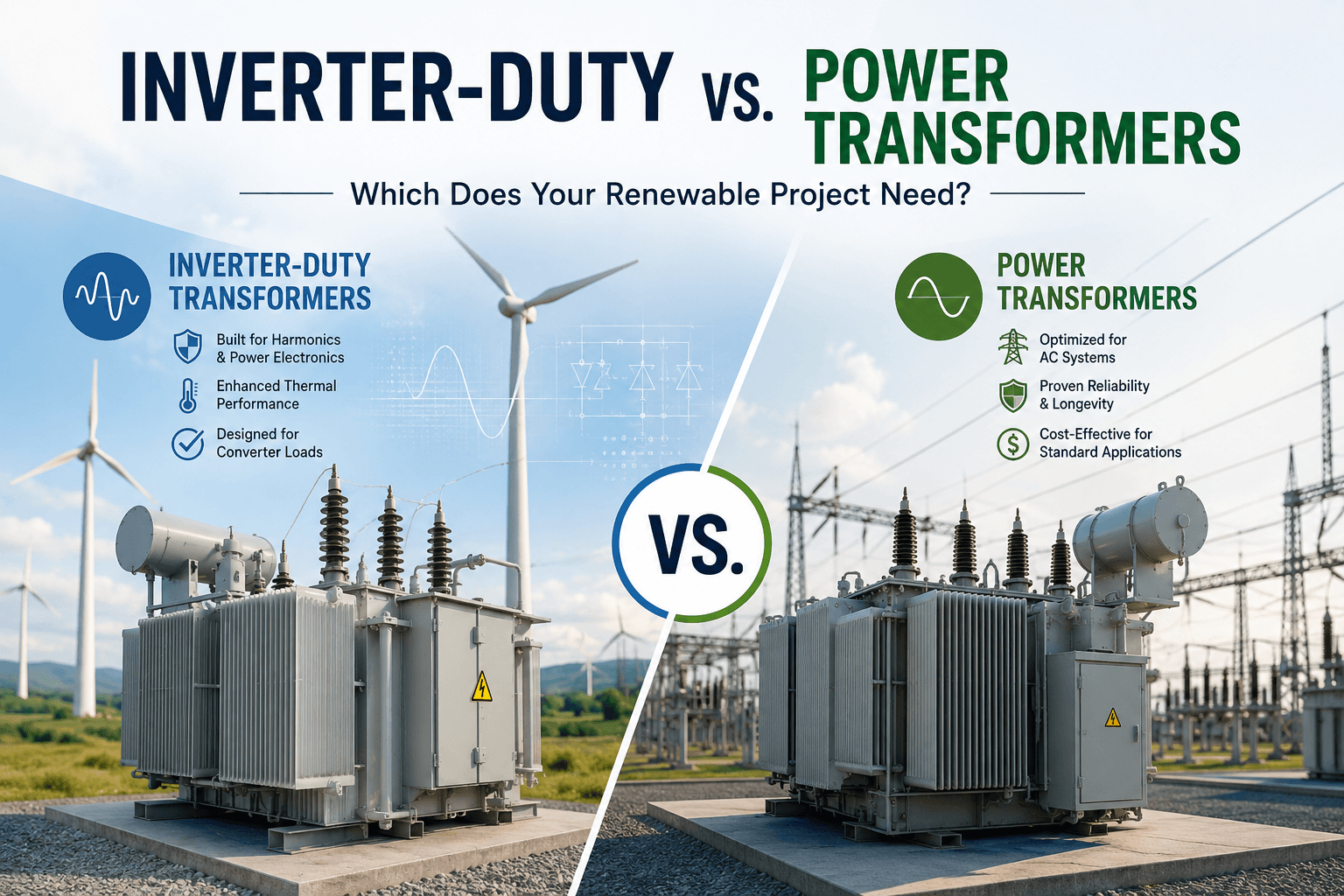
Transformer selection in a wind project is not simply a question of matching voltage and MVA ratings. The electrical characteristics of the generation system matter just as much.
Modern wind turbines rely heavily on power electronics. Depending on turbine architecture, converters can introduce harmonics, rapid switching effects, and operating conditions that differ from those seen by transformers serving conventional AC loads.
That distinction matters when choosing between an inverter-duty transformer and a conventional power transformer.
A standard power transformer may have a lower initial price and be perfectly suitable in parts of the wind plant where power quality is relatively clean. An inverter-duty transformer typically costs more because it is designed for the electrical stresses associated with converter-based generation.
The right choice depends on where the transformer sits in the system, the converter topology, harmonic spectrum, loading profile, insulation requirements, and expected operating life.
For wind project developers, the most useful comparison is not simply purchase price. It is the total cost of owning and operating the transformer over the life of the project.
What Is an Inverter-Duty Transformer?
An inverter-duty transformer is designed to operate with power electronic equipment such as inverters, converters, and variable-frequency drives.
In wind generation, this can include transformers electrically exposed to turbine converter output or other converter-driven equipment.
Unlike a clean sinusoidal AC waveform, converter-generated waveforms can contain harmonic components and fast voltage transitions. These conditions may increase winding and core losses, create additional heating, and place greater stress on insulation systems.
An inverter-duty transformer can therefore be designed with features such as:
- Additional thermal capacity
- Insulation systems selected for converter-related electrical stress
- Winding arrangements suited to the expected harmonic environment
- Electrostatic shielding where required
- Designs that account for increased eddy-current and stray losses
- Temperature-rise margins appropriate for the specified loading profile
The exact construction should follow the actual electrical environment. “Inverter-duty” should not be treated as a universal specification that automatically solves every power-quality problem.
The manufacturer still needs accurate information about the converter, harmonic spectrum, loading, grounding arrangement, voltage characteristics, and operating conditions.
What Is a Conventional Power Transformer?
A conventional power transformer transfers AC power between voltage levels through electromagnetic induction.
Within a wind farm, power transformers can appear at several points in the electrical system. A turbine transformer may step up turbine output voltage to the collection-system voltage, while the main substation transformer typically raises the collection voltage to the transmission or interconnection voltage.
Conventional power transformers are generally designed around expected sinusoidal operating conditions, specified loading, system fault levels, insulation requirements, ambient conditions, and applicable standards.
That does not mean they cannot operate in renewable energy projects.
In fact, conventional power transformers are fundamental to wind farm electrical infrastructure. The key question is whether a particular transformer will experience electrical stresses beyond those covered by its normal design assumptions.
Inverter-Duty vs. Power Transformers: The Main Differences
For wind developers, the distinction becomes clearer when the transformers are compared according to the stresses they must handle.
| Factor | Inverter-Duty Transformer | Conventional Power Transformer |
|---|---|---|
| Typical electrical environment | Converter-rich systems | Primarily sinusoidal AC systems |
| Harmonic consideration | Designed around specified harmonic loading | Requires evaluation if significant harmonics are present |
| Thermal design | May include additional capacity for harmonic-related losses | Based primarily on specified conventional loading conditions |
| Insulation requirements | Can be designed for converter-related voltage stresses | Designed for specified system voltage and insulation levels |
| Initial cost | Often higher | Often lower for equivalent basic ratings |
| Application | Converter-connected equipment and systems | Collection, substation, grid, and general AC applications |
| Design inputs | Converter characteristics are particularly important | System voltage, load, faults, environment, and grid requirements dominate |
The important point is that the labels alone do not determine suitability.
Two transformers with the same nominal MVA and voltage ratings can have substantially different thermal and insulation performance when exposed to converter-generated waveforms.
Why Wind Projects Create Different Transformer Requirements
Wind farms have become increasingly power-electronics-intensive.
Depending on turbine design, the generator may interface with the electrical system through a partial-scale or full-scale converter. Those converters provide valuable control over generator operation and grid interaction, but they also change the electrical conditions experienced by downstream equipment.
Harmonic currents can increase transformer losses
Harmonic currents can produce additional losses in transformer windings and structural components.
Higher-frequency current components can increase eddy-current and stray losses. The result can be higher operating temperatures than designers would predict from fundamental-frequency current alone.
This matters because transformer insulation life is strongly influenced by temperature.
A transformer that repeatedly operates hotter than expected may experience accelerated insulation aging, even if its apparent load remains within its nameplate rating.
For developers, that creates a direct lifecycle cost issue.
Saving money on the original transformer specification has limited value if the transformer later requires derating, additional cooling, unplanned repairs, or premature replacement.
Fast voltage transitions can affect insulation
Converter switching can also create steep-front voltage waveforms.
The severity experienced by the transformer depends on converter topology, switching characteristics, cable configuration, system impedance, filtering, grounding, and transformer construction.
This is why specifying a transformer simply as “inverter-duty” is not enough.
The transformer supplier should understand the actual converter and electrical system with which the equipment will operate.
Wind generation has variable loading
Wind transformers rarely operate at one steady load.
Output changes with wind conditions, turbine availability, curtailment, and grid requirements. Transformers may experience long periods of partial loading followed by periods near rated output.
This variable profile can sometimes reduce average thermal loading, but it does not eliminate harmonic or insulation concerns.
The transformer should therefore be evaluated against the realistic operating profile rather than only the maximum MVA rating.
Upfront Cost: Why Inverter-Duty Transformers Can Cost More
An inverter-duty transformer generally carries a higher initial cost when its design requires additional materials or engineering.
Potential cost drivers include larger conductors, additional insulation, shielding, enhanced cooling, modified winding arrangements, and design work associated with harmonic and converter conditions.
That premium can tempt developers to specify a conventional transformer whenever the basic voltage and power ratings match.
But comparing equipment only on purchase price can create a false economy.
Consider a simplified scenario.
A wind project receives two transformer proposals. The conventional unit has the lower capital cost. The inverter-duty alternative costs more but has been designed around the turbine converter’s harmonic spectrum and expected loading profile.
If both units are technically suitable, the cheaper transformer may deliver the better project economics.
If the conventional unit requires derating or experiences excessive heating in actual service, however, its lower purchase price can quickly become irrelevant.
The correct economic comparison is therefore not:
Which transformer costs less?
It is:
Which technically compliant transformer delivers the lowest risk-adjusted lifecycle cost?
Lifecycle Cost Matters More Than Purchase Price
Transformers are long-lived assets, and their financial impact extends far beyond procurement.
For wind developers, lifecycle cost should account for several factors.
Energy losses
Transformer losses occur whenever the equipment is energized and loaded.
Small differences in efficiency can become financially meaningful when accumulated over many years of operation.
Developers should evaluate both no-load and load losses against the project’s expected operating profile. A transformer with a higher purchase price but lower lifetime losses may offer a better net economic outcome.
However, loss evaluation should reflect actual wind generation patterns rather than assuming continuous full-load operation.
Maintenance requirements
Transformers require inspection and maintenance throughout their service life.
For liquid-filled units, this may include oil testing, leak inspections, bushing checks, cooling-system maintenance, protection-system testing, and condition monitoring.
A transformer operating under excessive thermal or electrical stress may demand more attention over time.
That adds direct maintenance expense and can also increase the risk of planned or unplanned outages.
Unplanned downtime
Downtime can be particularly expensive in renewable generation because a transformer failure may remove substantial generation capacity.
The financial impact depends heavily on where the failed transformer is located.
A turbine-level transformer failure may affect one turbine. A main substation transformer failure can affect a large portion of the wind plant or, depending on the electrical configuration, the entire facility.
That makes reliability particularly important for high-consequence transformers.
The lowest-cost transformer is not necessarily the lowest-cost asset if its failure carries significant lost-generation exposure.
Replacement logistics
Large transformers are not always easy to replace quickly.
Manufacturing lead times, transportation constraints, crane availability, site access, installation work, testing, and commissioning can all extend an outage.
Wind sites can add another challenge: location.
Remote projects may have limited road access or logistical constraints for moving heavy electrical equipment.
These factors should influence transformer selection, spare strategy, and lifecycle planning from the beginning of the project.
When Does a Wind Project Need an Inverter-Duty Transformer?
An inverter-duty design deserves serious consideration when the transformer is directly exposed to significant converter-generated electrical stresses.
This may occur when a transformer is connected close to the output of power electronic converters and the expected waveform contains harmonic content or switching characteristics that materially affect transformer performance.
The engineering team should evaluate:
- Converter topology and switching characteristics
- Harmonic current spectrum
- Expected voltage waveform
- Transformer loading profile
- Cable lengths and configuration
- Filtering
- Grounding method
- Required insulation coordination
- Ambient temperature and installation conditions
- Cooling requirements
- Expected service life
Rather than specifying “inverter-duty” as a generic procurement label, developers should provide these operating conditions to the transformer manufacturer.
That allows the supplier to design and validate the transformer for the actual application.
When Is a Conventional Power Transformer the Better Choice?
Not every transformer in a wind farm needs specialized inverter-duty construction.
A conventional power transformer may be appropriate where the electrical waveform at its terminals falls within the transformer’s design assumptions and harmonic loading is sufficiently low or otherwise accounted for.
The main wind farm substation transformer, for example, performs a different role from a transformer positioned immediately downstream of a turbine converter.
System studies should determine the harmonic environment at each location.
If analysis shows that a conventional design meets thermal, dielectric, harmonic, grid-code, and reliability requirements, paying for unnecessary design features may increase project CAPEX without producing meaningful lifecycle benefits.
The goal is not to use the most specialized transformer available.
It is to specify the transformer that fits the electrical duty.
A Better Way to Compare Transformer Bids
Transformer procurement often becomes difficult because suppliers may quote designs based on different assumptions.
One vendor may include harmonic-related thermal margins while another assumes near-sinusoidal loading. Their nameplate ratings can look similar even though the proposed equipment is not directly comparable.
Wind developers can improve bid quality by giving each supplier the same technical inputs.
A useful transformer request for quotation should define the required ratings, voltage levels, frequency, expected load profile, harmonic spectrum where applicable, converter characteristics, impedance requirements, insulation levels, cooling method, environmental conditions, applicable standards, monitoring requirements, and expected design life.
Then compare proposals across three dimensions.
1. Technical compliance
Can the transformer continuously operate under the project’s actual electrical and environmental conditions without unacceptable temperature rise or insulation stress?
Any proposal that cannot demonstrate this should not advance based solely on price.
2. Lifetime losses
Request guaranteed transformer losses and evaluate their economic impact using the project’s expected operating profile and energy value assumptions.
This converts efficiency differences into a financial metric that procurement teams can compare.
3. Reliability and outage exposure
Consider the consequence of failure.
For a transformer whose failure could curtail hundreds of megawatts, spending more for a design that meaningfully reduces lifecycle risk can be economically rational.
For lower-consequence equipment with straightforward replacement logistics, the calculation may be different.
Avoid Overspecifying Inverter-Duty Transformers
There is also a cost risk in the opposite direction.
Renewable energy projects can overspecify equipment simply because power electronics are present somewhere in the system.
A wind farm does not automatically require every transformer to have the same converter-related design features.
Harmonics and switching effects change as they move through cables, filters, transformers, and collection systems. The electrical environment at the turbine transformer can be very different from conditions at the main substation transformer.
Project-specific studies help determine where specialized designs actually provide value.
This approach controls CAPEX while maintaining reliability.
Questions to Ask Before Selecting a Transformer
Before approving the transformer specification, developers and EPC teams should be able to answer a few practical questions:
- Where is the transformer located relative to the converter?
- What harmonic spectrum will the transformer experience?
- Has harmonic-related heating been included in the thermal design?
- Are switching-related voltage stresses relevant at the transformer terminals?
- What loading profile is expected over a typical year?
- What losses are guaranteed by the manufacturer?
- What happens to project generation if this transformer fails?
- How quickly could the unit realistically be repaired or replaced?
- What monitoring and maintenance will be required?
- Has the manufacturer reviewed the actual converter and system conditions?
These questions turn transformer procurement from a nameplate-rating exercise into a lifecycle engineering decision.
Inverter-Duty or Power Transformer: Which Should You Choose?
For wind projects, neither transformer type is automatically the better choice.
Use an inverter-duty transformer where converter-related harmonics, switching characteristics, thermal effects, or insulation stresses require a design specifically engineered for those conditions.
Use a conventional power transformer where system studies and manufacturer analysis show that standard construction can safely and reliably handle the expected electrical environment.
Most importantly, compare technically suitable options based on lifecycle economics rather than purchase price alone.
A lower-cost transformer that experiences excessive losses, requires derating, increases maintenance demands, or creates greater failure exposure may cost substantially more over the project’s operating life.
At the same time, specifying specialized inverter-duty construction where it provides no measurable technical benefit can unnecessarily increase project CAPEX.
The best transformer specification sits between those two extremes. It matches the equipment to its actual electrical duty, accounts for the consequences of failure, and balances initial investment against losses, maintenance, reliability, and replacement risk over the full life of the wind project.
FAQs
Q. Are inverter-duty transformers always required for wind turbines?
No. The requirement depends on turbine architecture, converter configuration, harmonic levels, switching characteristics, and the transformer’s location within the electrical system. The actual operating conditions should determine the specification.
Q. Why can harmonics shorten transformer life?
Harmonic currents can increase winding eddy-current and stray losses, which may raise transformer operating temperature. Sustained higher temperatures can accelerate insulation aging if the transformer has not been designed for those conditions.
Q. Are inverter-duty transformers more expensive?
They can be. Additional thermal capacity, insulation, shielding, winding design, cooling, and application-specific engineering can increase initial cost. The relevant comparison, however, is total lifecycle cost between technically compliant designs.
Q. Can a conventional transformer handle inverter loads?
Potentially, but suitability must be demonstrated for the specific application. Harmonic loading, thermal performance, voltage stresses, insulation requirements, and manufacturer recommendations should all be evaluated.
Q. What matters most when buying a transformer for a wind farm?
Start with the actual electrical duty. Then evaluate technical compliance, guaranteed losses, reliability, maintenance requirements, outage consequences, replacement logistics, and total lifecycle cost. Purchase price should be considered within that broader economic assessment.