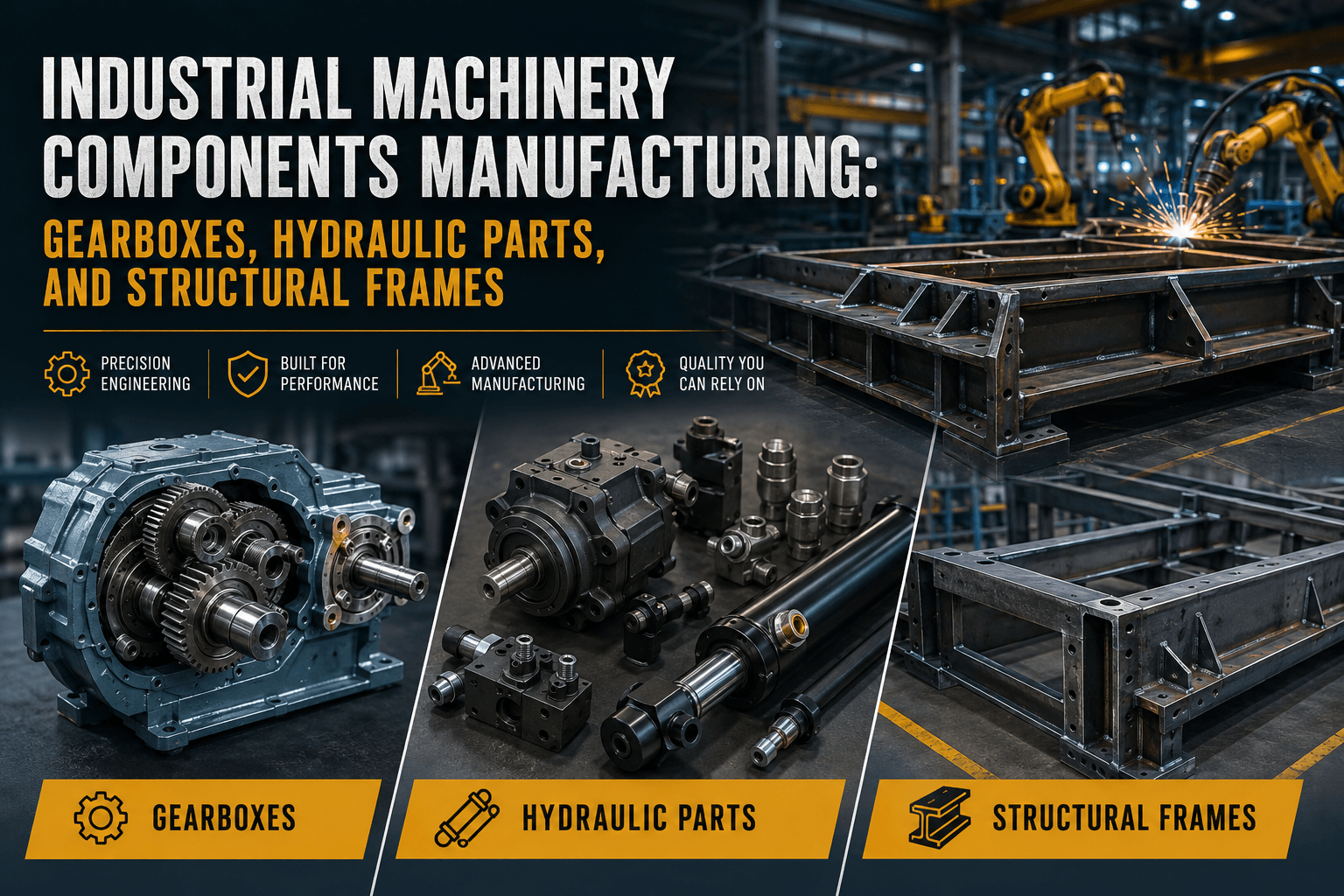
Industrial Machinery Components Manufacturing: Gearboxes, Hydraulic Parts, and Structural Frames
Industrial machinery powers industries ranging from construction and mining to material handling, agriculture, and manufacturing. Behind every reliable machine are precision-engineered components that ensure performance, durability, and safety.
Among the most critical are gearboxes, hydraulic components, and structural frames. These components experience heavy loads, harsh environments, and continuous operation, making manufacturing quality a key factor in equipment reliability.
This guide explains how these components are manufactured, the processes involved, quality standards, and what OEMs should consider when selecting a manufacturing partner.
Why Industrial Machinery Components Matter
Industrial equipment often operates:
- Under high torque
- In dusty and corrosive environments
- With continuous vibration
- Under heavy dynamic loads
- Across multiple shifts
Failure of a single component can result in:
- Equipment downtime
- Production losses
- Safety risks
- Increased maintenance costs
This is why manufacturers emphasize precision engineering, certified quality systems, and robust testing.
Major Industrial Machinery Components
1. Gearboxes
Gearboxes convert speed into torque and enable machines to perform demanding mechanical tasks.
Common applications include:
- Conveyor systems
- Crushers
- Mixers
- Winders
- Industrial pumps
- Material handling equipment
- Construction machinery
Manufacturing Process
Typical gearbox manufacturing involves:
Material Selection
Common materials include:
- Alloy steel
- Case-hardening steel
- Cast iron housings
- Forged steel shafts
Machining
Precision machining includes:
- CNC turning
- Gear hobbing
- Gear shaping
- Grinding
- Boring
- Milling
High gear accuracy reduces:
- Noise
- Wear
- Energy loss
Heat Treatment
Heat treatment improves durability through:
- Carburizing
- Induction hardening
- Nitriding
- Quenching and tempering
Surface Finishing
Critical surfaces undergo:
- Gear grinding
- Honing
- Lapping
These processes improve efficiency and gear life.
2. Hydraulic Components
Hydraulic systems deliver controlled power for heavy machinery.
Major components include:
- Hydraulic cylinders
- Valve blocks
- Manifolds
- Pistons
- Rods
- End caps
- Pumps
- Hydraulic housings
Manufacturing Process
Hydraulic components require extremely tight tolerances.
Processes include:
- CNC machining
- Deep-hole drilling
- Precision boring
- Honing
- Thread rolling
- Surface grinding
Cylinder rods are typically:
- Chrome plated
- Induction hardened
- Polished
This reduces friction and improves seal life.
Surface Finish Requirements
Hydraulic cylinders require:
- Low surface roughness
- Perfect sealing surfaces
- Minimal dimensional variation
Even small defects may result in leakage.
3. Structural Frames
Structural frames provide the backbone of industrial equipment.
Examples include:
- Machine bases
- Chassis
- Welded assemblies
- Equipment skids
- Fabricated structures
- Crane frames
- Loader frames
Manufacturing Workflow
Structural fabrication usually includes:
- Steel cutting
- CNC plasma cutting
- Laser cutting
- Press brake forming
- Robotic welding
- Manual welding
- Machining
- Painting
- Final assembly
Large frames may weigh from several hundred kilograms to multiple tonnes.
Materials Used
Different applications require different material properties.
| Component | Typical Materials |
|---|---|
| Gearboxes | Alloy steel, cast iron, forged steel |
| Hydraulic Parts | Carbon steel, alloy steel, stainless steel |
| Structural Frames | Mild steel, high-strength steel, structural steel, stainless steel |
Material selection depends on:
- Operating loads
- Corrosion resistance
- Fatigue life
- Cost
- Weldability
Manufacturing Technologies
Modern manufacturers employ advanced technologies to improve quality and productivity.
CNC Machining
Used for:
- Shafts
- Gears
- Valve blocks
- Housings
- Flanges
Benefits include:
- High precision
- Repeatability
- Faster production
Robotic Welding
Ideal for:
- Structural frames
- Heavy fabrications
- Repeat production
Advantages include:
- Consistent weld quality
- Higher productivity
- Reduced distortion
Laser Cutting
Laser cutting enables:
- Tight dimensional accuracy
- Clean edges
- Faster fabrication
- Reduced material waste
Coordinate Measuring Machines (CMM)
CMM inspection verifies:
- Dimensional accuracy
- Geometric tolerances
- GD&T compliance
Essential for high-precision industrial components.
Heat Treatment and Surface Engineering
Industrial machinery components often require enhanced mechanical properties.
Common treatments include:
- Carburizing
- Induction hardening
- Nitriding
- Black oxide coating
- Zinc plating
- Powder coating
- Shot blasting
- Chrome plating
These improve:
- Wear resistance
- Fatigue strength
- Corrosion protection
- Surface hardness
Quality Standards
Industrial buyers typically expect compliance with internationally recognized standards.
Common certifications include:
- ISO 9001
- ISO 14001
- ISO 45001
- ISO 3834 (welding)
- EN 1090 (structural fabrication)
- ASME standards (pressure-related applications)
Manufacturers should also implement:
- First Article Inspection (FAI)
- In-process inspection
- Final inspection
- Material traceability
- Weld qualification procedures
- Calibration systems
Testing Methods
Critical components undergo extensive testing before shipment.
Typical inspections include:
- CMM inspection
- Hardness testing
- Gear inspection
- Ultrasonic testing (UT)
- Magnetic Particle Inspection (MPI)
- Dye Penetrant Testing (DPT)
- Pressure testing
- Leak testing
- Load testing
Testing ensures components perform reliably in demanding operating conditions.
Choosing the Right Manufacturing Partner
Selecting the right supplier impacts quality, cost, and delivery performance.
Look for manufacturers with:
- Multi-axis CNC machining capabilities
- Heavy fabrication expertise
- Certified welding processes
- Heat treatment partnerships
- Strong quality systems
- In-house inspection facilities
- Supply chain integration
- Proven experience with industrial OEMs
A capable partner should also provide design-for-manufacturing (DFM) support to optimize cost and manufacturability.
Industry Applications
These components are widely used across industries such as:
- Construction equipment
- Mining machinery
- Agricultural machinery
- Material handling systems
- Packaging equipment
- Steel plants
- Cement plants
- Oil & gas equipment
- Power generation
- Renewable energy
- Industrial automation
Future Trends in Industrial Component Manufacturing
The industry is rapidly adopting advanced manufacturing technologies.
Key trends include:
- Smart factories with Industry 4.0 integration
- AI-powered quality inspection
- Digital twins for production optimization
- Predictive maintenance
- IoT-enabled manufacturing equipment
- Robotic automation
- Additive manufacturing for complex tooling
- Sustainable manufacturing practices
These innovations help manufacturers improve productivity while reducing waste and production costs.
Conclusion
Industrial machinery relies on precision-manufactured gearboxes, hydraulic components, and structural frames to deliver reliable performance in demanding environments. Achieving long service life requires high-quality materials, advanced machining, certified welding, stringent inspection, and rigorous testing.
For OEMs and industrial buyers, partnering with an experienced manufacturer that combines modern manufacturing technologies with robust quality systems ensures dependable components, lower lifecycle costs, and consistent project execution.
Frequently Asked Questions (FAQs)
Q. What are the main industrial machinery components?
The primary components include gearboxes, hydraulic cylinders and manifolds, structural frames, shafts, bearings, housings, and fabricated assemblies.
Q. Which manufacturing processes are commonly used?
CNC machining, gear hobbing, robotic welding, laser cutting, heat treatment, surface finishing, and precision inspection are widely used.
Q. Why is heat treatment important for gearboxes?
Heat treatment increases hardness, wear resistance, and fatigue strength, extending gearbox service life under heavy loads.
Q. What materials are used for structural frames?
Structural frames are commonly made from mild steel, high-strength low-alloy steel (HSLA), stainless steel, or structural-grade carbon steel, depending on the application.
Q. How do OEMs evaluate a component manufacturer?
OEMs assess manufacturing capabilities, quality certifications, inspection systems, engineering expertise, production capacity, on-time delivery performance, and industry experience.