
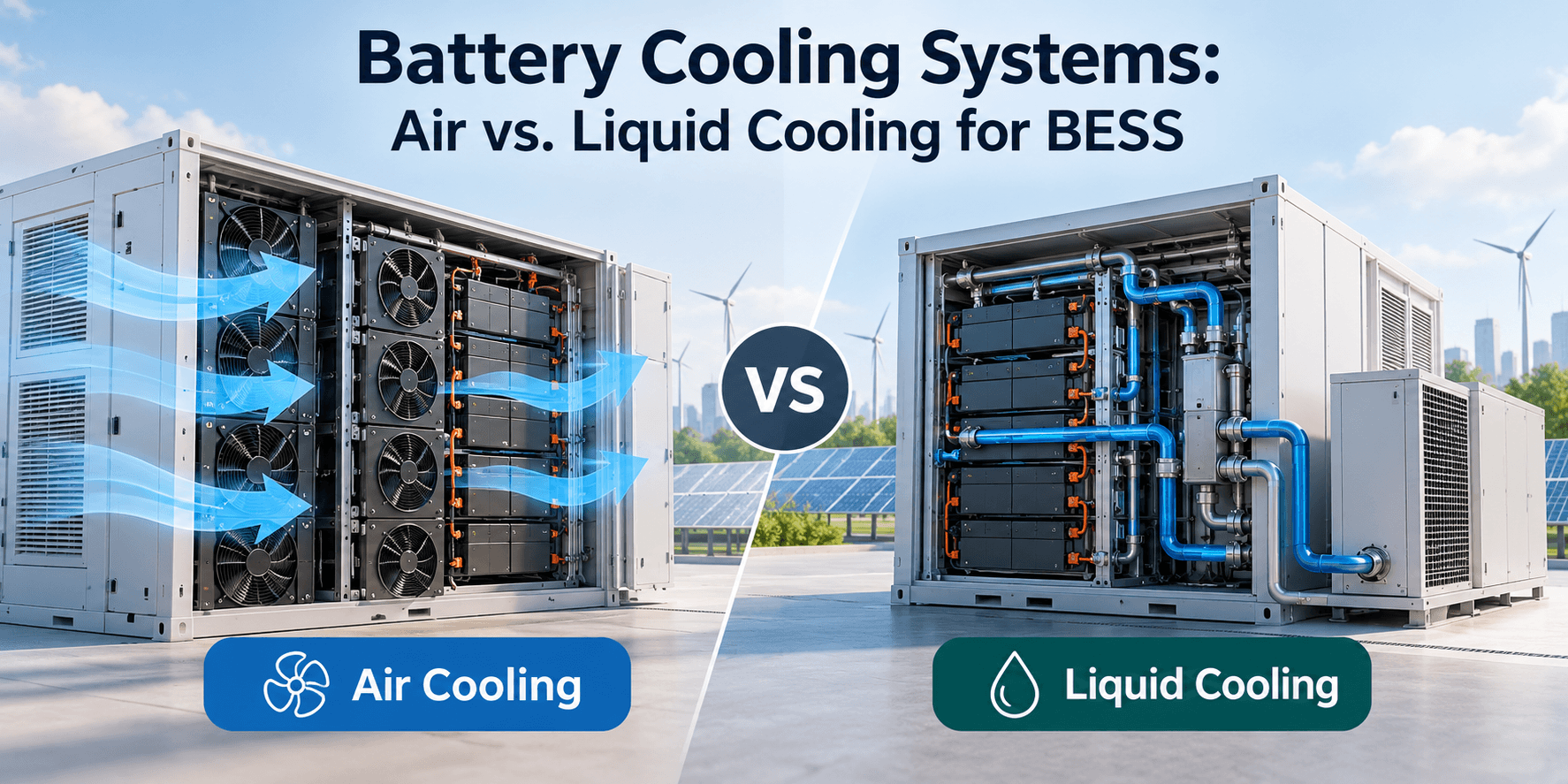
Battery Cooling Systems: Air vs. Liquid Cooling for BESS
Battery energy storage systems (BESS) generate heat during charging, discharging, and power conversion. As battery packs become larger and energy density increases, thermal management has a direct impact on safety, battery life, system efficiency, and operating costs.
For many BESS projects, the choice comes down to air cooling vs. liquid cooling. Air cooling is simpler and often more economical for smaller or lower-density systems. Liquid cooling offers better temperature control and heat removal, making it increasingly attractive for high-density and large-scale deployments.
Air Cooling for BESS
Air cooling uses fans, ducts, vents, and heat exchangers to move air across battery modules and remove excess heat.
The approach is relatively straightforward. Ambient air or conditioned air passes through the battery enclosure, absorbs heat, and is then exhausted or recirculated through an HVAC system.
Advantages of air cooling:
- Simpler system architecture
- Lower initial equipment cost
- Easier maintenance
- No coolant circulation loop
- Lower risk of coolant leakage
- Well suited to lower-density battery systems
However, air has a relatively low heat capacity. As battery capacity and power density increase, moving enough air to remove heat becomes more difficult.
Airflow can also create temperature differences between battery modules. Cells located closer to the cooling path may operate at different temperatures than cells farther away. Over time, uneven temperatures can contribute to inconsistent battery aging.
Liquid Cooling for BESS
Liquid cooling transfers heat from battery cells or modules into a circulating coolant. A typical system includes cold plates, coolant pipes, pumps, heat exchangers, sensors, and a cooling unit.
Because liquids can transfer substantially more heat than air in a compact space, liquid cooling can provide tighter temperature control while supporting higher battery energy densities.
Advantages of liquid cooling:
- Higher heat-transfer capacity
- More uniform battery temperatures
- Compact thermal-management design
- Better suited to high-energy-density systems
- Improved control of temperature during high-power operation
- Potentially better battery life through more consistent thermal conditions
The tradeoff is greater system complexity. Pumps, valves, piping, coolant, and additional controls increase the number of components that need to be designed, monitored, and maintained.
Air Cooling vs. Liquid Cooling: Key Differences
| Factor | Air Cooling | Liquid Cooling |
|---|---|---|
| Heat-transfer capacity | Lower | Higher |
| System complexity | Lower | Higher |
| Initial cost | Generally lower | Generally higher |
| Maintenance | Simpler | More involved |
| Temperature uniformity | Moderate | Better |
| Space efficiency | Lower | Higher |
| High-density BESS | Less suitable | Well suited |
| Leakage risk | None from coolant | Must be managed |
| Auxiliary power | Fans/HVAC | Pumps + cooling equipment |
| Typical use case | Lower-density systems | High-density, high-power systems |
The right choice depends less on the cooling technology itself and more on the battery chemistry, enclosure design, climate, operating profile, power-to-energy ratio, and required system lifetime.
How Cooling Affects BESS Performance
Thermal management is not simply about keeping batteries below a maximum temperature.
A well-designed system needs to maintain cells within an appropriate temperature range and limit temperature differences across the battery pack. This becomes particularly important during high-rate charging and discharging, when heat generation increases.
Poor thermal management can contribute to:
- Faster capacity degradation
- Reduced round-trip efficiency
- Increased thermal stress
- Cell-to-cell temperature imbalance
- Higher HVAC or auxiliary energy consumption
- Greater thermal safety challenges
For BESS operators, these effects can translate into lower available capacity and higher operating costs over the system’s lifetime.
Which Cooling System Is Better for High-Density BESS?
For high-density BESS applications, liquid cooling generally provides a stronger thermal-management solution.
This is particularly relevant where battery racks operate at high power or where space constraints make large airflow paths impractical. Liquid cooling can remove more heat from a smaller physical area and maintain a more consistent temperature across the battery system.
That does not mean liquid cooling is automatically the better choice for every project.
A lower-density installation with moderate power requirements may benefit from the simplicity and lower maintenance burden of air cooling. In these cases, the additional infrastructure required for liquid cooling may not provide enough operational value to justify its cost and complexity.
How Climate Influences the Choice
Ambient conditions should be considered early in BESS design.
In hot climates, air-cooled systems may require substantial HVAC capacity to maintain suitable battery temperatures. This can increase auxiliary energy consumption and affect overall system efficiency.
Liquid-cooled systems can provide greater thermal-control capability, but they still require a method of rejecting heat to the surrounding environment. A liquid loop does not eliminate the need for a properly designed heat-rejection system.
For projects in regions with high ambient temperatures, engineers should evaluate:
- Peak outdoor temperature
- Daily temperature variation
- Solar exposure
- Humidity
- Available HVAC capacity
- Cooling-system redundancy
- Expected battery operating profile
Cost Considerations
Comparing cooling technologies solely on equipment purchase price can lead to the wrong decision.
A proper BESS cooling analysis should consider total cost of ownership, including:
- Initial cooling equipment
- HVAC or heat-rejection infrastructure
- Auxiliary power consumption
- Maintenance
- Replacement components
- Battery degradation
- Available energy capacity over time
- Cooling-system reliability
Air cooling may have a lower upfront cost, but higher fan and HVAC energy consumption can affect operating economics.
Liquid cooling can require more capital investment, yet its improved thermal control may support higher energy density and more consistent battery performance.
Air vs. Liquid Cooling: How to Choose
A practical decision framework starts with the requirements of the BESS rather than the cooling technology.
Choose air cooling when:
- Battery energy density is relatively low
- Power demands are moderate
- Simplicity is a major priority
- Maintenance resources are limited
- The local climate is manageable with conventional HVAC
- The project has sufficient space for airflow and thermal equipment
Consider liquid cooling when:
- Battery racks have high energy density
- Charging and discharging rates are high
- Space is constrained
- Tight temperature uniformity is important
- The project operates in demanding thermal conditions
- Long-term thermal performance justifies additional system complexity
The Role of Thermal Management in BESS Safety
Cooling is only one part of a BESS thermal-management and safety strategy.
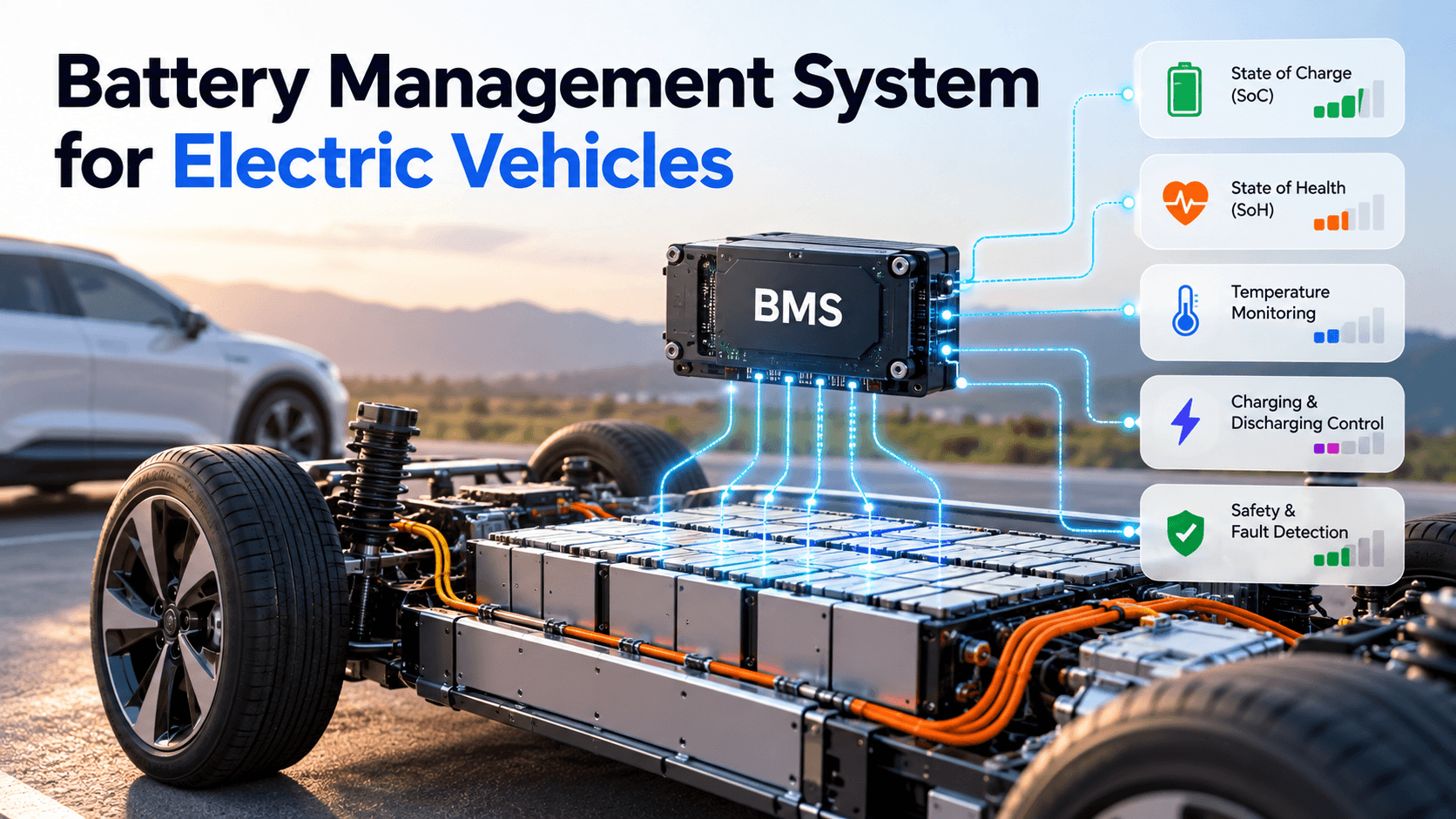
A complete system typically combines temperature sensors, battery management systems, cooling controls, ventilation, thermal event detection, and other safety measures. The design should also account for the specific battery chemistry and applicable standards and regulations.
Importantly, a cooling system should not be treated as a substitute for proper cell selection, battery management, enclosure design, or thermal-event mitigation.
Final Takeaway
Air cooling offers simplicity, lower system complexity, and potentially lower upfront costs. Liquid cooling provides stronger heat-transfer performance, better temperature uniformity, and greater suitability for high-density BESS applications.
For a new BESS project, the best choice should be based on energy density, power profile, climate, enclosure design, lifecycle economics, maintenance strategy, and safety requirements.
As battery systems continue to become more compact and powerful, liquid cooling is likely to remain an important option for applications where thermal performance and space efficiency outweigh the added complexity.