BESS Manufacturers in India: Cell Makers, Integrators and Component Suppliers
India’s Battery Energy Storage System (BESS) market is moving beyond pilot projects. Utilities, renewable energy developers, commercial and industrial users, and grid operators are increasingly looking for storage that can shift renewable power, manage peak demand, provide grid services, and improve power reliability.
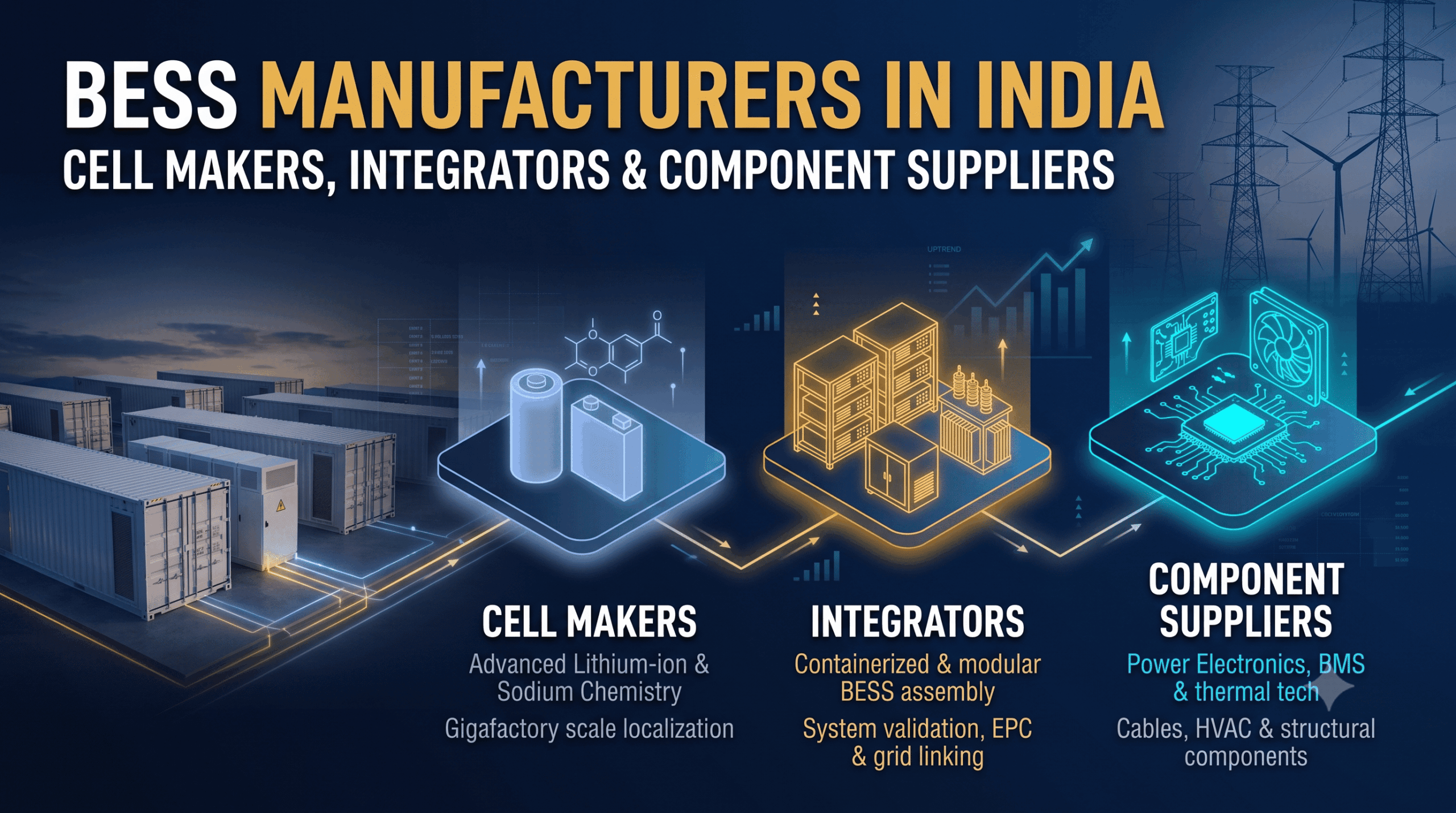
That growth is creating a broader domestic supply chain. It now includes lithium-ion cell manufacturers, battery pack and module makers, BESS integrators, power conversion equipment suppliers, transformers, switchgear, EMS platforms, and containerized system manufacturers.
This distinction matters when evaluating BESS manufacturers in India. A company that assembles a containerized BESS is not necessarily making the battery cells inside it.
According to the Ministry of New and Renewable Energy, India is projected to need 236.22 GWh of BESS capacity by 2031-32, as part of a total energy storage requirement of 411.4 GWh. The government is also supporting BESS through viability-gap funding and other policy measures.
India’s BESS manufacturing ecosystem
A utility-scale BESS typically contains several layers:
- Battery cells: The electrochemical storage unit, commonly using lithium-ion chemistry such as LFP.
- Modules and battery packs: Groups of cells assembled with monitoring and protection.
- Battery Management System (BMS): Monitors voltage, temperature, state of charge, and battery health.
- Power Conversion System (PCS): Converts DC battery power to AC and vice versa.
- Energy Management System (EMS): Controls when and how the system charges and discharges.
- Thermal management and fire protection: Keeps the battery within operating limits and manages safety risks.
- Container and mechanical systems: Houses the batteries and associated equipment.
- Transformers, switchgear and MV equipment: Connect the BESS to the project electrical infrastructure.
- System integration and EPC: Combines all of these elements into an operating storage project.
Because companies can participate at different levels, the term “BESS manufacturer” can be misleading.
BESS cell manufacturers in India
Exide Energy Solutions
Exide Industries is one of the most significant Indian companies moving into lithium-ion cell manufacturing.
Its subsidiary, Exide Energy Solutions Limited (EESL), is developing a multi-GWh lithium-ion cell manufacturing operation in Bengaluru. Exide says the business covers advanced-chemistry battery cells as well as modules and packs for EV and stationary applications.
Exide also already produces lithium-ion modules and packs at its Prantij facility in Gujarat. Its BESS offering is positioned as a Make-in-India solution for stationary storage applications.
Best known for: Battery manufacturing, lithium-ion cells, modules, packs and stationary storage.
Waaree Energy Storage Solutions
Waaree Energies is expanding from solar manufacturing into battery storage.
In 2026, Waaree Energy Storage Solutions announced funding for a planned 20 GWh advanced lithium-ion cell and battery-pack manufacturing facility. Waaree has also started an automated BESS container manufacturing facility as part of its broader energy-storage expansion.
The company’s broader strategy is notable because it connects solar generation, storage, power electronics, transformers and EPC capabilities within one group.
Best known for: Solar-to-storage integration, battery packs, BESS containers and renewable-energy infrastructure.
Amara Raja Energy & Mobility
Amara Raja Energy & Mobility has decades of experience in stationary and automotive batteries and is now investing heavily in advanced cell technologies.
The company already supplies industrial batteries for applications including telecom, UPS, railways and defence. It is also developing lithium-ion cell and battery capabilities through its advanced energy-storage initiatives.
Its existing manufacturing and service experience gives it an important advantage in stationary energy storage, particularly where reliability and lifecycle performance are critical.
Best known for: Industrial batteries, lithium-ion technology, battery packs and large-scale energy-storage manufacturing.
GODI India
GODI India is another Indian battery technology company focused on advanced lithium-ion cells and battery systems. It is particularly relevant to buyers looking for domestic battery technology development rather than simply imported cells assembled into packs.
Its importance is likely to increase as India tries to build more of the battery value chain domestically.
Best known for: Advanced lithium-ion cells, battery technology and energy-storage applications.
BESS system integrators in India
Cell manufacturing is only one part of the market. For many utility and C&I customers, the more important supplier is the system integrator.
The integrator takes batteries, PCS, BMS, EMS, HVAC, fire protection, switchgear and other equipment and turns them into a functioning storage system.
Waaree
Waaree is increasingly positioned as an integrated renewable-energy and storage supplier rather than only a solar manufacturer.
Its energy-storage portfolio covers utility-scale and C&I applications, while its 2026 manufacturing expansion includes automated BESS container production. The company is also supplying medium-voltage skids for BESS applications through Waaree Transpower.
That combination can be useful for developers looking to source multiple parts of a solar-plus-storage project from a single group.
Exide
Exide’s BESS business combines battery manufacturing expertise with system-level storage solutions.
Its BESS offering is aimed at applications where customers need to store renewable electricity and dispatch it when required. The company’s existing battery manufacturing footprint also gives it experience in testing, production, service and recycling.
HBL Power Systems
HBL Power Systems has a long history in specialized battery systems and industrial applications.
The company has developed BESS solutions for applications including railways, defence and industrial power. Its experience is particularly relevant for customers that need storage systems designed around demanding operating environments rather than purely lowest-cost energy shifting.
Best known for: Industrial batteries, specialized storage and BESS applications.
GoodEnough Energy
GoodEnough Energy is a newer Indian energy-storage company focused specifically on BESS manufacturing and system integration.
The company has been building domestic manufacturing capacity for large-scale battery storage systems, reflecting the broader shift toward local assembly of BESS equipment in India.
This segment is becoming increasingly competitive as Indian companies move from project development into actual storage-system manufacturing.
JSW Energy
JSW Energy is another major Indian energy company expanding into battery storage.
Its position is somewhat different from a conventional third-party BESS manufacturer. JSW can combine energy generation, storage development and project ownership, giving it the ability to deploy storage within its own renewable-energy portfolio as well as participate in the wider storage market.
BESS component suppliers in India
A BESS project needs considerably more than batteries.
For large projects, electrical infrastructure can represent a significant portion of the overall system cost and complexity. This creates opportunities for Indian manufacturers of transformers, switchgear, PCS equipment, control systems and other balance-of-system components.
Waaree Transpower
Waaree Transpower is a useful example of this emerging component market.
In August 2026, the company announced a roughly ₹160 crore order for 8.3 MVA medium-voltage skids for BESS applications. The containerized MV skid integrates electrical equipment used to connect storage systems to project infrastructure.
This illustrates an important trend: India’s BESS supply chain is expanding beyond cells and containers into specialized electrical equipment.
Delta Electronics India
Delta Electronics is active across power electronics and energy infrastructure, including equipment relevant to energy storage systems.
PCS technology is especially important in BESS because it determines how efficiently the battery can charge and discharge and how effectively it can interact with the electrical grid.
Power electronics and inverter suppliers
India also has a growing ecosystem of inverter and power-electronics manufacturers serving solar, UPS, industrial and storage applications.
For BESS buyers, the key question is not simply whether a supplier manufactures an inverter. The more important questions are whether its PCS supports:
- Bidirectional charging and discharging
- Grid-connected operation
- Frequency and voltage support
- Fast response
- Islanding or backup operation where required
- Grid-forming functionality where required
- Appropriate communication protocols
- Integration with the project’s EMS and SCADA
Indian BESS manufacturers vs global technology suppliers
India’s BESS market is not exclusively domestic.
Global companies such as CATL, BYD, Sungrow, Fluence, Wärtsilä and others have participated in the global and Indian storage ecosystem. In many projects, imported cells or complete battery systems are combined with Indian EPC, electrical infrastructure and commissioning capabilities.
That makes the market more nuanced than a simple domestic-versus-foreign comparison.
The supply model is increasingly moving toward local pack assembly and system integration while some cells and critical components continue to be imported. Recent industry analysis describes this as an important transition in India’s BESS manufacturing ecosystem.
For buyers, the question should therefore be:
How much of the BESS is actually manufactured in India?
A supplier may describe its product as Indian-made while importing the cells, PCS, BMS or other major components.
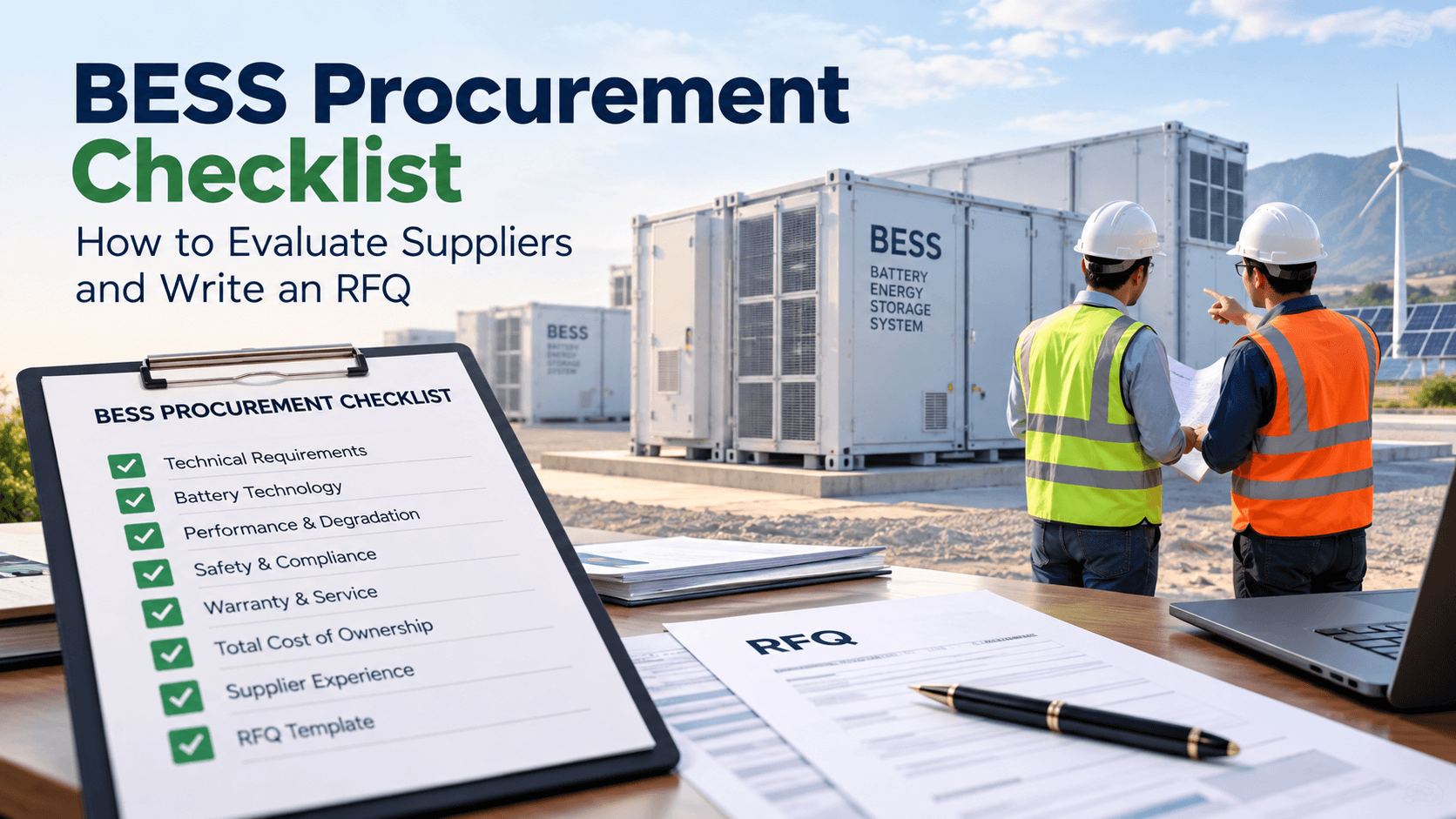
What to check when selecting a BESS manufacturer
1. Cell chemistry
LFP has become an important chemistry for stationary storage because of its balance of safety, cycle life and cost.
But chemistry alone does not determine system performance. Ask for the actual cell manufacturer, cell format, chemistry, rated cycle life and operating conditions.
2. Battery warranty
Look beyond the headline warranty period.
A serious BESS warranty should clarify:
- State-of-health guarantees
- Energy throughput limits
- Operating temperature assumptions
- Depth-of-discharge requirements
- Augmentation obligations
- Degradation assumptions
- Warranty exclusions
3. BMS and EMS architecture
The battery management system protects the battery. The energy management system controls the overall storage asset.
For larger projects, ask how these systems communicate with PCS, SCADA, forecasting platforms and the utility or grid operator.
4. PCS performance
The PCS affects efficiency, power quality and grid-support capabilities.
For grid-scale projects, evaluate round-trip efficiency, response time, operating range, overload capability and grid-forming or grid-following capabilities.
5. Fire and thermal safety
A BESS is a high-energy electrical asset. Thermal management and fire protection should therefore be evaluated during procurement, not treated as optional accessories.
Ask suppliers for system-level safety documentation, testing records, detection systems, suppression strategy and emergency-response procedures.
6. Local service capability
A lower equipment price does not help much if a project sits idle waiting for replacement parts or specialist engineers.
Evaluate:
- Indian service teams
- Spare-parts availability
- Remote monitoring
- Response-time commitments
- Warranty support
- Preventive maintenance
- Long-term software support
7. Domestic manufacturing content
If domestic sourcing is important for a project, ask suppliers to disclose the origin of major components.
A useful procurement checklist should separately identify:
| BESS layer | What to verify |
|---|---|
| Cells | Manufacturer, chemistry, country of origin |
| Modules | Assembly location and design |
| Packs | Manufacturing location and BMS |
| PCS | Manufacturer and power rating |
| EMS | Software provider and integration |
| Container | Manufacturing and assembly location |
| HVAC | Supplier and redundancy |
| Fire protection | Detection and suppression system |
| Transformer | Manufacturer and rating |
| MV equipment | Switchgear, skid and protection |
| EPC | Installation and commissioning responsibility |
Why India’s BESS market is attracting manufacturers
The fundamental driver is India’s growing need to integrate variable renewable generation.
The CEA estimates that India will need 47.24 GW/236.22 GWh of BESS by 2031-32 under the National Electricity Plan.
Government policy is also creating a stronger commercial foundation. India has implemented VGF schemes supporting approximately 43.8 GWh of BESS, while the Advanced Chemistry Cell PLI scheme has an overall allocation of ₹18,100 crore, including capacity intended for grid-scale storage.
The result is a market where several business models can coexist:
- Battery cell manufacturing
- Module and pack assembly
- Containerized BESS manufacturing
- BESS system integration
- Renewable-plus-storage EPC
- PCS and inverter manufacturing
- Transformer and MV equipment manufacturing
- BMS and EMS software
- Operations and maintenance
- Battery recycling and second-life applications
The future of BESS manufacturing in India
India’s BESS industry is still developing, so today’s list of manufacturers should not be treated as fixed.
The more important shift is structural. Companies that historically operated in batteries, solar, electrical equipment or power generation are now moving into adjacent parts of the storage value chain.
Exide is moving deeper into cells and packs. Waaree is combining solar, storage, electrical equipment and EPC capabilities. Amara Raja is building advanced cell capabilities. Newer companies are targeting dedicated BESS manufacturing and integration.
At the same time, international battery and power-electronics companies continue to influence the technology landscape.
For project developers and commercial buyers, this creates more choice, but also makes supplier due diligence more important. The right BESS manufacturer is not necessarily the company with the largest announced capacity. It is the supplier that can demonstrate the right combination of cell quality, system architecture, safety, bankability, warranty support, local service and proven project execution.
India’s storage market is entering a phase where manufacturing scale will matter, but execution will matter just as much.
Key takeaways
- India’s BESS ecosystem includes cell manufacturers, pack makers, system integrators and component suppliers.
- Exide, Waaree, Amara Raja and other Indian companies are expanding their battery manufacturing capabilities.
- BESS integration is becoming a major domestic manufacturing opportunity alongside cell production.
- Transformers, MV skids, PCS, EMS, switchgear and thermal-management systems are important parts of the supply chain.
- Buyers should distinguish between Indian assembly and genuinely domestic manufacturing of cells and major components.
- Warranty terms, degradation, safety systems, service infrastructure and project track record should carry as much weight as headline capacity.
- India’s long-term storage requirement provides a substantial growth opportunity for domestic manufacturers and technology suppliers.
Frequently asked questions
Who are the major BESS manufacturers in India?
Major Indian companies involved in battery and BESS manufacturing include Exide, Waaree, Amara Raja and HBL Power Systems, alongside newer dedicated BESS manufacturers and integrators. The appropriate supplier depends on whether the requirement is for cells, battery packs, complete BESS containers or a turnkey storage project.
Which companies manufacture lithium-ion cells in India?
Exide Energy Solutions and Amara Raja are among the major Indian companies developing advanced lithium-ion cell manufacturing capabilities. Waaree is also investing in large-scale lithium-ion cell and battery-pack manufacturing.
Are BESS systems manufactured entirely in India?
Not necessarily. A BESS assembled in India can still contain imported cells, PCS, BMS or other components. Buyers should request a component-level manufacturing and country-of-origin declaration before treating a system as domestically manufactured.
What is the difference between a BESS manufacturer and a BESS integrator?
A manufacturer produces hardware such as cells, modules, packs, containers or electrical equipment. An integrator combines those components into a complete storage system and is responsible for controls, interfaces, commissioning and overall system performance.
What should businesses consider before buying a BESS?
Start with the application and operating profile. Then evaluate usable energy, power rating, duration, cell chemistry, degradation, round-trip efficiency, safety, PCS performance, warranty, augmentation, service support and integration with the site’s electrical system.