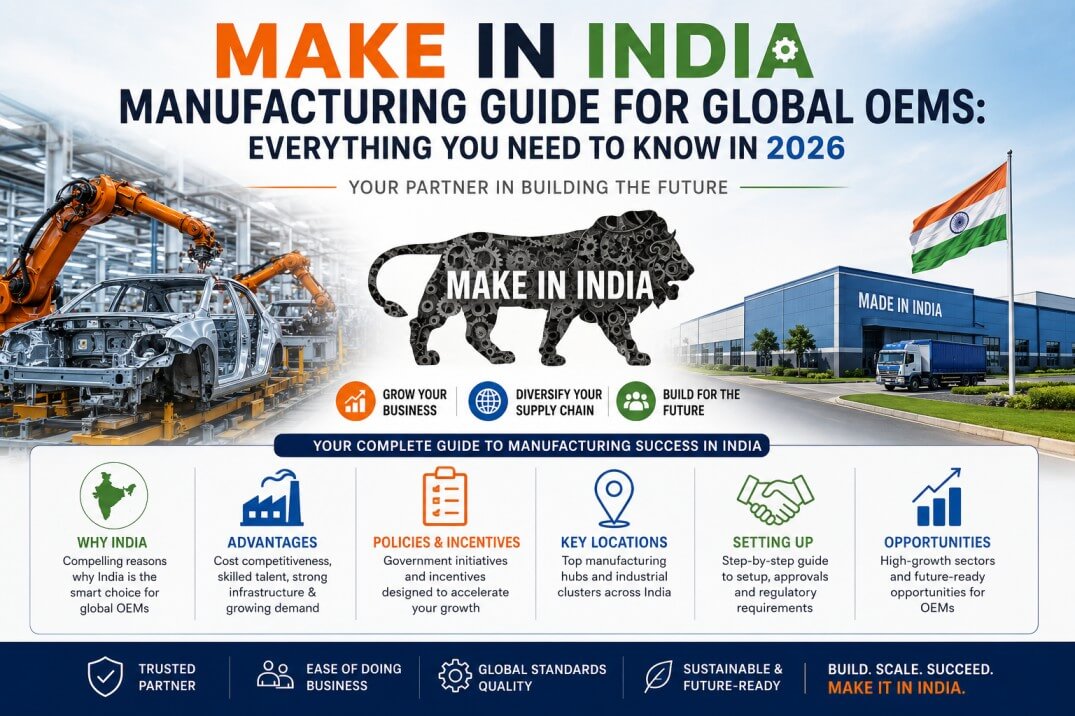
Make in India Manufacturing Guide for Global OEMs: Everything You Need to Know in 2026
Introduction
Make in India launched in 2014 as a government branding initiative. In 2026, it is the operating framework for a structural shift in global manufacturing – backed by Rs 2 lakh crore in PLI incentives, a 500-million-strong workforce, and a government that has made manufacturing FDI a top policy priority. For global OEMs, the question is no longer whether India is a credible manufacturing destination. The question is which product categories fit, how to enter, and how fast. This guide answers all three.
What Make in India Actually Means in 2026
Phase 1 (2014-2019): Brand and Policy Framework
Initial launch focused on ease of doing business reforms, FDI liberalisation across 25 sectors, and brand positioning. FDI inflows grew from $36B (2014) to $64B (2019).
Phase 2 (2020-2023): PLI Catalysis
Production Linked Incentive (PLI) schemes launched across 14 sectors. Over Rs 2 lakh crore committed. Apple’s Foxconn and Wistron plants in Karnataka, Samsung’s Noida expansion, and Micron’s semiconductor assembly facility in Gujarat are PLI-driven investments.
Phase 3 (2024-2026): Ecosystem Deepening
ECMS 2025 (Rs 22,919 Cr for electronics component manufacturing), India Semiconductor Mission (Rs 76,000 Cr), and PM MITRA textile parks signal a shift from assembly to deep manufacturing.
Headline numbers:
- Manufacturing sector: 17% of GDP, target 25% by 2030
- Manufacturing FDI: $165B cumulative (2014-2024)
- PLI-linked production: Rs 8 lakh crore projected by 2025
- Jobs created under PLI: 7 lakh+ direct
Sector-by-Sector Opportunity Assessment
Electronics and EMS – High Readiness
India’s electronics production has grown from $29B (2014) to $110B (2024). The PLI smartphone scheme alone attracted Apple, Samsung, and Xiaomi to expand Indian production. ECMS 2025 is now targeting components – PCBs, camera modules, connectors, display assemblies. For global EMS buyers, India’s contract manufacturing base is credible from SMT assembly through systems integration.
Aerospace and Defence – High Readiness for Tier-2/3
India’s defence procurement policy mandates 50%+ indigenous content. Foreign OEMs entering via offset obligations (35% for defence contracts above Rs 300 Cr) can build Indian supply chains that serve both Indian defence demand and global programmes.
Automotive – Mature Ecosystem
India is the world’s third-largest automobile market and a significant auto-component exporter ($21.2B in 2023-24). The IATF 16949-certified supplier base covers forging, casting, stamping, machining, plastics, and electronics. For global OEMs, India is a credible source for auto components across the value chain.
Pharmaceuticals – Deep Expertise
India is the pharmacy of the world: 3,000+ FDA-approved facilities, 20% of global generics supply, deep CDMO capability. For pharma OEMs, India is not a new entrant – it is an established, scaled, and trusted partner.
Industrial Machinery and Equipment
Clusters in Pune (auto/industrial), Coimbatore (pumps/compressors/textiles), Rajkot (forged components), and Ludhiana (small industrial machinery) offer deep, competitive supplier bases.
Textiles and Apparel
PM MITRA mega textile parks (7 parks, Rs 4,445 Cr investment) are creating integrated textile manufacturing zones that will change cost economics for sourcing from India.
Key Manufacturing Hubs
- Pune: Auto components, electronics, precision engineering – Bhosari, Chakan, Ranjangaon industrial areas
- Chennai: Auto (Ford, Hyundai, Renault-Nissan supply chain), electronics – Oragadam, SIPCOT Irungattukottai
- Bengaluru: Aerospace, defence, IT-integrated manufacturing – KIADB Aerospace Park, Devanahalli
- Hyderabad: Pharma, aerospace, defence – Genome Valley, Fab City
- Ahmedabad/Sanand: Automotive, electronics (Micron), FMCG – GIDC Sanand, Dholera SIR
- Coimbatore: Textiles, pumps, precision machining, auto parts – Kovai industrial clusters
- Noida/Greater Noida: Electronics (Samsung, Oppo, Vivo), garments – Yamuna Expressway Industrial Development Authority
- Hosur: Electronics, automotive, two-wheelers – Hosur Industrial Area
Regulatory and Policy Framework
FDI Policy: 100% FDI under automatic route in manufacturing. Sector-specific limits apply for defence (74% auto, 100% with government approval for strategic items).
Industrial Land and Approvals: State industrial development authorities (MIDC Maharashtra, KIADB Karnataka, TIDCO Tamil Nadu) are the primary land allocation bodies. Single-window clearance systems exist in most major states. Timelines: 3-6 months for standard approvals, 6-18 months for complex environmental clearances.
Labour Law: The Labour Codes (2020) consolidate 44 central labour laws into 4 codes. Key provisions: fixed-term employment, apprenticeship expansion, and occupational safety standardisation.
Tax: Corporate tax for new manufacturing entities: 15% effective rate. Standard corporate tax rate: 22%. GST largely cost-neutral for B2B transactions via Input Tax Credit.
PLI Scheme Participation: PLI schemes are industry-specific. Eligibility criteria, incentive structures, and application windows vary. Engage DPIIT (Department for Promotion of Industry and Internal Trade) directly or through industry bodies for current application windows.
How to Enter: Three Models
Model 1: Direct Greenfield Investment
Establish an Indian subsidiary, acquire land in an industrial zone, build factory, hire workforce. Maximum control, maximum capital requirement, longest time-to-production (24-36 months), full benefit of PLI incentives. Best for: companies with large, committed India volumes ($50M+ per year) and a 3-5 year horizon.
Model 2: Joint Venture with Indian Partner
Partner with an established Indian manufacturer – access their facilities, workforce, supply chain, and regulatory relationships. Shared investment, shared control. JV structures require careful legal structuring on IP protection and exit mechanisms. Best for: companies wanting faster market entry than greenfield, with a strategic Indian partner.
Model 3: Contract Manufacturing (Fastest Entry)
Source from established Indian CMs through RFQ, qualification, and purchase order. Zero capital investment, no entity setup, production within 3-6 months of qualification. Less control, no PLI eligibility (PLI goes to the CM), but de-risked and reversible. Best for: companies testing India’s cost competitiveness or with volumes below the threshold for greenfield economics.
The hybrid path used by most global OEMs: start with Model 3 (contract manufacturing) to validate quality and build India supply chain knowledge, then consider Model 1 or 2 for highest-volume, strategic products as confidence builds.
Supplier Qualification in India: What Good Looks Like
Certification baseline by sector:
- Industrial manufacturing: ISO 9001
- Automotive: IATF 16949
- Aerospace: AS9100 Rev D
- Electronics: IPC-A-610 (workmanship), J-STD-001 (soldering)
- Pharmaceuticals: FDA/WHO GMP, EU GMP
Beyond certification – what to look for in a factory audit:
- SPC (Statistical Process Control) charts actively maintained and acted upon
- Calibrated measurement equipment with current calibration records
- Documented control plans, FMEAs, and corrective action processes
- Workforce training records and retention rates (high turnover signals operational instability)
- ERP or MES system in use
- Customer reference list – who else do they supply, at what quality level
Red flags in Indian supplier audits:
- Certifications that are “in progress” or “just expired”
- Measurement equipment without calibration stickers
- Clean room during the audit that looks unused in practice
- No documented CAPA (Corrective and Preventive Action) history
Common Mistakes Global OEMs Make Entering India
- Awarding to the cheapest quote without qualification – India price competition is intense. The cheapest quote often reflects capacity the supplier does not have or quality processes they will not maintain.
- Expecting China-equivalent component lead times – India’s component import dependency means BOM lead times for electronics assemblies run longer than China.
- Underestimating relationship investment – Indian business culture values long-term relationships.
- Ignoring Tier-2 supplier risk – A qualified Tier-1 CM may source critical sub-components from a single, unqualified Tier-2.
- Managing India with China playbooks – Regulatory environment, labour practices, and quality management approaches differ meaningfully.
Key Takeaways
- Make in India in 2026 is policy-backed, capital-supported, and producing real manufacturing output.
- Six sectors offer immediate, credible opportunity for global OEMs: electronics, aerospace, automotive, pharma, industrial, and textiles.
- Three entry models exist – contract manufacturing is fastest; greenfield maximises PLI and long-term control.
- Supplier qualification in India follows global certification standards; the discipline is in verification, not assumption.
- The fastest, lowest-risk entry is through an established contract manufacturing platform with pre-qualified supplier networks.
FAQs
Q: Is the Make in India scheme only for Indian companies?
A: No. PLI schemes are available to foreign companies that establish Indian manufacturing entities. 100% foreign-owned subsidiaries can participate in PLI schemes subject to sector-specific eligibility criteria.
Q: How has Make in India performed vs targets?
A: Electronics (mobile phones) has been a notable success – India is now the world’s second-largest mobile phone manufacturer by volume. Overall FDI and manufacturing output have grown significantly.
Q: What is the difference between Make in India and Atmanirbhar Bharat?
A: Make in India focuses on attracting manufacturing investment (domestic and foreign). Atmanirbhar Bharat (Self-Reliant India, 2020) is a broader economic resilience framework that encompasses Make in India plus import substitution, MSME support, agriculture reform, and defence indigenisation.
Q: Can we import components into India for assembly and re-export?
A: Yes – through Export Oriented Unit (EOU) or Special Economic Zone (SEZ) frameworks, components can be imported duty-free for export-oriented assembly. This is the model used by Apple’s Indian contract manufacturers.