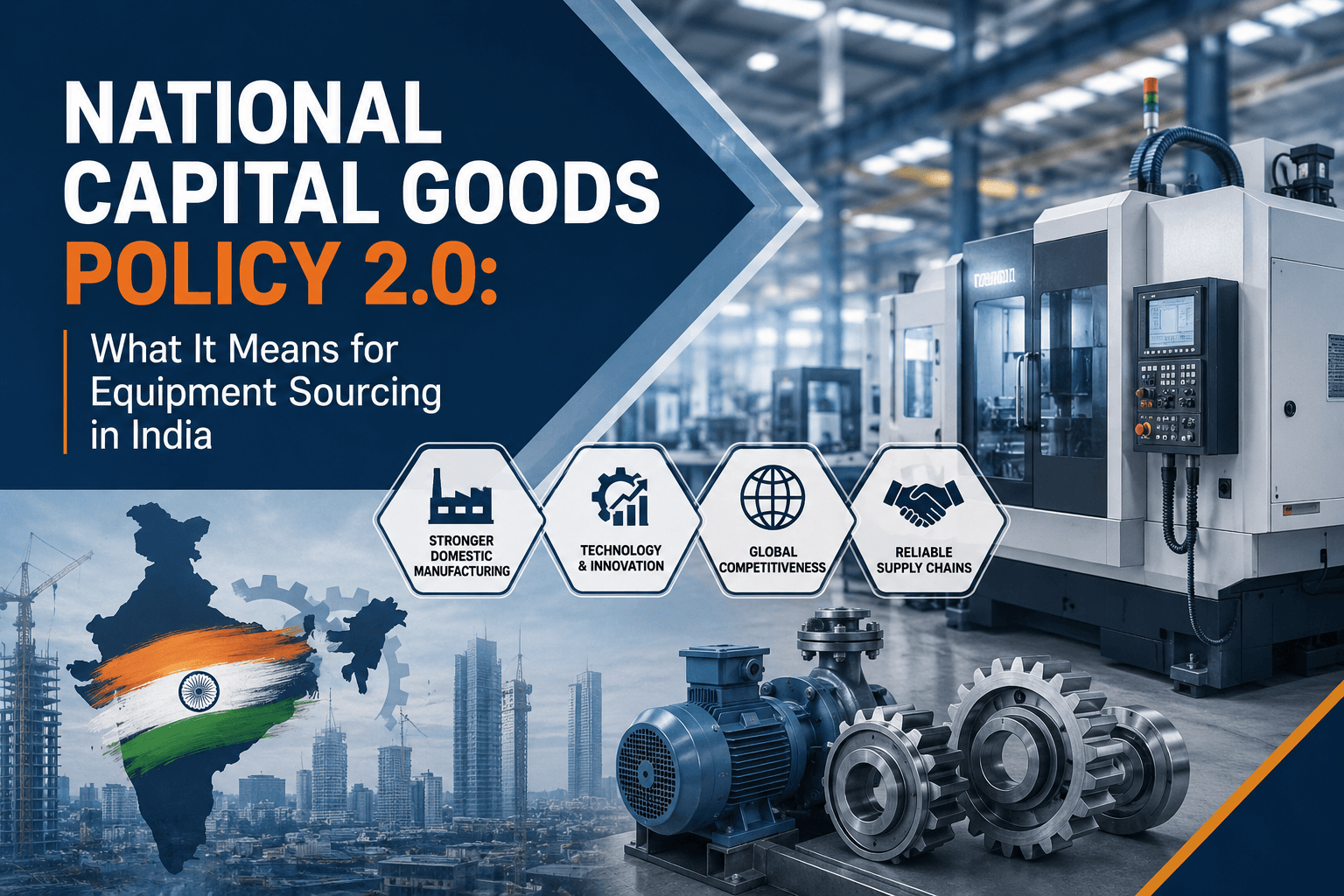
National Capital Goods Policy 2.0: What It Means for Equipment Sourcing in India
India’s capital goods sector is entering an important phase of change.
The original National Capital Goods Policy, introduced in 2016, was designed to strengthen domestic manufacturing, improve technology capabilities, increase exports, develop skilled talent, and reduce dependence on imported capital equipment. Its targets included raising the share of capital goods in manufacturing from 12% to 20%, increasing domestic production’s share of India’s capital goods demand, and making India a stronger exporter.
As the government works toward a new policy framework, often referred to as National Capital Goods Policy 2.0 or the National Capital Goods Policy 2025, equipment buyers should pay attention.
The impact will not be limited to manufacturers. It could also change how Indian companies evaluate machinery suppliers, compare imported and domestic equipment, manage procurement risk, and plan long-term investments.
For procurement and operations teams, the central question is simple:
Will India’s next capital goods policy make locally sourced equipment more competitive, reliable, and easier to procure?
The answer will depend on how the policy’s priorities translate into actual incentives, standards, financing, technology development, and supplier capabilities.
What Is the National Capital Goods Policy?
The National Capital Goods Policy was introduced in 2016 to create a stronger and more globally competitive capital goods industry in India.
Capital goods include the machinery and equipment businesses use to manufacture products or build infrastructure. This covers areas such as:
- Machine tools
- Construction and mining equipment
- Heavy electrical equipment
- Process plant machinery
- Textile machinery
- Plastic processing machinery
- Printing and packaging machinery
- Dies, moulds and press tools
- Industrial automation and related equipment
The policy was built around several priorities, including domestic manufacturing, technology development, skills, testing and certification, exports, and MSME development.
The government has also supported these objectives through schemes focused on competitiveness, technology development, common engineering facilities, testing infrastructure, skill development, and industry-academia collaboration.
For example, the Ministry of Heavy Industries’ Phase II capital goods scheme has supported Centres of Excellence, Common Engineering Facility Centres, testing and certification facilities, and industry accelerators for indigenous technology development.
Why a New Capital Goods Policy Matters
The manufacturing environment India faced in 2016 is different from the one businesses operate in today.
Companies are now dealing with more complex supply chains, automation, Industry 4.0 technologies, energy-efficiency requirements, localisation expectations, and geopolitical supply risks.
At the same time, India’s manufacturing ambitions have expanded across sectors such as electronics, automotive, defence, renewable energy, batteries, infrastructure, pharmaceuticals, and advanced engineering.
A revised capital goods policy therefore has the potential to address a broader question:
How can India build the machinery ecosystem required to support the next generation of manufacturing?
This matters directly to equipment buyers.
If domestic manufacturers become more capable and competitive, buyers could gain access to more local alternatives. If testing and certification improve, supplier qualification could become easier. If technology development accelerates, Indian equipment manufacturers could offer more advanced machinery.
But procurement teams should not assume that every imported machine will become obsolete or every Indian supplier will automatically become the better choice.
The real opportunity is to build a more competitive supplier base.
How Capital Goods Policy Could Affect Equipment Sourcing in India
1. More capable domestic equipment suppliers
One of the clearest implications of the policy direction is a stronger focus on domestic manufacturing.
The original policy aimed to increase the share of domestic production in India’s capital goods demand from 60% to 80%.
For equipment buyers, this could eventually mean a wider choice of Indian manufacturers across more specialised categories.
That matters because domestic sourcing can offer advantages beyond the initial purchase price.
A local equipment supplier may be able to provide:
- Faster technical support
- Easier spare-parts availability
- Shorter service response times
- Local installation teams
- Easier communication
- More practical customisation
- Lower exposure to international freight disruptions
However, procurement teams should evaluate these benefits alongside machine performance, lifecycle cost, reliability, and total cost of ownership.
2. Imports will remain important
A stronger domestic capital goods industry does not necessarily mean India will stop importing equipment.
The government continues to maintain a relatively open policy environment for the capital goods sector. According to the Ministry of Heavy Industries, there is no general restriction on imports and exports, while FDI up to 100% is permitted through the automatic route subject to applicable exceptions.
This is important for buyers.
Highly specialised machinery, advanced production systems, precision equipment, and technologies that are not yet widely available from Indian manufacturers may continue to come from overseas.
In practice, procurement strategies are likely to become more nuanced:
Source locally where domestic suppliers meet the required specifications and economics. Import where specialised technology, quality, capacity, or productivity makes international sourcing the stronger option.
The result could be a more balanced sourcing model rather than a simple shift from imports to domestic suppliers.
3. Total Cost of Ownership Will Matter More Than Purchase Price
Equipment sourcing decisions are often made around the initial quotation.
That can be misleading.
A machine that costs ₹1 crore less to purchase may become more expensive over its operating life if it has higher energy consumption, expensive spare parts, longer downtime, or limited local service support.
As Indian capital goods manufacturers improve their technology and engineering capabilities, buyers should compare equipment using total cost of ownership (TCO).
A practical TCO assessment should consider:
- Purchase price
- Import duties and logistics
- Installation and commissioning
- Energy consumption
- Maintenance
- Spare parts
- Operator requirements
- Downtime
- Warranty and service coverage
- Expected operating life
- Resale value
- Productivity and output
This approach becomes especially important when comparing an Indian manufacturer with an overseas supplier.
The cheapest machine is not necessarily the lowest-cost machine.
4. Testing and Certification Could Make Supplier Evaluation Easier
Equipment buyers often face a difficult problem when evaluating unfamiliar machinery suppliers.
A supplier may provide impressive specifications, but procurement teams still need confidence that the equipment will perform under real operating conditions.
This is where testing and certification infrastructure becomes important.
The government’s capital goods initiatives have included the development and upgrading of testing and certification facilities. Phase II projects, for example, include testing infrastructure covering mechanical, electrical, chemical, structural, metallurgical, electronics, and other characteristics.
For buyers, stronger testing infrastructure can improve the sourcing process by making technical comparisons more objective.
Instead of relying primarily on brochures and supplier claims, procurement teams can increasingly ask for:
- Test certificates
- Performance data
- Third-party validation
- Applicable BIS standards
- Factory acceptance test results
- Site acceptance test results
- Quality documentation
- Warranty commitments
This can reduce technical uncertainty during supplier selection.
5. Technology and Automation Will Become Bigger Procurement Criteria
The future of capital equipment sourcing is not simply about finding machines manufactured in India.
It is also about finding machines that help Indian manufacturers become more productive.
The original policy explicitly focused on improving technology depth and moving Indian capital goods from basic and intermediate capabilities toward advanced technologies.
That direction is increasingly relevant as manufacturers adopt:
- Industrial automation
- Robotics
- CNC systems
- Machine vision
- IoT-enabled equipment
- Predictive maintenance
- Digital monitoring
- Energy-efficient machinery
- Data-driven production systems
For procurement leaders, technology should therefore be evaluated as a business investment rather than a technical specification.
Ask:
What will this equipment improve?
The answer might be higher production capacity, lower scrap, reduced downtime, fewer operators, better quality, lower energy consumption, or greater production flexibility.
6. Local Service and Spare Parts Could Become a Competitive Advantage
Equipment downtime can be extremely expensive.
Consider a production line that generates ₹20 lakh in daily output. If a critical machine remains unavailable for three days because a specialised component has to be imported, the real cost can quickly exceed the price difference between suppliers.
This is why local service infrastructure deserves more attention during sourcing.
Procurement teams should evaluate suppliers on:
- Spare-parts availability in India
- Service engineer coverage
- Average response time
- Preventive maintenance capability
- Remote diagnostics
- Local inventory
- Warranty terms
- Training support
- Equipment commissioning support
A supplier with slightly higher upfront pricing may still deliver better economics if it reduces downtime.
7. Domestic Value Addition Could Become More Important
The broader policy direction around capital goods is closely connected with India’s manufacturing and localisation objectives.
For businesses buying equipment, this creates an important distinction between Indian supplier and Indian-made equipment.
They are not always the same.
An equipment company may operate in India while relying heavily on imported components, technology, or assemblies.
That does not automatically make the equipment unsuitable. But procurement teams that care about localisation should understand the supplier’s actual value chain.
Useful questions include:
- Where is the machine manufactured?
- Which major components are imported?
- Where is engineering performed?
- Are critical spare parts available locally?
- What percentage of the equipment is locally sourced?
- Does the supplier have Indian production capacity?
- Can the supplier support future upgrades locally?
These questions can become increasingly relevant as localisation becomes a larger part of industrial procurement strategies.
What Equipment Buyers Should Do Differently
Policy changes do not require procurement teams to immediately overhaul their sourcing strategies.
They do, however, create a good reason to strengthen them.
Build a Domestic Supplier Benchmark
For every major equipment category, maintain a shortlist of qualified Indian manufacturers alongside international suppliers.
Do not wait until a purchase requirement arrives.
A supplier database should capture:
- Product categories
- Technical capabilities
- Manufacturing location
- Certifications
- Installed base
- Key customers
- Production capacity
- Service network
- Lead times
- Spare-parts availability
- Financial stability
- Import dependency
This makes domestic alternatives easier to evaluate when a sourcing event begins.
Use a Standard Technical Evaluation Framework
Supplier comparisons become difficult when every vendor presents information differently.
Create a standard technical scorecard covering the factors that actually matter to your operation.
For example:
| Evaluation Area | Example Criteria |
|---|---|
| Machine performance | Output, accuracy, cycle time |
| Reliability | MTBF, warranty, service history |
| Energy | Power consumption, efficiency |
| Automation | Controls, sensors, integration |
| Local support | Engineers, service response |
| Spare parts | Availability and lead time |
| Compliance | Applicable standards and certifications |
| Commercials | Price, payment terms, TCO |
| Scalability | Upgrade and expansion options |
This allows domestic and international suppliers to compete on comparable criteria.
Look Beyond the Initial Quote
A proper equipment sourcing process should compare landed cost and lifecycle cost, not just supplier quotations.
For imported machinery, calculate the full landed cost, including freight, insurance, customs duties, taxes where applicable, installation, commissioning, and other associated costs.
For domestic equipment, assess transport, installation, service, financing, and long-term operating costs.
Then compare the total economics.
Ask Suppliers About Their India Roadmap
If capital goods policy continues to encourage domestic technology development and manufacturing, supplier capabilities may change rapidly.
During strategic sourcing discussions, ask suppliers about their plans for:
- Local manufacturing
- Technology development
- Automation
- Capacity expansion
- Spare-parts localisation
- R&D
- Service infrastructure
- Export capabilities
This can help procurement teams distinguish between suppliers that are simply selling equipment today and those investing in long-term capabilities.
What Could Change for Imported Equipment?
The most important takeaway is that National Capital Goods Policy 2.0 should not be interpreted as a simple “buy Indian” mandate.
India’s capital goods ecosystem still benefits from international technology, global suppliers, imported components, and foreign investment.
The government’s own description of the sector notes that imports and exports remain open, while technology transfer and foreign investment continue to play a role.
For procurement leaders, the more realistic outcome is increased competition.
An Indian manufacturer may become a stronger alternative to an imported machine.
An international supplier may respond by increasing local manufacturing.
A joint venture may localise production.
A domestic supplier may invest in better automation and testing.
All of these developments can improve buyer choice.
The Biggest Opportunity: More Competitive Sourcing
The long-term significance of India’s capital goods policy is bigger than whether a particular machine is sourced domestically or internationally.
A stronger capital goods ecosystem can create a healthier equipment market.
More capable suppliers can mean more competition.
Better testing can improve transparency.
Greater technology investment can improve equipment performance.
Stronger local service networks can reduce downtime.
More domestic manufacturing can shorten some supply chains.
And a larger Indian manufacturing ecosystem can create demand for increasingly sophisticated machinery.
For procurement teams, that means the goal should not be localisation at any cost.
The goal should be better equipment, better supplier resilience, and better economics.
How Procurement Teams Can Prepare for Capital Goods Policy Changes
A practical preparation plan can start with five steps.
1. Map your equipment categories
Identify which machines are critical to production and which categories currently depend heavily on imports.
2. Identify credible Indian alternatives
Build a qualified supplier pool before the next procurement cycle.
3. Compare total cost of ownership
Include energy, maintenance, downtime, spare parts, logistics, and service costs.
4. Strengthen supplier due diligence
Evaluate manufacturing capability, technical depth, certifications, financial stability, service infrastructure, and localisation.
5. Create a dual-sourcing strategy
For critical equipment, consider maintaining both domestic and international supplier options where commercially and technically viable.
This reduces dependence on any single supply channel.
What Does National Capital Goods Policy 2.0 Mean for Equipment Sourcing in India?
For equipment buyers, the emerging capital goods policy direction points toward a more competitive and capable Indian machinery ecosystem.
The original National Capital Goods Policy set ambitious goals around domestic manufacturing, exports, technology, skills, testing, and MSME development. Government initiatives since then have continued to support technology development, testing infrastructure, common engineering facilities, and industrial capability.
The next phase could make these priorities even more relevant to industrial procurement.
But buyers should avoid treating policy as a substitute for procurement discipline.
The right machine is still the one that meets your production requirements, delivers acceptable lifecycle economics, has reliable service support, and fits your long-term manufacturing strategy.
For Indian businesses, the opportunity is to use the changing capital goods landscape to expand supplier options, reduce sourcing risk, and make better equipment investment decisions.
The companies that benefit most will not necessarily be those that source everything locally.
They will be the ones that understand the changing supplier landscape and know when to buy Indian, when to import, and how to evaluate both on the same commercial and technical standards.
Frequently Asked Questions
What is the National Capital Goods Policy 2.0?
The term is generally used to describe the proposed/revised framework intended to build on India’s 2016 National Capital Goods Policy. The original policy focused on domestic manufacturing, technology development, exports, skills, testing infrastructure, and MSME growth. A new framework has been under development to replace the 2016 policy.
Will the policy make imported machinery more expensive?
Not necessarily. The policy direction is focused on strengthening India’s capital goods ecosystem, but the government continues to maintain an open framework for imports and exports. The actual impact on specific equipment will depend on applicable customs, tax, standards, and sector-specific policies.
Should Indian companies switch from imported equipment to domestic machinery?
Not automatically. Companies should compare domestic and imported equipment based on performance, lifecycle cost, reliability, service support, technology, compliance, and supply-chain risk.
Which industries could benefit from stronger capital goods manufacturing?
Industries such as automotive, infrastructure, construction, mining, energy, electronics, pharmaceuticals, textiles, chemicals, and general manufacturing all depend on capital equipment and could benefit from a stronger domestic machinery ecosystem.
How should procurement teams prepare?
Start by benchmarking domestic suppliers, standardising technical evaluation, calculating total cost of ownership, reviewing supplier localisation and service capabilities, and developing alternative sourcing options for critical equipment.