
Composites vs. Metallics in Aerostructure Manufacturing
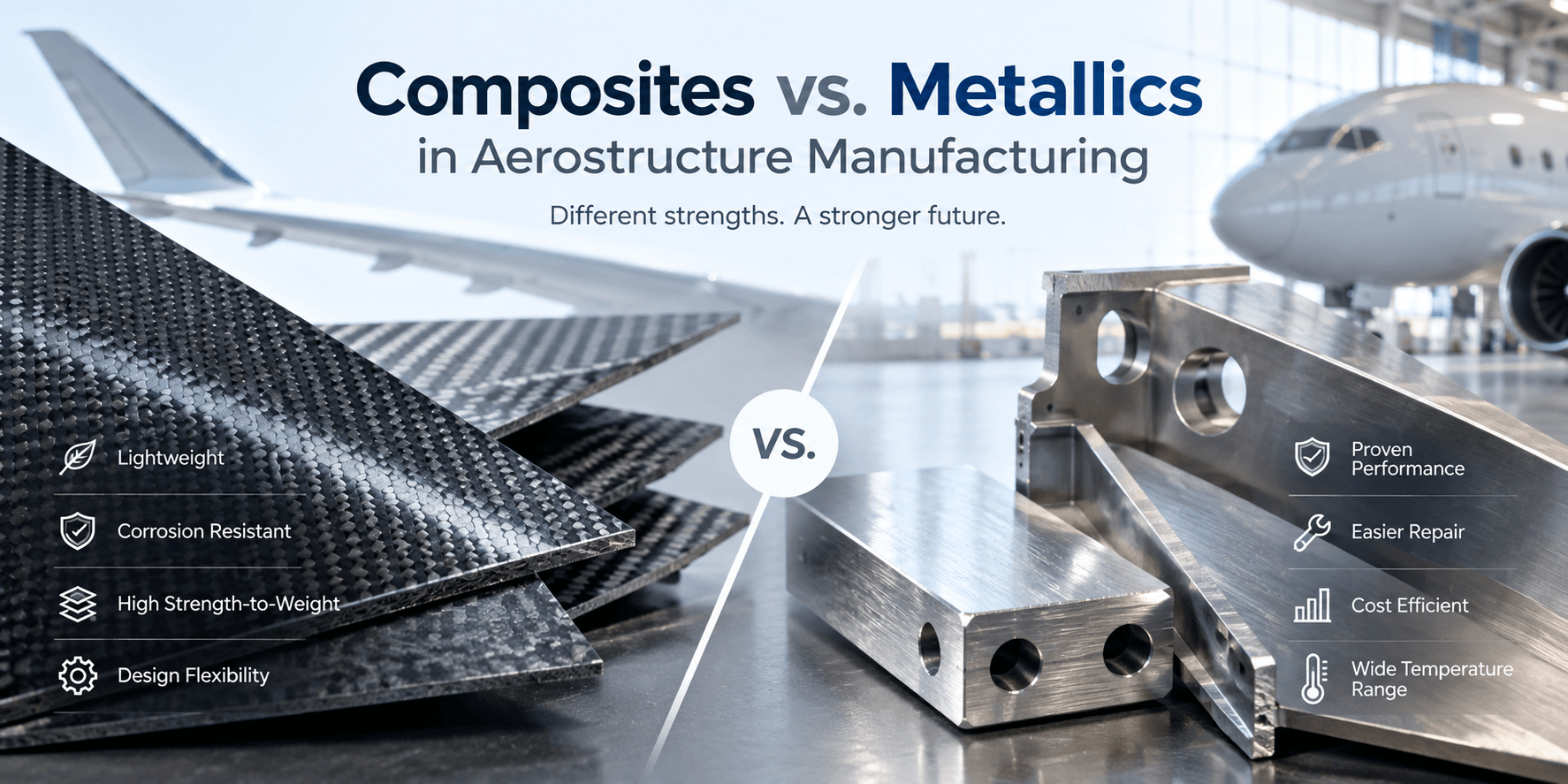
The choice between composites and metallics remains one of the most important decisions in aerostructure manufacturing. Both material families offer distinct advantages, and the right choice depends on the aircraft application, structural requirements, manufacturing process, cost targets, and lifecycle goals.
Composites are increasingly used for primary and secondary aircraft structures because of their high strength-to-weight ratio and corrosion resistance. Metallics, particularly aluminum and titanium alloys, remain essential because of their established manufacturing processes, predictable performance, repairability, and cost advantages in many applications.
What Are Composites and Metallics in Aerostructures?
Composite aerostructures typically combine reinforcing fibers, such as carbon fiber, with a polymer matrix. Carbon fiber reinforced polymer (CFRP) is widely used in aircraft structures because it can deliver high stiffness and strength at relatively low weight.
Metallic aerostructures are commonly manufactured from aluminum alloys, titanium alloys, steel, and other aerospace-grade metals. Aluminum has historically been a major structural material because it combines low density with good strength and relatively straightforward manufacturing. Titanium is used where higher temperature capability, strength, corrosion resistance, or compatibility with other aircraft systems is important.
The difference is not simply “new materials versus old materials.” Modern aircraft often use both. Engineers select materials according to the specific loads, environment, manufacturing requirements, and lifecycle economics of each component.
Composites vs. Metallics: Key Differences
| Factor | Composites | Metallics |
|---|---|---|
| Weight | Excellent strength-to-weight potential | Aluminum is lightweight, titanium is heavier |
| Stiffness | High, particularly with carbon fiber | Predictable and generally isotropic |
| Corrosion | Excellent resistance for most polymer composites | Varies by alloy and environment |
| Fatigue | Can perform very well, but damage behavior requires careful design | Well-understood fatigue characteristics |
| Damage tolerance | Requires specialized inspection and design | Damage is often easier to detect visually |
| Manufacturing | More complex processes and tooling | Mature, established processes |
| Repair | Can require specialized methods | Often simpler and more standardized |
| Production cost | Can be higher, depending on volume and process | Often lower for conventional structures |
| Design flexibility | Excellent ability to tailor fiber orientation | More limited material-direction tailoring |
| Recycling | Challenging for many thermoset composites | Metals are comparatively easy to recycle |
| Electrical/thermal behavior | Different from metals and must be considered | High electrical and thermal conductivity |
Weight and Structural Performance
Weight reduction is one of the strongest arguments for composite aerostructures.
Carbon fiber composites can provide high specific strength and stiffness, allowing engineers to achieve structural performance with less mass in suitable applications. This can be particularly valuable in large structures where even modest weight savings can affect aircraft operating economics.
Composites also offer an important design advantage: anisotropy can be used deliberately. Engineers can orient reinforcing fibers according to expected load paths rather than relying on the same material properties in every direction.
Metallic materials behave differently. Their relatively isotropic properties make structural behavior easier to predict and simplify many aspects of design and manufacturing. Aluminum and titanium alloys also have extensive historical databases and established certification practices.
The result is a tradeoff. Composites can enable highly optimized structures, while metallics can offer simpler and more predictable structural design in many applications.
Manufacturing Considerations
Manufacturing is where the difference between the two material families becomes particularly important.
Composite Manufacturing
Composite parts may involve processes such as:
- Automated fiber placement (AFP)
- Automated tape laying (ATL)
- Resin transfer molding (RTM)
- Compression molding
- Prepreg layup and autoclave curing
- Out-of-autoclave processing
The process often requires careful control of fiber placement, resin content, temperature, pressure, cure cycles, and part consolidation.
Large composite structures can reduce the number of individual components and fasteners by allowing engineers to manufacture larger integrated sections. However, tooling, material storage, cure requirements, inspection, and process control can increase manufacturing complexity.
Metallic Manufacturing
Metallic aerostructures rely on mature processes such as:
- CNC machining
- Sheet-metal forming
- Forging
- Extrusion
- Casting
- Welding and joining
- Riveting and mechanical fastening
These processes have decades of aerospace development behind them. Manufacturers have extensive knowledge of material behavior, tooling, inspection, repair, and production qualification.
Metallic production can therefore be particularly attractive when manufacturing volumes, cost targets, or supply-chain maturity are major considerations.
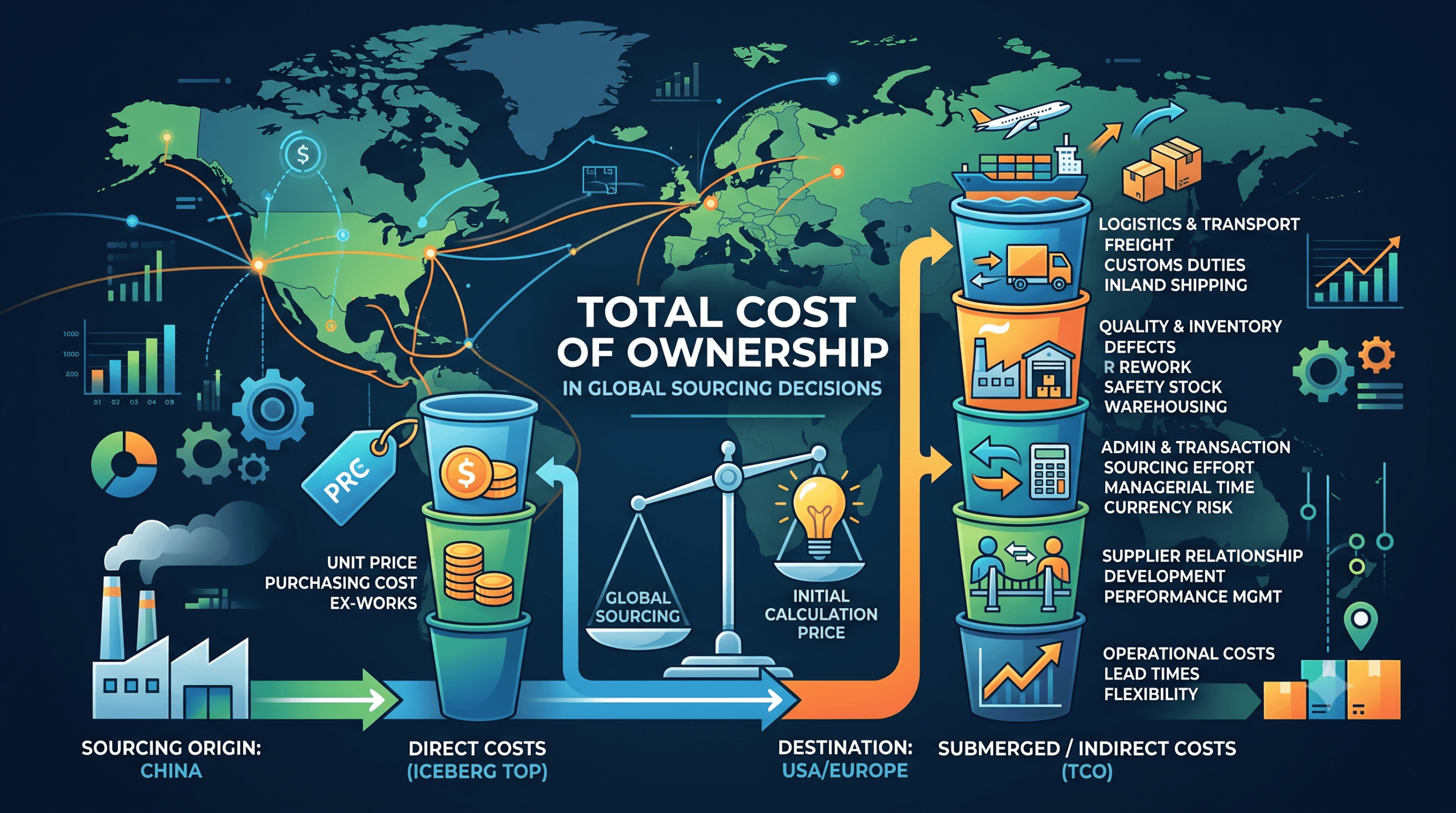
Cost: Material Price Is Only Part of the Equation
Comparing composite and metallic costs based only on raw material price can lead to the wrong conclusion.
A composite component may have a higher material cost but reduce the number of parts, fasteners, and assembly operations. If a large integrated component replaces several metallic subassemblies, the total manufacturing economics may become more competitive.
At the same time, composite manufacturing can require expensive tooling, specialized equipment, controlled environments, and nondestructive inspection.
Metallic structures can benefit from established equipment, suppliers, and production workflows. However, machining large metal components can generate significant material waste, while corrosion protection and assembly requirements add lifecycle costs.
For this reason, aerospace manufacturers typically need to evaluate total cost of ownership, rather than comparing material prices alone.
Corrosion and Environmental Resistance
Composites generally have a major advantage when corrosion is a concern. Polymer-based composite structures do not corrode in the same way as conventional metallic structures.
Metallic aircraft structures can be vulnerable to corrosion depending on the alloy, environment, surface treatment, and design. Manufacturers therefore use protective coatings, sealants, surface treatments, and inspection programs.
However, composites are not immune to environmental degradation. Moisture, temperature changes, ultraviolet exposure, impact damage, and other environmental factors can affect composite materials and their interfaces.
Material selection must therefore consider the full operating environment rather than treating composites as universally more durable.
Inspection and Damage Detection
One of the biggest differences between composites and metallics is how damage develops and how easily it can be detected.
Metallic damage such as cracks, dents, deformation, and corrosion can often be identified using established visual and nondestructive inspection techniques. Engineers have extensive experience interpreting these damage modes.
Composite damage can be more difficult to identify. An impact that leaves only a small mark on the surface may cause internal damage such as delamination or fiber breakage.
As a result, composite aerostructures can require advanced nondestructive inspection techniques, including ultrasonic inspection and other specialized methods.
This increases the importance of inspection expertise throughout the aircraft lifecycle.
Repair and Maintenance
Metallic structures have a significant advantage in repair maturity. Aerospace maintenance organizations have established procedures for repairing dents, cracks, corrosion, and other forms of damage.
Composite repair is also well established, but it can require specialized materials, equipment, environmental controls, and technician training. Repair procedures may involve removing damaged material, preparing the surface, applying reinforcement, and completing a controlled cure.
For aircraft operators, this means material selection affects more than the original manufacturing process. It also influences maintenance infrastructure, technician skills, inspection equipment, repair turnaround time, and lifecycle cost.
Where Composites Make the Most Sense
Composites are particularly attractive when manufacturers and aircraft designers prioritize:
- Low structural weight
- High stiffness-to-weight performance
- Corrosion resistance
- Aerodynamic integration
- Large integrated structures
- Reduced part counts
- Tailored structural properties
Where Metallics Still Have an Advantage
Metallic materials remain highly competitive where manufacturers need:
- Mature and predictable production processes
- Lower manufacturing complexity
- Proven repair procedures
- High-volume production
- Strong temperature performance
- Good electrical and thermal conductivity
- Well-established certification and inspection methods
Why Modern Aircraft Use Both Materials
The real manufacturing decision is rarely composites or metallics across the entire aircraft.
Modern aircraft use hybrid material architectures because different areas of the aircraft have different requirements. A composite wing component may sit alongside titanium fittings and aluminum structures. Fasteners, brackets, frames, landing-gear components, engine structures, and other parts may use different alloys or composite systems.
The challenge is ensuring these materials work together.
For example, joining carbon fiber composites to metals requires engineers to consider differences in thermal expansion, galvanic corrosion, load transfer, and joint design. These interfaces can become critical areas in both design and manufacturing.
How to Choose Between Composites and Metallics
A practical material-selection process should consider the complete lifecycle.
1. Define the structural requirements
Start with loads, stiffness, fatigue requirements, impact resistance, temperature range, and expected service life.
2. Evaluate the manufacturing process
Consider production volume, available equipment, tooling, automation, cure requirements, tolerances, inspection, and assembly.
3. Calculate lifecycle economics
Look beyond material price. Include manufacturing labor, scrap, tooling, inspection, maintenance, repair, downtime, and potential weight-related operating benefits.
4. Consider certification and supply chain
A technically attractive material may be difficult to implement if qualified suppliers, manufacturing capacity, or certification experience are limited.
5. Evaluate maintenance and repair
The best material for production is not necessarily the best material for the entire aircraft lifecycle.
The Future of Aerostructure Manufacturing
The industry is moving toward more sophisticated material combinations rather than a complete shift from metals to composites.
Automation is making composite production more repeatable and scalable. At the same time, advances in aluminum-lithium alloys, titanium manufacturing, additive manufacturing, surface treatments, and joining technologies continue to improve metallic structures.
Hybrid manufacturing is also becoming increasingly important. Engineers can combine composites and metals within the same structural architecture, selecting each material where it provides the greatest value.
The long-term opportunity is therefore less about declaring a single material the winner and more about matching material, design, and manufacturing process to the aircraft’s specific requirements.
Final Takeaway
Composites offer compelling advantages in weight, corrosion resistance, stiffness-to-weight performance, and structural integration. Metallics continue to offer mature manufacturing, predictable behavior, repairability, and cost advantages in many applications.
For aerostructure manufacturers, the strongest approach is to evaluate both materials against the full lifecycle of the component. The right choice depends on structural performance, production requirements, certification, maintenance, supply chain, and total cost, not simply the material’s headline properties.