
Why Boeing and Airbus Are Deepening India Sourcing in 2026
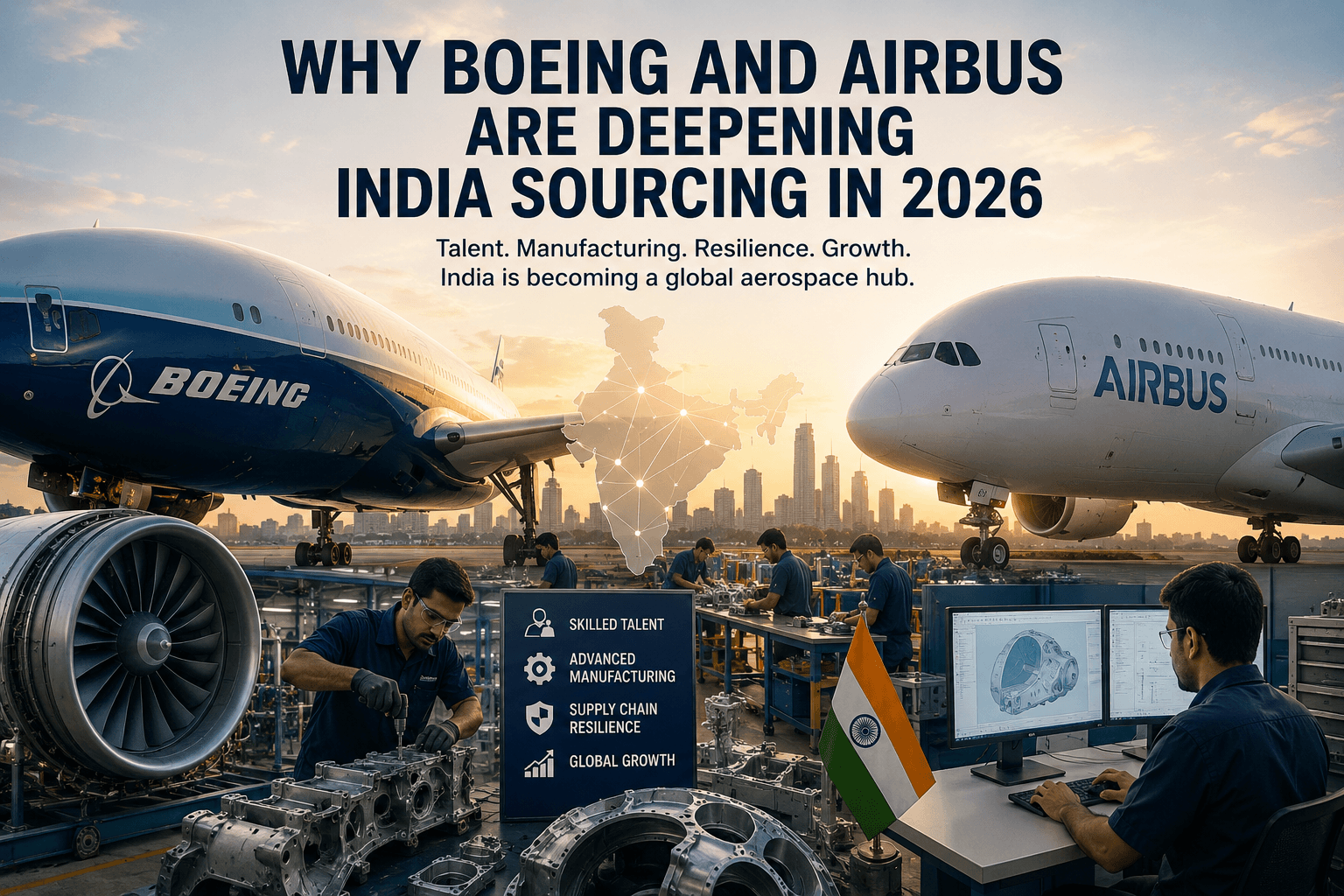
India is becoming more than a major customer for Boeing and Airbus. It is increasingly becoming part of how both companies build, support, and improve aircraft for customers around the world.
That shift is visible in the numbers. Airbus says it now sources more than $1.5 billion a year in components and services from India, up from $500 million in 2019. Boeing says its Indian supplier network has grown to more than 375 suppliers, with annual sourcing from India exceeding $1.4 billion.
The important point is that this is not simply a story about lower manufacturing costs.
Boeing and Airbus are looking at India for a combination of engineering talent, manufacturing capability, supply chain resilience, growing aviation demand, and an increasingly mature aerospace ecosystem.
Here is why India is becoming more important to both manufacturers in 2026.
1. India is developing from an aircraft buyer into a manufacturing partner
India has long been one of the world’s fastest-growing aviation markets. Airlines are ordering hundreds of aircraft, creating an obvious commercial opportunity for Boeing and Airbus.
But aircraft orders alone do not create a deep aerospace industry.
The bigger opportunity is developing a local supplier base that can manufacture components, systems, structures, and services for global aircraft programs.
That transition is already underway.
Airbus says more than 100 Indian companies currently supply critical components for its global programs. These include products such as flap track beams, aircraft doors, and helicopter fuselages.
Boeing similarly says Indian suppliers are manufacturing components and systems for aircraft including the 737, 777, 787, P-8, Apache, Chinook, and other defense platforms.
This changes the relationship.
India is no longer only a market where aircraft are sold. Indian factories and engineering teams are increasingly contributing to aircraft that may ultimately be delivered anywhere in the world.
2. Skilled engineering talent is a major advantage
Cost is part of India’s appeal, but focusing only on cheap labor misses the bigger story.
Aerospace manufacturing requires engineers, machinists, quality specialists, software developers, technicians, designers, and supply chain professionals who can work to extremely demanding standards.
India already has a large engineering and technology workforce, giving aerospace companies a talent pool they can develop for increasingly complex work.
Airbus has expanded this capability through its Bengaluru technology center, which brings together engineering, digital transformation, customer services, and procurement. The company says Indian teams now contribute across the lifecycle of its commercial aircraft and helicopter programs.
Boeing has also built a substantial engineering and technology presence in Bengaluru and Chennai, alongside its supplier-development activities.
The result is important for the supply chain: Indian companies can potentially move beyond basic machining and assembly into engineering-intensive and higher-value aerospace work.
3. Aerospace companies need more resilient supply chains
The global aerospace industry has spent the past few years dealing with production bottlenecks, shortages, delivery delays, and supplier constraints.
That has made supply chain resilience a board-level issue.
For Boeing and Airbus, expanding the supplier base across geographies can reduce dependence on individual manufacturing locations and create additional capacity.
India fits naturally into that strategy.
It already has large manufacturing industries, including automotive, engineering, electronics, and industrial components. Some Indian aerospace suppliers can use capabilities developed in these sectors and adapt them to aerospace’s stricter quality and certification requirements.
Companies such as Aequs illustrate this transition. The aerospace manufacturer supplies companies including Airbus, Boeing, Spirit AeroSystems, and Safran and has been investing in higher-value aircraft component manufacturing.
The goal is not necessarily to replace existing suppliers in the US or Europe.
It is to build a broader, more flexible global production network.
4. Indian suppliers are moving up the value chain
The most significant change may be the type of work Indian companies are winning.
Early aerospace outsourcing often centered on relatively straightforward manufacturing activities.
The opportunity today is much broader.
Indian suppliers are increasingly involved in:
- Aerostructures
- Precision machining
- Composite components
- Aircraft doors and structures
- Systems and subassemblies
- Engineering and design
- Software and digital services
- Maintenance, repair and overhaul
- Defense aerospace components
Boeing describes this progression as a move from simpler assemblies toward more complex manufacturing, including composites and full-size determinant assembly supported by robotics.
That progression matters because higher-value work tends to create deeper relationships between an OEM and its suppliers.
Once a supplier demonstrates the required quality, reliability, certification, and delivery performance, it becomes much harder to replace than a commodity supplier.
5. Airbus is building procurement capability in India
Airbus’ strategy provides a particularly clear example of where India is heading.
In March 2026, Airbus inaugurated a new technology center in Bengaluru with a dedicated procurement function. The company described the site as a hub connecting engineering, digital transformation, customer services, and procurement.
Airbus says its annual sourcing from India has grown from approximately $500 million in 2019 to more than $1.5 billion, and it expects to exceed $2 billion well before the end of the decade.
That is more than a purchasing decision.
A local procurement organization can help Airbus identify suppliers, develop their capabilities, manage supplier relationships, and integrate Indian companies into global programs.
It also signals that India is becoming a strategic sourcing location rather than simply a low-cost outsourcing destination.
6. Boeing is building a deeper supplier ecosystem too
Boeing’s numbers tell a similar story.
The company says it now works with more than 375 Indian suppliers and sources more than $1.4 billion annually from India. Its supply chain partners support more than 33,000 jobs in the country.
Boeing is also investing in supplier capability rather than simply placing purchase orders.
Its Kaushal supply chain initiative focuses on supplier skill development, while partnerships with Indian companies and institutions are designed to strengthen manufacturing and workforce capabilities.
This is important because aerospace supply chains cannot scale simply by adding factories.
They need trained people, repeatable processes, quality systems, certification expertise, and the ability to meet strict delivery requirements.
Supplier development helps create those capabilities.
7. India’s aviation growth creates a useful local ecosystem
There is another advantage that is easy to overlook.
Boeing and Airbus are not building supplier networks in a vacuum. They are operating inside one of the world’s fastest-growing aviation markets.
Air India’s fleet expansion illustrates the scale of demand. In January 2026, Air India ordered another 30 Boeing 737 MAX aircraft, taking its Boeing order book to nearly 200 aircraft across Boeing’s single-aisle and widebody families. Boeing forecasts demand for nearly 3,300 new aircraft in India and South Asia over the next two decades.
That growing fleet creates demand for much more than aircraft.
It supports:
- Component manufacturing
- Aircraft maintenance
- Engineering services
- Training
- Spare parts
- Repair facilities
- Aviation software
- Ground support
- Logistics
- MRO infrastructure
In other words, aircraft demand helps create the industrial ecosystem that makes deeper sourcing possible.
8. Government policy is reinforcing the shift
India’s industrial policy is another piece of the equation.
The government has been pushing for greater domestic manufacturing and a larger role for Indian companies in aerospace and defense supply chains.
In 2026, the Ministry of Defence’s draft Defence Acquisition Procedure proposed stronger indigenous-content requirements and other measures intended to expand India’s domestic defense manufacturing base.
The government has also been emphasizing private-sector participation, MSMEs, advanced manufacturing, and supplier development.
For aerospace companies, this creates an environment in which building local capability is increasingly aligned with government priorities.
It also gives Indian suppliers an incentive to invest in facilities, technology, certifications, and workforce development.
9. Airbus is pairing sourcing with local production
Airbus’ India strategy is becoming increasingly integrated.
In February 2026, Tata Advanced Systems inaugurated India’s first private-sector helicopter final assembly line for the Airbus H125 at Vemagal, Karnataka.
Airbus is also supporting final assembly of the C295 military transport aircraft in Vadodara.
These projects matter because final assembly can act as an anchor for a broader supplier ecosystem.
When an OEM establishes production or assembly operations, suppliers have a stronger reason to locate nearby, invest in capabilities, and develop long-term relationships.
The result can be a reinforcing cycle:
OEM presence → supplier investment → workforce development → more local capability → additional sourcing.
10. Indian aerospace companies are becoming more credible global suppliers
Perhaps the biggest change is happening at the supplier level.
Indian aerospace companies increasingly understand that winning an OEM contract is only the beginning.
They must demonstrate consistent quality, traceability, delivery performance, regulatory compliance, cybersecurity, documentation, and the ability to scale production.
That raises the barrier to entry, but it also creates a competitive advantage for suppliers that succeed.
For Indian companies, an aerospace relationship with Boeing or Airbus can become a gateway to other global customers.
For Boeing and Airbus, a supplier that has already demonstrated aerospace-grade capabilities in India can become a valuable part of the global supply chain.
This creates a long-term incentive on both sides.
What this means for Indian aerospace suppliers
The opportunity is significant, but it is not evenly distributed.
Indian companies that want to benefit from the next phase of aerospace sourcing will need to compete on more than price.
The strongest opportunities are likely to be in areas where India can combine engineering talent with manufacturing depth.
These include:
- Precision manufacturing: Tight-tolerance components and complex machined parts.
- Aerostructures: Larger assemblies, fuselage components, doors, and structural systems.
- Composites: Increasingly important across commercial and defense aircraft.
- Electronics and avionics: Particularly as aircraft become more software- and electronics-intensive.
- Engineering services: Design, simulation, testing, and digital engineering.
- MRO: Maintenance and repair capabilities for India’s rapidly expanding aircraft fleet.
- Advanced manufacturing: Robotics, automation, additive manufacturing, and digitally connected production.
The winners will likely be companies that can combine competitive economics with aerospace-grade reliability.
The challenges India still needs to solve
The growth story should not be mistaken for a finished transformation.
India still faces challenges around certification, infrastructure, logistics, supplier scale, specialized materials, financing, and the ability of smaller companies to make the investments required by aerospace programs.
There is also a difference between having a large number of suppliers and having a truly deep aerospace ecosystem.
The next stage will require more companies capable of producing highly complex systems, not simply more companies producing individual parts.
Workforce development will remain critical too. Boeing’s supplier-skilling programs and Airbus’ training and education initiatives show that both manufacturers recognize this constraint.
What happens next?
The direction is becoming clearer.
Boeing and Airbus are not simply increasing the amount they purchase from India. They are increasingly integrating India into their global industrial strategies.
That distinction matters.
A supplier making one component for an Indian aircraft delivery is participating in the local market.
A supplier whose component is designed, manufactured, certified, and shipped from India for aircraft delivered globally is participating in the global aerospace value chain.
India is moving toward the second model.
Airbus’ plan to take Indian sourcing beyond $2 billion, Boeing’s expanding supplier network, new final assembly operations, growing engineering centers, and continued supplier development all point in the same direction.
The bottom line
Boeing and Airbus are deepening India sourcing in 2026 because India increasingly offers the combination they need: skilled engineering talent, competitive manufacturing, a growing supplier ecosystem, expanding aviation demand, and a strategic location for diversifying global supply chains.
The bigger story is not how much India can save on aircraft components.
It is how much more of the aircraft industry’s value chain India can capture.
If Indian suppliers continue moving from basic manufacturing into complex structures, systems, engineering, and lifecycle services, the country could evolve from an important aerospace outsourcing destination into a genuine global aerospace manufacturing hub.
That would be a much bigger shift than simply winning more supplier contracts.
FAQs
Why are Boeing and Airbus increasing sourcing from India?
The main reasons are India’s engineering talent, competitive manufacturing capabilities, growing supplier base, large aviation market, and the need for more diversified and resilient global supply chains.
How much does Airbus source from India?
Airbus says it currently sources more than $1.5 billion annually in components and services from India and is targeting more than $2 billion before the end of the decade.
How much does Boeing source from India?
Boeing says its annual sourcing from India exceeds $1.4 billion, with more than 375 suppliers currently participating in its Indian supply network.
Is India only attractive because of lower labor costs?
No. Cost is one factor, but aerospace companies also value India’s engineering workforce, manufacturing capabilities, supplier ecosystem, and ability to support increasingly complex work.
What opportunities does this create for Indian companies?
Opportunities extend beyond machining and basic components into aerostructures, composites, precision manufacturing, engineering, avionics, software, MRO, and advanced manufacturing.
Will India become a major global aerospace manufacturing hub?
India is moving in that direction, but reaching that position will depend on continued investment in supplier capabilities, certification, infrastructure, workforce development, technology, and manufacturing scale.