

Appliance Component Manufacturing: Sheet Metal, Plastics, and Electronics Assembly
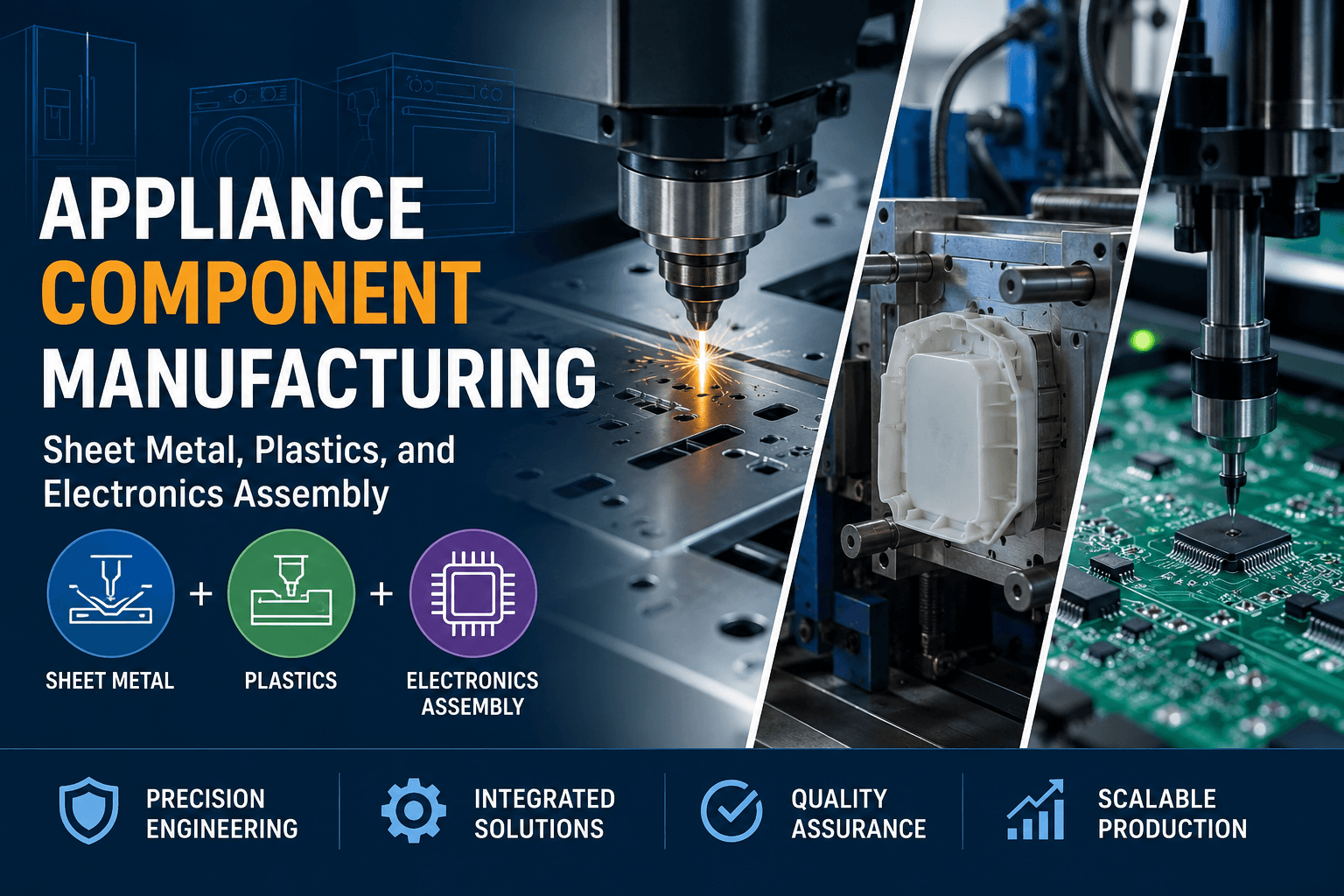
Modern appliances rely on more than innovative designs and smart features. Behind every refrigerator, washing machine, microwave, and air conditioner is a complex manufacturing process that combines precision sheet metal fabrication, high-quality plastic molding, and reliable electronics assembly.
Bringing these capabilities together under one manufacturing partner helps appliance brands reduce production complexity, improve quality, and speed up time to market. This article explains how each manufacturing process contributes to appliance production and why integrated manufacturing has become a competitive advantage.
The Building Blocks of Appliance Manufacturing
Most household appliances consist of three primary component categories:
- Metal structures that provide strength and durability.
- Plastic components that improve functionality, appearance, and weight.
- Electronic assemblies that enable control, automation, and connectivity.
Each category requires specialized manufacturing expertise, but they must also fit together with tight tolerances to ensure consistent product performance.
Sheet Metal Manufacturing for Appliance Components
Sheet metal forms the structural foundation of many appliances. From outer cabinets to internal brackets and mounting frames, these components must meet strict requirements for strength, corrosion resistance, and dimensional accuracy.
Common sheet metal components include:
- Appliance enclosures
- Mounting brackets
- Chassis assemblies
- Control panel housings
- Compressor supports
- Ventilation panels
- Internal structural frames
Manufacturing processes typically include:
- Laser cutting
- CNC punching
- Precision bending
- Deep drawing
- Welding
- Surface finishing
- Powder coating
High-quality sheet metal fabrication ensures components fit together accurately during final assembly while maintaining long-term durability in demanding household environments.
Plastic Components That Improve Functionality
Plastic parts provide flexibility in design while reducing overall product weight and manufacturing costs. They also allow manufacturers to create complex shapes that would be difficult or expensive using metal alone.
Typical plastic appliance components include:
- Control knobs
- Door handles
- Interior trays
- Covers and bezels
- Water reservoirs
- Fan housings
- Electrical insulation components
Injection molding remains the most widely used process because it delivers:
- High production volumes
- Excellent repeatability
- Tight dimensional control
- Smooth surface finishes
- Cost efficiency for large production runs
Material selection depends on the application’s temperature resistance, chemical exposure, impact strength, and appearance requirements.
Electronics Assembly Powers Modern Appliances
Today’s appliances include sophisticated electronic systems that manage everything from energy efficiency to smart home connectivity.
Electronics assembly typically includes:
- Printed circuit board (PCB) assembly
- Surface mount technology (SMT)
- Through-hole assembly
- Cable and wire harness assembly
- Sensor integration
- Display module installation
- Functional testing
As appliances become increasingly connected, electronics manufacturing requires higher quality standards, traceability, and rigorous testing to ensure reliable operation throughout the product lifecycle.
Why Integrated Manufacturing Matters
Managing multiple suppliers for metal fabrication, plastic molding, and electronics assembly can introduce delays, communication challenges, and quality inconsistencies.
An integrated manufacturing approach offers several advantages:
Better Quality Control
When one manufacturer oversees multiple production stages, component compatibility improves and inspection standards remain consistent throughout the manufacturing process.
Faster Production
Integrated production minimizes transportation between suppliers and reduces waiting time between manufacturing stages.
Lower Total Costs
Consolidating suppliers often reduces logistics expenses, inventory management costs, and administrative overhead while improving production efficiency.
Simplified Supply Chain
Working with a single manufacturing partner provides one point of contact for engineering changes, scheduling, quality management, and production planning.
Quality Standards in Appliance Component Manufacturing
Appliance manufacturers expect suppliers to maintain strict quality systems throughout production.
Key quality practices include:
- Incoming material inspection
- In-process dimensional verification
- Automated optical inspection
- Functional electronics testing
- Assembly validation
- Traceability systems
- Final quality inspection
Consistent quality management helps reduce defects, warranty claims, and production disruptions.
Design for Manufacturability
Successful appliance manufacturing begins during product development.
Manufacturers often work closely with design teams to optimize components for efficient production while maintaining performance requirements.
Design for Manufacturability (DFM) focuses on:
- Reducing unnecessary complexity
- Selecting cost-effective materials
- Improving assembly efficiency
- Standardizing components
- Minimizing production waste
Early collaboration helps prevent costly design changes later in production.
Emerging Trends in Appliance Manufacturing
Consumer expectations continue to shape manufacturing priorities across the appliance industry.
Key trends include:
Smart Appliances
Connected appliances require more advanced electronics, sensors, wireless communication modules, and embedded software integration.
Sustainable Manufacturing
Manufacturers are increasingly using recycled materials, energy-efficient production methods, and environmentally responsible finishing processes.
Lightweight Design
Combining engineered plastics with optimized metal structures helps reduce product weight without compromising strength.
Increased Automation
Robotic welding, automated inspection, and smart production systems improve consistency while increasing manufacturing efficiency.
Choosing the Right Manufacturing Partner
Selecting a manufacturing partner involves more than comparing production costs.
Consider suppliers that offer:
- Expertise in sheet metal fabrication
- Advanced plastic injection molding capabilities
- Electronics assembly services
- Engineering and DFM support
- Quality certifications
- Scalable production capacity
- Strong supply chain management
- Comprehensive testing capabilities
An experienced partner can help streamline production while supporting future product innovation.
Conclusion
Appliance component manufacturing depends on the seamless integration of sheet metal fabrication, plastic molding, and electronics assembly. Each process plays a critical role in delivering products that meet today’s expectations for durability, efficiency, and performance.
Manufacturers that combine these capabilities under one roof can improve quality, simplify supply chains, reduce production costs, and accelerate product development. As appliances continue to evolve with smarter technologies and higher efficiency standards, integrated manufacturing will remain essential for delivering reliable products at scale.
Frequently Asked Questions
Q. What materials are commonly used for appliance sheet metal components?
Manufacturers typically use stainless steel, galvanized steel, cold rolled steel, and aluminum depending on the application’s strength, corrosion resistance, and cost requirements.
Q. Why is plastic injection molding important in appliance manufacturing?
Injection molding enables high-volume production of lightweight, durable, and precisely shaped components with consistent quality and lower manufacturing costs.
Q. What does electronics assembly include for appliances?
Electronics assembly includes PCB assembly, cable harnesses, sensors, displays, connectors, testing, and integration with the appliance’s control systems.
Q. What are the benefits of integrated appliance component manufacturing?
Integrated manufacturing improves quality control, shortens production timelines, simplifies supply chain management, reduces costs, and enhances collaboration during product development.