

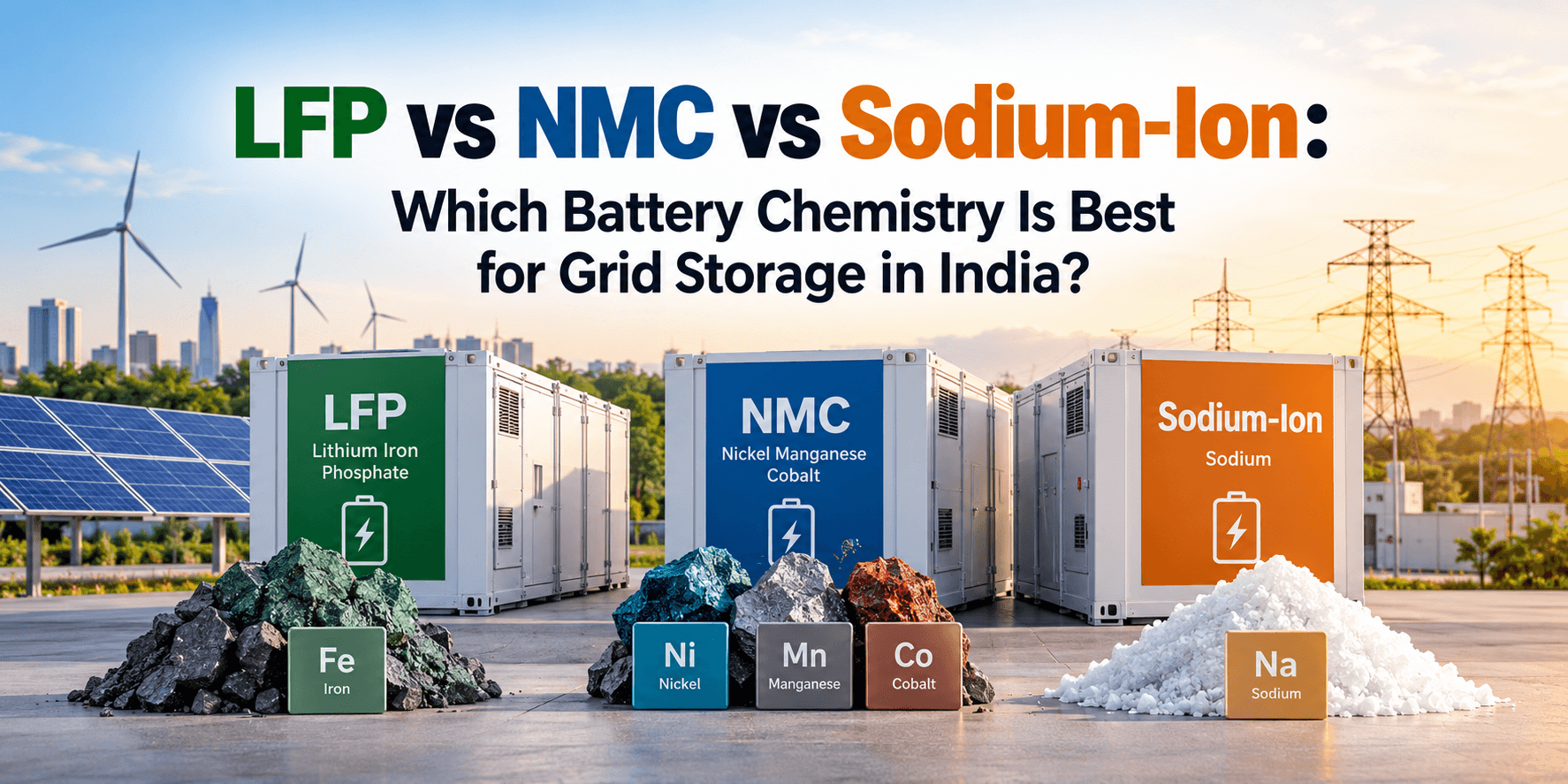
LFP vs NMC vs Sodium-Ion: Which Battery Chemistry Is Best for Grid Storage in India?
India’s battery storage market is moving from pilot projects toward large-scale deployment. The Central Electricity Authority projects 236.22 GWh of battery energy storage capacity by 2031-32, while the broader storage requirement is expected to keep rising as renewable generation expands.
That makes battery chemistry a strategic decision, not simply a technical one.
For most grid-scale projects in India today, LFP is the strongest all-around choice. NMC remains useful where energy density and compact system design matter more than cost and long-term cycling economics. Sodium-ion is the most interesting emerging alternative, particularly for applications where supply-chain diversification, temperature performance, and reduced dependence on lithium are important.
But the “best” chemistry ultimately depends on how the battery will be used.
LFP vs NMC vs Sodium-Ion at a Glance
| Factor | LFP | NMC | Sodium-Ion |
|---|---|---|---|
| Energy density | Medium | High | Lower |
| Cycle life | High | High | Promising, varies by design |
| Safety | Strong | Good, requires careful thermal management | Strong potential |
| Cost potential | Very good | Higher | Strong long-term potential |
| Thermal performance | Good | Good, but more demanding | Excellent potential in cold conditions |
| Material availability | Relatively favorable | More dependent on nickel/cobalt supply chains | Strong advantage from abundant sodium |
| Technology maturity | High | High | Emerging |
| Grid-scale suitability | Excellent | Good | Promising |
| Best fit in India | Utility BESS, solar shifting, peak management | Space-constrained or high-energy-density applications | Emerging utility storage and diversified supply chains |
The important point is that these technologies should not be compared using energy density alone. Grid storage is fundamentally different from an electric vehicle. A utility battery sits on a site where land, cooling, fire protection, augmentation, degradation and lifetime cost all matter.
Why Grid Storage Has Different Battery Requirements
An EV needs to carry as much energy as possible in a limited amount of space and weight.
A grid battery has a different job. It may charge during periods of low electricity prices or excess solar generation and discharge during peak demand. It can also provide services such as frequency regulation, renewable-energy shifting and grid balancing.
CEA describes BESS as a system that can store electricity and later provide it to the grid, helping manage load fluctuations and renewable intermittency.
That changes the priorities.
For an Indian grid-scale project, developers should pay close attention to:
- Levelized cost of storage
- Round-trip efficiency
- Cycle life
- Calendar life
- Degradation
- Safety and thermal management
- Availability of replacement cells
- Operating temperature
- Land requirements
- Warranty terms
- Recycling and end-of-life management
- Local service and spare-parts availability
The cheapest battery at the cell level is not necessarily the cheapest storage system over 15 or 20 years.
LFP: The Strongest All-Round Choice for Grid Storage
Lithium iron phosphate, or LFP, has become one of the leading choices for stationary energy storage.
Its biggest advantage is that it offers a practical balance between cost, safety, cycle life and performance.
CEA’s technology catalogue previously reported LFP cycle-life figures in the range of 6,000 to 8,000 cycles and calendar life of roughly 10 to 20 years, although actual performance depends heavily on cell design, operating conditions and depth of discharge.
LFP also avoids cobalt in the cathode. That can reduce exposure to some of the supply-chain and cost issues associated with NMC.
Why LFP works well in India
India’s grid storage requirements are increasingly connected to solar and renewable-energy integration. A typical project might charge during the daytime and discharge during evening demand peaks.
That can mean frequent cycling.
LFP is well suited to this operating profile because its relatively high cycle durability allows developers to extract more useful energy over the system’s lifetime.
It is also less dependent on maximizing energy density. A utility-scale BESS can occupy a larger physical footprint if doing so produces better economics.
Where LFP has an advantage
LFP is particularly attractive for:
- Solar-plus-storage projects
- Peak shaving
- Energy arbitrage
- Renewable-energy time shifting
- Distribution-level storage
- Utility-scale BESS
- Projects requiring frequent cycling
Its main weakness is lower energy density than NMC. IEA data shows that current LFP cells have lower gravimetric energy density than the latest NMC cells.
For most stationary projects, however, that trade-off is manageable.
NMC: Higher Energy Density, But Does the Grid Need It?
NMC, or nickel manganese cobalt oxide, has been widely deployed in electric vehicles and has also been used in grid-connected lithium-ion systems.
Its major advantage is energy density.
IEA reports that current-generation NMC cells can reach substantially higher energy density than LFP, while LFP offers a cost advantage.
That sounds like a major advantage until you consider where the battery is installed.
A utility BESS does not have to fit inside a vehicle.
If a project has plenty of land, paying more for higher energy density may not create enough value to justify the additional cost and material complexity.
Where NMC can make sense
NMC can still be attractive when:
- Land is expensive or severely constrained
- High energy density is a major requirement
- The project needs a compact battery footprint
- Existing supply chains favor NMC
- The application has specific power and energy requirements that benefit from the chemistry
NMC is also a mature technology with extensive manufacturing experience.
However, for many new grid-scale projects, the question is no longer whether NMC works. It clearly does.
The question is whether its additional energy density creates enough economic value to offset LFP’s advantages.
For many stationary applications, the answer is increasingly no.
Sodium-Ion: The Chemistry to Watch
Sodium-ion batteries are attracting significant attention because they replace lithium with sodium as the primary charge carrier.
That matters for India because battery storage is becoming strategically important, and reducing dependence on a narrow set of global mineral and manufacturing supply chains has value.
India’s Ministry of New and Renewable Energy has already published a dedicated assessment of the global sodium-ion landscape and its potential in India under the India-UK ASPIRE programme.
The technology is also moving beyond laboratory research. IEA describes sodium-ion as entering the scale-up phase, while noting that its lower energy density remains a disadvantage compared with LFP and NMC.
Sodium-ion’s biggest advantages
Sodium-ion has several characteristics that are potentially valuable for stationary storage:
Reduced lithium dependence: Sodium is abundant, which could help diversify battery supply chains.
Good low-temperature performance: IEA notes that newer sodium-ion batteries can perform particularly well at low temperatures compared with lithium-ion chemistries.
Potential cost advantages: As manufacturing scales, sodium-ion could become increasingly competitive, particularly if lithium prices rise or sodium-ion manufacturing achieves sufficient scale.
Stationary-storage suitability: Lower energy density matters less when the battery is sitting on land rather than moving a vehicle.
The biggest sodium-ion limitation
The technology is not yet as mature as LFP for large-scale commercial deployment.
IEA reports that the latest sodium-ion cells can reach around 175 Wh/kg, compared with up to around 205 Wh/kg for LFP and 265 Wh/kg for NMC.
Those numbers will continue to change as manufacturers improve cell designs, but the basic trade-off remains:
Sodium-ion gives up some energy density in exchange for potential advantages in materials, temperature performance and supply-chain diversification.
For a utility BESS, that trade-off could make sense.
Which Chemistry Is Cheapest?
It is tempting to rank the three purely by battery pack price.
That can be misleading.
The relevant metric for a grid developer is closer to cost per useful MWh delivered over the project’s lifetime.
For example, suppose Battery A is cheaper per kWh but degrades faster. Battery B costs more initially but delivers more usable cycles with less degradation.
Battery B could have the lower lifetime storage cost.
This is why project developers should evaluate:
LCOS = Total lifetime storage cost ÷ Total useful energy delivered
The calculation should include:
- Battery CAPEX
- PCS and inverter costs
- BMS and thermal management
- EPC costs
- Land and civil works
- O&M
- Auxiliary electricity consumption
- Battery degradation
- Augmentation
- Financing
- Insurance
- Replacement costs
- End-of-life costs
This is also why a simple “₹/kWh” comparison between chemistries can produce the wrong conclusion.
Safety Matters More at Grid Scale
Safety is another area where chemistry selection cannot be separated from system design.
A BESS is not simply a collection of cells. It includes battery modules, BMS, thermal management, power-conversion equipment, controls and fire-safety systems.
The CEA has also proposed additional safety requirements for BESS, including two-fault tolerance and fire and explosion protection at cell, module, container and site levels.
That means developers should evaluate the entire system rather than assume that one chemistry is automatically “safe.”
For Indian projects, high ambient temperatures make thermal management particularly important.
A strong procurement specification should therefore address:
- Cell-level monitoring
- Thermal runaway detection
- Fire detection and suppression
- Container ventilation
- HVAC performance
- Emergency shutdown
- Fault isolation
- Site separation
- BMS functionality
- Safety testing and certification
Chemistry matters, but engineering matters too.
LFP vs NMC vs Sodium-Ion for Indian Conditions
India presents a particularly interesting operating environment for batteries.
High temperatures can increase cooling requirements and accelerate degradation if systems are poorly designed.
At the same time, many storage projects will be paired with solar generation and will therefore experience predictable daily cycling.
That favors technologies that can tolerate frequent cycling while maintaining acceptable lifetime economics.
LFP in India
Best for: Most utility-scale BESS projects.
LFP offers a mature combination of cycle life, safety characteristics, cost competitiveness and established supply chains.
NMC in India
Best for: Projects where footprint and energy density justify the premium.
NMC can make sense when land constraints are significant or when a specific application benefits from higher energy density.
Sodium-ion in India
Best for: Emerging projects willing to adopt a newer technology in exchange for potential supply-chain and cost advantages.
India has already begun evaluating the technology’s domestic potential, so sodium-ion deserves serious consideration in long-term procurement strategies.
What About India’s Growing Storage Requirement?
The scale of India’s future storage requirement makes this chemistry question increasingly important.
According to MNRE’s summary of the National Electricity Plan, India’s total energy-storage requirement is projected to reach 411.4 GWh by 2031-32, including 236.22 GWh from BESS. By 2047, the BESS requirement is projected at 1,840 GWh.
The government is also supporting BESS deployment through measures including viability-gap funding and other policy initiatives. MNRE’s current ESS policy listings include VGF support and transmission-charge measures for energy storage.
At that scale, India is unlikely to rely on one battery chemistry forever.
Instead, the market will probably develop around several technologies optimized for different use cases.
The Verdict: LFP Wins Today, Sodium-Ion Could Win More Tomorrow
If you are selecting a battery chemistry for a new grid-scale storage project in India today, LFP is generally the safest starting point.
It offers the best overall balance of:
- Cost
- Cycle life
- Safety
- Commercial maturity
- Availability
- Suitability for frequent cycling
NMC is a specialized choice rather than the default choice. Its high energy density is valuable, but stationary storage does not face the same weight and volume constraints as electric vehicles.
Sodium-ion is the most important emerging challenger. It may become increasingly attractive as manufacturing scales and project developers place greater value on supply-chain diversification, abundant raw materials and temperature performance. But developers should evaluate bankability, warranties, degradation data and long-term service support carefully before treating it as a direct replacement for LFP.
For most Indian grid-storage applications, the practical ranking today is:
1. LFP: Best overall choice
2. Sodium-ion: Best emerging alternative
3. NMC: Best when energy density or footprint is critical
The bigger lesson is that battery chemistry should be selected around the project’s operating profile and lifetime economics, not simply the cheapest cell price or highest energy density.
As India’s storage market scales toward hundreds of GWh, the winners will be the technologies that deliver reliable energy at the lowest lifetime cost while meeting increasingly demanding safety, performance and supply-chain requirements.