

API-First Manufacturing: Integrating ERP, Supplier & Logistics Systems
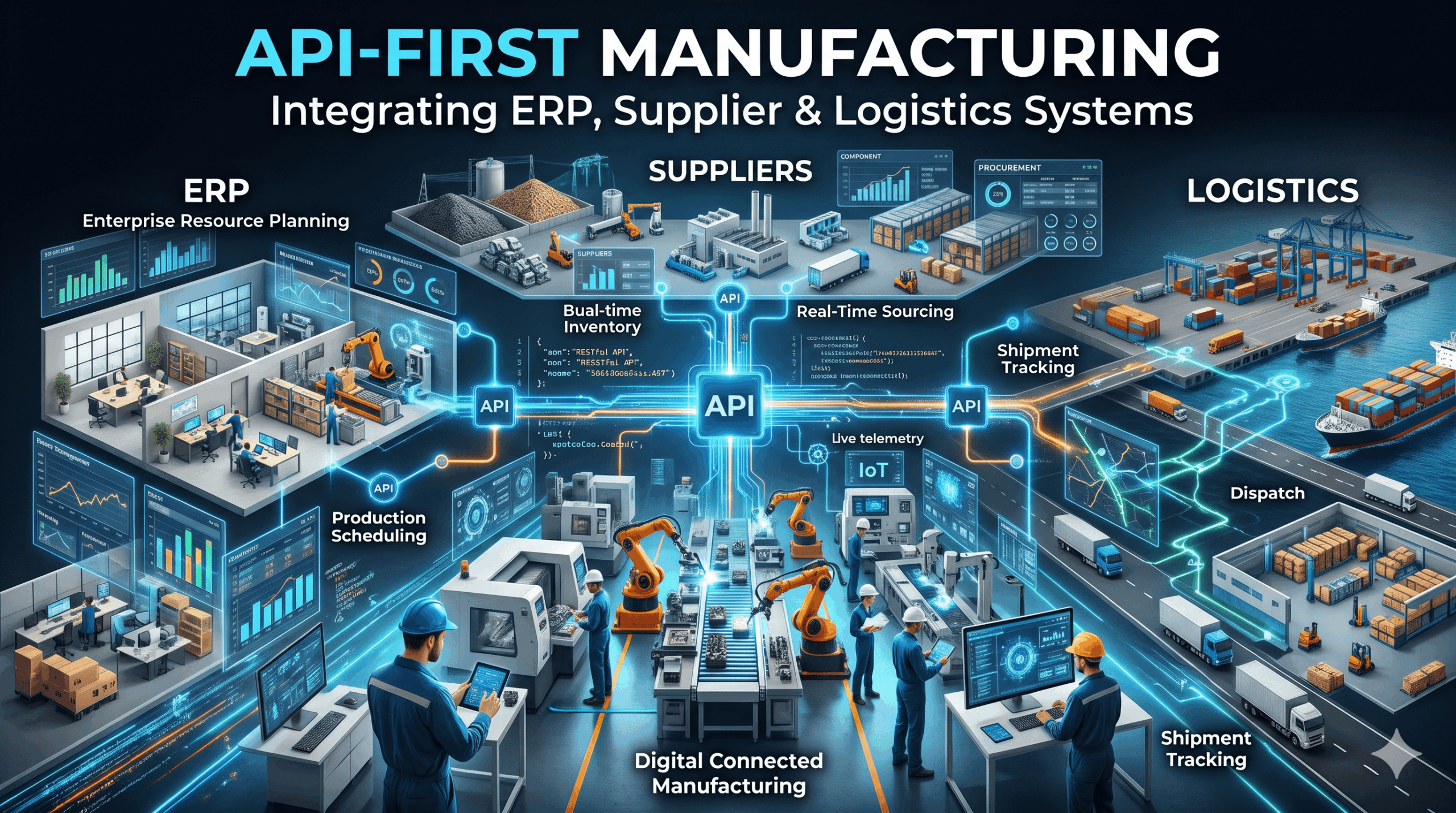
Modern manufacturing depends on how well systems communicate with one another. An ERP platform may manage production schedules and inventory, supplier systems may track raw material availability, and logistics platforms may handle shipments and delivery updates. When these systems operate in silos, manufacturers face delays, inconsistent data, and limited visibility across the supply chain.
An API-first manufacturing strategy helps solve this problem by connecting ERP, supplier, and logistics systems through standardized, reliable interfaces. Instead of relying on manual data entry, disconnected spreadsheets, or fragile point-to-point integrations, manufacturers can build a connected digital ecosystem that supports faster decisions and more efficient operations.
This approach is becoming increasingly important for manufacturers managing complex supplier networks, multiple production facilities, and changing customer demands. The goal is not simply to connect software. It is to create a reliable flow of information from procurement and production to shipping and delivery.
What Is API-First Manufacturing?
API-first manufacturing is an approach to digital operations in which application programming interfaces (APIs) are designed as a core part of the technology architecture. These APIs allow manufacturing systems to exchange data and trigger actions without requiring users to move information manually between platforms.
An API acts as a defined communication layer between applications. For example, when a supplier confirms a purchase order, an API can transmit the updated delivery date to the manufacturer’s ERP system. That update can then inform production planning, inventory management, and logistics coordination.
In a traditional manufacturing environment, these steps may depend on emails, spreadsheets, or manual updates. An API-first approach makes the exchange more consistent and easier to automate.
Common systems connected through this architecture include:
- ERP systems: Manage purchasing, inventory, production planning, finance, and order processing.
- Supplier platforms: Share purchase order confirmations, material availability, pricing, and shipment readiness.
- Warehouse management systems (WMS): Track inventory movements, picking, packing, and warehouse operations.
- Transportation management systems (TMS): Coordinate carriers, freight bookings, shipment tracking, and delivery status.
- Manufacturing execution systems (MES): Monitor shop-floor activities, production progress, and quality operations.
- Customer and order management systems: Provide order details, demand forecasts, and delivery requirements.
The result is a connected environment where operational data can move between systems with less manual intervention.
Why Manufacturers Need Better System Integration
Many manufacturers have invested in modern software without achieving end-to-end visibility. The issue is often not a lack of technology, but the difficulty of getting existing platforms to work together.
A purchasing team might know that a supplier has confirmed a shipment, while production planners still see the original delivery date in the ERP. Logistics teams may receive tracking information separately, leaving customer service without an accurate delivery estimate.
These information gaps create operational problems.
Disconnected data slows down decisions
When systems maintain separate records, employees must verify information before acting. Teams may spend hours reconciling inventory figures, checking purchase order statuses, or confirming delivery schedules.
API integrations help synchronize key data between systems, reducing repetitive work and making current information more accessible.
Supplier delays disrupt production planning
Manufacturing schedules depend on the availability of components and raw materials. If supplier updates arrive late, production teams may continue working with outdated assumptions.
An integration between supplier systems and the ERP can communicate revised delivery dates as soon as they become available. Planning teams can then evaluate the impact on production schedules and identify alternatives earlier.
Limited shipment visibility increases uncertainty
Without logistics integration, manufacturers may rely on carrier portals or manual status updates to understand where shipments are.
Connecting transportation systems with ERP and warehouse platforms gives teams a clearer view of shipment progress, expected arrivals, and potential delivery exceptions.
Manual integration becomes harder to maintain
Traditional integrations often rely on custom scripts, scheduled file transfers, or direct connections between individual applications. As the number of systems grows, maintaining these connections can become expensive and risky.
An API-first architecture encourages reusable interfaces and consistent integration patterns, making it easier to add suppliers, facilities, and logistics partners over time.
How API-First Integration Connects ERP, Supplier, and Logistics Systems
A successful integration strategy connects business processes, not just individual applications. The most useful starting point is to identify where information needs to move and which operational decisions depend on it.
ERP and Manufacturing Systems
Orders, inventory, production plans, and material requirements
Standardized APIs
Integration and API Layer
Data mapping, authentication, validation, routing, and monitoring
Events and data exchange
Supplier Systems
Orders and confirmations
Warehouse Systems
Stock and fulfillment
Logistics Systems
Freight and tracking
1. Integrating ERP systems with supplier platforms
ERP integration with supplier systems creates a shared view of purchasing activity and material availability.
Typical workflows include:
- Sending purchase orders to supplier portals.
- Receiving order acknowledgments and confirmed delivery dates.
- Synchronizing product specifications, pricing, and supplier records.
- Tracking supplier performance and order fulfillment.
- Updating expected material availability for production planning.
Consider a manufacturer that orders specialized components from several suppliers. One supplier reports a two-day delay through its portal. An API can pass that update to the ERP, where the revised date becomes available to procurement and production planning teams.
If the delay threatens a production deadline, the manufacturer can investigate alternative inventory, adjust the production sequence, or contact another supplier.
The value comes from giving teams enough time to respond, rather than discovering the problem when production is already affected.
2. Connecting ERP and logistics platforms
Logistics integration connects order management, warehouse operations, freight planning, and delivery tracking.
Relevant data exchanges include:
- Shipment creation and freight booking requests.
- Carrier assignments and tracking numbers.
- Dispatch confirmations and estimated arrival times.
- Delivery exceptions and proof of delivery.
- Freight costs and shipment reconciliation.
For example, once a warehouse marks an order as ready for dispatch, an API can send the shipment details to a transportation management system. The TMS can coordinate the carrier booking and return tracking information.
As the carrier reports progress, the integration can update shipment status in the ERP or customer-facing order platform.
This reduces the need for employees to copy tracking numbers between systems and gives customer service teams better information when responding to delivery questions.
3. Connecting suppliers, production, and warehouse operations
The benefits of API-first manufacturing extend beyond procurement and transportation.
Integrating supplier data with warehouse management and manufacturing execution systems helps align incoming materials with production requirements.
For example, a warehouse system can report that a critical component has been received and passed inspection. That event can update available inventory in the ERP and support the release of a production order.
The integration must account for quality checks, inventory status, and any required approvals. Receiving a shipment does not necessarily mean the material is ready for production.
When these business rules are built into the workflow, teams can coordinate material availability more accurately.
API Integration Patterns for Manufacturing
Not every manufacturing workflow needs the same integration method. The right pattern depends on how quickly information must move, how systems expose data, and what happens when a connection fails.
| Integration pattern | How it works | Best suited for |
|---|---|---|
| REST APIs | Applications request or update data through defined endpoints | Purchase orders, inventory queries, shipment details |
| Webhooks | A system sends a notification when a specified event occurs | Order confirmations, shipment status changes, delivery updates |
| Event-driven messaging | Systems publish events that other applications consume asynchronously | Production events, inventory changes, supplier delays |
| Batch integration | Data moves in scheduled groups | Historical records, financial reconciliation, non-urgent updates |
| EDI with API integration | Existing electronic data interchange workflows connect to modern applications | Supplier networks, purchase orders, invoices, shipping notices |
REST APIs for transactional workflows
REST APIs are useful when one application needs to retrieve or update a specific record in another system.
A procurement application might request the current status of a purchase order or submit a revised delivery date. The receiving system validates the request and returns a response.
These interactions work well for transactional operations, provided the APIs support the required business actions and access controls.
Webhooks for event notifications
Webhooks allow an application to notify another system when an event occurs, rather than requiring the receiving system to check repeatedly.
A supplier platform might send a notification when an order is confirmed or a shipment is ready. The integration layer receives the event, validates it, and routes the update to the appropriate application.
Webhook delivery should be designed for retries, duplicate events, and authentication failures.
Event-driven messaging for complex operations
Manufacturing environments often involve several systems responding to the same operational change.
When inventory falls below a defined threshold, for example, procurement may need to review replenishment, planning may need to reassess production capacity, and warehouse teams may need to investigate stock discrepancies.
An event-driven architecture allows multiple services to respond to a relevant event without requiring the originating application to coordinate every downstream action.
Messaging platforms can also buffer traffic during temporary outages. However, consumers must handle delayed or repeated messages and should not assume that events always arrive in the original order.
EDI and APIs can work together
Many established manufacturers and suppliers already use electronic data interchange (EDI) for structured business documents.
Replacing every EDI connection may be unnecessary or impractical. Instead, an integration layer can translate EDI messages into internal data structures and expose the resulting information through APIs.
This hybrid model lets manufacturers modernize internal workflows while preserving existing partner connections.
Key Benefits of API-First Manufacturing Integration
API integration creates value when it improves a measurable business process. The strongest benefits usually involve data accuracy, operational visibility, and the time required to respond to changes.
Better inventory visibility
Connecting ERP, warehouse, and supplier systems provides a more complete view of inventory across locations and supply chain stages.
Teams can distinguish between stock on hand, material in transit, reserved inventory, and items awaiting inspection. This distinction matters because not every recorded unit is immediately available for production or fulfillment.
More accurate information supports replenishment decisions and reduces unnecessary manual reconciliation.
Faster response to supply chain disruptions
Supplier delays, carrier issues, and unexpected demand changes can affect production schedules quickly.
When operational events move between systems automatically, teams can identify disruptions sooner and assess their impact before they become larger problems.
Integration does not eliminate supply chain risk, but it can reduce the time between detecting a problem and deciding what to do about it.
Less manual data entry
Employees often spend time updating the same order or shipment details in multiple applications. This work increases the risk of inconsistent records and takes attention away from higher-value tasks.
Automated data exchange reduces repetitive updates and gives employees more time to investigate exceptions, coordinate with suppliers, and improve operational processes.
Improved coordination across departments
Procurement, production, warehousing, finance, and logistics depend on overlapping information.
When each department works from different records, disagreements about delivery dates, inventory balances, or order status can slow decisions.
API integrations help synchronize important data and establish a clearer operational picture across teams.
Greater flexibility as operations expand
Manufacturers may add new facilities, acquire businesses, introduce supplier portals, or adopt different logistics providers.
A reusable API layer can reduce the need to redesign every existing integration whenever the technology environment changes. The degree of reuse depends on consistent data models, interface standards, and the capabilities of connected systems.
Challenges to Address Before Implementing API Integrations
API-first manufacturing requires more than connecting endpoints. Existing systems, inconsistent data, and operational constraints can all affect the outcome.
Legacy ERP and supplier systems
Older applications may have limited API support or depend on proprietary interfaces.
Possible approaches include using supported integration adapters, middleware, vendor connectors, or EDI gateways. Where custom development is required, manufacturers should avoid building undocumented dependencies that only one person understands.
A practical assessment should identify which systems can support modern APIs directly and which need an intermediary.
Inconsistent data formats
Two systems may describe the same product, supplier, or shipment differently. They may also use different units of measurement, identifiers, status codes, or time zones.
Without data mapping and validation, an integration can transfer information successfully while still creating incorrect business records.
Manufacturers should define common data models for important entities such as products, suppliers, purchase orders, inventory, and shipments. They should also establish rules for master data ownership and conflict resolution.
API security and access control
Manufacturing integrations can expose sensitive information, including supplier pricing, product specifications, production schedules, and shipment details.
Security should be built into the integration architecture from the start. Important controls include:
- Strong authentication and authorization.
- Role-based or scope-based access to API resources.
- Encryption in transit and appropriate protection for stored data.
- Secret rotation and secure credential management.
- Rate limiting and abuse protection.
- Audit logs and monitoring for unusual access patterns.
- Network segmentation and appropriate isolation of operational technology systems.
Where APIs interact with production or industrial control environments, manufacturers should apply additional safeguards to prevent unauthorized access from affecting physical operations.
Reliability during outages
Supplier portals, ERP systems, and carrier APIs can become unavailable. A temporary outage should not result in lost purchase orders or inconsistent inventory records.
Reliable integrations need bounded retries, timeouts, idempotent operations where appropriate, durable message queues when needed, and a clear process for handling failed transactions.
Teams should also define how to reconcile records after an outage and how to identify updates that were delayed or rejected.
Version management and ongoing maintenance
API providers may introduce new fields, change authentication requirements, or retire older endpoints.
Manufacturers should establish versioning policies, document dependencies, test integrations before production releases, and monitor provider announcements. Contract and supplier management processes may also need to account for changes in external API availability.
An integration is not complete when it first works. It must remain dependable as business requirements and connected systems evolve.
How to Build an API-First Manufacturing Integration Strategy
A phased approach helps manufacturers manage risk, demonstrate value early, and avoid attempting to modernize the entire technology environment at once.
Step 1: Map critical business workflows
Start with the processes that cause the most operational friction.
Examples include purchase order confirmation, raw material replenishment, inbound shipment tracking, production material release, and outbound delivery updates.
For each workflow, document the systems involved, the data being exchanged, the people responsible, and the decisions that depend on the information.
This exercise helps identify where integration can make a meaningful difference.
Step 2: Audit existing systems and interfaces
Review the capabilities of the ERP, supplier platforms, warehouse systems, logistics applications, and manufacturing execution systems.
Determine whether each application supports REST APIs, webhooks, event messaging, EDI, file transfers, or proprietary connectors.
The assessment should also cover authentication methods, rate limits, data quality, vendor support, and any restrictions on accessing production data.
Step 3: Prioritize use cases by business value
Avoid starting with the largest or most technically complex integration simply because it involves the most systems.
Choose a use case with a clear business outcome, manageable dependencies, and a way to measure improvement.
For example, automating supplier order acknowledgments may be a better starting point than building a real-time integration across every production facility and logistics provider.
Useful prioritization criteria include:
- Time currently spent on manual processing.
- Frequency and impact of data errors.
- Cost of delayed or missing information.
- Implementation effort and integration complexity.
- Availability of reliable source data.
- Business risk if the integration fails.
Step 4: Design a reusable API architecture
Define how applications will communicate, how data will be validated, and how failures will be handled.
Depending on the environment, the architecture may include an API gateway, integration platform, message broker, event-processing services, and centralized monitoring.
Establish conventions for authentication, naming, versioning, error responses, logging, and data ownership.
Avoid unnecessary complexity. A small number of well-designed integrations may be sufficient for an initial rollout, while a large supplier ecosystem may require more advanced routing and event management.
Step 5: Build and test a focused pilot
Implement one high-value workflow and test it with realistic data.
For example, connect a supplier platform to the ERP so that purchase order acknowledgments and confirmed delivery dates update the appropriate records.
Testing should cover normal transactions, invalid data, duplicate messages, timeouts, authentication failures, and recovery after an outage.
Include business users in acceptance testing. A technically successful API call is not enough if the resulting information does not support the actual procurement or planning workflow.
Step 6: Monitor performance and operational impact
Track both technical reliability and business results.
Technical metrics might include API latency, error rates, message backlog, retry frequency, and integration availability.
Business metrics might include purchase order processing time, the rate of manual corrections, inventory record accuracy, supplier confirmation delays, and shipment visibility.
Set baseline values before launch and define realistic targets for the pilot. Do not assume that an integration automatically improves every metric.
Step 7: Expand using proven patterns
Once the pilot demonstrates value, reuse its data models, security controls, monitoring standards, and integration practices for additional workflows.
Expand gradually to more suppliers, warehouses, carriers, or facilities. Review the architecture as complexity increases, especially when new integrations introduce different data standards or reliability requirements.
This approach creates a foundation for long-term modernization without requiring a complete replacement of existing manufacturing systems.
Measuring the ROI of API Integration in Manufacturing
The return on investment depends on the processes being improved, the cost of implementation, and the reliability of the resulting workflows.
A useful business case considers both direct savings and operational improvements.
| KPI | What it measures | How to evaluate improvement |
|---|---|---|
| Order processing time | Time required to exchange and confirm purchase orders | Compare average processing time before and after automation |
| Manual data entry | Human effort spent transferring information between systems | Measure hours saved and the number of manual updates eliminated |
| Inventory accuracy | Agreement between system records and verified inventory | Compare inventory discrepancies and adjustment rates |
| Supplier on-time delivery | Supplier performance against agreed delivery dates | Track performance using consistent definitions and time periods |
| Shipment visibility | Ability to access current shipment status | Measure the proportion of shipments with timely, usable status updates |
| Integration reliability | Consistency of successful data exchange | Monitor failures, recovery time, duplicates, and delayed messages |
A simple ROI model can help estimate the financial impact:
\[ \text{ROI}=\frac{\text{Annual Benefits}-\text{Annual Costs}}{\text{Annual Costs}}\times100 \]
Annual benefits may include reduced manual processing, fewer data correction costs, lower avoidable freight expenses, and less production disruption where those savings can be demonstrated.
Annual costs should include software licenses, implementation, infrastructure, monitoring, maintenance, and ongoing support.
For example, if a manufacturer spends less time reconciling purchase orders after integration, the financial benefit should be calculated using the actual hours saved and an appropriate labor cost. If a project also reduces delays, estimate that benefit separately and avoid counting the same improvement twice.
A clear measurement plan makes it easier to determine whether to expand the integration or revisit the design.
Best Practices for Secure and Scalable Manufacturing APIs
Long-term success depends on treating integration as an operational capability rather than a one-time development project.
Establish clear data ownership
Define which application is authoritative for each type of information. The ERP might own purchase order records, while a carrier platform owns shipment tracking events.
When multiple systems can update the same field, specify how conflicts are resolved. This prevents integrations from repeatedly overwriting valid information.
Design for asynchronous operations
Not every manufacturing workflow needs an immediate response. Shipment tracking, supplier acknowledgments, and inventory notifications can often be handled asynchronously.
Use messaging or event-driven patterns where appropriate, and define how downstream systems recover from delays and process events safely.
Make integrations observable
Centralized logs, metrics, alerts, and trace identifiers help teams follow a transaction across multiple systems.
Monitoring should identify failed updates, unusual delays, repeated retries, and growing message backlogs. Teams also need clear ownership for investigating and resolving integration incidents.
Use consistent security standards
Apply common authentication, authorization, encryption, and credential-management practices across integrations. Review third-party access regularly and limit permissions to the resources each partner or application actually needs.
Security reviews should include supplier and logistics connections, not only internally developed APIs.
Document operational procedures
Document data mappings, dependencies, API versions, retry policies, escalation paths, and recovery procedures.
When integration knowledge is recorded and maintained, support teams can diagnose problems more quickly and avoid relying on individual developers to resolve routine issues.
The Future of API-First Manufacturing
API-first manufacturing provides a foundation for more connected and responsive operations. As manufacturers modernize their systems, reliable data exchange becomes increasingly important for automation, analytics, and coordinated decision-making.
Several developments are likely to shape this work.
Real-time supply chain visibility
Manufacturers can combine supplier confirmations, warehouse events, production updates, and carrier tracking to build a more current view of material and order status.
The value depends on the quality and timeliness of the underlying data. Integrating inaccurate or delayed information will not produce reliable visibility on its own.
AI-assisted planning and exception management
AI tools can use integrated operational data to identify unusual patterns, summarize supplier delays, or help planners compare potential responses to a disruption.
These applications depend on consistent data, appropriate access controls, and clear human oversight. Critical production and procurement decisions should retain suitable validation and approval mechanisms.
Digital twins and connected production environments
A digital twin uses digital representations of physical assets, processes, or systems to support analysis and simulation.
API and event integrations can supply a digital twin with updates from production, inventory, equipment, and logistics systems. This can help manufacturers examine the potential impact of changes before adjusting real-world operations.
More standardized partner connectivity
As supplier ecosystems grow, manufacturers benefit from reusable interface contracts, shared data definitions, and consistent security requirements.
Standards-based integration can reduce custom work for each new partner, although differences in system capabilities and business processes will still require careful mapping.
The broader opportunity is to make connected operations easier to extend and maintain as manufacturing requirements change.
Conclusion
API-first manufacturing is a practical way to connect ERP, supplier, warehouse, and logistics systems without requiring every application to be replaced.
By standardizing data exchange, automating important workflows, and designing for security and reliability, manufacturers can improve operational visibility and reduce the manual work associated with disconnected systems.
The best starting point is usually a specific business problem, such as delayed supplier confirmations or limited shipment visibility. From there, manufacturers can measure the results, refine their integration architecture, and expand to additional workflows.
A well-designed API strategy does more than move data between applications. It helps procurement, production, warehousing, and logistics teams work from more consistent information and respond to operational changes with greater confidence.
Frequently Asked Questions
What is API-first manufacturing?
API-first manufacturing is an approach to manufacturing technology in which APIs are designed as a core part of the system architecture. These interfaces allow ERP, supplier, warehouse, production, and logistics applications to exchange data and coordinate workflows.
How do APIs integrate ERP and supplier systems?
APIs can exchange purchase orders, supplier acknowledgments, delivery dates, pricing, and material availability between supplier platforms and ERP systems. This reduces manual data entry and helps procurement and production teams work with more current information.
What is the difference between API integration and EDI in manufacturing?
APIs provide interfaces for applications to exchange data or trigger operations, often through web requests or events. EDI uses established formats and protocols to exchange structured business documents, such as purchase orders and invoices. Manufacturers can use both approaches together.
Is API-first integration suitable for legacy manufacturing systems?
Yes, although the implementation depends on each system’s capabilities. Legacy platforms may require adapters, middleware, vendor connectors, or EDI translation layers to communicate with modern applications.
How does API integration improve supply chain visibility?
It connects information from suppliers, ERP systems, warehouses, and carriers so teams can access updates about order status, inventory, shipments, and delivery exceptions. The improvement depends on data quality, integration reliability, and how quickly external systems provide updates.
What are the main risks of API integration in manufacturing?
Common risks include inconsistent data, unauthorized access, API outages, duplicate messages, incompatible system versions, and failed transactions. Manufacturers can reduce these risks through data validation, access controls, monitoring, retry policies, testing, and documented recovery procedures.
How should manufacturers measure API integration success?
Manufacturers should establish baseline metrics and track changes in order processing time, manual effort, inventory accuracy, shipment visibility, integration reliability, and operational costs. The selected metrics should reflect the specific workflow being improved.