
The Wearables & Hearables Manufacturing Boom: Scaling Smartwatches, Earbuds & Speakers in India
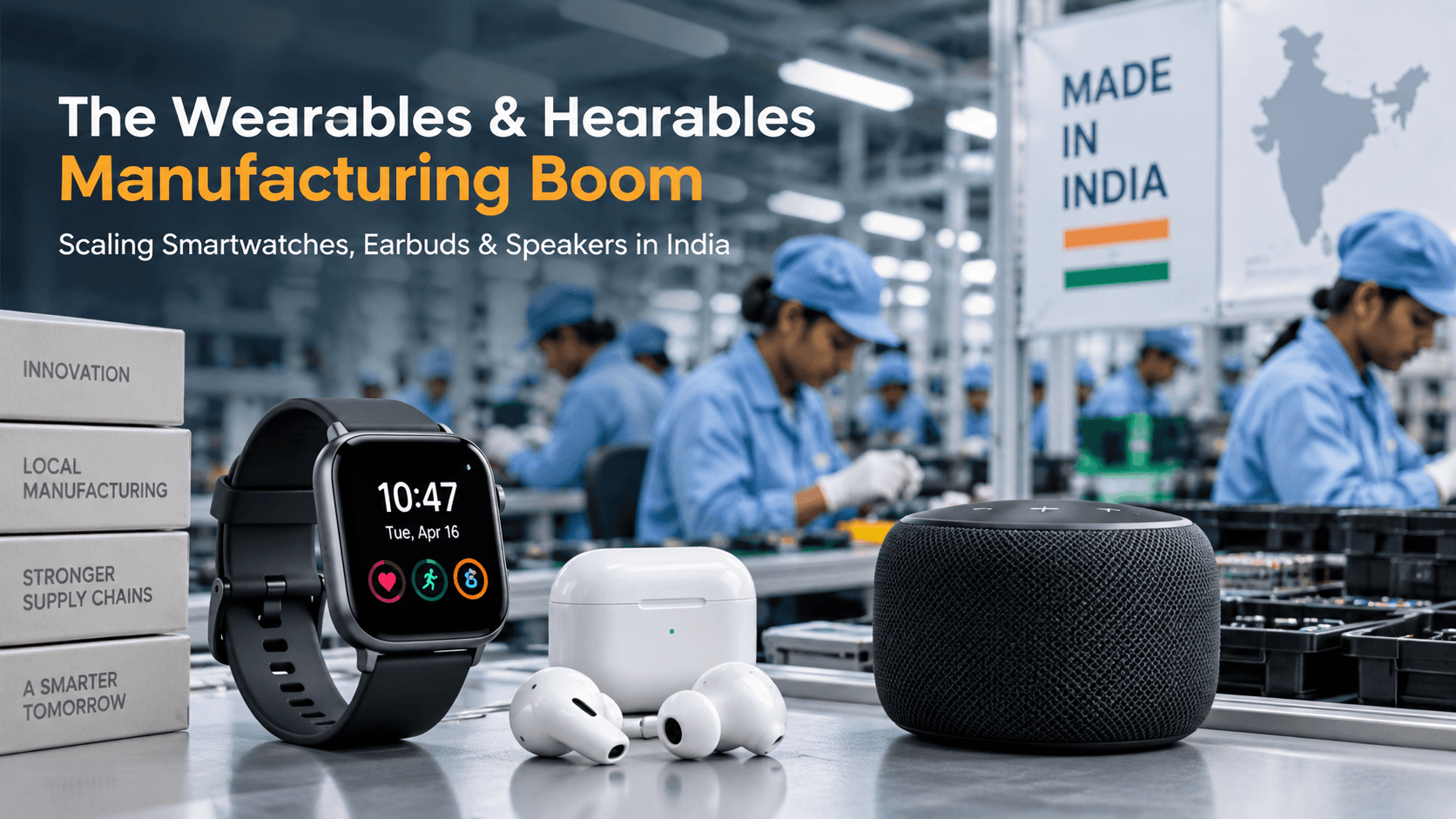
India’s wearables and hearables market has moved beyond the early phase of imported, rebranded devices. Smartwatches, wireless earbuds, neckbands, and compact speakers are increasingly being designed, assembled, and manufactured for the Indian market, with local production becoming a strategic priority for brands and electronics companies.
The opportunity is significant, but scaling manufacturing is not simply about increasing production volume. Companies need reliable component sourcing, strong quality controls, efficient assembly lines, regulatory compliance, inventory visibility, and the ability to respond quickly to changing consumer demand.
For manufacturers, the next phase of growth will depend on how effectively they can connect these pieces.
India’s Wearables Manufacturing Market Is Maturing
The rise of affordable smart devices has created a large domestic consumer base for wearables and hearables. Smartwatches and true wireless stereo (TWS) earbuds have become mainstream consumer electronics products, while portable and smart speakers continue to expand across multiple price segments.
Several factors are supporting this manufacturing shift:
- Growing domestic demand for connected consumer electronics
- Government incentives supporting electronics manufacturing
- Brands looking to reduce dependence on overseas supply chains
- Increasing availability of local assembly and component ecosystems
- Demand for shorter production and delivery cycles
- Expansion of Indian consumer electronics brands
This creates an interesting transition. India is not only becoming a large market for these products. It is also becoming an increasingly important manufacturing base.
What It Takes to Scale Smartwatch Manufacturing
Smartwatches may look compact, but their manufacturing process involves multiple components and tightly coordinated production stages.
A typical smartwatch can include:
- Display and touchscreen
- Printed circuit board assembly (PCBA)
- Battery
- Sensors
- Microphone and speaker
- Bluetooth and wireless connectivity components
- Buttons and charging components
- Casing and straps
- Firmware and software
As production volumes increase, even small inefficiencies can create substantial costs.
For example, a manufacturer producing 100,000 units per month cannot rely on manual tracking to understand which components have arrived, which production batches are complete, or where quality issues originated.
Manufacturing systems need to provide visibility from procurement through assembly, testing, packaging, and dispatch.
TWS Earbuds Require Precision at Scale
Wireless earbuds create a different manufacturing challenge.
Their small form factor leaves little room for production errors. Battery installation, acoustic components, charging contacts, Bluetooth components, microphones, and enclosure assembly all need to work together reliably.
Quality problems that might appear minor during production can quickly become expensive after shipment. A charging issue, poor battery performance, connectivity problem, or defective microphone can lead to returns and warranty claims.
This makes testing particularly important.
Manufacturers may need multiple quality checkpoints, including:
- Component inspection
- PCB testing
- Battery testing
- Acoustic testing
- Bluetooth and connectivity testing
- Charging case testing
- Final device testing
- Packaging inspection
The challenge is maintaining these controls without slowing production.
Speakers Add Another Layer of Manufacturing Complexity
Portable and smart speakers combine electronics with mechanical and acoustic manufacturing.
Depending on the product, manufacturers may need to manage:
- Speaker drivers
- Amplifier boards
- PCBs
- Batteries
- Wireless modules
- Microphones
- Enclosures
- Grilles and acoustic materials
- Buttons and controls
- Charging systems
Product differentiation also creates manufacturing complexity. Two speaker models may share several components but require different enclosures, firmware, packaging, or acoustic configurations.
A flexible production environment becomes important as product variants increase.
Supply Chain Management Becomes a Major Growth Constraint
Scaling production means scaling the supply chain at the same time.
A manufacturing line cannot operate efficiently if critical components repeatedly arrive late. At the same time, holding excessive inventory can tie up working capital and increase the risk of obsolete components.
This is especially relevant in consumer electronics, where product specifications and market demand can change quickly.
Manufacturers need better visibility into:
- Purchase orders
- Supplier lead times
- Component availability
- Incoming materials
- Production requirements
- Inventory levels
- Work-in-progress
- Finished goods
- Supplier quality
- Demand forecasts
A connected manufacturing and inventory system can help teams identify shortages before they become production stoppages.
Quality Control Has to Scale With Production
Increasing production volume without strengthening quality management can create a difficult trade-off.
More units mean more opportunities for defects to enter the production process. If quality checks happen only at the end of the line, manufacturers may discover problems after significant labor and material costs have already been incurred.
A better approach is to build quality into each stage.
For example, manufacturers can use batch-level traceability to identify:
- Which supplier provided a component
- Which production line assembled the device
- Which operator or workstation handled the process
- Which test results were recorded
- Which finished-goods batch contains the component
This type of traceability can significantly simplify root-cause analysis when defects appear in the market.
Why Production Visibility Matters
As manufacturing operations grow, spreadsheets and disconnected systems become increasingly difficult to manage.
A production manager may need answers to questions such as:
- How many units are currently in production?
- Which orders are at risk of delay?
- Which components are running low?
- What is today’s production output?
- How many units failed quality testing?
- Which supplier has the highest defect rate?
- How much finished inventory is available?
- What is the actual production cost per unit?
If answering these questions requires collecting data manually from different teams, decision-making slows down.
Real-time operational visibility gives manufacturers a clearer picture of what is happening on the shop floor and across the supply chain.
Automation Can Improve Manufacturing Efficiency
Automation does not necessarily mean replacing every manual process.
In many manufacturing environments, the bigger opportunity is eliminating repetitive administrative work and connecting information that is currently scattered across systems.
Manufacturers can automate areas such as:
- Material requirement planning
- Purchase order workflows
- Inventory updates
- Production scheduling
- Quality records
- Batch tracking
- Reorder alerts
- Cost calculations
- Production reporting
- Dispatch documentation
The result is less manual coordination and faster access to operational information.
The Role of Manufacturing Software
For growing wearables and hearables manufacturers, manufacturing software can become the operational layer connecting procurement, inventory, production, quality, and finance.
The most useful systems are not necessarily the ones with the longest feature lists. They are the ones that fit the company’s actual production workflow.
A growing electronics manufacturer may need capabilities such as:
Inventory management: Track components, work-in-progress, and finished goods across locations.
Bill of materials management: Maintain accurate component requirements for different product variants.
Production planning: Convert demand and orders into practical production schedules.
Batch and serial tracking: Maintain traceability throughout the production lifecycle.
Quality management: Record inspections, testing results, defects, and corrective actions.
Procurement: Connect material requirements with supplier orders and delivery schedules.
Cost tracking: Understand material, labor, and production costs at the product or batch level.
When these functions operate together, teams can make decisions using the same underlying data.
Scaling Manufacturing Without Losing Control
The biggest challenge for India’s wearables and hearables manufacturers may not be producing more devices. It may be producing more devices without sacrificing quality, margins, or delivery reliability.
That requires operational discipline.
Manufacturers preparing for the next stage of growth should focus on:
- Building reliable supplier networks
Reduce dependence on single suppliers for critical components wherever practical. - Improving production visibility
Track production status, output, downtime, and bottlenecks in real time. - Strengthening quality controls
Detect defects earlier and maintain traceability across production batches. - Managing inventory carefully
Balance component availability against working-capital requirements. - Standardizing production processes
Document repeatable workflows before production volumes increase further. - Connecting operational data
Reduce dependency on disconnected spreadsheets and manual reports. - Tracking unit economics
Understand how material costs, labor, wastage, rework, and overhead affect margins.
What the Next Phase Could Look Like
India’s wearables and hearables manufacturing opportunity is broader than assembling smartwatches and earbuds for the domestic market.
As local manufacturing capabilities mature, companies can potentially move further upstream into component sourcing, product development, engineering, testing, and export-oriented production.
That shift will require more sophisticated operations.
The manufacturers best positioned to scale will likely be those that treat production, procurement, inventory, quality, and financial control as one connected operation rather than separate functions.
For India’s growing electronics ecosystem, manufacturing scale will matter. But operational visibility will determine how efficiently that scale can be achieved.
FAQs
Is India becoming a major wearables manufacturing hub?
India is developing a larger electronics manufacturing ecosystem, supported by domestic demand, government initiatives, and investments in local production. Wearables and hearables are part of this broader electronics manufacturing growth.
What are the main challenges in manufacturing smartwatches and earbuds?
Key challenges include component sourcing, production consistency, quality testing, battery safety, inventory management, supplier reliability, product traceability, and controlling production costs.
Why is inventory management important for electronics manufacturers?
Electronics manufacturers need to balance component availability with the risk of excess or obsolete inventory. Better inventory visibility helps reduce shortages while keeping working capital under control.
How can manufacturing software help wearables manufacturers?
Manufacturing software can connect procurement, inventory, production planning, quality management, traceability, costing, and reporting, giving teams a more complete view of operations.
What should manufacturers prioritize before increasing production volume?
Manufacturers should establish reliable processes for sourcing, production planning, quality control, inventory management, traceability, and cost tracking before aggressively increasing capacity.