
Digital Twin Technology in Manufacturing Operations
Manufacturers are under constant pressure to produce more with fewer resources while maintaining quality, reducing downtime, and responding quickly to changing customer demands. Traditional monitoring systems provide valuable operational data, but they often show only what has already happened.
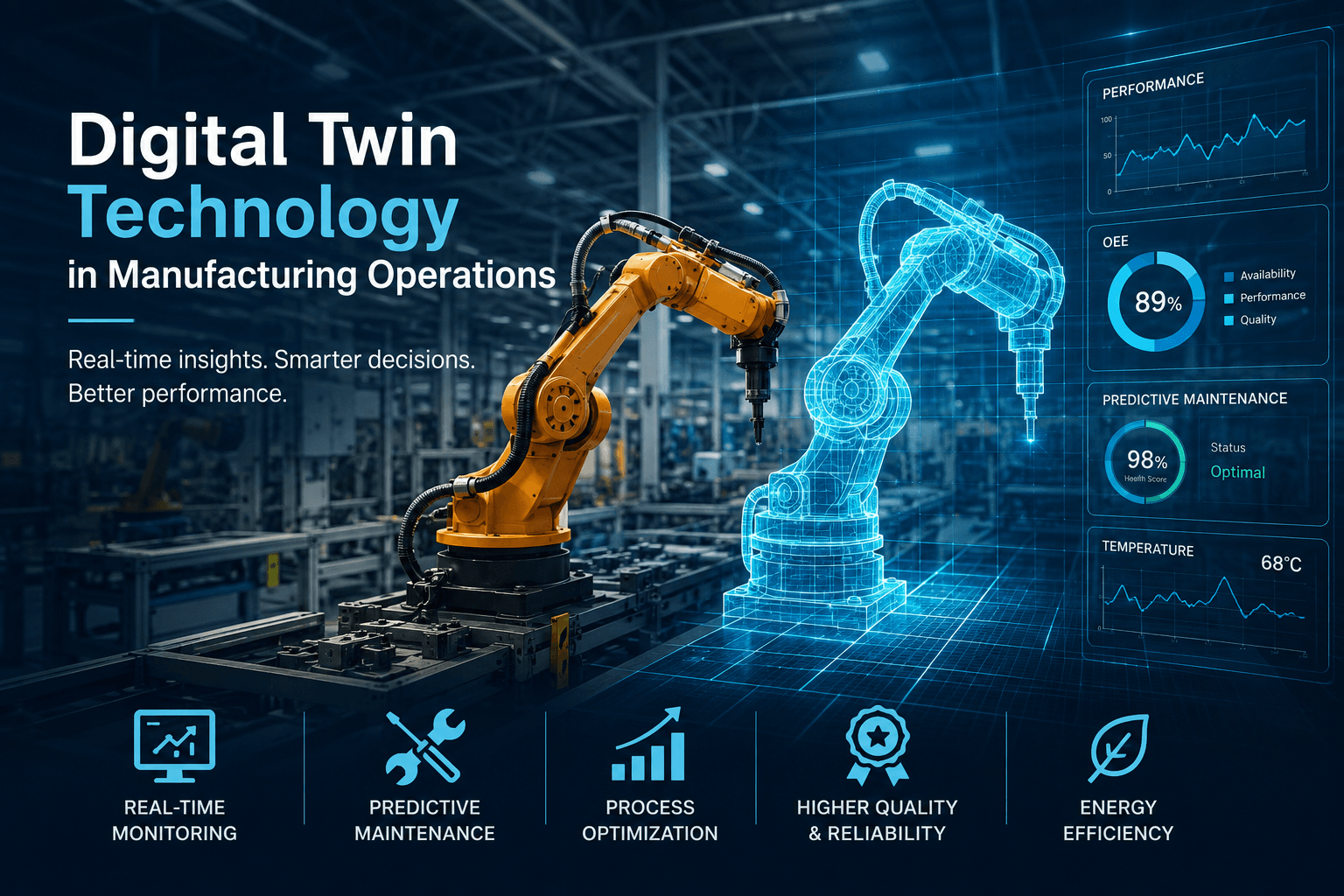
Digital twin technology changes that by creating a virtual representation of physical assets, production lines, or entire manufacturing facilities. Connected through sensors, IoT devices, and analytics platforms, a digital twin continuously reflects the current state of its physical counterpart. This enables manufacturers to monitor performance, predict failures, test improvements, and make better operational decisions before implementing changes on the factory floor.
As Industry 4.0 continues to evolve, digital twins are becoming a key technology for manufacturers seeking greater efficiency, flexibility, and resilience.
What Is Digital Twin Technology?
A digital twin is a dynamic digital model of a physical object, machine, production line, or manufacturing plant. Unlike a static 3D model, a digital twin receives real-time operational data from connected devices and updates continuously to reflect actual conditions.
The digital twin combines information from multiple sources, including:
- IoT sensors
- PLC and SCADA systems
- Manufacturing Execution Systems (MES)
- Enterprise Resource Planning (ERP) software
- CAD and engineering models
- Historical maintenance records
- AI and machine learning models
By combining these data sources, manufacturers gain a real-time view of equipment health, production performance, and operational efficiency.
How Digital Twins Work
Digital twins operate through a continuous feedback loop between physical assets and digital models.
The process typically includes:
- Sensors collect operational data from manufacturing equipment.
- Data is transmitted through industrial IoT networks.
- The digital twin updates automatically using live information.
- Analytics engines evaluate equipment behavior and production trends.
- AI models identify anomalies, predict failures, and recommend actions.
- Operators use dashboards to monitor performance and simulate improvements.
Because the model updates continuously, decision-makers can evaluate different scenarios without disrupting production.
Types of Digital Twins in Manufacturing
Manufacturers use several types of digital twins depending on operational goals.
Product Digital Twins
These represent individual products throughout their lifecycle, from design and engineering to production and maintenance.
Common applications include:
- Product design validation
- Prototype testing
- Performance monitoring
- Warranty analysis
Asset Digital Twins
Asset twins model individual machines or manufacturing equipment.
Examples include:
- CNC machines
- Industrial robots
- Compressors
- Pumps
- Conveyor systems
These models help monitor equipment condition and optimize maintenance schedules.
Process Digital Twins
Process twins simulate manufacturing workflows rather than individual machines.
Manufacturers use them to optimize:
- Production scheduling
- Material flow
- Cycle times
- Resource allocation
- Quality control
System Digital Twins
System twins model entire production facilities or factories.
They help organizations evaluate:
- Plant-wide efficiency
- Capacity planning
- Energy consumption
- Supply chain interactions
- Factory expansion strategies
Benefits of Digital Twin Technology
Digital twins provide measurable improvements across manufacturing operations.
Reduced Equipment Downtime
Predictive analytics identify equipment issues before they lead to breakdowns.
Maintenance teams can:
- Replace worn components early
- Schedule repairs during planned downtime
- Reduce unexpected equipment failures
This minimizes costly production interruptions.
Improved Predictive Maintenance
Instead of relying on fixed maintenance schedules, manufacturers service equipment based on its actual condition.
Benefits include:
- Longer equipment lifespan
- Lower maintenance costs
- Better spare parts planning
- Reduced emergency repairs
Higher Production Efficiency
Digital twins reveal hidden inefficiencies throughout production.
Manufacturers can identify:
- Bottlenecks
- Idle equipment
- Unbalanced production lines
- Excessive cycle times
These insights improve overall equipment effectiveness (OEE).
Better Product Quality
Quality teams can monitor production variables in real time.
Digital twins detect deviations before defective products are produced, helping reduce:
- Scrap
- Rework
- Warranty claims
- Customer complaints
Faster Process Optimization
Before modifying production lines, engineers can test proposed changes within the digital twin.
They can simulate:
- Equipment upgrades
- New layouts
- Production schedules
- Staffing changes
This reduces implementation risk and shortens improvement cycles.
Energy Optimization
Manufacturing facilities consume significant amounts of electricity, water, compressed air, and other utilities.
Digital twins identify opportunities to reduce:
- Energy waste
- Peak demand
- Equipment overuse
- Utility costs
Many manufacturers also use these insights to support sustainability initiatives.
Real-World Applications
Digital twin technology supports a wide range of manufacturing operations.
Predictive Maintenance
Factories continuously monitor machine vibration, temperature, pressure, and operating conditions.
When abnormal patterns appear, maintenance teams receive alerts before equipment fails.
Production Line Optimization
Engineers simulate production line changes before implementation.
This helps determine:
- Optimal machine placement
- Production balancing
- Labor allocation
- Throughput improvements
Inventory Optimization
Digital twins integrate production schedules with inventory systems.
Manufacturers gain better visibility into:
- Raw materials
- Work-in-progress inventory
- Finished goods
- Supply chain disruptions
Workforce Training
Virtual factory environments allow employees to practice operating equipment safely without affecting production.
Training simulations improve:
- Operator confidence
- Safety compliance
- Maintenance procedures
- Emergency response readiness
Factory Planning
Manufacturers planning new facilities can evaluate multiple factory layouts before construction begins.
Simulation helps optimize:
- Material flow
- Equipment placement
- Storage areas
- Logistics routes
Challenges of Implementing Digital Twins
Despite their advantages, digital twins require careful planning.
Common challenges include:
Data Integration
Manufacturing systems often use equipment from multiple vendors.
Connecting legacy systems with modern IoT platforms can be complex.
Data Quality
A digital twin is only as accurate as the data it receives.
Incomplete or inaccurate sensor data can reduce model reliability.
High Initial Investment
Implementation may require investments in:
- IoT sensors
- Connectivity infrastructure
- Cloud platforms
- Analytics software
- Employee training
Organizations should evaluate expected ROI before deployment.
Cybersecurity
Connected manufacturing systems increase the importance of cybersecurity.
Manufacturers should implement:
- Network segmentation
- Multi-factor authentication
- Continuous monitoring
- Secure remote access
- Regular security updates
Best Practices for Successful Implementation
Manufacturers can improve adoption by following a structured approach.
Start with a focused pilot project rather than modeling an entire factory.
Prioritize equipment that experiences frequent downtime or high maintenance costs.
Ensure data quality before developing predictive models.
Integrate digital twins with existing ERP, MES, and maintenance systems to avoid creating isolated data silos.
Train operators, maintenance teams, and engineers to interpret digital twin insights and incorporate them into daily decision-making.
Regularly update simulation models as equipment, production processes, and business requirements evolve.
The Future of Digital Twins in Manufacturing
Digital twin technology continues to advance alongside artificial intelligence, edge computing, 5G connectivity, and industrial IoT.
Future developments are expected to include:
- Autonomous production optimization
- AI-driven process recommendations
- Real-time supply chain digital twins
- Collaborative robotics integration
- Carbon footprint monitoring
- Fully connected smart factories
As computing power increases and implementation costs decline, digital twins are likely to become standard across manufacturing operations of all sizes.
Key Takeaways
Digital twin technology enables manufacturers to create real-time virtual models of physical assets, production lines, and entire facilities. These models improve operational visibility, reduce downtime, support predictive maintenance, and optimize manufacturing processes through simulation and data-driven insights.
While implementation requires investments in sensors, connectivity, software, and data integration, the long-term benefits often include higher equipment reliability, improved product quality, lower operating costs, and greater production efficiency. As Industry 4.0 technologies continue to mature, digital twins will play an increasingly important role in helping manufacturers build smarter, more resilient, and more sustainable operations.
Frequently Asked Questions
Q. What is a digital twin in manufacturing?
A digital twin is a virtual representation of a physical machine, production process, or manufacturing facility that updates continuously using real-time operational data.
Q. How do digital twins improve manufacturing efficiency?
They help identify bottlenecks, predict equipment failures, optimize production schedules, reduce downtime, and improve resource utilization.
Q. What technologies are required for digital twins?
Digital twins typically rely on IoT sensors, cloud computing, AI, machine learning, industrial analytics, ERP systems, MES platforms, and secure network connectivity.
Q. Which industries benefit most from digital twins?
Industries such as automotive, aerospace, electronics, pharmaceuticals, food and beverage, energy, heavy machinery, and consumer goods manufacturing commonly use digital twin technology.
Q. Is digital twin technology suitable for small manufacturers?
Yes. Many cloud-based solutions allow small and medium-sized manufacturers to begin with a single production line or critical asset, then expand their digital twin capabilities as their needs and budgets grow.