Aluminum Extrusions for Construction: Applications, Alloys, and Cross-Section Design
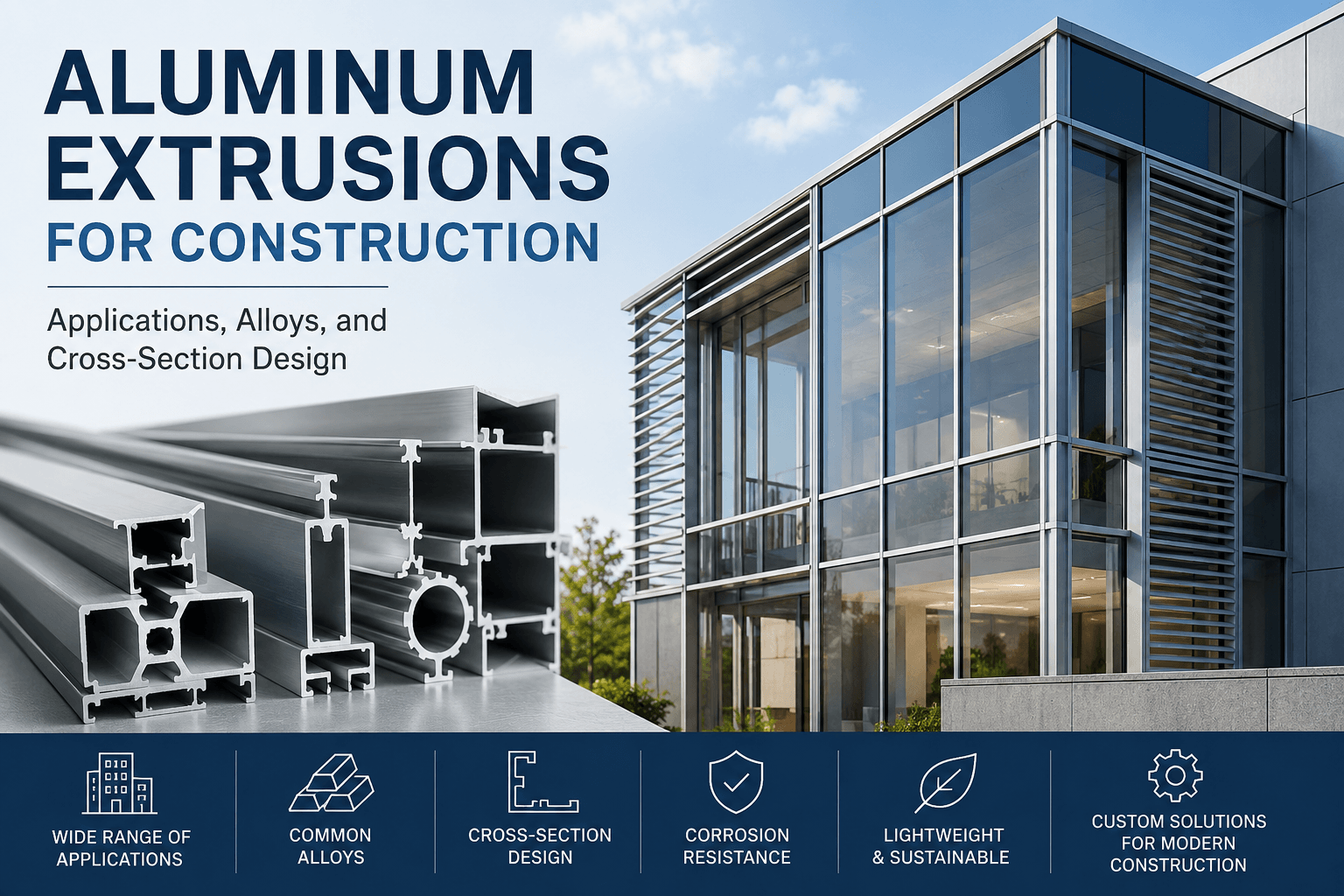
Aluminum extrusions have become an essential manufacturing solution for the modern construction industry. Their combination of low weight, high strength-to-weight ratio, corrosion resistance, design flexibility, and recyclability makes aluminum an attractive material for everything from window frames and curtain walls to structural components, façades, railings, and solar mounting systems.
For architects, engineers, contractors, and procurement teams, selecting the right aluminum extrusion alloy, profile design, and manufacturing process can significantly affect a project’s performance, cost, durability, and installation time.
This guide explains the major applications of aluminum extrusions in construction, commonly used alloys, cross-section design principles, finishing options, and key factors to consider when sourcing extruded aluminum profiles.
What Are Aluminum Extrusions?
Aluminum extrusion is a manufacturing process in which a heated aluminum billet is pushed through a specially designed die to create a continuous profile with a specific cross-sectional shape.
The process allows manufacturers to produce relatively complex shapes while maintaining consistent dimensions along the length of the profile.
Unlike machining, which removes material from a solid block, extrusion creates the required geometry directly. This can reduce material waste and make it economical to manufacture long structural and architectural components.
Common construction extrusion profiles include:
- Window and door frames
- Curtain wall profiles
- Structural channels
- T-sections and I-sections
- Square and rectangular tubes
- Handrails and balustrades
- Façade framing systems
- Solar panel mounting rails
- Partition frames
- Heat sinks and equipment profiles
- Decorative architectural sections
Why Use Aluminum Extrusions in Construction?
Aluminum offers several characteristics that make it particularly suitable for construction applications.
1. Lightweight Construction
Aluminum is significantly lighter than steel, making extruded profiles easier to transport, handle, and install.
This can be particularly beneficial for large façade systems, windows, partitions, and modular construction components where reducing component weight can simplify installation.
2. High Strength-to-Weight Ratio
Although aluminum is lightweight, properly selected alloys and profile geometries can provide substantial structural performance.
Engineers can also increase stiffness by modifying the cross-section rather than simply adding more material.
For example, ribs, webs, flanges, and hollow sections can increase resistance to bending and buckling without creating an unnecessarily heavy component.
3. Corrosion Resistance
Aluminum naturally forms a thin oxide layer when exposed to air. This oxide layer provides protection against further corrosion.
Additional treatments such as anodizing and powder coating can further improve corrosion resistance and provide the desired appearance.
4. Design Flexibility
One of the biggest advantages of aluminum extrusion is the ability to create customized cross-sections.
Manufacturers can integrate:
- Mounting channels
- Screw bosses
- Internal cavities
- Snap-fit features
- Reinforcing ribs
- Drainage channels
- Gaskets
- Fastener locations
into the extrusion itself.
This can reduce the number of separate components required during assembly.
5. Recyclability
Aluminum can be recycled repeatedly while retaining much of its material value. This makes it useful for construction projects where sustainability and material recovery are important considerations.
Major Applications of Aluminum Extrusions in Construction
Aluminum Extrusions for Windows and Doors
Window and door systems are among the most common applications for architectural aluminum extrusion.
Extruded profiles can be designed to accommodate:
- Glass panels
- Rubber gaskets
- Locks and hinges
- Drainage paths
- Thermal breaks
- Fasteners
- Weather seals
Aluminum window frames are popular because they provide dimensional stability, relatively low weight, corrosion resistance, and a clean architectural appearance.
Curtain Wall Systems
Curtain walls require long, lightweight framing members capable of supporting glass and transferring wind loads back to the building structure.
Aluminum extrusions are widely used for:
- Mullions
- Transoms
- Pressure plates
- Cover caps
- Spandrel framing
- Corner profiles
The extrusion cross-section can incorporate cavities and reinforcing geometry to achieve the required stiffness while maintaining a relatively low weight.
Building Façades
Architectural aluminum extrusions can be used to create external façade systems and decorative elements.
Applications include:
- Façade frames
- Louvers
- Sunshades
- Cladding support systems
- Decorative trims
- Architectural fins
Because aluminum can be anodized or powder coated in different finishes, designers have considerable freedom in appearance.
Railings and Balustrades
Extruded aluminum is also commonly used for handrails, guardrails, and balustrade systems.
Profiles can be designed with internal channels for mounting glass panels, brackets, fasteners, or support components.
The relatively low weight of aluminum can simplify transportation and installation compared with heavier metal systems.
Solar Panel Mounting Systems
The growth of rooftop and commercial solar installations has created significant demand for aluminum extrusion profiles.
Typical components include:
- Solar mounting rails
- End clamps
- Mid clamps
- Roof brackets
- Panel support profiles
- Structural channels
Aluminum is particularly useful for these applications because of its low weight, corrosion resistance, and ability to be extruded into long, precise profiles.
Interior Partition Systems
Commercial offices, retail spaces, hospitals, and other buildings use aluminum extrusion systems for modular partitions.
Profiles can accommodate glass, panels, doors, wiring, and connection hardware.
This allows manufacturers to create modular systems that can be assembled, disassembled, and reconfigured relatively easily.
Common Aluminum Alloys for Construction Extrusions
Choosing the correct alloy is an important part of aluminum extrusion design.
Different alloys offer different combinations of strength, extrudability, corrosion resistance, machinability, and surface finish quality.
6063 Aluminum Alloy
6063 is one of the most widely used alloys for architectural aluminum extrusion.
It provides:
- Excellent extrudability
- Good surface finish
- Good corrosion resistance
- Moderate mechanical strength
- Excellent suitability for anodizing
It is commonly used for:
- Window frames
- Door frames
- Curtain wall components
- Railings
- Decorative profiles
- Architectural sections
For applications where appearance and extrusion complexity are particularly important, 6063 is often a strong choice.
6061 Aluminum Alloy
6061 provides higher strength than 6063 and is widely used for structural and engineering applications.
Typical applications include:
- Structural profiles
- Frames
- Machinery supports
- Heavy-duty mounting systems
- Solar structures
- Industrial construction components
However, 6061 can be more challenging to extrude into highly complex shapes than 6063.
6005A Aluminum Alloy
6005A is another alloy used when a balance of strength and extrudability is required.
It can be suitable for:
- Structural profiles
- Transportation-related structures
- Frames
- Platforms
- Support systems
The final alloy selection should be based on the required mechanical properties and applicable construction standards.
Aluminum Extrusion Cross-Section Design
Cross-section design is one of the most important factors affecting the performance and cost of an aluminum extrusion.
A well-designed profile can achieve the required structural performance while minimizing material consumption.
Wall Thickness
Wall thickness must be selected carefully.
Extremely thin walls can create challenges during extrusion and may result in:
- Dimensional variation
- Distortion
- Surface defects
- Reduced structural performance
Excessively thick sections, on the other hand, can increase material consumption, weight, and cost.
The optimal wall thickness depends on the alloy, profile geometry, extrusion size, and manufacturer’s capabilities.
Hollow Sections
Hollow profiles can provide excellent stiffness-to-weight performance.
For example, a rectangular hollow aluminum extrusion can offer greater bending resistance than a flat bar while using less material than a solid section with equivalent external dimensions.
Hollow sections are frequently used in:
- Frames
- Structural supports
- Door systems
- Façade systems
- Railings
Ribs and Webs
Adding ribs or webs can increase the stiffness of an extrusion without dramatically increasing its overall weight.
These features can help resist:
- Bending
- Torsion
- Buckling
- Local deformation
However, ribs should be designed with extrusion limitations in mind.
Symmetry
Symmetrical profiles are generally easier to extrude consistently.
Highly asymmetric cross-sections can create uneven metal flow through the die, potentially increasing the risk of distortion or dimensional variation.
Where possible, designers should consider balanced geometry.
Corners and Radii
Sharp internal corners can be difficult to manufacture and may create stress concentrations.
Using appropriate radii can improve:
- Metal flow
- Die life
- Profile quality
- Structural performance
The exact radius should be determined in consultation with the extrusion manufacturer.
Design for Manufacturability
Designing an aluminum profile only around its final function can lead to unnecessary manufacturing challenges.
A better approach is to involve the extrusion supplier early in the design process.
Important considerations include:
Extrusion Size
The overall dimensions of the profile affect the required extrusion press, die design, billet size, and production cost.
Complexity
More complex profiles may require specialized dies and tighter process control.
Tolerances
Not every feature needs an extremely tight tolerance.
Using unnecessarily tight tolerances can increase manufacturing costs without providing meaningful performance benefits.
Critical dimensions should therefore be clearly identified.
Die Design
The extrusion die determines the final cross-sectional geometry.
Complex profiles may require more sophisticated die designs, increasing initial tooling costs.
For high-volume projects, however, the tooling investment can be justified through lower per-part production costs.
Aluminum Extrusion Finishes for Construction
Surface finishing is important for both aesthetics and durability.
Anodizing
Anodizing creates a controlled oxide layer on the aluminum surface.
It can provide:
- Improved surface durability
- Corrosion resistance
- Attractive architectural finishes
- Consistent appearance
Anodized aluminum is commonly used in window frames, façades, doors, and decorative architectural components.
Powder Coating
Powder coating applies a dry powder finish that is cured onto the aluminum surface.
It offers a broad selection of colors and finishes and is widely used for architectural applications.
Powder-coated aluminum can be specified in different gloss levels, textures, and colors depending on project requirements.
Mill Finish
Mill finish refers to aluminum that has not received a decorative or protective surface coating beyond the normal extrusion process.
It can be suitable for components where appearance is not critical or where the part will receive additional processing.
Aluminum Extrusion vs. Steel for Construction
The choice between aluminum and steel depends on the application.
| Factor | Aluminum Extrusion | Steel |
|---|---|---|
| Weight | Low | Higher |
| Corrosion resistance | Generally high | Often requires protection |
| Strength | Moderate to high depending on alloy | Generally higher |
| Extrusion flexibility | Excellent | More limited for comparable processes |
| Surface finishing | Anodizing, powder coating | Painting, galvanizing, coatings |
| Handling | Relatively easy | Heavier |
| Recyclability | Highly recyclable | Highly recyclable |
| Architectural applications | Excellent | Excellent |
For lightweight architectural and modular systems, aluminum can provide significant advantages. For very high-load structural applications, steel may remain the preferred material.
Cost Factors for Aluminum Extrusions
The cost of an aluminum extrusion depends on several variables.
1. Alloy
Different aluminum alloys have different material and processing costs.
2. Profile Weight
Extrusion pricing is often strongly influenced by the amount of aluminum used per meter or per unit.
Reducing unnecessary material through optimized geometry can lower costs.
3. Tooling
Custom extrusion dies require an upfront tooling investment.
However, the tooling cost can become relatively small when spread across a large production volume.
4. Surface Finish
Anodizing, powder coating, painting, and other treatments add processing costs.
5. Machining
Additional operations such as:
- Cutting
- Drilling
- Milling
- Tapping
- Punching
- CNC machining
can increase the final component cost.
6. Production Volume
Higher production volumes generally make custom extrusion more economical because tooling and setup costs can be distributed across more parts.
How to Choose an Aluminum Extrusion Supplier
Selecting the right supplier is as important as selecting the correct alloy.
Evaluate suppliers based on:
- Extrusion press capabilities
- Alloy availability
- Profile size capabilities
- Die design expertise
- Dimensional control
- Surface finishing capabilities
- CNC machining capacity
- Quality inspection systems
- Production capacity
- Packaging and logistics
- Experience with construction applications
For large construction projects, it is also important to confirm that the supplier can maintain consistent quality throughout the production run.
Quality Control for Construction Aluminum Extrusions
Quality inspection can include:
- Dimensional inspection
- Straightness measurement
- Surface inspection
- Alloy verification
- Hardness testing
- Mechanical testing
- Coating thickness measurement
- Anodizing quality inspection
- Packaging inspection
For critical construction applications, manufacturers and buyers should define the applicable standards, tolerances, testing requirements, and documentation before production begins.
Sustainability Benefits of Aluminum Extrusions
Sustainability is becoming increasingly important in construction.
Aluminum’s recyclability makes it attractive for projects seeking to reduce material waste and improve lifecycle performance.
The ability to produce lightweight profiles can also reduce transportation and handling requirements.
Additionally, extrusion designs can be optimized to use material efficiently by incorporating hollow sections, ribs, and other structural features.
However, the environmental impact of aluminum also depends heavily on how the metal is produced, processed, transported, and recycled. Responsible sourcing and high recycled content can therefore play an important role in improving the overall sustainability of an aluminum construction system.
Future Trends in Aluminum Extrusion for Construction
Several trends are shaping the future of aluminum extrusion manufacturing.
More Complex Profiles
Advances in extrusion tooling and manufacturing technology are enabling increasingly complex profiles that combine multiple functions into a single component.
Lightweight Structural Design
Engineers are increasingly optimizing cross-sections to reduce material consumption while maintaining stiffness and strength.
Integrated Assembly Features
Profiles are being designed with built-in channels, clips, fastener locations, and connection features to simplify assembly.
Sustainable Aluminum
Demand for recycled and lower-carbon aluminum is expected to continue growing as construction companies focus more heavily on embodied carbon and lifecycle performance.
Digital Manufacturing
CAD, simulation, automated inspection, and digital production monitoring are helping manufacturers improve extrusion accuracy and reduce development time.
Conclusion
Aluminum extrusions for construction provide an effective combination of lightweight design, corrosion resistance, structural performance, manufacturing flexibility, and architectural appeal.
The right solution depends on more than simply selecting an aluminum alloy. Engineers must consider cross-section geometry, wall thickness, tolerances, extrusion complexity, finishing requirements, mechanical loads, production volume, and installation requirements.
Alloys such as 6063, 6061, and 6005A can serve different construction needs, while optimized profile designs can reduce material usage and simplify assembly.
For construction companies, architects, and product manufacturers, working with an experienced aluminum extrusion supplier during the design stage can help create profiles that are not only technically effective but also economical to manufacture at scale.
Frequently Asked Questions
What is the best aluminum alloy for construction extrusion?
There is no single best alloy for every application. 6063 is widely used for architectural applications because of its excellent extrudability and surface finish, while 6061 is often preferred when higher strength is required.
Why are aluminum extrusions used for windows?
Aluminum extrusions allow manufacturers to create lightweight, durable, corrosion-resistant window frames with integrated channels for glass, seals, hardware, and thermal-break components.
Can aluminum extrusions be used for structural applications?
Yes. Properly designed aluminum extrusion profiles can be used for structural frames, supports, solar mounting systems, façades, and other applications. The alloy, geometry, loading conditions, and applicable engineering standards must be considered.
Is aluminum extrusion cheaper than steel?
The answer depends on the application, volume, design, and material requirements. Aluminum may cost more per kilogram than steel, but its lower weight, corrosion resistance, extrusion flexibility, and easier handling can provide lifecycle and manufacturing advantages.
What makes a good aluminum extrusion cross-section?
A good cross-section balances structural performance, weight, manufacturability, tolerances, finishing requirements, and cost. Hollow sections, ribs, webs, and integrated mounting features can improve functionality while minimizing unnecessary material.
Can aluminum extrusions be customized?
Yes. Custom extrusion dies can produce profiles specifically designed for a particular construction application. Custom profiles can integrate channels, cavities, ribs, mounting points, and other functional features.