


Battery Management System for Electric Vehicles
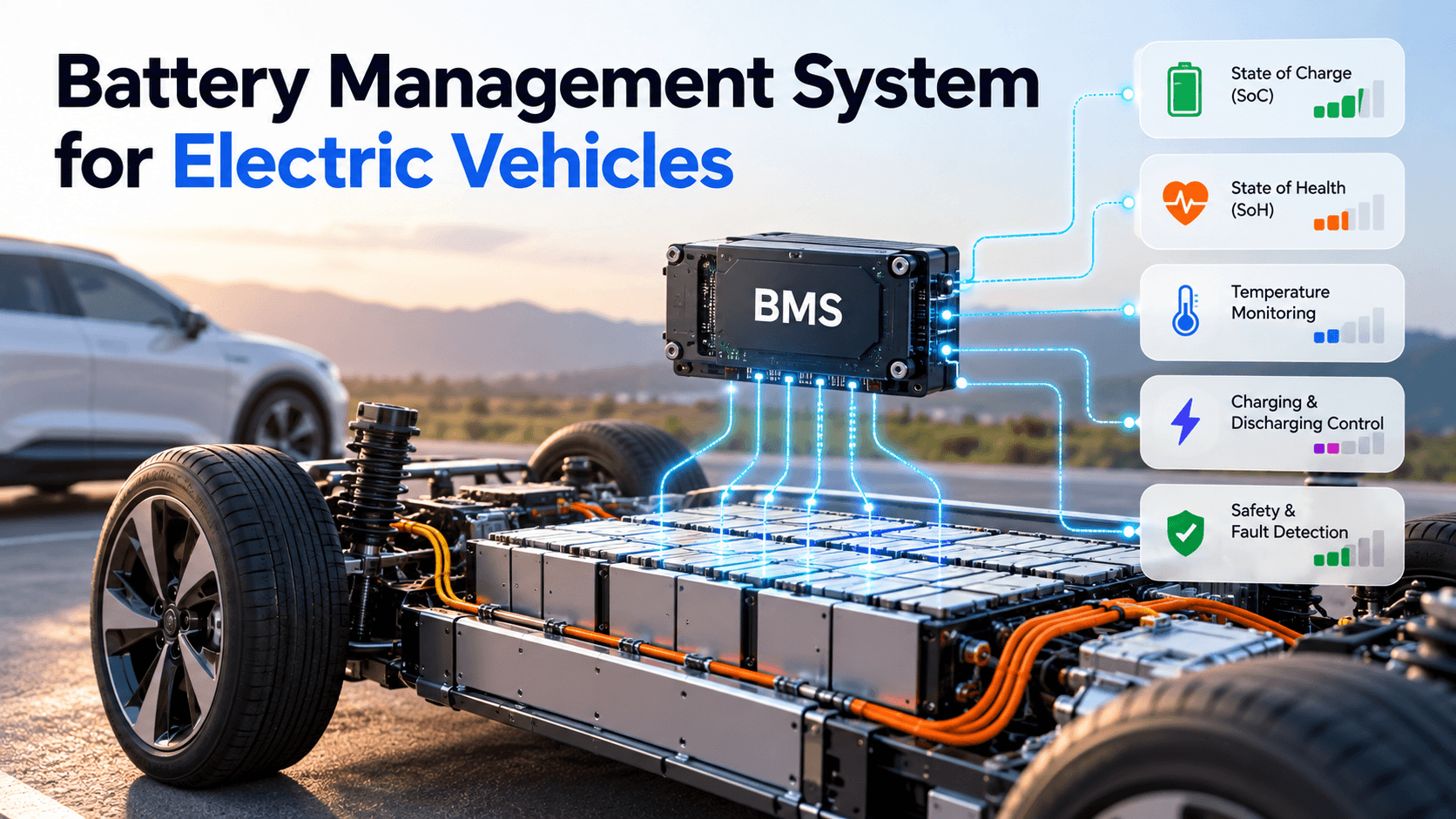
Electric vehicle batteries are more than a collection of cells connected together. They are complex energy systems that need continuous monitoring and control to operate safely, efficiently, and reliably.
This is where a Battery Management System (BMS) becomes essential.
A battery management system for electric vehicles monitors battery conditions, controls charging and discharging, manages temperature, estimates available energy, and protects the battery from operating outside safe limits. In modern EVs, the BMS plays a central role in battery safety, vehicle performance, driving range, and battery life.
As EV adoption grows and battery packs become larger and more sophisticated, understanding how BMS technology works is increasingly important for EV manufacturers, fleet operators, engineers, and technology providers.
What Is a Battery Management System?
A Battery Management System is an electronic control system that monitors and manages the individual cells and overall battery pack in an electric vehicle.
An EV battery pack may contain hundreds or thousands of individual cells. These cells need to operate within specific voltage, temperature, and current limits. Even small differences between cells can affect the performance and lifespan of the entire pack.
The BMS continuously collects data from the battery and uses that information to make decisions.
A typical BMS monitors:
- Cell and pack voltage
- Charging and discharging current
- Battery temperature
- State of Charge (SoC)
- State of Health (SoH)
- Cell balancing
- Charging and discharging limits
- Fault conditions
- Battery isolation and safety conditions
The system can then communicate this information to other vehicle systems, including the vehicle control unit, charging system, and dashboard.
Why Is a BMS Important in Electric Vehicles?
Lithium-ion batteries, which are widely used in EVs, require careful operating conditions. Excessive voltage, deep discharge, high temperatures, or high current can damage cells and, in severe cases, create safety risks.
A BMS acts as the battery pack’s monitoring and protection layer.
For example, if a cell approaches an unsafe voltage during charging, the BMS can reduce or stop charging. If battery temperature becomes too high, it can request reduced power or activate cooling systems.
Without effective battery management, an EV battery could experience:
- Reduced driving range
- Faster battery degradation
- Uneven cell aging
- Lower charging performance
- Excessive heat
- Reduced reliability
- Potential safety hazards
The BMS therefore affects much more than battery protection. It directly influences the overall EV ownership and operating experience.
Key Functions of a Battery Management System
A modern BMS performs several functions simultaneously. Some focus on safety, while others improve battery performance and help manufacturers extract more usable energy from the pack.
1. Battery Monitoring
Continuous monitoring is one of the most fundamental BMS functions.
The system measures voltage, current, and temperature at different points in the battery pack. This creates a real-time picture of battery operating conditions.
Cell-level voltage monitoring is particularly important because individual cells do not always behave identically. Differences can develop because of manufacturing variation, temperature differences, aging, or operating conditions.
By monitoring cells individually, the BMS can identify abnormal behavior before it becomes a larger problem.
2. State of Charge Estimation
State of Charge, or SoC, represents how much usable energy remains in the battery.
It is similar to the fuel gauge in a conventional vehicle, although calculating battery SoC is considerably more complicated than measuring the amount of fuel in a tank.
The BMS uses information such as:
- Battery current
- Voltage
- Temperature
- Previous operating conditions
- Charging and discharging history
to estimate the remaining energy.
An accurate SoC estimate helps the vehicle provide a reliable remaining-range calculation and allows the powertrain to operate within appropriate battery limits.
3. State of Health Monitoring
State of Health, or SoH, indicates the battery’s condition compared with its original or reference condition.
As a battery ages, its usable capacity and power capability can decline.
The BMS can monitor indicators such as:
- Available capacity
- Internal resistance
- Charge and discharge performance
- Temperature behavior
- Historical operating patterns
SoH information can be useful for vehicle diagnostics, warranty management, fleet maintenance, and battery lifecycle planning.
For commercial EV fleets, this information becomes particularly valuable because battery condition can influence operating costs and vehicle availability.
4. Cell Balancing
Cells within the same battery pack can gradually develop different charge levels.
If these differences become significant, the usable capacity of the entire pack may be limited by the weakest or most constrained cell.
Cell balancing helps reduce these differences.
There are two common approaches:
Passive balancing removes excess energy from higher-voltage cells, typically by dissipating it as heat.
Active balancing transfers energy between cells or cell groups, potentially improving energy efficiency and reducing balancing losses.
The appropriate approach depends on factors such as battery architecture, cost, performance requirements, and pack design.
5. Thermal Management
Temperature has a major effect on lithium-ion battery performance, charging capability, degradation, and safety.
A BMS monitors battery temperatures and can interact with the vehicle’s thermal management system.
Depending on the design, the system may:
- Activate cooling
- Request heating
- Limit charging power
- Limit discharge power
- Prevent operation under unsafe conditions
Effective thermal management is especially important during fast charging, high-power acceleration, and operation in extreme environmental conditions.
6. Overvoltage and Undervoltage Protection
Battery cells must operate within defined voltage limits.
Charging a cell beyond its safe voltage range can accelerate degradation and create safety concerns. Excessive discharge can also damage the cell.
The BMS continuously monitors cell voltages and can intervene when predefined limits are reached.
This protection helps maintain battery reliability throughout its operating life.
7. Overcurrent and Short-Circuit Protection
EV batteries can deliver substantial electrical power.
The BMS monitors current flowing into and out of the battery and identifies abnormal conditions such as excessive current or potential short circuits.
Depending on the system architecture, the BMS can work with contactors and other protection devices to disconnect the battery from the vehicle when necessary.
8. Communication With Other Vehicle Systems
The BMS does not operate in isolation.
It typically communicates with other electronic control units through automotive communication networks such as CAN.
It can share information including:
- Available battery power
- Charging limits
- Battery temperature
- SoC
- SoH
- Fault codes
- Current operating restrictions
This allows the vehicle control system to adjust performance based on real-time battery conditions.
Main Components of an EV Battery Management System
Although BMS architecture varies between vehicles, most systems contain several core components.
Battery Monitoring Unit
The monitoring electronics measure parameters such as cell voltage and temperature.
In large battery packs, multiple monitoring units may be distributed throughout the pack rather than using one centralized circuit.
BMS Controller
The controller processes measurements, executes control algorithms, evaluates battery conditions, and communicates with other vehicle systems.
It is effectively the decision-making layer of the BMS.
Current Sensor
Current sensors measure the flow of electricity into and out of the battery.
Accurate current measurements are important for SoC estimation, power calculations, protection, and diagnostics.
Temperature Sensors
Temperature sensors are distributed across the battery pack to detect hot or cold areas.
The number and placement of sensors depend on the battery design and thermal characteristics.
Contactors
Contactors are electrically controlled switches that connect or disconnect the high-voltage battery from the vehicle’s electrical system.
The BMS can control these devices as part of the battery’s safety strategy.
Communication Interface
The BMS communicates with other vehicle systems through interfaces such as CAN or other automotive communication technologies.
This enables battery information to become part of the vehicle’s broader control architecture.
How Does a Battery Management System Work?
The BMS operates continuously while the battery is being charged, discharged, or otherwise monitored.
A simplified process looks like this:
Step 1: Measure
Sensors collect voltage, current, and temperature data from the battery.
Step 2: Analyze
The BMS controller evaluates the measurements against operating limits and battery models.
Step 3: Estimate
Algorithms estimate parameters such as SoC, SoH, available power, and remaining energy.
Step 4: Protect
If the system detects an unsafe condition, it can limit charging or discharging, trigger thermal management, or disconnect the battery.
Step 5: Communicate
The BMS shares battery information and operating limits with other vehicle controllers.
Step 6: Record and Diagnose
Depending on the vehicle architecture, battery events and fault information may be stored for diagnostics and service.
This process happens continuously, allowing the vehicle to respond to changing battery conditions in real time.
BMS and Electric Vehicle Charging
Charging is one of the most demanding operating conditions for an EV battery.
During charging, the BMS monitors cell voltage, temperature, current, and other conditions to determine how much charging power the battery can safely accept.
This becomes particularly important during DC fast charging.
A battery may initially accept high charging power, but the allowable power can change as the battery approaches a high state of charge or as temperatures change.
The BMS can communicate charging limits to the charging system, helping prevent the battery from exceeding safe operating conditions.
This is one reason charging speed is not simply determined by the maximum rating of the charging station. The battery’s condition and BMS controls also influence how much power can actually be accepted.
Centralized vs Distributed BMS Architecture
BMS architecture can vary depending on the size and design of the battery pack.
Centralized BMS
In a centralized architecture, most monitoring and control electronics are located in a central BMS unit.
This approach can simplify certain aspects of system design but may require more wiring between the central controller and individual cells or modules.
Distributed BMS
In a distributed architecture, monitoring electronics are placed closer to battery modules.
This can reduce wiring complexity and support larger battery systems.
Distributed architectures can be useful for large EV battery packs where hundreds or thousands of cells need to be monitored.
The choice between architectures depends on factors such as cost, packaging, scalability, reliability, serviceability, and vehicle requirements.
BMS Challenges in Modern Electric Vehicles
As EV batteries become larger and charging becomes faster, BMS requirements are becoming more demanding.
Managing Large Battery Packs
Modern EVs may contain very large numbers of cells. Monitoring these cells accurately requires robust electronics, communication systems, and software.
Improving SoC and SoH Accuracy
Battery behavior changes with temperature, age, usage patterns, and charging history.
Estimating SoC and SoH accurately across different conditions remains a significant engineering challenge.
Supporting Fast Charging
Fast charging increases electrical and thermal demands on the battery.
The BMS must balance charging speed with safety, battery longevity, and thermal constraints.
Detecting Faults Early
A good BMS should identify abnormal conditions before they develop into serious failures.
This requires reliable sensors, fault-detection logic, diagnostics, and appropriate safety mechanisms.
Managing Battery Aging
Battery performance changes over time. A BMS needs to account for degradation rather than treating a new battery and an older battery exactly the same way.
Advanced algorithms can help adapt battery management strategies as the pack ages.
Benefits of an Effective BMS
A well-designed BMS can deliver benefits across the entire EV lifecycle.
Improved Battery Safety
Monitoring and protection functions help keep the battery within defined operating limits.
Longer Battery Life
Appropriate charging, thermal management, and operating controls can reduce unnecessary stress on battery cells.
Better Driving Range
Accurate energy estimation helps the vehicle make better use of available battery capacity while providing drivers with more reliable range information.
Faster and Safer Charging
The BMS can help determine how much power the battery can accept under current conditions.
Better Diagnostics
Battery data can help manufacturers, service teams, and fleet operators identify problems and understand battery condition.
Lower Lifecycle Costs
Better battery management can support longer battery life, improved maintenance planning, and more informed decisions about battery replacement or reuse.
BMS for Commercial EV Fleets
Battery management becomes even more important when EVs are deployed in commercial fleets.
Fleet operators need to balance vehicle availability, charging time, battery degradation, energy costs, and operating schedules.
BMS data can support fleet-level decisions such as:
- Identifying batteries that require inspection
- Monitoring battery degradation
- Optimizing charging strategies
- Planning vehicle maintenance
- Comparing battery performance across vehicles
- Supporting warranty and lifecycle decisions
When BMS data is connected to fleet management or telematics platforms, operators can move from reactive maintenance toward more proactive battery management.
What Is the Future of EV Battery Management?
The role of the BMS is expanding as electric vehicle technology evolves.
Future systems are likely to place greater emphasis on software, advanced battery models, cloud connectivity, predictive diagnostics, and data-driven optimization.
Some emerging areas include:
Cloud-Connected Battery Analytics
Battery data can be analyzed beyond the vehicle itself, allowing manufacturers and fleet operators to monitor performance across large numbers of vehicles.
Predictive Battery Diagnostics
Instead of simply detecting a fault after it occurs, advanced systems can look for patterns that indicate a developing problem.
More Accurate Battery Models
Improved models can help estimate available energy and battery health under changing temperature, load, and aging conditions.
Integration With Charging Infrastructure
Closer integration between vehicles, chargers, and energy management platforms could help optimize charging based on battery condition, electricity costs, and operational requirements.
Battery Lifecycle Management
BMS data can also support decisions beyond the vehicle’s first life, including battery refurbishment, second-life applications, and recycling.
Choosing the Right BMS for an EV Application
There is no single BMS design that fits every electric vehicle.
The right solution depends on the battery chemistry, pack size, voltage architecture, power requirements, thermal system, safety requirements, communication protocols, and vehicle use case.
When evaluating a BMS, manufacturers should consider:
- Cell monitoring accuracy
- Safety architecture
- SoC and SoH estimation
- Cell balancing strategy
- Thermal management integration
- Communication capabilities
- Diagnostic functions
- Scalability
- Software flexibility
- Functional safety requirements
- Cybersecurity
- Cost and lifecycle support
For high-volume EV programs, the BMS should be evaluated as part of the complete battery and vehicle architecture rather than as an isolated electronic component.
Conclusion
A Battery Management System is one of the most important control systems in an electric vehicle.
It monitors battery conditions, protects cells, manages charging and discharging, estimates battery state, supports thermal management, and communicates critical information to the rest of the vehicle.
As EV batteries become larger, charging becomes faster, and vehicles become more software-driven, BMS technology will play an even greater role in safety, performance, reliability, and battery lifecycle management.
For EV manufacturers and fleet operators, investing in a capable BMS is not simply about protecting a battery. It is about getting more useful, reliable, and predictable performance from one of the vehicle’s most valuable components.