
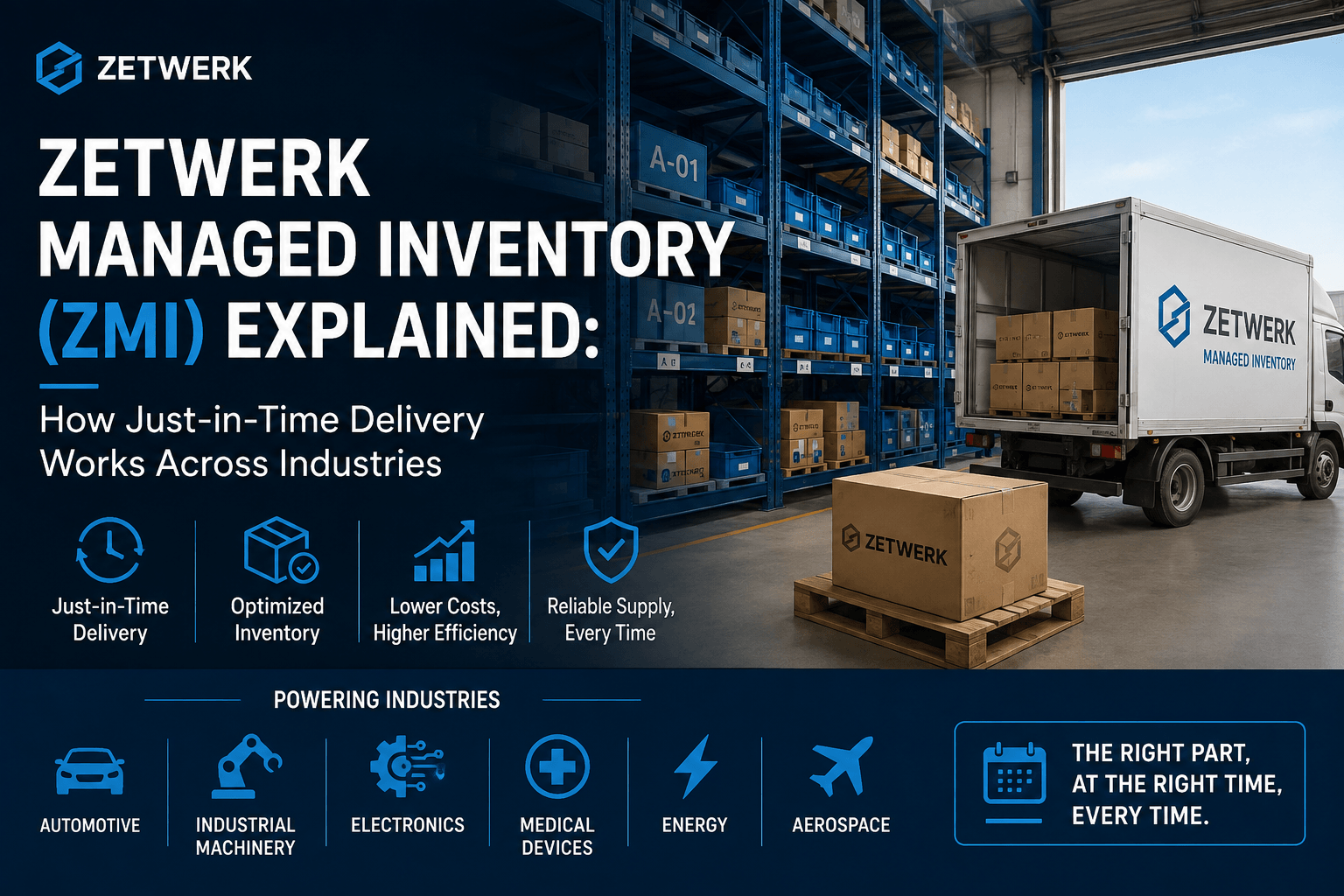
Zetwerk Managed Inventory (ZMI) Explained: How Just-in-Time Delivery Works Across Industries
Manufacturers face a difficult tradeoff when sourcing components globally. Overseas manufacturing can lower production costs, but longer lead times, shipping uncertainty, and changing demand can make it harder to keep production moving.
Zetwerk Managed Inventory (ZMI) is designed to address that gap.
ZMI is a vendor-managed inventory service that combines global manufacturing and sourcing with locally managed inventory. Zetwerk monitors inventory consumption, supply conditions, lead times, and other variables, then replenishes stock before shortages disrupt production.
The result is a supply model that aims to provide the cost advantages of global sourcing with the responsiveness of a local supplier.
What Is Zetwerk Managed Inventory (ZMI)?
Zetwerk Managed Inventory, or ZMI, is an enhanced vendor-managed inventory (VMI) service from Zetwerk.
Under the model, Zetwerk takes responsibility for managing agreed inventory levels for a manufacturer’s components. Instead of waiting for a customer to place an order after inventory runs low, Zetwerk monitors consumption and supply conditions and proactively manages replenishment.
The model is particularly useful for manufacturers that need components on a predictable schedule but do not want to hold large amounts of safety stock or rely entirely on long international lead times.
ZMI connects several parts of the supply chain:
- Global component manufacturing and sourcing
- Demand and inventory forecasting
- Local warehousing
- Inventory monitoring
- Supply chain management
- Logistics and transportation
- Just-in-time delivery
According to Zetwerk, ZMI can provide components within five days of the customer’s door in its applicable managed inventory network.
Why Traditional Just-in-Time Manufacturing Can Be Difficult
Just-in-time manufacturing is built around a simple principle: keep inventory lean and receive materials close to when they are needed.
That can reduce carrying costs and excess inventory. But it also creates a dependency on reliable suppliers, transportation, production schedules, and demand forecasts.
A disruption at any point can create problems.
For example, imagine an industrial equipment manufacturer sourcing a critical fabricated component from an overseas supplier. The manufacturer may have planned production several months ahead, but demand suddenly increases. At the same time, the supplier’s production lead time extends and ocean transportation becomes less predictable.
With a traditional purchasing model, the manufacturer may have only a few options:
- Increase safety stock.
- Expedite shipments at a higher cost.
- Find another supplier.
- Risk a production delay.
ZMI approaches the problem differently by placing inventory closer to the point of consumption and continuously monitoring both inventory usage and upstream supply conditions.
This is an important distinction. The goal is not simply to keep more inventory. It is to position the right inventory in the right location and replenish it based on actual supply and demand conditions.
How Does ZMI Work?
The ZMI process begins with planning and continues through manufacturing, warehousing, monitoring, and replenishment.
1. Forecast component requirements
Zetwerk works with the customer to establish near-term and longer-term forecasts for the components required.
This gives the supply chain team a baseline for determining how much inventory should be available and when additional production should begin.
Forecasting is especially important when components have long manufacturing lead times. Production can begin before inventory reaches a critical level, rather than waiting for a shortage to occur.
2. Establish inventory requirements
Zetwerk and the customer agree on the inventory levels needed to support production.
The objective is to maintain sufficient stock without unnecessarily tying up working capital in excess inventory.
The exact inventory strategy can vary depending on component usage, demand patterns, manufacturing lead times, and supply conditions.
3. Manufacture and source components
Components can be sourced through Zetwerk’s global manufacturing network.
This creates an important part of the ZMI model: the physical inventory may be positioned locally even when the components are manufactured elsewhere.
Zetwerk describes this as combining the lead-time advantages of a domestic supplier with the cost savings associated with strategic global sourcing.
4. Store inventory locally
The components are held in a Zetwerk-managed warehouse closer to the customer’s manufacturing operation.
Local inventory reduces the dependency on international transportation for every individual replenishment order.
Instead, larger production and shipping decisions can happen upstream, while the customer receives components from nearby inventory when needed.
5. Monitor consumption and supply conditions
ZMI tracks inventory consumption against projected usage.
It also considers supply-side variables such as manufacturing lead times, shipping times, and raw material availability.
This matters because inventory management cannot rely on historical consumption alone.
If a customer’s production rate increases, inventory can fall faster than expected. If a supplier’s lead time increases, replenishment needs to start earlier.
Monitoring both sides of the equation helps the supply chain respond before a shortage becomes a production problem.
6. Replenish inventory proactively
When inventory or supply conditions change, Zetwerk manages replenishment to maintain the agreed stock levels.
The company’s published example illustrates how this works: if a customer’s demand increases while upstream production lead times also increase, Zetwerk can increase the size of the next shipment to compensate.
That proactive approach is what separates managed inventory from simply storing finished parts in a warehouse.
ZMI vs. Traditional Vendor-Managed Inventory
ZMI shares many characteristics with traditional vendor-managed inventory, but Zetwerk positions it as a broader supply chain solution.
Traditional VMI generally focuses on the supplier managing inventory levels for a customer.
ZMI adds broader visibility into global manufacturing and supply conditions. Zetwerk says its technology and manufacturing network allow it to monitor market variables, supply issues, shipping times, and other factors that can affect lead times.
| Traditional approach | Zetwerk Managed Inventory |
|---|---|
| Customer manages multiple suppliers | One managed supply partner can coordinate the broader supply chain |
| Inventory decisions may rely heavily on forecasts | Actual consumption is tracked against projected usage |
| Global production can mean long replenishment cycles | Inventory is positioned closer to the customer |
| Disruptions may require reactive action | Supply and inventory variables are monitored proactively |
| JIT can increase shortage risk | Local inventory provides a buffer against upstream lead-time variability |
The key benefit is not simply “more inventory.” It is better placement and management of inventory.
How ZMI Supports Just-in-Time Delivery
Just-in-time manufacturing depends on timing.
The component needs to arrive close to the moment production requires it, without creating unnecessary inventory buildup.
ZMI supports that model by moving some of the complexity upstream.
Instead of requiring a manufacturing company to coordinate every production order, international shipment, warehouse movement, and replenishment decision itself, the managed inventory provider handles much of that process.
The basic flow looks like this:
Global sourcing → Manufacturing → International logistics → Local managed inventory → JIT delivery → Production line
This model allows manufacturers to maintain access to globally sourced components while keeping the final delivery point geographically closer to their production facility.
Zetwerk states that its ZMI service is designed to provide JIT deliveries within five days in its applicable network.
Benefits of Zetwerk Managed Inventory
Lower inventory risk
Manufacturers do not necessarily need to compensate for long global lead times by holding large quantities of every component.
By positioning inventory locally and managing replenishment, ZMI can help reduce exposure to long replenishment cycles.
More predictable production
A missing component can stop an otherwise ready production line.
Keeping required parts in a nearby managed warehouse can improve component availability and make production planning more predictable.
Better response to demand changes
Forecasts are useful, but actual demand rarely follows a perfectly straight line.
ZMI monitors actual consumption and can adjust replenishment when usage changes.
Global sourcing with local availability
One of the central ideas behind ZMI is separating where a component is manufactured from where it needs to be delivered.
A manufacturer can use global production capabilities while keeping inventory closer to its facility.
Reduced supply chain workload
Managing multiple manufacturers, freight providers, warehouses, and replenishment schedules can consume significant procurement and operations resources.
Zetwerk’s managed supply chain model is intended to consolidate these activities and provide end-to-end support across sourcing, manufacturing, logistics, and inventory management.
Greater supply chain visibility
ZMI provides visibility into inventory consumption and broader supply conditions.
That can help teams identify potential issues earlier rather than discovering a supply problem only when a component is already needed on the production floor.
How ZMI Can Apply Across Industries
Managed inventory can be valuable wherever manufacturers depend on a steady supply of physical components.
Industrial machinery
Industrial equipment manufacturers often work with complex assemblies and components that may have significant production lead times.
Zetwerk specifically positions ZMI as a way for construction and industrial machinery manufacturers to support lean manufacturing while building resilience into their supply strategy.
Electronics and appliances
Electronics and consumer product manufacturers can face changing demand and complex global component supply chains.
Zetwerk describes ZMI as a way for these manufacturers to avoid long lead times while supporting just-in-time manufacturing.
Energy and utilities
Energy and utility projects can depend on components that must be available according to project schedules.
Zetwerk’s energy and utilities offering includes managed inventory and logistics designed to ensure components are available when required.
Automotive and other engineered products
For manufacturers operating complex production systems, component availability is directly connected to throughput.
A managed inventory model can help companies maintain leaner operations without relying exclusively on last-minute expedited shipments.
The exact value depends on the component, demand profile, manufacturing lead time, and location. ZMI is therefore best viewed as a supply chain strategy rather than a universal inventory formula.
What Makes ZMI Different From Simply Holding Safety Stock?
Safety stock and managed inventory solve related problems, but they are not the same thing.
Safety stock is inventory held as protection against uncertainty.
Managed inventory is a process for continuously monitoring inventory and coordinating replenishment.
A company could hold six months of inventory and still have poor visibility into its supply chain. Conversely, a well-managed inventory program can use consumption data and supply information to determine when replenishment should happen.
ZMI combines inventory positioning with supply chain management.
That means the question becomes less about “How much extra inventory should we keep?” and more about “Where should inventory be positioned, when should it be replenished, and what upstream conditions could affect availability?”
When Should a Manufacturer Consider Managed Inventory?
ZMI or another VMI solution may be worth evaluating when several of these conditions apply:
- Components have long or unpredictable lead times.
- Production depends on a consistent supply of specific parts.
- Global sourcing provides cost advantages but creates delivery challenges.
- Inventory carrying costs are becoming a concern.
- Procurement teams spend significant time managing multiple suppliers.
- Demand changes make forecasting difficult.
- Production downtime caused by component shortages is expensive.
- The company wants JIT delivery without relying heavily on expedited freight.
The strongest candidates are usually components that are both operationally important and difficult to replenish quickly.
Not every part needs managed inventory. Low-value, locally available items may be better handled through conventional purchasing.
The Bigger Picture: JIT Without Giving Up Supply Chain Resilience
The traditional view of just-in-time manufacturing often emphasizes minimizing inventory.
Modern supply chains need to consider another question: How can inventory stay lean without making the operation fragile?
That is where managed inventory becomes valuable.
ZMI combines local inventory positioning with global manufacturing and supply chain management. Instead of forcing manufacturers to choose between global cost efficiency and local availability, the model attempts to connect the two.
For manufacturers, the practical outcome is straightforward: fewer supply chain tasks to coordinate internally, better visibility into inventory, and a more responsive path from global production to the factory floor.
Frequently Asked Questions About ZMI
What does ZMI stand for?
ZMI stands for Zetwerk Managed Inventory. It is Zetwerk’s enhanced vendor-managed inventory service for manufacturers.
Is ZMI the same as JIT?
No. JIT, or just-in-time manufacturing, is an inventory and production strategy focused on receiving materials when they are needed. ZMI is a managed inventory service designed to support JIT by monitoring inventory, supply conditions, and replenishment.
How does ZMI reduce long lead times?
ZMI uses locally managed inventory so that components do not have to travel from the original manufacturing location every time the customer needs a part. Zetwerk states that ZMI can provide components within five days of the customer’s door in its applicable network.
Who manages the inventory in ZMI?
Zetwerk manages agreed inventory levels, monitors consumption and supply conditions, and manages replenishment to help maintain component availability.
Does ZMI require manufacturing to happen locally?
No. A core part of the model is combining global manufacturing and sourcing with inventory positioned closer to the customer.
Can ZMI help manufacturers reduce inventory costs?
It can help manufacturers avoid relying solely on large amounts of safety stock to compensate for long or uncertain lead times. Actual savings depend on the company’s components, demand patterns, logistics costs, and inventory strategy.
Conclusion
Zetwerk Managed Inventory is built around a simple supply chain problem: global manufacturing can offer cost advantages, but global lead times can make just-in-time production difficult.
ZMI addresses that problem by combining global sourcing and manufacturing with locally managed inventory, continuous inventory monitoring, and proactive replenishment.
For manufacturers, the value is not simply faster delivery. It is a different way to manage the tradeoff between inventory efficiency, supply chain resilience, and production reliability.
When the right components are already positioned near the point of use, global sourcing does not have to mean waiting weeks for every replenishment order.
That is the central idea behind ZMI: the right part, at the right time, with the supply chain working behind the scenes to make it possible.