

From ISRO to Industry: Private Manufacturing of Satellite & Spacecraft Subsystems
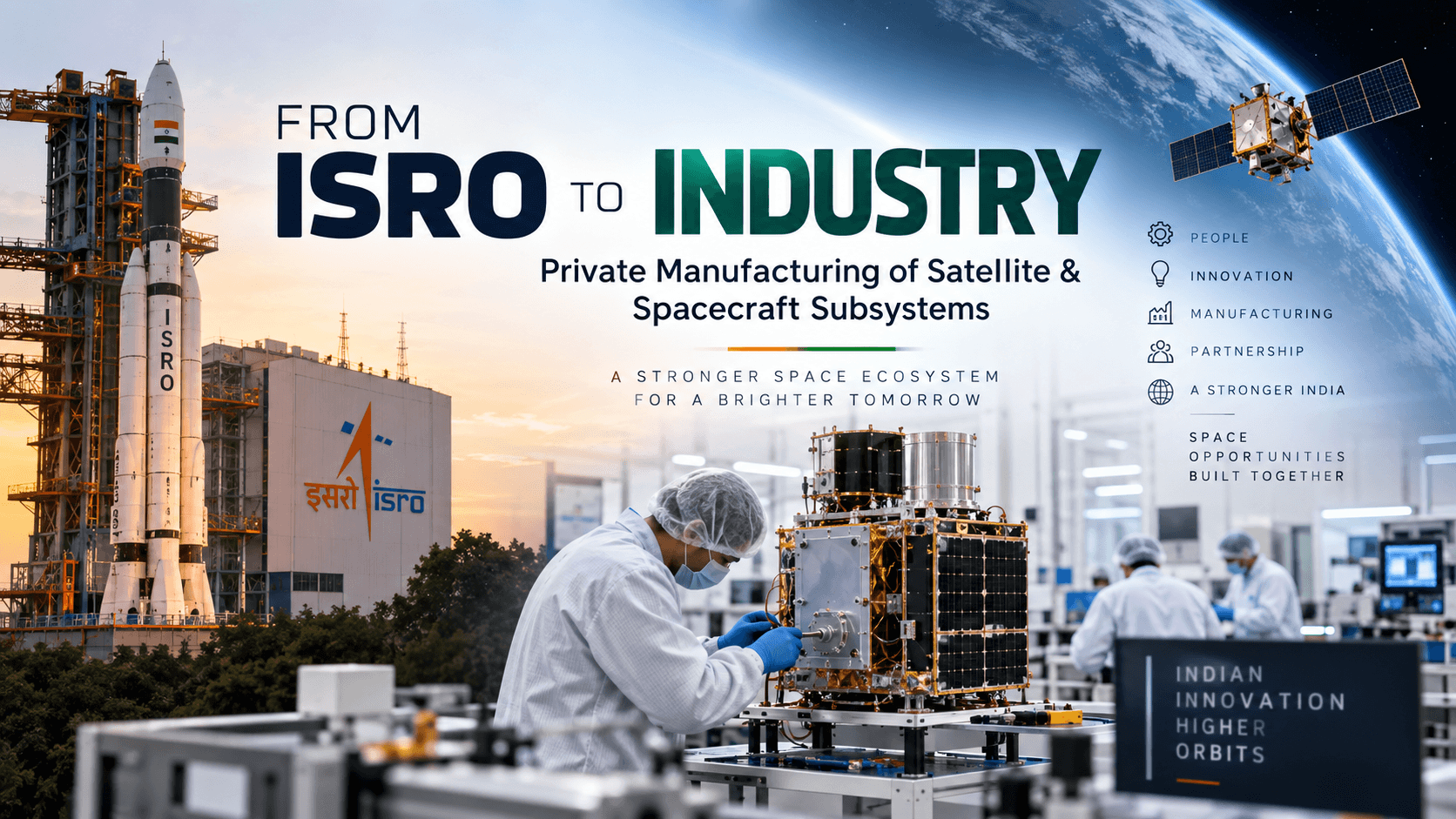
India’s space sector is moving beyond a model led almost entirely by government agencies. Private companies are now becoming an important part of the country’s space manufacturing ecosystem, building everything from satellite structures and propulsion systems to avionics, electronics, and other spacecraft subsystems.
This shift is creating a new opportunity for Indian manufacturers. Instead of supplying conventional industrial components, companies can now participate directly in the growing space supply chain.
The rise of private space manufacturing in India is not simply about launching more satellites. It is about building the industrial capacity required to design, manufacture, test, integrate, and maintain increasingly complex spacecraft at scale.
For manufacturers, this could become one of the country’s most strategically important technology opportunities.
How India’s Space Industry Is Changing
For decades, Indian Space Research Organisation (ISRO) played the central role in India’s space program.
Government organizations developed launch vehicles, satellites, propulsion systems, electronics, and other critical technologies. Private companies participated in the ecosystem primarily as suppliers and contractors.
That model is changing.
India’s space-sector reforms have opened the door for greater private participation across activities such as satellite development, launch services, space applications, and manufacturing.
Organizations such as Indian National Space Promotion and Authorization Center (IN-SPACe) are also helping create a framework for private-sector participation.
The result is a broader ecosystem where startups, established manufacturers, component suppliers, research institutions, and space companies can work together.
This creates an important distinction:
India is no longer building only a space program. It is building a space industry.
What Are Satellite and Spacecraft Subsystems?
A spacecraft is made up of multiple interconnected systems. Each subsystem performs a specific function, but all of them must work together reliably in an extremely demanding environment.
Common spacecraft subsystems include:
1. Structural Subsystems
The spacecraft structure provides mechanical support and protects sensitive components.
Manufacturing can include:
- Satellite frames
- Panels and brackets
- Equipment mounting structures
- Payload supports
- Separation systems
- Lightweight structural assemblies
Materials such as aluminum alloys, titanium, composites, and specialized engineering materials may be used depending on the application.
The challenge is to achieve the required combination of strength, stiffness, weight, dimensional accuracy, and thermal performance.
2. Power Systems
Satellites require reliable power throughout their missions.
Typical components include:
- Solar panels
- Battery systems
- Power distribution units
- Power conditioning electronics
- Electrical harnesses
- Connectors and interfaces
A failure in the power subsystem can affect the entire spacecraft, which makes manufacturing quality and testing especially important.
3. Thermal Management Systems
Spacecraft experience significant temperature variations.
Thermal-control systems help keep sensitive electronics and instruments within their operating temperature ranges.
Manufacturing opportunities include:
- Thermal straps
- Heat sinks
- Radiators
- Insulation assemblies
- Thermal interface components
- Heat pipes
- Specialized coatings and surface treatments
Thermal management becomes particularly important as spacecraft electronics become smaller and more powerful.
4. Avionics and Electronics
Avionics serve as the spacecraft’s electronic nervous system.
They can include:
- Flight computers
- Control electronics
- Communication electronics
- Sensor interfaces
- Data-handling systems
- Power electronics
- Navigation systems
Manufacturers entering this segment need strong capabilities in electronics design, precision manufacturing, testing, quality control, and environmental qualification.
5. Propulsion Systems
Propulsion allows spacecraft to maneuver, maintain orbit, or perform mission-critical operations.
Depending on the spacecraft, propulsion systems can involve:
- Thrusters
- Propellant tanks
- Valves
- Feed systems
- Pressure regulators
- Propulsion control electronics
- Structural components
This is one of the most technically demanding areas of spacecraft manufacturing because component reliability can directly affect mission success.
6. Communication Systems
Satellites need to communicate with ground stations and, in some cases, with other spacecraft.
Communication subsystem components can include:
- Antennas
- RF electronics
- Waveguides
- Filters
- Transmitters
- Receivers
- Amplifiers
- Cabling and connectors
As satellite communications expand, demand for specialized RF and microwave manufacturing capabilities is likely to become increasingly important.
Why Private Manufacturing Matters
The growth of private participation can solve a fundamental challenge for the space sector: scale.
Government agencies have historically had to manage multiple responsibilities, including research, mission development, manufacturing, testing, launches, and operations.
A broader private ecosystem allows these activities to become more distributed.
A spacecraft company may focus on satellite design while sourcing structures, electronics, propulsion components, and specialized assemblies from qualified suppliers.
This creates a supply chain similar to other advanced industries.
Faster Production
Specialized manufacturers can focus on repeatable production processes rather than building every component from scratch for individual missions.
This can reduce production cycles as satellite constellations grow.
Greater Manufacturing Capacity
Large-scale satellite programs require more than engineering expertise. They require factories, machines, skilled workers, testing infrastructure, quality systems, and reliable suppliers.
Private investment can expand this capacity.
Technology Specialization
A manufacturer that focuses exclusively on thermal systems, RF components, precision structures, or propulsion components can develop deep expertise in its niche.
That specialization can benefit the entire ecosystem.
Cost Optimization
Repeatable manufacturing processes can help reduce costs over time.
This becomes particularly important for commercial satellite operators competing in price-sensitive markets.
From Component Supplier to Strategic Space Partner
For traditional manufacturers, entering the space sector does not necessarily mean developing an entire satellite.
There is a potentially more practical path:
Become exceptionally good at one critical subsystem or manufacturing capability.
A company with existing expertise in CNC machining, electronics, composites, welding, precision fabrication, coatings, or testing may already possess some of the capabilities required by the space industry.
The difference is that space applications demand significantly stronger controls around:
- Material traceability
- Process documentation
- Dimensional accuracy
- Cleanliness
- Quality assurance
- Environmental testing
- Configuration management
- Supplier qualification
- Product reliability
The opportunity lies in adapting existing industrial capabilities to these requirements.
What Makes Space Manufacturing Different?
A component that works perfectly in an industrial or automotive application may not automatically be suitable for spacecraft.
Space hardware operates under unusual conditions.
Depending on the mission, components may experience:
- Extreme temperature changes
- Vibration
- Shock
- Vacuum
- Radiation
- Launch loads
- Electromagnetic interference
- Long periods without physical maintenance
There is also a fundamental manufacturing principle in the space sector:
You cannot easily repair a component once the spacecraft is in orbit.
That makes reliability a central consideration.
Testing Becomes Part of Manufacturing
Space manufacturing does not end when a component comes off the production line.
Qualification and acceptance testing may involve environmental conditions designed to replicate or exceed the stresses the hardware will experience.
Depending on the component, testing can include:
- Thermal vacuum testing
- Vibration testing
- Shock testing
- Electromagnetic compatibility testing
- Pressure testing
- Leak testing
- Functional testing
- Life-cycle testing
Manufacturers entering the industry therefore need to think about design, manufacturing, inspection, and testing as one connected process.
The Role of Quality and Traceability
Quality management is particularly important in aerospace and space manufacturing.
A space company needs to know not only whether a component meets its specification, but also how it was produced.
This means manufacturers may need detailed records covering:
- Raw material certificates
- Batch numbers
- Manufacturing processes
- Inspection results
- Calibration records
- Non-conformances
- Corrective actions
- Component history
Traceability creates confidence across the supply chain.
For a growing private space industry, this is more than a compliance exercise. It is part of building a trustworthy supplier ecosystem.
Opportunities for Indian Manufacturers
The opportunity extends well beyond companies that already identify themselves as space businesses.
Several manufacturing segments can potentially participate in the space supply chain.
Precision Engineering
Companies with advanced machining capabilities can manufacture highly precise structural and mechanical components.
Electronics Manufacturing
PCB assembly, power electronics, embedded systems, and specialized electronic assemblies can support satellite manufacturers.
Composite Manufacturing
Lightweight composite structures can help spacecraft designers reduce mass while maintaining mechanical performance.
Surface Engineering
Specialized coatings and treatments can address thermal, corrosion, wear, and environmental requirements.
Additive Manufacturing
3D printing can support rapid prototyping and the production of complex, lightweight geometries.
Testing and Qualification
Testing infrastructure itself can become a valuable part of the private space ecosystem.
Harness and Cable Manufacturing
Electrical harnesses may appear relatively simple, but spacecraft applications demand careful engineering, assembly, inspection, and documentation.
Building a Space-Ready Manufacturing Capability
Manufacturers interested in entering the sector should avoid treating space as simply another customer segment.
The better approach is to build a space-qualified manufacturing system.
That starts with understanding the target application.
For example, a company manufacturing satellite brackets may need to evaluate:
- Material selection
- Manufacturing process
- Dimensional tolerances
- Surface finish
- Mass requirements
- Cleanliness requirements
- Inspection methodology
- Environmental conditions
- Documentation
- Qualification requirements
The objective is not simply to make a component.
It is to create a repeatable process that produces the required component reliably.
Digital Manufacturing Can Strengthen the Supply Chain
Digital tools can play an important role in making private space manufacturing more scalable.
Manufacturers can use digital systems for:
- CAD and model-based engineering
- Production planning
- Quality management
- Manufacturing execution
- Inspection data
- Asset tracking
- Configuration management
- Supplier management
- Digital traceability
This becomes increasingly valuable as production volumes increase.
A manufacturer producing ten spacecraft components can potentially manage processes manually.
A manufacturer supplying thousands of components to multiple satellite programs needs much stronger systems.
The Rise of Satellite Constellations
One of the biggest changes in the space industry is the shift from individual satellites toward constellations.
Instead of manufacturing one spacecraft for a single mission, companies may need to produce dozens, hundreds, or even thousands of satellites.
That changes the manufacturing equation.
The focus shifts toward:
Repeatability + throughput + quality + cost control.
This creates opportunities for manufacturers that can industrialize spacecraft production without compromising reliability.
It also means that capabilities traditionally associated with automotive, electronics, and advanced manufacturing may become increasingly relevant to space.
Challenges Private Companies Must Overcome
The opportunity is significant, but entering the space supply chain is not straightforward.
High Qualification Requirements
Space customers need confidence that suppliers can consistently meet demanding specifications.
Building that confidence can take time.
Limited Production Volumes
Some specialized spacecraft components still have relatively small markets.
Manufacturers need to balance investment against realistic demand.
High Development Costs
Specialized equipment, testing, certification, engineering talent, and quality systems can require substantial investment.
Skilled Workforce
Space manufacturing requires engineers and technicians who understand both manufacturing processes and aerospace requirements.
Long Sales Cycles
B2B space contracts can involve lengthy technical evaluations, qualification processes, and procurement cycles.
Companies need sufficient financial and operational runway to manage these cycles.
What the Future Looks Like
The next phase of India’s space sector is likely to depend increasingly on the strength of its industrial base.
Launch vehicles and satellites may attract the headlines, but the underlying supply chain will determine how efficiently the sector can scale.
That supply chain includes thousands of individual capabilities:
- Machining
- Electronics
- Materials
- Software
- Composites
- Sensors
- Power systems
- Thermal systems
- Testing
- Assembly
- Logistics
- Quality management
As private space companies grow, they will need reliable suppliers that can deliver these capabilities repeatedly.
For Indian manufacturers, this represents a shift from being peripheral suppliers to becoming strategic partners in the space ecosystem.
How Manufacturers Can Prepare
Companies considering the space market can begin with a focused approach.
Identify Existing Capabilities
Start by assessing what you already do well.
A manufacturer does not necessarily need to build a new business from scratch. Existing capabilities in precision engineering, electronics, composites, or testing may provide an entry point.
Understand Space Customer Requirements
Study the technical, quality, documentation, and qualification requirements associated with the target product.
Invest in Process Control
Repeatability is critical.
Document processes, establish inspection standards, monitor production variables, and build strong quality systems.
Build Relationships With Space Companies
Partnerships with satellite manufacturers, launch companies, research institutions, and larger aerospace suppliers can provide a practical route into the market.
Start With Components
Rather than immediately attempting to manufacture complete spacecraft, companies can focus on a specific component or subsystem where they have a competitive advantage.
Build for Scale
If satellite constellations continue to grow, suppliers that can move from prototype production to repeatable manufacturing will have an advantage.
The Bigger Opportunity for India
India’s space ambitions are increasingly connected to its broader manufacturing ambitions.
The same capabilities that support high-quality space hardware can strengthen other advanced industries as well.
Precision engineering, electronics, composites, automation, testing, and digital manufacturing all have applications across aerospace, defense, automotive, energy, medical technology, and industrial equipment.
That makes private space manufacturing more than a niche opportunity.
It can become a catalyst for developing higher-value manufacturing capabilities across the Indian industrial ecosystem.
Conclusion
The evolution from an ISRO-led space ecosystem toward a broader private industry marks an important stage in India’s space journey.
Private companies are not simply competing to build satellites and launch vehicles. They are helping create the manufacturing infrastructure behind them.
For Indian manufacturers, the opportunity is clear: develop specialized capabilities, meet demanding quality standards, build reliable processes, and become trusted suppliers within the space supply chain.
The companies that succeed may not always be the ones building the most visible spacecraft.
They may be the ones quietly manufacturing the critical components and subsystems that make those spacecraft possible.
FAQs About Private Space Manufacturing in India
What is private space manufacturing in India?
Private space manufacturing in India refers to companies outside government space agencies developing and manufacturing spacecraft, satellite components, launch-vehicle components, and related systems for commercial and government applications.
What satellite subsystems can private companies manufacture?
Private manufacturers can participate in areas such as spacecraft structures, power systems, avionics, thermal management, propulsion components, communication systems, electronics, harnesses, and other specialized assemblies.
How can a traditional manufacturer enter the space industry?
Manufacturers can start by identifying existing capabilities that have applications in space, then adapting their processes to meet the industry’s requirements for precision, reliability, traceability, quality, and testing.
Why is satellite manufacturing growing in India?
The growth of private-sector participation, increasing commercial space activity, satellite constellations, and broader investment in the space ecosystem are creating additional demand for spacecraft and their components.
What makes spacecraft manufacturing different from conventional manufacturing?
Space hardware must operate reliably in demanding environments, including launch vibration, vacuum, temperature extremes, and radiation. As a result, qualification, testing, documentation, and traceability are particularly important.
What is the role of ISRO in India’s private space ecosystem?
ISRO continues to play a central role in India’s national space program, while private companies increasingly contribute to the broader ecosystem through spacecraft, launch systems, components, applications, and manufacturing.