

BESS Components Explained: Cells, BMS, PCS, EMS and Balance of Plant
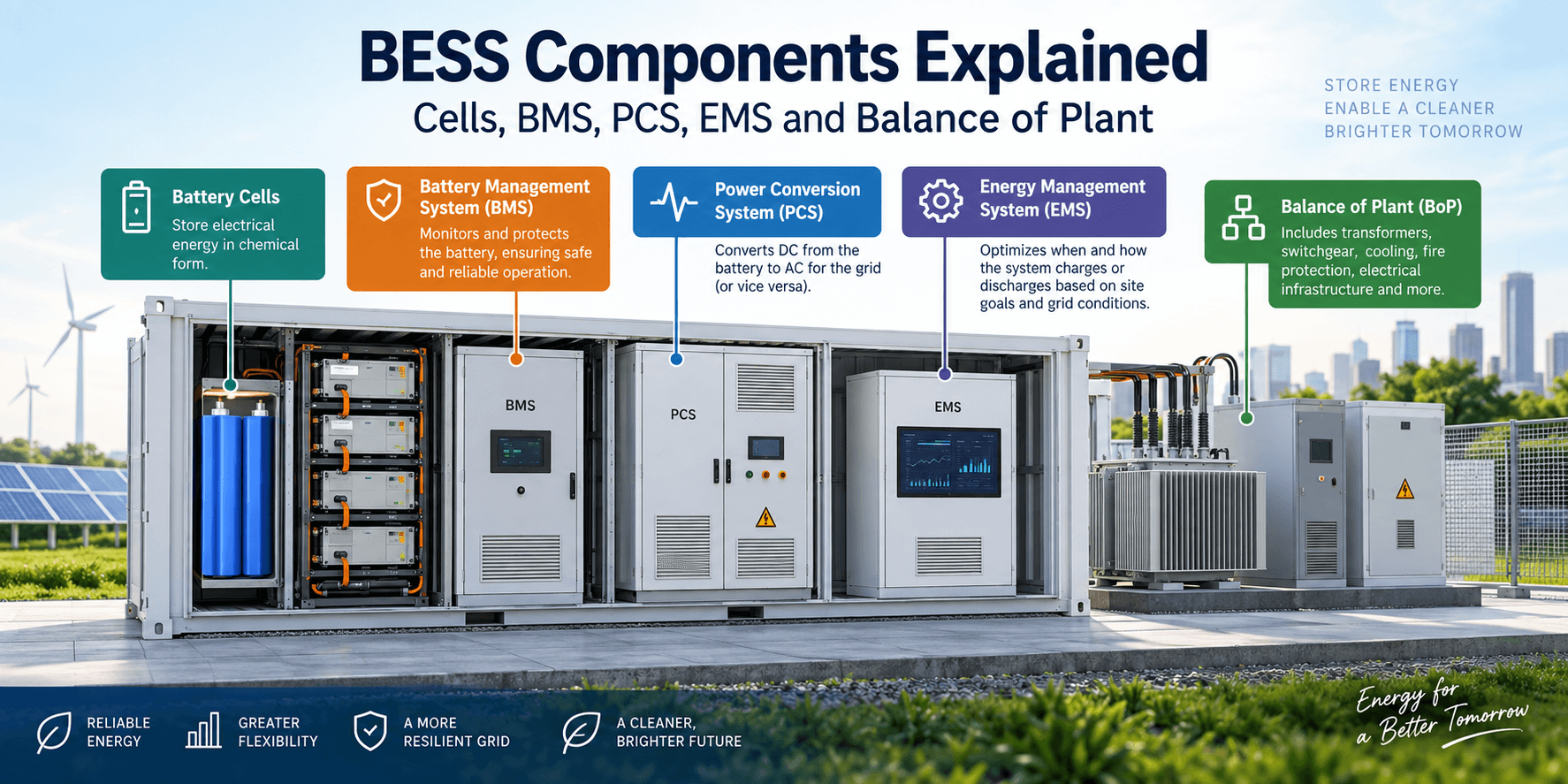
A battery energy storage system (BESS) is more than a collection of batteries. It is an integrated system that stores electrical energy, manages battery health, converts power between AC and DC, controls charging and discharging, and keeps the installation safe.
The main BESS components are battery cells, the battery management system (BMS), power conversion system (PCS), energy management system (EMS), and balance of plant (BoP). Each has a distinct role, but they must work together for the system to operate safely and efficiently.
This guide explains what each component does, how they interact, and why each one matters when designing, buying, or operating a BESS.
BESS components at a glance
A typical BESS can be viewed as several layers:
- Battery cells: Store electrical energy.
- Battery modules and racks: Organize cells into usable battery assemblies.
- BMS: Monitors and protects the batteries.
- PCS: Converts electricity between AC and DC.
- EMS: Decides when and how the system should charge or discharge.
- Balance of plant: Provides the electrical, mechanical, thermal, safety, and site infrastructure needed to operate the system.
- Grid connection equipment: Connects the BESS to the facility or electrical grid.
The exact architecture varies by project. A small commercial battery system may combine several functions into one enclosure, while a utility-scale BESS can have dedicated equipment for each layer.
1. Battery cells: where energy is stored
Battery cells are the fundamental energy storage units inside a BESS.
A cell uses electrochemical reactions to store energy and release it as electricity. Multiple cells are connected in series and parallel to achieve the required voltage, capacity, current, and power characteristics.
Lithium-ion technology dominates many modern BESS installations, although different lithium-ion chemistries can be used depending on the application.
How cells become a battery system
Individual cells are generally assembled into a hierarchy:
Cell → Module → Rack → Battery system
A module contains multiple cells. Several modules can form a rack, and multiple racks can make up the battery portion of a larger BESS.
This architecture allows manufacturers to scale the system while incorporating monitoring and protection at different levels.
Key battery cell characteristics
When evaluating cells for a BESS, important parameters include:
- Energy capacity
- Nominal voltage
- Operating voltage range
- Maximum charge and discharge current
- Energy density
- Cycle life
- Round-trip efficiency
- Operating temperature range
- Calendar life
- Degradation characteristics
- Safety characteristics
The right cell is not necessarily the one with the highest energy density. For stationary storage, factors such as safety, lifetime, operating conditions, cost, and degradation can be equally important.
2. Battery Management System (BMS): the battery’s protection layer
The Battery Management System (BMS) monitors and manages the battery.
Its job is to keep the battery operating within defined electrical and thermal limits while providing information about its condition to higher-level control systems.
A BMS typically monitors parameters such as:
- Cell voltage
- Pack or module voltage
- Current
- Temperature
- State of charge (SOC)
- State of health (SOH)
- Fault conditions
- Charging and discharging limits
What does the BMS actually do?
One of its most important functions is protection.
If a cell or module moves outside an acceptable operating range, the BMS can trigger warnings, limit current, or initiate protective shutdown procedures, depending on the system architecture.
The BMS may also perform cell balancing. Cells in a series-connected battery can develop slightly different voltage and state-of-charge characteristics over time. Balancing helps keep cells within an appropriate operating range.
BMS and battery life
The BMS does not prevent battery degradation entirely. However, appropriate monitoring and control can help avoid operating conditions that accelerate degradation.
For example, repeatedly exposing cells to excessive temperatures, current, or unsuitable voltage limits can negatively affect battery performance and lifetime.
This makes BMS data important not only for safety, but also for asset management and operational decisions.
3. Power Conversion System (PCS): connecting DC batteries to AC power
Battery cells store energy as DC electricity. Most buildings and electrical grids operate using AC electricity.
The Power Conversion System (PCS) provides the interface between these two domains.
During charging:
AC → PCS → DC → Battery
During discharging:
Battery → DC → PCS → AC
The PCS therefore plays a central role in determining how much power the BESS can import or export.
What does a PCS do?
Depending on the system design, the PCS can handle functions such as:
- AC/DC power conversion
- DC/AC power conversion
- Charging control
- Discharging control
- Power factor control
- Reactive power control
- Grid support functions
- Voltage and frequency response
- Electrical protection and fault handling
The PCS is often specified in terms of power, such as MW, while the battery is also described in terms of energy, such as MWh.
For example, a system might have a nominal rating of 10 MW / 20 MWh. In simple terms, it can deliver up to 10 MW of power and has 20 MWh of stored energy under the applicable operating conditions.
The relationship between power and energy is important when sizing a BESS for applications such as peak shaving, frequency regulation, renewable energy shifting, or backup power.
4. Energy Management System (EMS): the system’s decision layer
The Energy Management System (EMS) operates at a higher level than the BMS.
While the BMS focuses on battery-level monitoring and protection, the EMS determines how the overall BESS should operate based on its objectives and available information.
For example, an EMS may determine that the battery should:
- Charge when electricity prices are low.
- Hold energy during a high-value period.
- Discharge when prices rise.
- Maintain a reserve for backup.
- Respond to a grid or site power requirement.
The exact strategy depends on the project.
BMS vs. EMS
The distinction can be simplified as follows:
| System | Primary role |
|---|---|
| BMS | Protects and manages the battery |
| PCS | Converts and controls electrical power |
| EMS | Coordinates system operation and energy strategy |
The EMS may communicate with the BMS and PCS, but it does not replace either one.
A useful way to think about the architecture is:
BMS = Is the battery safe to operate?
PCS = How do we move electrical power?
EMS = When and why should we move that power?
5. Balance of Plant (BoP): everything that makes the BESS work
Balance of plant, often abbreviated as BoP, refers broadly to the supporting equipment and infrastructure required to operate the BESS.
The exact definition varies between projects and suppliers. It can include electrical, mechanical, thermal, civil, communications, and safety systems.
Common BoP elements include:
- Transformers
- Switchgear
- Circuit breakers
- Disconnects
- Protection equipment
- Cabling and busbars
- HVAC or liquid cooling systems
- Fire detection and suppression systems
- Auxiliary power systems
- Control and communications networks
- Enclosures or containers
- Racks and mechanical structures
- Site monitoring equipment
- Grounding systems
- Security and access systems
In larger projects, the BoP can represent a substantial portion of the engineering and installation effort.
Why BoP matters
A battery can have excellent technical specifications and still fail to deliver the expected project performance if the surrounding infrastructure is poorly designed.
For example, inadequate thermal management can affect battery performance and lifetime. Incorrect electrical protection can create safety and reliability risks. Poor communications architecture can make it difficult to monitor or control the system.
BoP is therefore not simply an accessory to the battery. It is part of the system required to turn battery cells into a functioning energy asset.
6. How the main BESS components work together
A simplified BESS architecture looks like this:
Grid / Building
↓
Transformer and Switchgear
↓
PCS
↕
DC Bus
↕
Battery Racks
↓
Battery Modules
↓
Battery Cells
Meanwhile:
BMS → monitors and protects the battery
EMS → coordinates overall operation
BoP → supports electrical, thermal, mechanical, safety, and site requirements
The actual architecture can be more complex. Utility-scale systems may have multiple battery containers, PCS units, transformers, switchgear assemblies, and layers of supervisory controls.
7. BMS, PCS and EMS: what is the difference?
These three systems are sometimes confused because they all participate in BESS control.
Their responsibilities are different.
BMS
The BMS operates close to the battery.
It monitors individual cells or modules, calculates battery operating parameters, manages protection functions, and communicates battery status and limits to other systems.
PCS
The PCS operates at the electrical power interface.
It controls the conversion and flow of electrical power between the battery’s DC side and the AC system.
EMS
The EMS operates at the system or site level.
It coordinates the BESS according to operational objectives, such as energy arbitrage, peak demand management, renewable energy integration, or grid services.
A simple analogy is:
BMS: Protect the battery.
PCS: Control the flow of electricity.
EMS: Coordinate the operation.
8. Why thermal management is a critical BESS component
Battery performance is strongly influenced by temperature.
A BESS therefore needs a thermal management system designed to keep battery components within their permitted operating range.
Depending on the system, thermal management may use:
- Air cooling
- Liquid cooling
- Refrigeration
- Heating systems
- Fans and ventilation
- Pumps and heat exchangers
Thermal management affects more than comfort inside the enclosure. It can influence battery performance, degradation, efficiency, and safety.
For large systems, thermal design should account for operating conditions, ambient temperature, heat generation, enclosure layout, and the required operating profile.
9. Safety systems in a BESS
Safety is distributed across multiple layers rather than handled by one component.
The BMS provides electrical and battery-level protection. The PCS and electrical equipment provide additional protection on the power side. Thermal management helps control operating temperature, while dedicated detection and suppression systems can address fire-related risks.
Depending on the installation, a BESS may include:
- Smoke detection
- Gas detection
- Temperature monitoring
- Fire detection
- Fire suppression
- Emergency shutdown systems
- Ventilation
- Electrical isolation
- Access control
- Remote monitoring
The appropriate configuration depends on the battery technology, system design, local regulations, installation environment, and applicable safety standards.
10. What to consider when evaluating BESS components
When comparing BESS suppliers or system designs, looking only at battery capacity can be misleading.
A more complete evaluation should consider the interaction between the major components.
Battery
Look at:
- Chemistry
- Usable energy
- Degradation assumptions
- Cycle life
- Warranty terms
- Temperature limits
- Operating window
BMS
Consider:
- Monitoring capabilities
- Cell-level visibility
- Protection functions
- SOC and SOH estimation
- Balancing approach
- Communication interfaces
- Fault handling
PCS
Evaluate:
- Rated power
- Efficiency
- Operating voltage range
- Reactive power capability
- Grid-support functions
- Response time
- Protection features
- Grid-code compliance
EMS
Look at:
- Dispatch capabilities
- Forecasting
- Optimization logic
- Integration with renewable generation
- Utility or market interfaces
- Remote monitoring
- Reporting and analytics
Balance of plant
Consider:
- Transformers and switchgear
- Cooling
- Fire protection
- Auxiliary power
- Communications
- Site layout
- Maintenance access
- Environmental conditions
11. Why the complete BESS architecture matters
A BESS is an integrated system, not simply a battery connected to a grid.
A high-capacity battery needs appropriate power conversion equipment. The PCS needs a control system that can coordinate operation. The BMS needs reliable monitoring and protection. All of these systems need supporting electrical, thermal, communication, and safety infrastructure.
The performance of the complete system is therefore influenced by how well its components work together.
For project developers and buyers, this means evaluating system-level performance, not just individual component specifications.
Key questions include:
- How much energy is actually usable?
- What power can the system deliver under the required conditions?
- How will battery degradation affect performance over time?
- What are the thermal operating limits?
- How do the BMS, PCS, and EMS communicate?
- What happens when a component fails?
- What safety systems are included?
- What are the warranty and performance guarantees?
- How easy is the system to monitor and maintain?
12. Final takeaway
The five core elements of a BESS each perform a different job.
Cells store the energy.
The BMS monitors and protects the battery.
The PCS converts and controls electrical power.
The EMS coordinates when and how the system operates.
The balance of plant provides the infrastructure that allows everything else to operate safely and reliably.
Understanding these layers makes it easier to compare BESS architectures, assess supplier proposals, and identify where performance, safety, and lifecycle costs come from.