
EV DC Fast Charger Manufacturing: What OEMs Need from a Contract Partner

Two quotations can describe a 120 kW DC fast charger and still cover very different products. One may include the enclosure, power modules, controller, and final testing. Another may assume the OEM supplies the firmware, arranges validation, and takes responsibility for integration. The headline rating tells you little about where one team’s work ends and another’s begins.
That boundary matters when an original equipment manufacturer (OEM) moves from a working prototype to repeatable production. A charger has to bring power electronics, mechanical assemblies, software, and protection functions together. Buying each part against a specification is only the beginning.
This guide helps procurement, engineering, and supplier-quality teams at Indian charger OEMs define what to outsource, assess a contract partner’s evidence, and compare costs for 60–240 kW programmes. It also explains which responsibilities need clear ownership, with manufacturing principles that remain useful internationally and standards that must be checked for each destination market.
India’s DC Fast Charging Demand and the OEM Manufacturing Decision
For an OEM, the useful demand question is specific: which vehicles, locations, and operating patterns will the charger serve? A highway location, an urban public site, and a fleet depot can lead to different requirements for output sharing, cable handling, connectivity, and maintenance access.
Translate that use case into a product specification before approaching DC fast charger manufacturers. State the output voltage and current ranges, connector arrangement, expected ambient conditions, duty cycle, and required communications. Clarify whether the quoted power is available to one vehicle or shared across outlets.
Then connect the product to a production plan. A pilot batch, recurring monthly orders, and a multi-location rollout need different material commitments and test capacity. Give prospective partners realistic volume bands and a ramp-up sequence, rather than an unsupported peak forecast. This helps them explain what they can support and where investment or supplier qualification is still required.
Inside a DC Fast Charger: Components and Interfaces
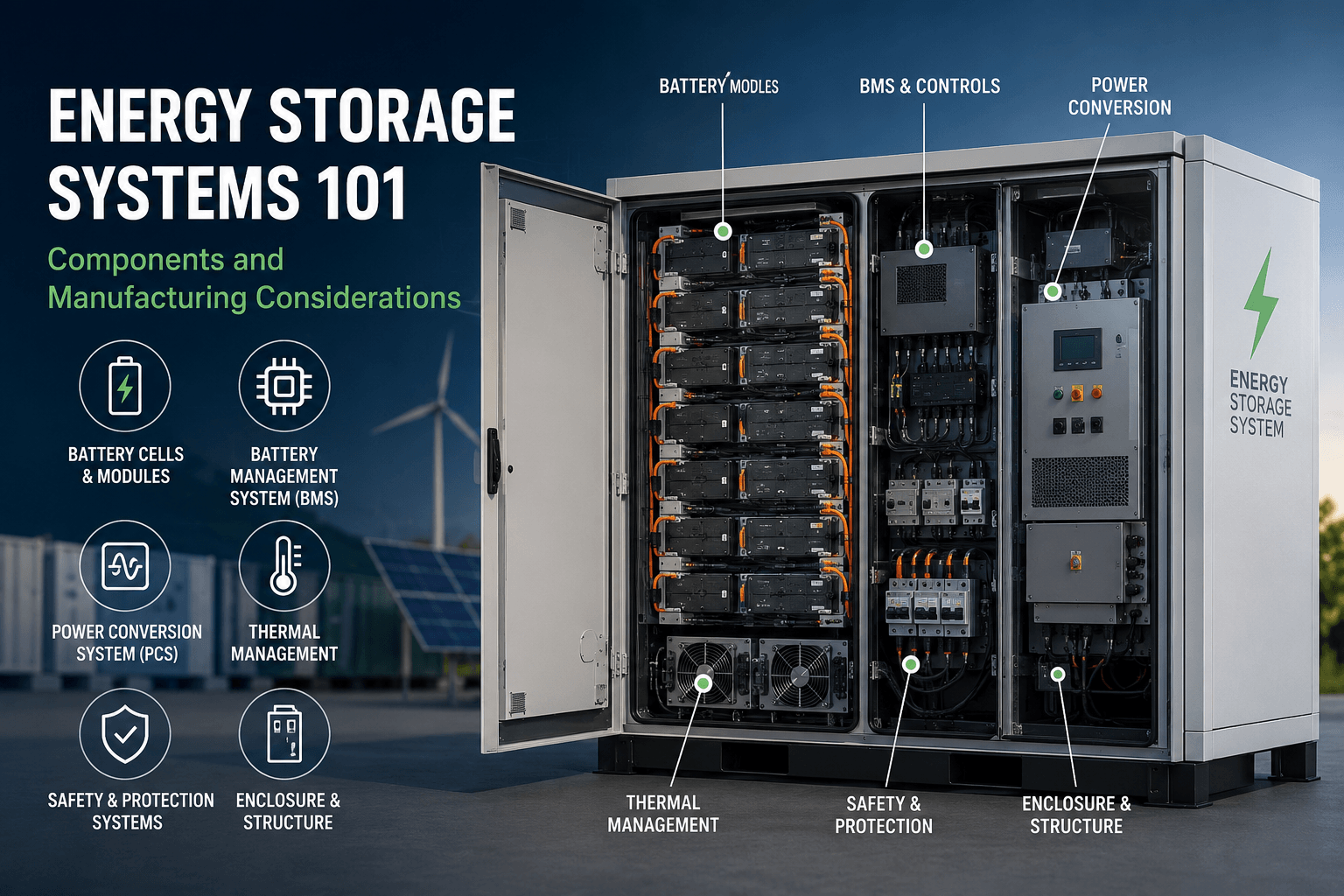
A conventional grid-fed DC fast charger converts incoming AC power into controlled DC power for the vehicle. Its control system coordinates charging, monitors operating conditions, and communicates with the vehicle and the charging-management backend.
The main sourcing packages are closely connected:
- Power modules convert and regulate electrical power. Their operating ranges and interfaces must fit the complete charger.
- Control electronics coordinate charging and communicate with other systems. Firmware versions and configuration settings belong in the product definition.
- Protection, sensing, and switching assemblies support the electrical safety design and controlled operation.
- Cables and connectors carry power to the vehicle and support the specified connection interface.
- Enclosures and cooling arrangements protect and manage the operating environment of the equipment.
- Displays, metering, and connectivity hardware support the agreed-upon user and operator functions.
The buyer’s task is to check the interfaces between these packages. For example, ask how the team validates airflow after fitting filters, cable routes, and doors. Request evidence for the assembled configuration and its operating conditions, rather than accepting a component datasheet as proof of whole-charger performance.
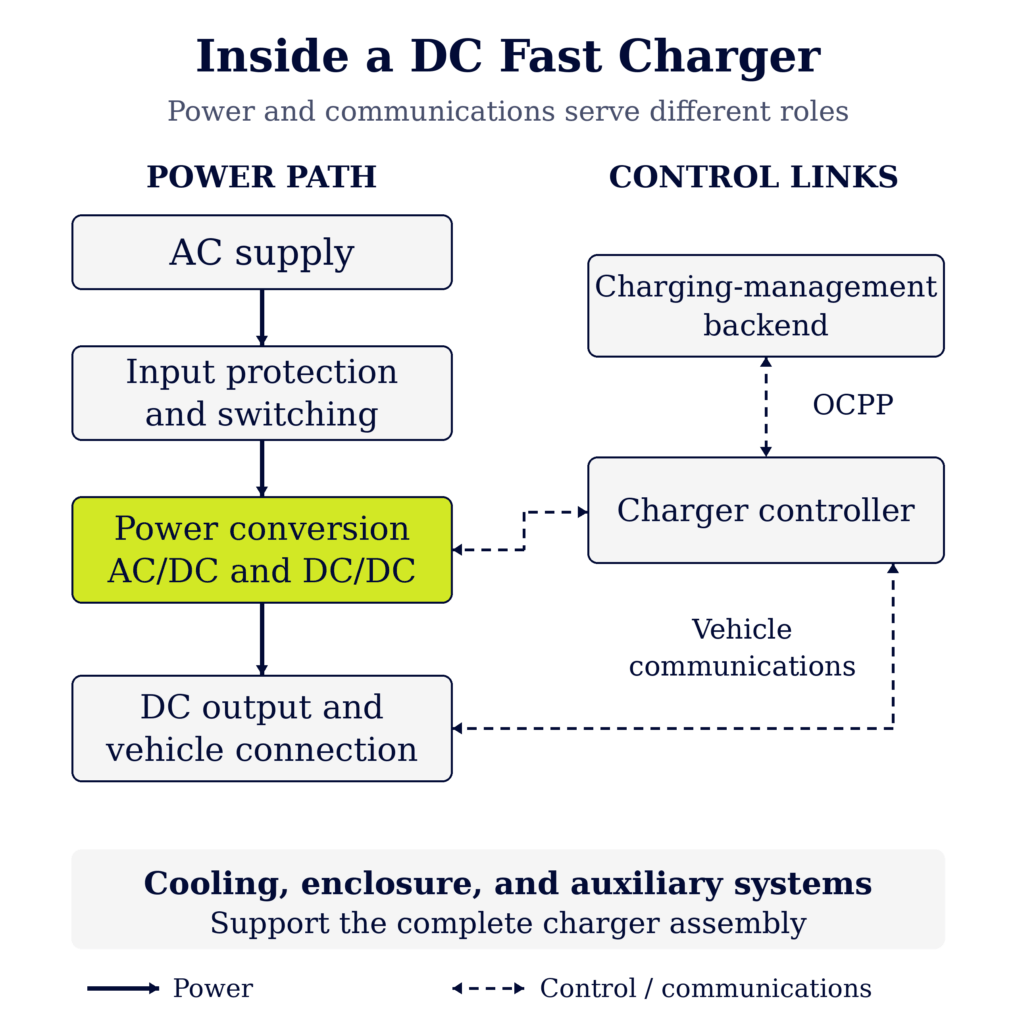
Functional overview of a conventional AC-fed DC charger. OCPP means Open Charge Point Protocol. Cooling and enclosure design support the complete assembly; this is not a wiring or protection-design drawing.
What OEMs Can Outsource and What They Must Define
An OEM can outsource printed circuit board assembly (PCBA), enclosure fabrication, wiring harnesses, procurement, integration, and final assembly. The scope can also include design support, firmware work, and validation management where the partner’s capability and the commercial agreement support those tasks.
Start by distinguishing between manufacturing that relies on an OEM-controlled design and a programme in which the partner contributes to product development. Both arrangements need an agreed design baseline, approved components, acceptance criteria, and access to the records required to support the product.
The key outsourcing decision is who owns system integration, validation evidence, and change control, alongside who manufactures each component. The OEM need not perform every task internally, but each task needs a named accountable party.
Use a responsibility matrix before placing the production order:
| Workstream | What the agreement should settle |
| Product definition | Who approves drawings, specifications, interfaces, and the bill of materials |
| Component sourcing | Who selects suppliers, approves alternatives, and handles shortages |
| System integration | Who resolves mechanical, electrical, and software interface issues |
| Firmware and configuration | Who controls releases, access rights, and production programming |
| Validation evidence | Who commissions tests, holds reports, and reviews configuration coverage |
| Production release | Who approves pilot results, acceptance limits, and shipment records |
| Changes and field failures | Who authorises changes, assesses retesting, investigates faults, and implements corrections |
Consider a hypothetical power-module substitution. While the replacement may fit physically and have the same nominal rating, it will still require a review of its communications, thermal behaviour, and the effect on existing evidence. Agree on who assesses that change before production encounters a shortage.
Standards, Testing, and OCPP: What Evidence Should OEMs Request?
Avoid accepting a single statement such as “ARAI/BIS/OCPP approved”. Ask what was assessed, against which requirements, and for which product configuration.
Applicable standards and their editions
The BIS compendium on EV charging infrastructure identifies IS 17017 Part 1 for general requirements and Part 23 for DC electric vehicle supply equipment (EVSE). It also covers connector, communications, and electromagnetic-compatibility standards. This serves as a starting point for creating the list of applicable standards, but it does not provide evidence that a specific charger complies.
For international specifications, IEC 61851-23:2023 addresses DC EV supply equipment. Do not assume that an IEC edition automatically matches the applicable Indian adoption or is mandatory in every market. Have the responsible technical team confirm the standards, editions, amendments, and conformity route for the intended product and destination.
Laboratory reports and product coverage
If a supplier presents ARAI or another laboratory’s evidence, request the actual document. Check the issuer, report or certificate number, tested model, ratings, applicable standards, results, and stated limitations. Establish whether the production configuration falls within the assessed scope.
Keep laboratory testing, a certification scheme, and a tender’s acceptance conditions distinct. A laboratory report should not be presented as a BIS licence. Equally, a certificate for one model should not be assumed to cover an entire product family. Consult the issuing body for clarification on coverage instead of relying on a sales summary.
OCPP conformance and backend integration
The Open Charge Point Protocol (OCPP) concerns communication between charging stations and charging-management systems. OCPP certification does not replace electrical-safety assessment. Specify the protocol version and required functions, then agree how the charger will be tested with the intended backend.
Follow the Open Charge Alliance’s guidance on verifying OCPP certificates: check the certification number and the official certified-product listing. Separately request integration evidence for the functions your operator needs, such as authorisation, transaction reporting, remote commands, and agreed recovery behaviour after connectivity interruptions.
How to Evaluate a DC Fast Charger Manufacturing Partner
A factory presentation is a useful introduction. Supplier approval needs evidence tied to your product and production plan. Structure the review around the following checks.
Engineering and thermal-validation capability
Ask who will review design-for-manufacture issues, resolve integration problems, and support engineering changes. Request relevant examples, as experience in assembling electronics may not fully demonstrate comprehensive charger-development capability.
For thermal performance, ask for the ambient conditions, load profile, test duration, measured temperatures, and power-reduction behaviour used in validation. Check that the evidence reflects the enclosure and cooling configuration being purchased. A demonstration at an unspecified temperature is difficult to compare with a documented test.
Production tests and traceability
Agree on the checks performed on every unit and distinguish them from design-validation or sample-based tests. Request the proposed test plan, acceptance limits, equipment calibration records, and failure-handling process. Have qualified engineers determine the required electrical-safety and functional tests.
Records should let the buyer connect a shipped serial number to its approved hardware configuration, firmware release, test results, and relevant component batches. Ask the supplier to demonstrate the retrieval process using a sample record. Traceability is more useful when records can actually be found and interpreted.
Supply-chain controls and scale
Review approved suppliers, incoming inspection, storage controls, and the process for identifying obsolete or constrained parts. Establish how proposed alternatives reach the OEM for approval.
For capacity, look beyond assembly-floor space. Ask about test-station throughput, trained operators, material availability, rework capacity, and the bottleneck at the proposed product mix. Agree on measurable pilot-release conditions before increasing order volumes.
Service, warranty, and access
Define who diagnoses faults, supplies spares, repairs assemblies, and supports firmware updates. Set response expectations, escalation contacts, warranty boundaries, and access to diagnostic information in the agreement.
Before approval, request the following minimum decision pack:
| Evidence | What the OEM should establish |
| Scope and responsibility matrix | Each deliverable and interface has an owner |
| Controlled product baseline | Drawings, components, firmware, and configurations are identifiable |
| Validation and conformity documents | Evidence is relevant to the proposed model and market |
| Pilot-build and test records | Acceptance criteria can be applied consistently |
| Ramp-up and support plan | Capacity, dependencies, spares, and escalation arrangements are credible |
Cost Drivers for 60–240 kW DC Fast Chargers
Power rating is one cost input. To compare quotations, first align the output voltage and current ranges, number of connectors, simultaneous-charging behaviour, and required communications. Then examine cooling, enclosure construction, environmental requirements, testing, and support scope.
A quotation comparison should separate four groups:
- Recurring equipment cost: the agreed hardware, assembly, programming, and production checks.
- One-time programme costs: engineering, tooling, fixtures, validation work, and certification activities where applicable.
- Commercial and lifecycle costs: minimum order quantities, inventory commitments, warranty, spares, software services, and repair support.
- Site costs: civil works, electrical infrastructure, utility connection, installation, and commissioning, according to the project scope.
Avoid comparing a factory-supply quotation with a turnkey installed price. List taxes, freight, exclusions, payment terms, and delivery assumptions as separate items. For a programme with several power variants, ask which engineering and tooling costs are shared and which recur.
The same discipline applies to a 50 kW DC fast charger price enquiry. Without the configuration and supply boundary, a price offers little guidance for an OEM sourcing decision. Request a quotation against a common specification instead of treating unrelated advertised prices as a benchmark.
Localisation also needs to be defined. Ask which assemblies are made locally, which components are imported, and how any stated local-content percentage is calculated. Assess the resulting supplier dependencies and support arrangements alongside purchase price.
Final Thoughts: Choosing the Right DC Charger Manufacturing Partner
A useful shortlist brings together engineering fit, relevant test evidence, controlled production, and credible support. Compare partners against the same configuration and commercial scope. Above all, make ownership of integration, validation records, and product changes explicit; those responsibilities need to remain clear after the first batch ships.
Contact ZETWERK’s electronics manufacturing experts to discuss your DC fast charger programme, from component sourcing and assembly to testing, packaging, and distribution. Share your specifications, expected volumes, and delivery requirements to explore an end-to-end contract manufacturing solution and request a programme-specific quotation.
Frequently Asked Questions (FAQs)
What can an OEM outsource to a DC fast charger manufacturing partner?
An OEM can outsource PCBA, enclosures, harnesses, component procurement, integration, and final assembly. Design support, firmware work, and validation management can also be included when capability and scope are agreed. Define deliverables, acceptance criteria, evidence access, and change authority for each work package.
Does OCPP certification cover electrical safety?
No. OCPP certification concerns the conformance of the protocol implementation within its certified scope. Electrical safety requires separate assessment against applicable requirements. The OEM should review both the relevant safety evidence and the protocol version and functions needed for the intended charging-management system.
Is an ARAI test report the same as BIS certification?
No. A laboratory test report records the assessment described in that document; it is not automatically a BIS certification licence. Check the document’s issuer, tested configuration, standards, results, and scope. Confirm separately which conformity route and procurement requirements apply to the charger.
Can a component or firmware change affect existing validation evidence?
Yes. A change can affect the relevance of previous results, although it does not automatically mean every test must be repeated. Have the responsible engineering team assess the impact, document its reasoning, and obtain the issuing laboratory’s or certification body’s guidance where applicable before releasing the change.
What production-test records should an OEM request?
Request serial-number-linked results for the agreed acceptance plan, together with the hardware configuration, firmware version, test-equipment identification, and disposition of failures or rework. The exact tests and limits should be defined by qualified engineers for the applicable product requirements and contract.
Why do DC fast charger quotations with the same kW rating differ?
They can cover different voltage and current ranges, connector arrangements, cooling systems, environmental requirements, validation work, and support commitments. Volumes and commercial terms also affect the offer. Compare quotations against one controlled specification and an explicit list of inclusions and exclusions.
Does the charger quotation include installation and grid-connection costs?
Not necessarily. An equipment-supply quotation may exclude civil works, electrical infrastructure, utility connection, installation, and commissioning. A turnkey offer may include some or all of these items. Require separate cost lines and clear responsibility boundaries so the equipment price can be compared fairly with the installed project cost.