Battery Cell Manufacturing in India: PLI-ACC, Gigafactories and Localisation of BESS
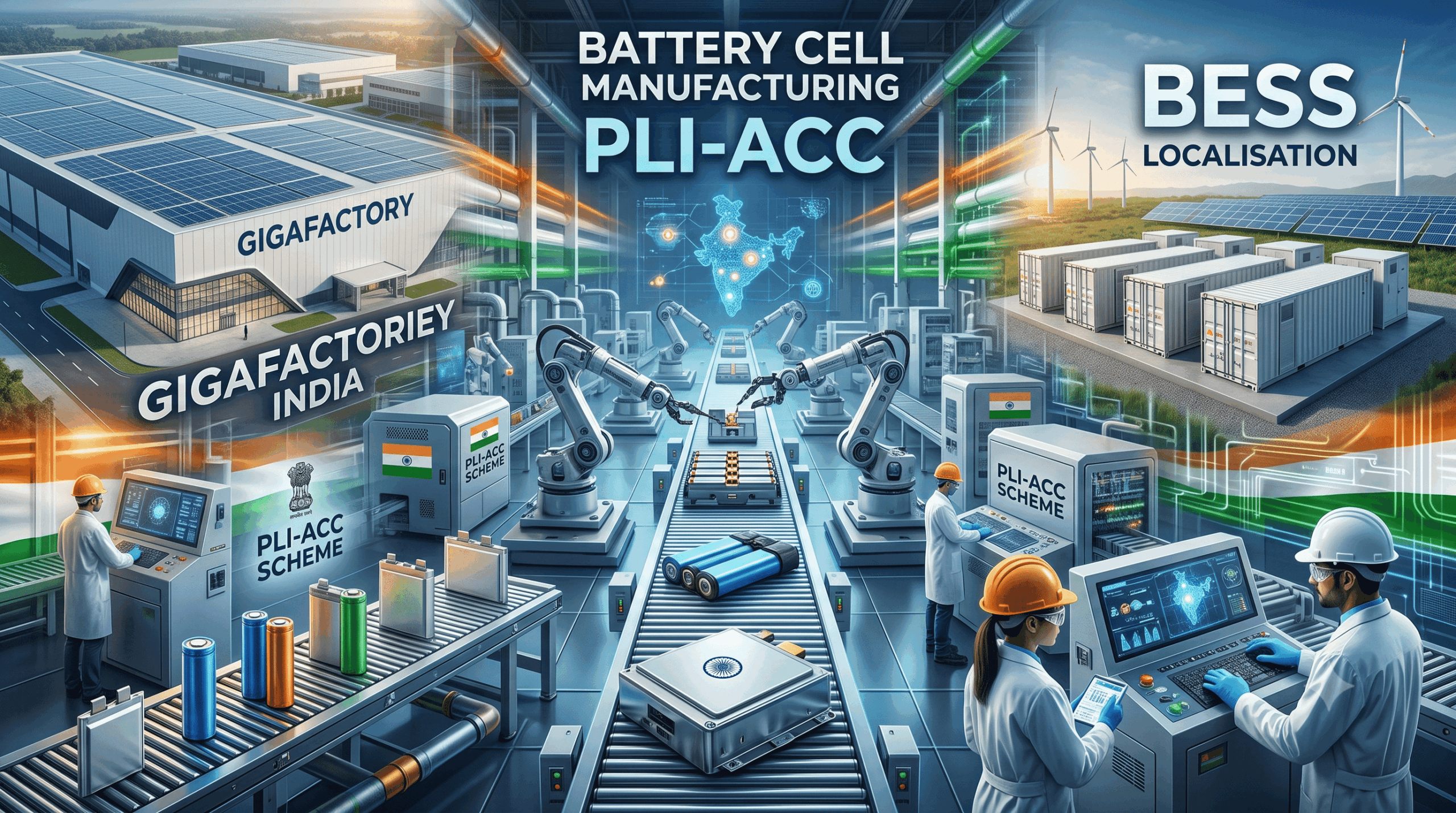
India’s battery manufacturing industry is entering a critical phase. Government incentives, investments in gigafactories, rising renewable energy capacity, and growing demand for grid-scale storage are creating opportunities across the battery value chain. Yet the gap between announced manufacturing capacity and operational cell production remains a major challenge.
The government’s ₹18,100 crore Production Linked Incentive (PLI) scheme for Advanced Chemistry Cells (ACC) aims to establish 50 GWh of domestic cell manufacturing capacity. By March 2026, 40 GWh had been awarded to four companies, but only 1 GWh of capacity had been installed under the scheme. A separate 10 GWh allocation for grid-scale stationary storage applications is now being pursued.
For battery manufacturers, renewable energy developers, utilities, and investors, the opportunity is no longer just about building factories. It is about creating a competitive domestic ecosystem that can manufacture cells, source materials locally, integrate battery energy storage systems, and deliver reliable storage at scale.
Key Takeaways
- PLI-ACC is a major policy driver: The ₹18,100 crore scheme is designed to build domestic advanced battery cell manufacturing capacity and reduce import dependence.
- Gigafactory execution matters more than announcements: Installed capacity, production yields, and commercial output will determine how quickly India builds a competitive industry.
- BESS creates a distinct growth opportunity: Grid-scale battery storage has different technical and commercial requirements from electric vehicle batteries.
- Localisation extends beyond cell assembly: Materials, battery management systems, power conversion systems, thermal management, software, and recycling all matter.
- Supply chain development is essential: Domestic manufacturing must reduce exposure to imported cells, processed minerals, components, and production technology.
1. Why Battery Cell Manufacturing Matters for India
Battery cells are a core component of India’s energy transition. They support electric mobility, renewable energy integration, grid balancing, backup power, and commercial and industrial energy management.
India has developed capabilities in battery pack assembly and downstream integration. However, manufacturing advanced battery cells at scale requires more specialised technology, capital, process control, and access to raw materials.
This distinction is important. A company can assemble battery packs domestically while relying on imported cells. That creates local manufacturing activity, but it leaves a substantial share of the product’s value and supply chain exposure outside India.
Domestic cell production can help address several strategic priorities:
- Reduce dependence on imported advanced chemistry cells.
- Build domestic expertise in electrochemistry and manufacturing processes.
- Develop suppliers for battery materials and components.
- Create skilled jobs in engineering, production, and quality assurance.
- Improve supply chain resilience for electric mobility and stationary storage.
- Establish capabilities that can support future battery technologies.
The commercial case, however, depends on more than import substitution. Indian manufacturers must also achieve competitive costs, consistent quality, reliable production yields, and enough demand to keep their factories operating efficiently.
2. Understanding the PLI-ACC Scheme
The Production Linked Incentive scheme for Advanced Chemistry Cell Battery Storage was approved in May 2021 with a budgetary outlay of ₹18,100 crore. Its original objective was to establish 50 GWh of domestic ACC manufacturing capacity and encourage investment in large-scale battery production.
How the PLI-ACC scheme works
Unlike a grant that simply reimburses factory construction, a production-linked incentive is designed to reward qualifying manufacturing performance. The scheme encourages companies to establish manufacturing facilities, meet committed capacity and investment requirements, and increase domestic value addition.
Key design features include:
- A total programme outlay of ₹18,100 crore.
- A targeted 50 GWh of ACC manufacturing capacity.
- Requirements for investment in manufacturing facilities.
- Minimum domestic value addition that increases over time.
- Incentives linked to qualifying manufacturing performance and scheme conditions.
Under the published scheme framework, beneficiaries must achieve at least 25% domestic value addition initially and raise it to 60% within five years, subject to the applicable programme structure and conditions.
PLI-ACC allocation and implementation status
The distinction between allocated capacity and operational capacity is central to assessing the scheme’s progress.
Total programme target
50 GWh
Capacity awarded
40 GWh
Capacity installed by March 2026
1 GWh
Separate grid-storage allocation
10 GWh
Sources: Ministry of Heavy Industries and Press Information Bureau, 2026. The 10 GWh grid-storage allocation is part of the wider 50 GWh programme, not an additional 10 GWh on top of it.
The figures show that India has made progress in allocating manufacturing capacity, but scaling operational production remains the immediate challenge.
The government announced a separate process in July 2026 to select manufacturers for 10 GWh of ACC capacity dedicated to grid-scale stationary storage. The published tender schedule sets 13 October 2026 as the bid submission deadline.
What the scheme means for manufacturers
For companies evaluating battery manufacturing investments, PLI-ACC can improve the policy framework for long-term capacity development. However, incentives alone do not guarantee commercial success.
Manufacturers still need to secure technology, production equipment, raw materials, customer contracts, skilled employees, and sufficient working capital. They also need to prove that their cells can meet customer specifications consistently at commercially viable costs.
For suppliers, the scheme offers a related opportunity. As cell production expands, demand may grow for cathode and anode materials, current collector foils, separators, electrolytes, manufacturing equipment, testing systems, and recycling services.
The scale of this opportunity will depend on actual factory commissioning and production ramp-up, rather than announced capacity alone.
3. India’s Gigafactory Landscape: From Announcements to Production
A gigafactory is a large-scale battery manufacturing facility, typically designed to produce cells at gigawatt-hour scale annually. These facilities require substantial capital investment, specialised production equipment, process expertise, and a dependable supply of materials.
India’s emerging gigafactory ecosystem includes projects supported by the PLI-ACC scheme as well as investments announced by manufacturers outside the programme.
Major PLI-ACC beneficiaries
The following table summarises the four companies awarded capacity under the scheme, based on government disclosures in March 2026.
| Company | Awarded capacity | Location |
|---|---|---|
| Ola Cell Technologies | 20 GWh | Krishnagiri, Tamil Nadu |
| ACC Energy Storage | 5 GWh | Dharwad, Karnataka |
| Reliance New Energy Battery Storage | 5 GWh | Jamnagar, Gujarat |
| Reliance New Energy Battery | 10 GWh | Jamnagar, Gujarat |
| Total | 40 GWh |
Source: Ministry of Heavy Industries, government disclosures dated February and March 2026. Awarded capacity does not represent fully commissioned production capacity.
These projects illustrate how battery manufacturing is developing across several industrial regions. Their progress will influence supplier investment, workforce development, logistics networks, and the availability of domestically produced cells.
Why factory commissioning is only the first milestone
A battery factory does not become commercially competitive as soon as its production line is installed. Manufacturers must move through several stages before reaching stable output.
1. Plant construction and equipment installation
Facilities, dry rooms, coating equipment, formation systems, and production utilities must be commissioned and qualified.
2. Process development and yield improvement
Manufacturers need to reduce defects, improve consistency, and increase the share of cells that meet specifications.
3. Product qualification
Cells must demonstrate safety, performance, durability, and consistency for their intended applications.
4. Commercial production at scale
The factory must sustain output, meet delivery commitments, control costs, and maintain reliable customer demand.
For investors and industrial buyers, these milestones are more useful than a headline capacity figure alone. A plant with lower nameplate capacity but reliable output may be a stronger commercial proposition than a much larger facility still working through commissioning issues.
The economics of scale
Large production volumes can spread fixed costs across more cells and improve equipment utilisation. They can also strengthen purchasing power and support investment in automation and quality control.
However, scale introduces its own risks. A manufacturer that builds capacity faster than demand develops may face low utilisation, high financing costs, and pressure to cut prices.
Successful gigafactories therefore need to align three elements:
- Technology readiness: Production processes must deliver consistent cells.
- Demand visibility: Customer commitments should support realistic utilisation targets.
- Supply chain resilience: Critical materials and components must be available at predictable cost and quality.
The next phase of India’s battery manufacturing growth will depend on how effectively companies balance these factors.
4. Battery Energy Storage Systems Are Creating a New Demand Market
Battery energy storage systems, commonly known as BESS, store electricity and discharge it when required. They can help manage the variability of renewable energy, reduce peak demand, support grid stability, and provide backup power.
Unlike an electric vehicle battery, which is designed around vehicle range, weight, charging, and driving conditions, a stationary storage battery is often evaluated on its usable energy, power output, efficiency, cycle life, safety, and lifetime cost.
This difference creates an important opportunity for Indian cell manufacturers.
Why grid-scale storage matters
Solar and wind generation do not always match electricity demand. Solar output, for example, typically peaks during daylight hours, while evening demand can remain high.
A BESS can store electricity during periods of surplus generation and release it during periods of higher demand. Depending on its configuration, it can also provide frequency response, ramping support, and other grid services.
For developers and utilities, the commercial case depends on the value of the services delivered, the cost of charging energy, system efficiency, degradation, and the revenue or savings available under the project structure.
India’s dedicated 10 GWh grid-storage manufacturing allocation
The government’s July 2026 tender for 10 GWh of ACC manufacturing capacity earmarked for grid-scale stationary storage is a significant policy development. It recognises stationary storage as a distinct market rather than treating battery manufacturing solely as an electric mobility opportunity.
This dedicated allocation could help manufacturers align cell design and production plans with stationary storage requirements.
Potential priorities include:
- Long service life under repeated charge and discharge cycles.
- Strong thermal stability and appropriate safety design.
- Competitive cost per unit of usable energy.
- Reliable performance under Indian operating conditions.
- Compatibility with battery management and energy management systems.
- Serviceability and predictable end-of-life handling.
The commercial impact will depend on the selected manufacturers, their commissioning schedules, and the availability of bankable storage projects.
Choosing the right battery chemistry for BESS
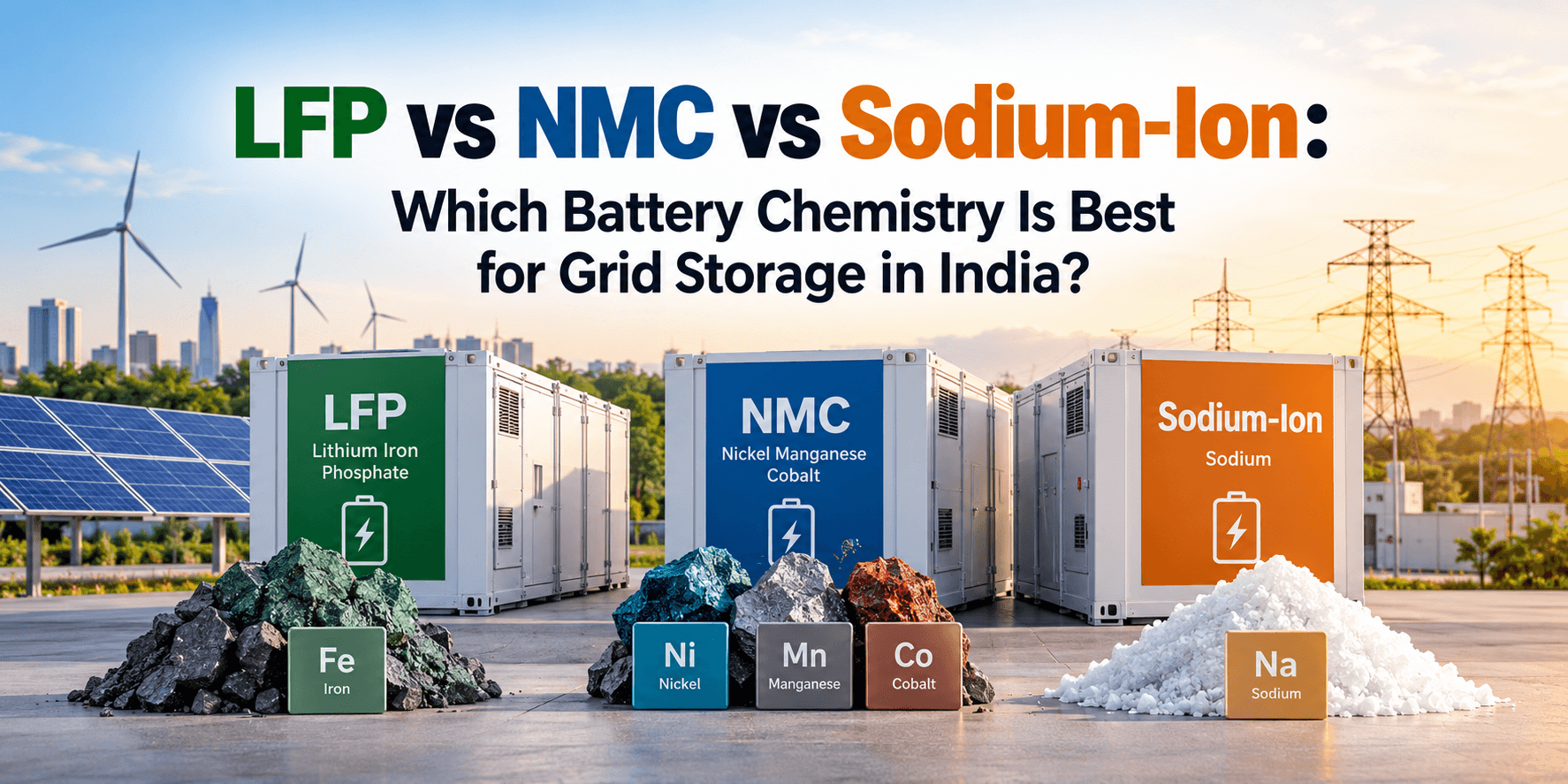
Lithium iron phosphate (LFP) is widely used in stationary storage because it offers a useful combination of safety characteristics, cycle life, and cost. Nickel manganese cobalt (NMC) cells can offer higher energy density, although energy density may be less important in many stationary installations than cost, durability, and safety.
Other technologies, including sodium-ion batteries and flow batteries, may also suit specific applications as their costs, performance, and supply chains develop.
There is no single chemistry that is best for every project. The choice depends on discharge duration, ambient temperature, available space, operating profile, financing assumptions, and expected lifetime revenue.
For India, the priority should be to build manufacturing capabilities that can serve commercially attractive applications without tying the industry to a single technology too early.
5. Localisation of BESS: What Needs to Be Manufactured in India?
Localisation is often measured by the proportion of a product’s value created domestically. In battery storage, however, localisation involves several connected layers, from electrochemical materials to complete systems and software.
A battery pack assembled in India may still depend on imported cells, battery management electronics, power conversion equipment, and other high-value components. Increasing domestic assembly alone does not eliminate these dependencies.
The BESS value chain
Raw materials and processing
Lithium, iron, phosphate, graphite, and other inputs
Battery materials and components
Cathodes, anodes, separators, electrolytes, and foils
Cell manufacturing
Electrode production, cell assembly, formation, and testing
Pack and system integration
Battery management, enclosures, thermal systems, and power conversion
Complete BESS deployment
Controls, grid integration, commissioning, maintenance, and recycling
Priority areas for domestic manufacturing
| Value chain segment | Localisation opportunity | Main challenge |
|---|---|---|
| Cell manufacturing | Domestic production of qualified ACC cells | Technology, yields, and scale |
| Active materials | Cathode and anode material production | Process expertise and input sourcing |
| Cell components | Separators, electrolytes, and metal foils | Quality consistency and competitive costs |
| Battery packs | Modules, enclosures, interconnects, and assembly | Design integration and validation |
| Battery management systems | Monitoring electronics and control software | Reliability, cybersecurity, and qualification |
| Power conversion systems | Inverters and bidirectional converters | Efficiency, grid compliance, and cost |
| Thermal management | Cooling, ventilation, and fire safety systems | System-level safety and performance |
| Software and controls | Energy management, monitoring, and optimisation | Interoperability and field reliability |
| Recycling | Material recovery and end-of-life processing | Collection, economics, and recovery yields |
The government has reported that the PLI-ACC initiative has stimulated interest in component manufacturing and recycling. It has also highlighted the National Critical Mineral Mission as part of the broader effort to strengthen mineral supply chains.
Why cell manufacturing is the hardest layer to localise
Cell manufacturing requires precise control over electrode coating, drying, assembly, electrolyte filling, formation, and quality testing. Small variations in materials or production conditions can affect performance, safety, and useful life.
A competitive domestic industry needs more than access to production machinery. It requires experienced process engineers, robust quality systems, reliable material suppliers, and continuous process improvement.
Manufacturers must also develop the ability to adapt cell designs to customer requirements and changing chemistry choices. These capabilities take time to establish and improve through repeated production and testing.
Building a domestic component ecosystem
Local suppliers can reduce lead times, improve technical support, and make product customisation easier. But localisation should be based on performance and economics, not simply on the percentage of components sourced domestically.
For example, an Indian BESS integrator may benefit from sourcing enclosures, busbars, cooling systems, and electrical equipment locally while continuing to qualify imported cells during its early growth phase. As domestic cell production becomes more reliable, the integrator can gradually increase its local cell sourcing.
This staged approach allows manufacturers to develop a domestic supply chain without compromising safety or project delivery.
6. The Biggest Challenges Facing India’s Battery Manufacturing Industry
India’s battery manufacturing opportunity is substantial, but the industry must overcome several structural challenges before domestic production can compete consistently with established global suppliers.
High capital requirements and long ramp-up periods
Gigafactories require major investments in production lines, clean and dry environments, testing equipment, utilities, and quality systems. Additional working capital is needed to purchase materials and support production ramp-up.
These costs create financial pressure when factories take longer than expected to reach commercial output. Investors must account for commissioning delays, low initial yields, and the possibility that battery prices may fall before a facility reaches full utilisation.
Dependence on imported materials and technology
Domestic cell production does not automatically mean a fully local supply chain. Manufacturers may still rely on imported processed minerals, battery-grade materials, equipment, and specialised production know-how.
India’s National Critical Mineral Mission is intended to strengthen the critical mineral value chain, including exploration, processing, and recovery. However, developing competitive domestic processing capacity will take sustained investment and technical development.
Technology transfer and manufacturing expertise
Cell production is a process-intensive business. Manufacturers need to establish reliable operating procedures, improve production yields, validate materials, and protect product quality at scale.
Partnerships with experienced technology providers can help, but long-term competitiveness also requires domestic engineering expertise and the ability to improve processes independently.
Price competition and economies of scale
Established global producers benefit from mature supplier networks, high production volumes, and accumulated manufacturing experience. New Indian facilities may struggle to match their costs during the early stages of operation.
Government support can help establish domestic capacity, but it cannot permanently replace efficient operations, strong product quality, and predictable demand.
Safety, testing, and long-term reliability
Battery storage systems must operate safely across a range of temperatures, charging conditions, and duty cycles. Failures can result in costly downtime, equipment damage, or fire.
Manufacturers and integrators need appropriate cell qualification, pack-level testing, battery management, thermal controls, system protection, and emergency response provisions. For grid-scale projects, reliability over the intended operating life is especially important because replacement costs can undermine project economics.
7. What Battery Manufacturers and BESS Developers Should Do Next
The path to a competitive domestic battery industry requires coordinated decisions across manufacturing, procurement, project development, and technology.
For battery cell manufacturers
- Prioritise production yield and product consistency before aggressively expanding capacity.
- Secure long-term supply arrangements for critical materials.
- Develop chemistry-specific manufacturing and testing expertise.
- Qualify products against clear customer requirements.
- Build partnerships with pack manufacturers, EV companies, and BESS integrators.
- Track domestic value addition alongside cost, reliability, and capacity utilisation.
For BESS integrators and project developers
- Evaluate cells based on lifetime system economics, not purchase price alone.
- Qualify suppliers using safety, degradation, warranty, and performance data.
- Develop sourcing strategies that balance domestic localisation with supply reliability.
- Design systems around actual grid requirements and project revenue models.
- Standardise interfaces between cells, battery management systems, power conversion equipment, and energy management software.
- Plan for maintenance, replacement, and end-of-life recovery from the beginning.
For investors and industrial buyers
Manufacturing announcements should be assessed against measurable operating milestones. Investors should examine commissioning progress, actual production, yield improvement, customer qualification, material sourcing, and expected utilisation.
For industrial buyers, a supplier’s ability to meet delivery schedules and maintain product consistency may be more valuable than a large announced capacity figure.
A useful diligence framework includes five questions:
- Is the manufacturing technology proven at the intended scale?
- Can the company secure qualified materials at competitive prices?
- Has the product passed relevant safety and performance testing?
- Is there sufficient customer demand to support utilisation?
- Can the business compete without relying indefinitely on policy support?
These questions help distinguish long-term manufacturing opportunities from projects that remain dependent on future execution.
8. The Outlook for Battery Cell Manufacturing in India
India’s battery manufacturing industry is moving from a predominantly downstream assembly model toward a broader ecosystem that includes cell production, materials, components, and recycling.
Government disclosures in February 2026 noted that at least 10 manufacturers outside the PLI-ACC beneficiary group had announced a combined 178 GWh of battery manufacturing capacity over the following five years. These figures represent announced plans, not verified operational capacity.
The distinction matters because the industry’s future will depend on execution. Announced capacity must translate into commissioned facilities, reliable production, qualified products, and competitive pricing.
Three developments will be especially important over the coming years.
First, domestic cell production must scale reliably. Higher production volumes and improved yields can reduce costs, deepen technical expertise, and encourage investment in upstream suppliers.
Second, BESS demand must translate into bankable projects. Grid-scale storage can support renewable energy integration and electricity system flexibility, but manufacturers need predictable demand and viable project economics.
Third, localisation must extend beyond assembly. Domestic materials, components, software, recycling, and engineering capabilities will determine how much value India retains within its battery supply chain.
The government’s dedicated 10 GWh grid-storage manufacturing tender is a step toward aligning domestic battery production with stationary storage needs. Its longer-term impact will depend on how quickly the selected capacity becomes operational and how effectively manufacturers serve the market.
Conclusion
Battery cell manufacturing in India is entering a decisive stage. The PLI-ACC scheme has created a policy framework for gigafactory investment, while the growing need for energy storage is opening a separate market for stationary battery systems.
However, capacity allocation is only the beginning. The industry must improve manufacturing yields, strengthen material supply chains, build technical expertise, and establish reliable demand for domestically produced cells.
For BESS developers, manufacturers, and investors, the strongest opportunities will emerge where localisation delivers tangible benefits: lower lifecycle costs, dependable supply, better technical support, and systems designed for India’s operating conditions.
India’s long-term competitiveness will depend not simply on how many gigawatt-hours of battery capacity are announced, but on how much of that capacity becomes reliable, commercially viable domestic production.
Frequently Asked Questions
What is the PLI-ACC scheme in India?
The PLI-ACC scheme is a ₹18,100 crore government programme designed to encourage domestic manufacturing of advanced chemistry cells. It targets 50 GWh of manufacturing capacity and promotes domestic value addition, investment, and reduced import dependence.
How much battery manufacturing capacity has been allocated under PLI-ACC?
As of March 2026, 40 GWh had been awarded to four beneficiary companies. Government disclosures reported 1 GWh of installed capacity at that time. The remaining 10 GWh is being allocated through a separate process for grid-scale stationary storage applications.
What is the difference between a gigafactory and a battery assembly plant?
A gigafactory manufactures battery cells at large scale, although the exact scope depends on the facility. A battery assembly plant typically combines purchased cells into modules, packs, or complete storage systems. Some facilities integrate both activities.
Why is localisation important for BESS in India?
Localisation can reduce supply chain exposure, improve component availability, support domestic engineering, and create manufacturing jobs. Its benefits depend on achieving competitive costs and meeting required safety and performance standards.
Which battery chemistry is best for grid-scale storage?
LFP is widely used in stationary storage because of its combination of cycle life, safety characteristics, and cost. Other chemistries may be suitable for particular applications. The best choice depends on project duration, operating conditions, lifetime economics, and technical requirements.
What are the main barriers to battery cell manufacturing in India?
Key barriers include high capital costs, manufacturing yield improvement, dependence on imported materials and technology, limited process expertise, competition from established global manufacturers, and the need for reliable long-term demand.