Renewable Energy Evacuation Infrastructure: Towers, Conductors & Substation Structures
Renewable energy projects can generate electricity efficiently, but getting that power from the generation site to the grid requires reliable evacuation infrastructure. Wind farms, solar parks, hybrid projects, and battery-backed renewable plants often operate in remote areas where existing transmission capacity may be limited.
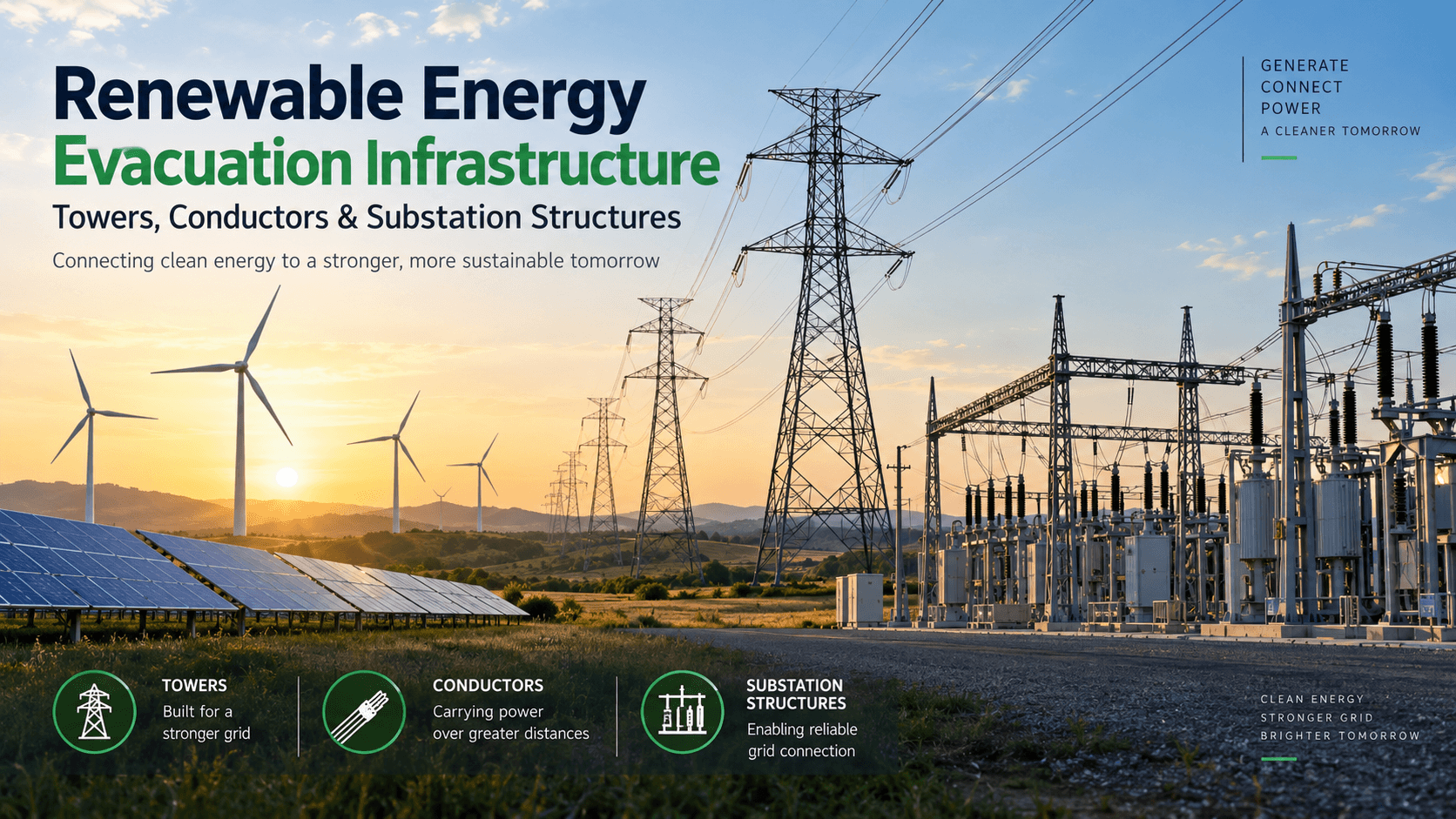
Renewable energy evacuation infrastructure bridges that gap. It includes transmission towers, conductors, substations, gantries, bus structures, and other steel infrastructure needed to collect, transform, switch, and transmit power safely.
For project developers and EPC contractors, the challenge is not simply building these structures. The infrastructure must handle electrical loads, environmental conditions, right-of-way constraints, construction timelines, and long-term maintenance requirements.
What Is Renewable Energy Evacuation Infrastructure?
Renewable energy evacuation infrastructure is the electrical and structural network used to move electricity from a generation facility to a transmission or distribution grid.
A typical system may include:
- Collector systems within the renewable energy plant
- Step-up transformers
- Transmission lines
- Lattice or tubular transmission towers
- Conductors and earth wires
- Substation structures
- Gantries and equipment support structures
- Busbar structures
- Cable support systems
- Switchyard steelwork
- Earthing and protection systems
The exact configuration depends on the project’s generation capacity, grid connection voltage, terrain, distance to the point of interconnection, and applicable grid standards.
Why Evacuation Infrastructure Matters for Renewable Projects
Renewable generation is often located where the natural resource is strongest, not where electricity demand is highest.
Solar parks may be developed in areas with high solar irradiation, while wind projects are typically located in regions with favorable wind conditions. These locations can be far from major load centers and existing transmission networks.
That makes evacuation capacity a critical part of project planning.
A generation facility can be ready to produce electricity, but inadequate transmission infrastructure can restrict how much power reaches the grid. Delays in towers, conductors, substations, or associated equipment can also affect project commissioning schedules.
For developers, evacuation infrastructure therefore needs to be considered alongside generation equipment rather than treated as a separate downstream activity.
Transmission Towers for Renewable Energy Evacuation
Transmission towers provide the structural support required to carry overhead conductors across the transmission route.
For renewable energy projects, tower design can vary significantly depending on voltage level, span length, terrain, conductor configuration, and environmental conditions.
Common tower configurations include:
Lattice Towers
Lattice steel towers are widely used for high-voltage transmission because they provide high structural strength while keeping material usage relatively efficient.
They can be configured for different conductor arrangements and adapted to various tower heights and loading conditions.
Tubular Towers
Tubular steel towers can be used in applications where a different structural or visual profile is preferred. Their suitability depends on voltage, loading, fabrication requirements, transportation constraints, and project specifications.
Special Towers
Transmission routes do not always follow uniform terrain. River crossings, railway crossings, highways, steep slopes, and other obstacles may require specially designed structures.
These towers can have different heights, spans, foundations, and loading requirements from standard structures used along the rest of the line.
Conductors: The Power-Carrying Element
Conductors carry electrical power between substations and across transmission lines.
Selecting the appropriate conductor involves more than considering its current-carrying capacity. Project teams may also evaluate:
- Thermal performance
- Electrical losses
- Mechanical strength
- Sag and tension
- Span length
- Ambient temperature
- Wind and ice loading where applicable
- Corona performance
- Installation requirements
- Lifecycle costs
Aluminium-based conductors and aluminium conductor steel-reinforced configurations are commonly used in overhead transmission applications, while newer conductor technologies may be considered where higher transmission capacity or specific operating characteristics are required.
The conductor choice also affects tower loading, stringing requirements, clearances, and overall transmission-line design.
Substation Structures
Substations are a key part of renewable energy evacuation systems. They step voltage up or down, provide switching and protection functions, and connect the renewable project to the wider grid.
A renewable energy substation may contain a range of steel structures, including:
Equipment Support Structures
Steel supports hold electrical equipment such as disconnectors, instrument transformers, surge arresters, and other switchyard components at the required elevations and clearances.
Gantries
Gantries support incoming and outgoing transmission lines and provide the structural framework for connecting overhead lines to substation equipment.
Busbar Structures
Busbar support structures maintain the required electrical clearances while providing mechanical support for the substation bus arrangement.
Control and Auxiliary Structures
Depending on the project, the substation may also require cable support structures, lighting towers, equipment platforms, and other steelwork.
The structural design must account for equipment loads as well as environmental and electrical requirements.
Key Design Considerations
Renewable evacuation structures need to perform reliably under both normal operating conditions and demanding environmental loads.
Wind and Environmental Loads
Transmission towers and substation structures are exposed to wind throughout their service life. Design must account for the applicable wind conditions and project-specific loading requirements.
Other environmental factors may include temperature variations, seismic activity, corrosion exposure, and, in certain regions, ice or other climatic loads.
Electrical Clearances
Structural dimensions and conductor arrangements must maintain the required clearances between energized components, structures, the ground, and other infrastructure.
This is particularly important when designing towers, gantries, and switchyard structures.
Foundation Conditions
A structurally sound tower still depends on an appropriate foundation.
Soil characteristics, groundwater conditions, terrain, tower loads, and site accessibility can all influence foundation selection. Geotechnical investigation is therefore an important input into transmission-line design.
Corrosion Protection
Transmission infrastructure is expected to operate for decades, often in exposed environments.
Hot-dip galvanizing is widely used for protecting structural steel components from corrosion. Coating specifications should be selected according to the project’s environmental conditions and applicable standards.
Standards and Engineering Requirements
Renewable energy evacuation infrastructure needs to comply with applicable electrical, structural, and transmission standards.
Depending on the location and project requirements, specifications may cover:
- Structural steel design
- Transmission tower loading
- Conductor design
- Electrical clearances
- Galvanizing
- Welding and fabrication
- Bolting
- Substation equipment support
- Quality inspection and testing
In India, project specifications may also reference requirements from organizations and authorities such as Central Electricity Authority, transmission utilities, state authorities, and relevant Indian Standards.
The applicable requirements should always be confirmed against the latest project specification and statutory requirements rather than relying on a generic tower or substation design.
Manufacturing and Quality Control
The reliability of evacuation infrastructure depends heavily on manufacturing quality.
For transmission towers, the manufacturing process generally involves steel preparation, cutting, punching or drilling, forming where required, trial assembly, galvanizing, inspection, and packing.
Quality control can include checks for:
- Steel grade and material certificates
- Dimensional accuracy
- Hole positions and tolerances
- Bolt compatibility
- Weld quality
- Galvanizing thickness and appearance
- Component identification
- Assembly accuracy
Substation structures require similar attention to dimensional tolerances, fabrication quality, galvanizing, and fit-up because structures must interface correctly with electrical equipment.
Installation and Project Execution
Evacuation infrastructure often involves multiple work fronts.
Transmission-line construction may include route surveys, foundation work, tower erection, conductor stringing, and testing. Substation construction runs in parallel with civil works, equipment installation, structural erection, and electrical commissioning.
Effective coordination between engineering, procurement, manufacturing, logistics, and site teams can help reduce schedule risks.
This is particularly important for renewable projects, where grid-connection milestones can influence the overall commissioning timeline.
How to Choose an Evacuation Infrastructure Partner
Project developers and EPC companies should assess suppliers based on more than quoted steel prices.
Important evaluation criteria include:
Engineering capability: Can the supplier develop or manufacture structures according to project-specific loads, drawings, and specifications?
Manufacturing capacity: Can it produce the required quantities within the project’s delivery schedule?
Quality systems: Are material traceability, dimensional inspection, galvanizing, and testing properly controlled?
Standards compliance: Does the supplier understand the standards and utility-specific requirements applicable to the project?
Logistics: Can components be packed, transported, and delivered efficiently to remote project sites?
Execution experience: Has the supplier worked on transmission lines, renewable evacuation systems, or substations with comparable requirements?
A reliable supply chain matters because a delay in structural components can affect multiple downstream activities.
The Role of Evacuation Infrastructure in Renewable Energy Expansion
As renewable generation capacity grows, transmission infrastructure becomes increasingly important. New solar and wind projects often require dedicated connections and network reinforcement to move electricity from resource-rich regions to demand centers.
This creates continuing demand for transmission towers, conductors, substation structures, and associated steelwork.
The infrastructure itself may appear straightforward compared with generation technologies such as solar modules or wind turbines, but it forms a critical link between electricity generation and grid delivery.
For renewable energy developers, the goal is not simply to install generation capacity. The entire system, from generation through evacuation and grid connection, needs to work together.
Conclusion
Renewable energy evacuation infrastructure provides the physical backbone for connecting new generation capacity to the electricity grid.
Transmission towers provide structural support, conductors carry electricity, and substation structures enable the switching, transformation, and connection functions required at grid interconnection points.
For developers and EPC contractors, successful evacuation infrastructure depends on sound engineering, appropriate material selection, manufacturing quality, corrosion protection, standards compliance, and dependable project execution.
As renewable capacity continues to expand, well-designed evacuation infrastructure will remain essential to turning generation potential into usable grid-connected electricity.