Sourcing for EV vs. ICE Vehicles: What Changes in Component Manufacturing
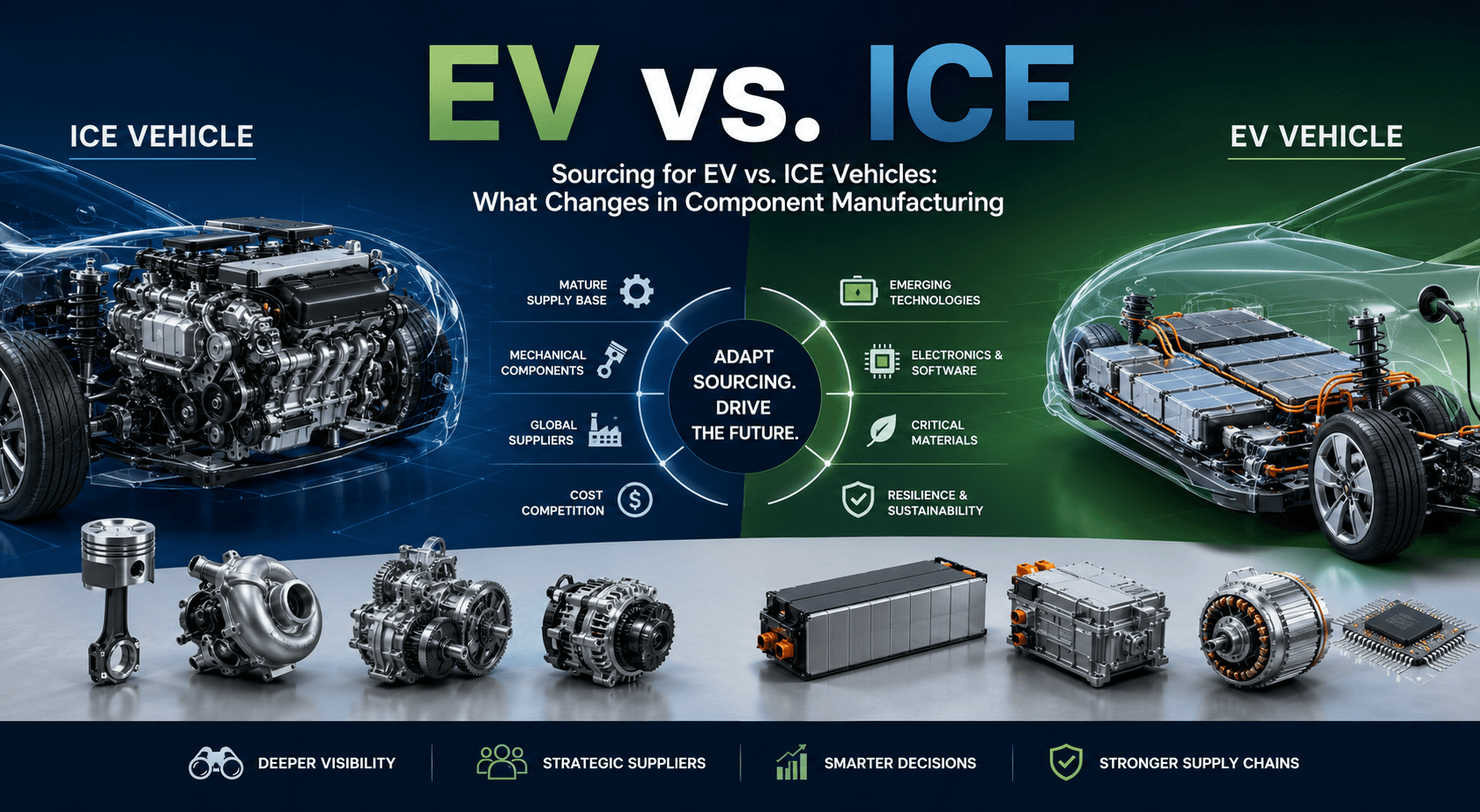
The shift from internal combustion engine (ICE) vehicles to electric vehicles (EVs) changes much more than the powertrain. It changes what automakers buy, which suppliers matter most, where supply chain risks sit, and how sourcing teams evaluate long-term partnerships.
For automotive sourcing leaders, the key challenge is not simply replacing ICE components with EV equivalents. The supplier ecosystem itself is changing.
Mechanical systems that once accounted for a significant share of sourcing complexity are giving way to batteries, power electronics, semiconductors, thermal systems, electric motors, and software-dependent components. At the same time, sourcing teams have to manage ICE and EV programs in parallel as production volumes shift at different rates across markets.
That requires a different sourcing model.
The Core Difference Between EV and ICE Component Sourcing
An ICE vehicle depends on a mature ecosystem built around engines, transmissions, fuel systems, exhaust systems, and hundreds of associated mechanical components.
EVs remove or simplify many of these systems.
In their place, manufacturers need high-value electrical and electronic systems, including:
- Battery cells, modules, and packs
- Electric motors
- Inverters and power electronics
- High-voltage connectors and cabling
- Battery management systems
- Onboard chargers
- DC-DC converters
- More advanced thermal management components
- Semiconductor-intensive control systems
The sourcing challenge therefore shifts from managing a broad mechanical supply base toward securing fewer, often higher-value and more strategically sensitive technologies.
This distinction matters because many EV components depend on supply chains that look very different from traditional automotive manufacturing.
EVs Change Where Vehicle Value Is Concentrated
ICE sourcing has traditionally involved a deep, multi-tier network of mechanical component manufacturers. Automakers and Tier 1 suppliers have spent decades optimizing these relationships around cost, quality, manufacturing capacity, and just-in-time delivery.
EVs redistribute that value.
The battery is the clearest example. Instead of sourcing hundreds of engine-related components, manufacturers may place a much larger share of vehicle economics into cells, battery materials, pack components, power electronics, and related systems.
As a result, sourcing teams need to pay closer attention to the economics and resilience of a smaller number of strategically important categories.
A disruption affecting a relatively inexpensive ICE component can stop a production line. The same is true for EVs, but the financial exposure can be considerably larger when the affected category involves batteries, semiconductors, or power electronics.
Supplier criticality therefore needs to be assessed by more than annual spend.
The Supplier Base Is Changing
The transition to EV manufacturing introduces suppliers that may not come from the traditional automotive ecosystem.
Battery manufacturers, semiconductor companies, electronics specialists, mineral processors, chemical companies, and software providers are becoming increasingly important to vehicle production.
For sourcing leaders, this creates a qualification challenge.
Traditional automotive suppliers are accustomed to strict requirements around quality systems, traceability, production validation, change management, and delivery performance. Suppliers entering automotive from electronics, energy, or technology markets may operate under different commercial and manufacturing models.
Procurement teams need to evaluate both technical capability and automotive readiness.
A supplier may have excellent battery technology, for example, but sourcing teams still need confidence in its ability to deliver consistent quality at automotive volumes over a multi-year vehicle program.
This makes supplier development increasingly important.
Rather than selecting a supplier and monitoring performance afterward, sourcing organizations may need to work more closely with strategic suppliers during industrialization, capacity expansion, quality validation, and localization.
Battery Sourcing Extends Far Beyond the Cell Supplier
Battery sourcing illustrates how EV procurement pushes sourcing teams deeper into the supply chain.
An automaker purchasing battery cells may appear to have a direct relationship with a cell manufacturer. But the underlying supply chain includes cathode materials, anode materials, lithium, nickel, graphite, separators, electrolytes, and numerous processing steps.
Risk can emerge several tiers below the contracted supplier.
That means sourcing leaders need greater visibility into where materials originate, where they are processed, and how concentrated those supply chains are.
The strategic question changes from:
“Can our supplier deliver?”
to:
“What dependencies determine whether our supplier can deliver?”
That distinction is increasingly important across EV categories.
Semiconductor Exposure Becomes More Strategic
Modern ICE vehicles already rely heavily on semiconductors, but electrification increases their importance across power conversion, battery management, charging, motor control, safety systems, and vehicle electronics.
For sourcing organizations, semiconductor procurement presents a structural challenge.
Automotive manufacturers may not always purchase chips directly. A semiconductor can sit several tiers below the OEM inside a module supplied by another company.
That can make capacity constraints difficult to identify until they affect production.
Sourcing teams therefore need better visibility into semiconductor content across critical assemblies.
This can include identifying high-risk devices, understanding manufacturer dependencies, tracking fabrication capacity, and evaluating whether alternative components can be qualified before shortages occur.
The objective is not necessarily to source every semiconductor directly. It is to understand where semiconductor dependencies create production risk.
EV Sourcing Requires Deeper Raw Material Visibility
Traditional automotive sourcing organizations have historically focused heavily on Tier 1 and Tier 2 suppliers.
EV supply chains make that boundary less useful.
Lithium, nickel, graphite, copper, rare earth elements, and other materials can influence cost, availability, compliance, and geopolitical exposure long before a finished component reaches an assembly plant.
Sourcing leaders therefore need a clearer view of upstream dependencies.
Consider an electric motor.
The immediate supplier may manufacture the complete motor assembly. However, supply continuity may depend on permanent magnets, which in turn depend on rare earth extraction and processing capacity concentrated in particular regions.
Evaluating only the motor supplier leaves a significant part of the risk picture invisible.
This is why multi-tier supply chain mapping is becoming a core sourcing capability rather than a specialized risk-management exercise.
Cost Models Need to Change
ICE component sourcing benefits from decades of manufacturing history.
Procurement teams often have established should-cost models for castings, machining, stamping, injection molding, assembly, and other mature manufacturing processes.
EV components introduce different cost structures.
Battery cells, power electronics, semiconductors, magnets, and high-voltage systems can be affected by raw material prices, technology choices, manufacturing yields, energy costs, intellectual property, and rapidly changing production scale.
Historical piece-price comparisons may therefore provide limited insight.
Sourcing teams need cost models that expose the underlying drivers.
For a battery-related component, that could mean understanding:
- Material composition
- Commodity exposure
- Manufacturing yield
- Energy requirements
- Plant utilization
- Logistics
- Regional incentives
- Technology generation
The goal is to move negotiations beyond supplier quotations and toward a shared understanding of how the component should economically behave.
Dual Sourcing Is Not Always Straightforward
Dual sourcing is a familiar way to reduce automotive supply risk. With EV technologies, however, creating a second source can be more complicated.
Battery cells from two suppliers may differ in chemistry, dimensions, performance characteristics, thermal behavior, or battery management requirements.
Power electronics may also require substantial engineering validation before an alternative supplier can be introduced.
This creates a tradeoff between technical optimization and sourcing flexibility.
Engineering teams may prefer a highly integrated design optimized around one supplier’s technology. Procurement teams may prefer interchangeability and multiple qualified sources.
Neither objective can be managed independently.
Sourcing leaders should bring engineering, manufacturing, quality, and procurement together earlier in the product development process to decide where standardization is worth pursuing and where supplier-specific technology creates enough value to justify concentration risk.
Localization Becomes a Strategic Sourcing Decision
EV supply chains are also being shaped by regional manufacturing policies, incentives, tariffs, sustainability requirements, and geopolitical considerations.
As a result, the lowest quoted global price may not represent the lowest total business cost.
Sourcing decisions increasingly need to account for:
- Regional production requirements
- Transportation and logistics exposure
- Tariffs and trade restrictions
- Local content rules
- Energy costs
- Supply continuity
- Sustainability requirements
- Access to incentives
- Currency exposure
This makes total landed cost only part of the equation.
Sourcing teams need to evaluate what could be called total strategic cost, including the financial consequences of disruption, regulatory changes, localization requirements, and future capacity constraints.
ICE and EV Supply Chains Must Be Managed in Parallel
One of the most difficult sourcing problems is that the industry is not moving from ICE to EV production overnight.
Automakers may need to support ICE, hybrid, plug-in hybrid, and battery-electric platforms simultaneously.
That creates two opposing risks.
The first is underinvesting in EV supply capacity and struggling to secure components when demand grows.
The second is exiting ICE supply relationships too quickly and creating shortages for programs that remain commercially important.
Suppliers face the same uncertainty.
An ICE component manufacturer may hesitate to invest in new tooling or capacity if long-term demand is declining. This can create supply risk even while the component remains essential to current vehicle programs.
Sourcing leaders therefore need category strategies that account for both growth and decline.
Managing the ramp-down of a supply base can require as much planning as building a new one.
How Automotive Sourcing Leaders Should Adapt
The EV transition requires procurement to become involved earlier and operate with a wider view of the supply chain.
Several capabilities become particularly important.
Build visibility beyond Tier 1 suppliers. Identify critical upstream materials, technologies, manufacturing locations, and capacity dependencies.
Segment suppliers by strategic risk, not just spend. A low-spend semiconductor or specialized material can carry enormous production consequences.
Integrate sourcing earlier with engineering. Supplier selection, component architecture, and design choices increasingly determine future sourcing flexibility.
Develop EV-specific cost models. Traditional mechanical should-cost approaches need to be supplemented with models covering batteries, electronics, semiconductors, and critical materials.
Plan capacity over longer horizons. Strategic categories may require reservations, long-term agreements, joint investments, or other commitments before vehicle volumes materialize.
Design alternatives before they are needed. Identifying a second supplier during a shortage is far harder than qualifying alternatives during product development.
Manage ICE supplier transitions deliberately. Monitor supplier financial health, tooling availability, capacity decisions, and sub-tier dependencies as volumes decline.
These capabilities move sourcing beyond transactional procurement. They position it as part of vehicle architecture, manufacturing strategy, and enterprise risk management.
What the EV Transition Means for Component Manufacturers
The transition also changes what OEMs expect from component suppliers.
Manufacturers that historically competed primarily on price, quality, and delivery may increasingly need to demonstrate capabilities in electronics, traceability, automation, software integration, advanced materials, and multi-region production.
Traditional suppliers also need to decide where they fit in the EV value chain.
Some may adapt existing capabilities. A manufacturer experienced in precision machining, thermal systems, connectors, or lightweight structures may find new opportunities within EV platforms.
Others may need partnerships, acquisitions, or new production capabilities to remain relevant as ICE component volumes decline.
For sourcing teams, understanding each supplier’s transition strategy becomes part of supplier risk management.
A supplier’s performance today does not necessarily indicate whether it will remain competitive and financially stable throughout the next vehicle generation.
The Strategic Sourcing Model Is Changing
EV sourcing is not simply ICE sourcing with a different bill of materials.
The transition changes the technologies being purchased, the economics behind them, the suppliers that control critical capacity, and the depth of supply chain visibility required to manage risk.
For automotive sourcing leaders, the most important shift is therefore organizational.
Procurement needs to move upstream.
That means participating earlier in technology and design decisions, understanding dependencies several tiers into the supply chain, building category-specific cost intelligence, and treating capacity and resilience as strategic variables alongside price.
The organizations that make this shift will be better positioned to manage both sides of the automotive transition: securing the technologies required for EV growth while maintaining a reliable and economically viable supply base for ICE and hybrid programs that remain in production.
In an industry where one constrained component can disrupt an entire vehicle program, sourcing strategy increasingly becomes manufacturing strategy.