
Battery Storage for Industries: A C&I BESS Guide for Indian Manufacturers
Introduction
Electricity is a major operating expense for many Indian manufacturers. For facilities running energy-intensive machinery, refrigeration, compressors, furnaces, or automated production lines, even small changes in power costs can affect profit margins.
The challenge is not just how much electricity a factory consumes. It is also when that electricity is used, how much power the facility draws at once, and how reliably the grid meets production needs.
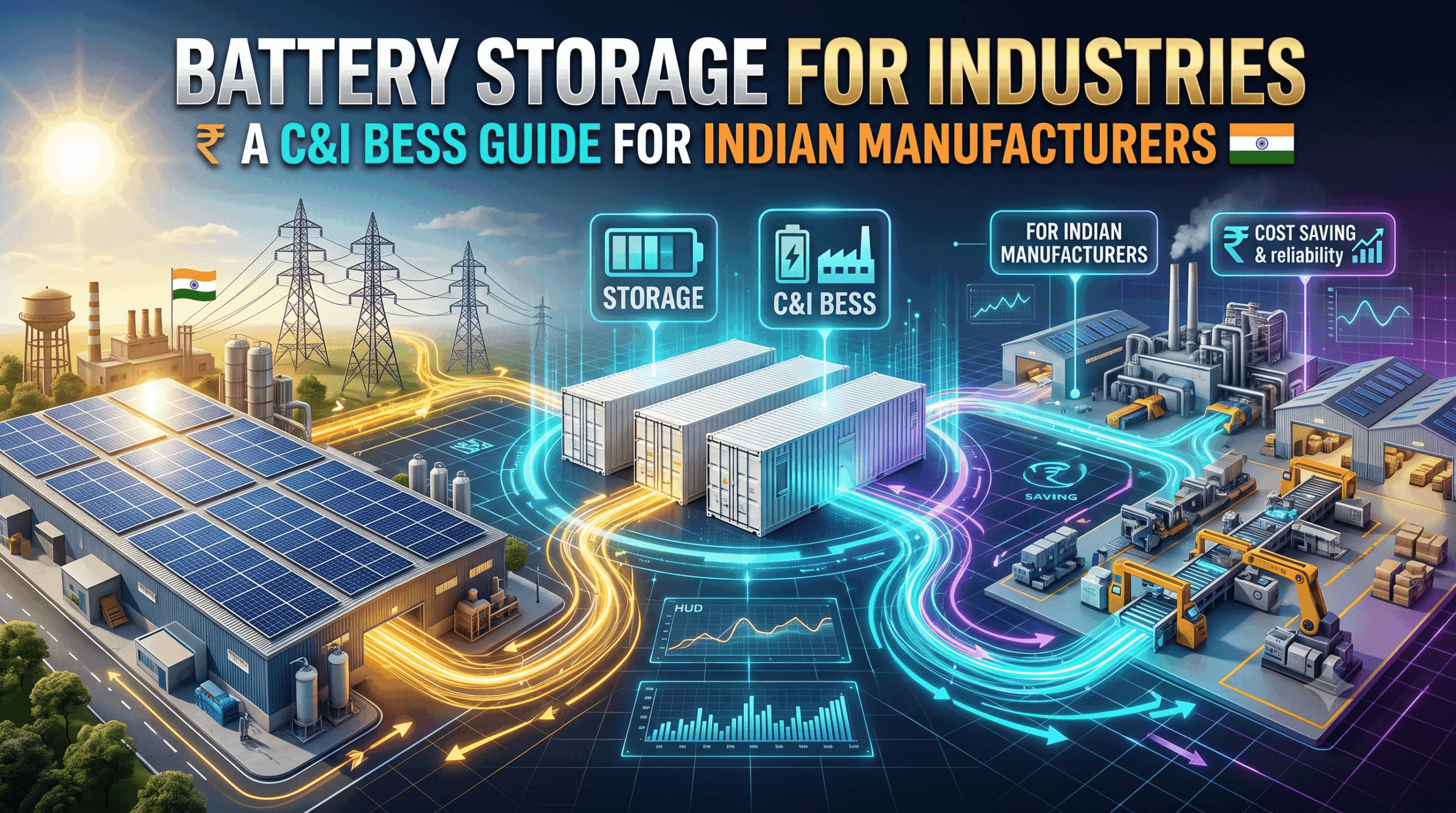
A commercial and industrial Battery Energy Storage System (C&I BESS) gives manufacturers another way to manage these challenges. It stores electricity when it is available or economical and releases it when the factory needs it most.
For Indian manufacturers, battery storage can help manage peak demand, increase the use of rooftop solar, reduce reliance on diesel generators in suitable applications, and improve energy resilience. However, the financial benefits depend on the facility’s electricity tariff, load profile, operating schedule, and storage requirements.
This guide explains how industrial battery storage works, where it makes business sense, how to assess costs and returns, and what to consider before choosing a system.
What Is a C&I Battery Energy Storage System?
A C&I Battery Energy Storage System is an energy storage solution designed for commercial buildings, factories, warehouses, industrial parks, and other large electricity consumers.
Unlike a conventional backup battery, an industrial BESS can be managed as part of a facility’s wider energy system. It can charge from the grid or an eligible on-site generation source, then discharge electricity according to operational requirements.
A typical system includes five main components:
- Battery cells: Store electrical energy for later use.
- Battery Management System (BMS): Monitors battery conditions, temperatures, voltage, and other safety parameters.
- Power Conversion System (PCS): Converts electricity between the battery’s DC supply and the facility’s AC electrical system.
- Energy Management System (EMS): Coordinates charging, discharging, and energy use based on configured operating rules.
- Thermal management and safety equipment: Help maintain operating conditions and manage battery-related risks.
Together, these components allow manufacturers to control when stored energy is used rather than relying entirely on electricity purchased at the moment of consumption.
Why Indian Manufacturers Are Considering Industrial Battery Storage
Manufacturers face different energy challenges depending on their location, industry, and production process. Several common issues make battery storage worth evaluating.
1. Managing peak electricity demand
Many industrial electricity bills include charges linked to recorded maximum demand, alongside charges for energy consumed.
A factory may operate within its normal power range for most of the month but experience short periods of unusually high demand when multiple machines start together. Depending on the tariff and billing rules, these peaks can increase electricity costs.
A correctly sized BESS can discharge during selected peak periods to reduce the facility’s grid draw. This is known as peak shaving.
The savings depend on the applicable demand charges, metering interval, existing load profile, and the battery’s ability to respond at the right time.
2. Making better use of rooftop solar
Rooftop solar can reduce daytime electricity purchases, but generation does not always match a factory’s consumption.
For example, a plant may generate surplus solar electricity during the afternoon but operate a second or third shift after sunset. Without suitable storage, some of that surplus may be exported at a lower value or go unused because of system constraints.
A BESS can store eligible surplus solar generation and release it later. This can increase on-site solar consumption when the value of using that electricity exceeds the value of exporting it.
The actual benefit depends on the export compensation rules, solar generation profile, battery losses, and the timing of factory demand.
3. Improving resilience during power interruptions
Power interruptions can disrupt production schedules, interrupt sensitive processes, and create restart costs.
A suitably designed BESS can provide rapid power support for selected loads or, if engineered for it, operate as part of a backup power system.
However, not every grid-connected BESS can supply a factory during an outage. The inverter, protection system, electrical configuration, and controls must support the intended backup or islanded operating mode.
Manufacturers should also distinguish between supporting critical controls and maintaining an entire production line. These applications can require very different battery capacities.
4. Reducing diesel generator use
Diesel generators remain important in facilities that need backup power, but running them can be expensive because of fuel, maintenance, and operating inefficiencies at low loads.
A BESS can potentially reduce generator runtime or support short-duration power needs. In some systems, batteries and generators operate together to manage changing loads.
The economics depend on the generator’s actual fuel consumption, maintenance costs, annual runtime, and the battery’s charging source. A battery that must be recharged from the same generator may not deliver the expected savings.
5. Preparing for changing electricity tariffs
Time-of-day tariffs can make electricity more expensive during certain periods and cheaper during others. These structures vary by state, consumer category, and tariff order.
Where the price difference is sufficient, a battery may charge during lower-cost periods and discharge during higher-cost periods.
Manufacturers should check their current state tariff schedule rather than assume that a particular charging and discharging pattern will always be economical.
How Does an Industrial BESS Work?
The operating cycle is straightforward, although the controls and economics require careful planning.
Step 1: Charge the battery
The BESS charges from the grid during selected periods or from on-site solar generation when suitable surplus energy is available.
Step 2: Monitor the factory’s energy demand
The EMS tracks electricity consumption, battery state of charge, operating limits, and configured energy priorities.
Step 3: Discharge when it creates value
The system releases stored electricity during peak demand, high-tariff periods, or designated backup events.
Step 4: Coordinate with other electrical assets
Where supported, the EMS coordinates the battery with rooftop solar, the grid connection, generators, and facility loads.
Step 5: Track performance
Operating data helps the facility evaluate energy savings, battery degradation, system availability, and maintenance requirements.
The objective is not to discharge the battery as often as possible. It is to use stored electricity when the financial or operational benefit justifies the cost of charging, conversion losses, and battery wear.
Key Industrial Applications of C&I BESS
Different industries have different power requirements. The best application depends on the factory’s load profile and the consequences of a power interruption.
Manufacturing plants
Manufacturers can evaluate battery storage for peak shaving, solar integration, and selected critical-load support.
Facilities with large motors, compressed-air systems, process equipment, or multiple production shifts may benefit if their demand patterns and tariff structure create a suitable business case.
Automotive and engineering facilities
Automotive plants and engineering workshops often rely on coordinated production lines, robotics, and precision equipment.
A BESS may support selected critical loads or manage short-duration demand peaks. Facilities must assess power quality requirements and equipment startup currents before selecting a system.
Food processing and cold storage
Refrigeration and temperature-control systems can run for long periods, including outside normal production hours.
Battery storage can help shift electricity use or support selected refrigeration loads during interruptions, provided the system is sized for the required power and duration.
Textiles, chemicals, and process industries
These facilities may have continuous processes, significant electrical demand, or costly production interruptions.
A BESS may offer value through demand management and resilience. Where the process requires continuous high-power operation for extended periods, battery duration and replacement costs become especially important.
Warehouses and industrial parks
Warehouses with rooftop solar, electric material-handling equipment, or EV charging infrastructure may use batteries to manage load peaks and shift energy consumption.
The opportunity is particularly relevant when several large loads operate at the same time.
How to Size a Battery Storage System for a Factory
Battery sizing should begin with the problem the manufacturer wants to solve, not with a vendor’s standard system size.
Two specifications matter most: power capacity, measured in kilowatts (kW) or megawatts (MW), and energy capacity, measured in kilowatt-hours (kWh) or megawatt-hours (MWh).
Power capacity indicates how much electricity the system can deliver at a given moment. Energy capacity indicates how much electricity it can deliver over time.
For example, a nominal 500 kW / 1,000 kWh system has a two-hour nominal energy-to-power ratio. Its actual usable output and duration will depend on operating limits, efficiency, reserve settings, and other design factors.
Step 1: Collect electricity consumption data
Review at least 12 months of electricity bills where available. Obtain interval-level meter data, ideally at 15-minute or finer resolution where supported.
Identify:
- Monthly maximum demand and demand charges.
- Energy consumption by time of day.
- Production schedules and shift patterns.
- Solar generation and export data, if applicable.
- Power interruptions and generator operating hours.
Step 2: Define the primary use case
Decide whether the system will primarily manage demand charges, shift solar energy, reduce generator use, or support critical loads.
A battery sized for peak shaving may be unsuitable for several hours of backup. Likewise, a system designed for backup may not offer the best financial return when used for daily tariff arbitrage.
Step 3: Estimate the required discharge power
For peak shaving, estimate the difference between the facility’s target grid demand and its expected demand during peak periods.
For backup applications, determine the combined running load and startup requirements of the equipment that must remain operational.
Step 4: Estimate the required energy capacity
Multiply the required discharge power by the expected discharge duration.
For example, supporting a 300 kW load for two hours requires 600 kWh of delivered energy before accounting for design reserves and losses. The installed battery capacity must be higher if usable capacity is limited by the manufacturer’s operating specifications.
Step 5: Validate the design against real operating data
Simulate the proposed system against historical load and tariff data. Include charging opportunities, battery efficiency, degradation, reserve requirements, and any limits on grid import or export.
This analysis is more reliable than selecting a battery using monthly electricity consumption alone.
What Does Industrial Battery Storage Cost in India?
The installed cost of a C&I BESS depends on battery chemistry, power rating, duration, enclosure, cooling, fire protection, inverter capacity, controls, civil works, electrical integration, and commissioning.
A larger energy capacity does not necessarily mean proportionally higher total cost per kWh. Longer-duration systems may spread some fixed equipment costs across more stored energy, while smaller projects may face higher costs per unit of capacity.
Manufacturers should request a complete installed-cost quotation that clearly identifies:
- Battery and power conversion equipment.
- EMS, metering, and control integration.
- Electrical panels, cabling, and protection systems.
- Civil works and site preparation.
- Fire detection, suppression, and emergency provisions.
- Installation, testing, and commissioning.
- Warranty coverage, service agreements, and replacement assumptions.
- Taxes, exclusions, and any required grid or utility upgrades.
Avoid relying on a battery-only price when comparing proposals. The installed system and its long-term operating costs determine the investment decision.
How to Calculate BESS ROI and Payback
A battery storage investment should be evaluated using annual net savings, lifecycle costs, and expected performance over the project period.
Identify the main sources of value
Potential benefits include:
- Lower maximum-demand charges.
- Lower electricity costs from time-of-day shifting.
- Greater use of on-site solar generation.
- Reduced diesel consumption.
- Avoided production losses, where these can be estimated credibly.
Not every project will capture all these benefits. The analysis should include only savings supported by the facility’s actual operating conditions.
Calculate annual net savings
Start with the estimated annual electricity and operating savings. Then subtract charging costs, battery-related maintenance, auxiliary power consumption, and other incremental operating expenses.
Also account for efficiency losses, battery degradation, and any expected replacement costs.
Calculate simple payback
A basic screening calculation is:
Simple payback = Initial installed investment ÷ Annual net savings
For example, suppose a factory invests ₹1.2 crore in a BESS and expects ₹30 lakh in annual net savings.
The simple payback is four years.
This is an illustrative calculation, not a market price or a forecast of typical returns. A full investment decision should also consider financing, taxes, changing tariffs, discount rates, and battery performance over time.
Compare the project with alternatives
Evaluate the BESS against options such as demand-management changes, production scheduling, solar-only expansion, generator upgrades, or a combination of these measures.
A smaller battery combined with better load scheduling may outperform a larger system that is poorly matched to the facility’s needs.
Battery Chemistry: What Should Manufacturers Consider?
Lithium iron phosphate (LFP) is commonly considered for stationary storage because of its thermal stability characteristics and suitability for repeated cycling. Other lithium-ion chemistries and alternative storage technologies may be appropriate for specific requirements.
When evaluating a battery, manufacturers should consider more than chemistry alone.
Important factors include:
- Usable energy capacity at commissioning and over time.
- Expected cycle life under the proposed operating conditions.
- Round-trip efficiency.
- Thermal management requirements.
- Safety certifications and test documentation.
- Warranty terms and throughput limits.
- Availability of service and replacement components in India.
Ask vendors to explain how the warranty changes with operating temperature, depth of discharge, cycling frequency, and calendar age.
Safety, Standards, and Compliance in India
Battery storage projects require careful electrical, thermal, and operational risk management. Requirements can depend on the system design, installation location, voltage level, local authority, and applicable regulations.
Before procurement, manufacturers should confirm the applicable requirements with their electrical consultant, utility, and relevant authorities.
Key considerations include:
- Battery enclosure placement and access for emergency responders.
- Fire detection, suppression, ventilation, and thermal management.
- Electrical isolation, earthing, overcurrent protection, and emergency shutdown.
- Battery monitoring and fault reporting.
- Applicable Central Electricity Authority requirements, BIS standards, and local fire and electrical approvals.
- Grid interconnection requirements and any restrictions on charging or exporting electricity.
India’s energy storage policy and technical framework continue to evolve. The Central Electricity Authority and Ministry of New and Renewable Energy publish relevant guidance and updates. Manufacturers should verify the latest applicable rules before finalising a project rather than relying on older incentive or compliance summaries.
Should You Buy a BESS or Choose an Energy Storage Service?
Manufacturers can consider different ownership and financing models.
Direct purchase
The company pays for the system upfront or through financing and takes responsibility for ownership-related decisions.
This approach can suit facilities with available capital, strong internal engineering teams, and a clear long-term operating plan.
Battery storage as a service
Under an energy storage service arrangement, a third-party provider may finance, install, maintain, or operate the system under a commercial agreement.
The facility may avoid some upfront capital expenditure, depending on the contract. However, service charges, minimum commitments, performance guarantees, and exit terms need careful review.
Evaluate the contract, not just the payment model
Compare total expected costs over the contract period. Clarify who bears the risk of underperformance, battery degradation, equipment replacement, and changes in electricity tariffs.
A service model is not automatically cheaper than ownership. Its value depends on how the contract allocates risk and what the provider guarantees.
How to Choose a C&I BESS Vendor
A credible supplier should be able to explain how its proposed system will perform under your actual operating conditions.
Use these criteria when assessing proposals.
Technical design: Does the proposal match the required discharge power, energy duration, and operating mode?
Performance guarantees: Are usable capacity, efficiency, availability, and degradation assumptions clearly documented?
Safety and compliance: Can the vendor provide relevant test reports, certifications, protection designs, and commissioning procedures?
Integration capability: Can the system work with the facility’s electrical infrastructure, solar installation, generator, and energy monitoring equipment?
Service support: Are spare parts, remote monitoring, response times, and maintenance responsibilities defined?
Commercial transparency: Are exclusions, warranties, escalation clauses, and end-of-life responsibilities clear?
Request a proposal based on the same load data and operating assumptions from every shortlisted vendor. This makes both technical and financial comparisons more meaningful.
A Practical Checklist Before Investing in Industrial Battery Storage
Before approving a project, confirm that your team has:
- Reviewed electricity bills and interval-level load data.
- Identified the primary application and target outcome.
- Checked the applicable state tariff and metering rules.
- Estimated the required power and usable energy capacity.
- Modelled savings against historical operating data.
- Included efficiency losses, degradation, maintenance, and replacement costs.
- Reviewed installation, safety, and grid integration requirements.
- Compared direct purchase with service-based options.
- Evaluated vendor warranties and performance guarantees.
- Prepared a measurement plan to verify actual savings after commissioning.
A pilot or staged deployment may be useful when load patterns are uncertain or the factory has several potential applications.
Frequently Asked Questions
What is a C&I BESS?
A C&I Battery Energy Storage System stores electricity for use by commercial and industrial facilities. It can help manage demand peaks, shift energy use, integrate solar power, and support selected loads during interruptions when designed for that purpose.
Is battery storage suitable for every manufacturing plant?
No. Its suitability depends on the electricity tariff, demand profile, operating schedule, backup requirements, and installed system cost. Some factories may achieve better returns through energy efficiency, load scheduling, or solar improvements before investing in batteries.
Can an industrial BESS eliminate diesel generators?
Not necessarily. A battery may reduce generator runtime or support critical loads, but the required backup duration and power rating can make full replacement impractical. Many facilities will benefit more from coordinated battery and generator operation.
How long can an industrial battery provide power?
Duration depends on usable energy capacity and the connected load. A system with 1,000 kWh of usable energy could theoretically supply a 500 kW load for two hours, before considering conversion losses, operating reserves, and other constraints.
Does a BESS work with rooftop solar?
Yes. A suitably configured system can store surplus solar generation for later use. The economic benefit depends on the timing of solar output and factory demand, export compensation, battery losses, and system controls.
Are government subsidies available for industrial BESS in India?
Some Indian energy storage schemes support grid-scale projects, infrastructure, or specific eligible developments. Manufacturers should not assume that a utility-scale incentive automatically applies to a behind-the-meter factory installation. Check the current scheme rules and eligibility conditions before including any incentive in the financial model.
How can manufacturers measure actual savings after installation?
Compare post-installation performance with an agreed baseline using interval meter data, electricity bills, battery operating logs, and solar or generator records. Adjust for changes in production volume, shifts, and other operating conditions to separate battery savings from unrelated changes.
Conclusion
Industrial battery storage can give Indian manufacturers greater control over electricity costs, solar energy use, and selected power reliability needs. Its value, however, comes from matching the battery to the factory’s real operating conditions.
The strongest projects begin with detailed load data, a clearly defined use case, a realistic financial model, and a system design that accounts for safety and lifecycle performance.
Before choosing a C&I BESS, manufacturers should compare it with other energy management options and assess the investment over its full operating life. The right system is not necessarily the largest one. It is the system that delivers measurable operational or financial value at a justifiable cost.
For manufacturers evaluating battery storage, the next step is a site-specific energy assessment. It can establish whether peak shaving, solar integration, backup support, or a combination of applications offers the strongest business case for the facility.