Prototyping to Mass Production: A Consumer Product Manufacturing Timeline
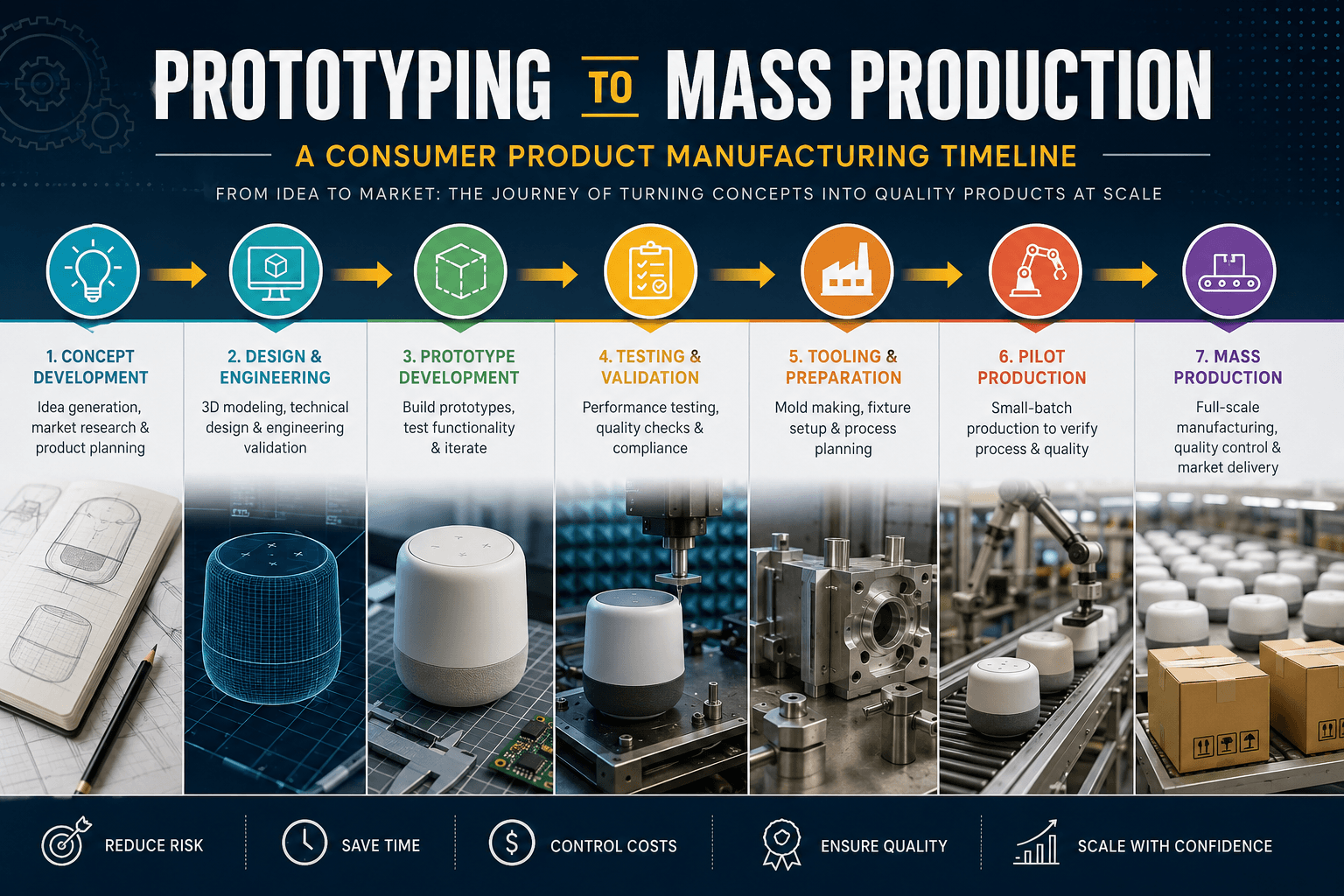
Bringing a consumer product from an initial idea to mass production involves far more than designing a prototype and finding a factory. Successful product development requires a structured process that connects product design, engineering, prototyping, testing, supplier sourcing, tooling, quality control, and production planning.
For consumer product companies, understanding the manufacturing timeline from prototype to mass production is essential for controlling costs, avoiding delays, and launching products on schedule.
This guide explains the major stages of the consumer product manufacturing process, typical timelines, key milestones, and the factors that can accelerate or delay production.
What Is the Consumer Product Manufacturing Process?
The consumer product manufacturing process is the sequence of activities required to transform a product concept into a commercially manufactured product.
A typical journey looks like this:
Product Concept → Engineering Design → Prototype → Testing → Design Validation → Tooling → Pilot Production → Quality Approval → Mass Production → Product Launch
Depending on the product’s complexity, materials, certifications, and production volume, the complete process can take several months to more than a year.
Products such as simple plastic accessories may move quickly from prototype to production, while consumer electronics, appliances, connected devices, and products requiring regulatory certification can take considerably longer.
Consumer Product Manufacturing Timeline at a Glance
| Manufacturing Stage | Typical Timeline | Primary Objective |
|---|---|---|
| Product Concept & Requirements | 1–3 weeks | Define product specifications |
| Industrial & Engineering Design | 2–8 weeks | Create production-ready design |
| Prototype Development | 2–6 weeks | Build and evaluate prototypes |
| Testing & Design Validation | 2–8 weeks | Identify and resolve issues |
| Supplier Selection | 2–6 weeks | Identify manufacturing partners |
| DFM & Design Optimization | 1–4 weeks | Prepare design for production |
| Tooling & Mold Development | 4–12 weeks | Create production tooling |
| Pilot Production | 1–3 weeks | Validate manufacturing process |
| Quality Approval | 1–3 weeks | Confirm production quality |
| Mass Production | 2–12+ weeks | Manufacture commercial quantities |
These are general estimates. Actual timelines vary substantially based on product complexity and supply-chain requirements.
1. Product Concept and Requirements
Typical timeline: 1–3 weeks
Every manufacturing project starts with a clearly defined product concept.
At this stage, companies determine what the product needs to do, who will use it, how much it should cost, and what technical requirements it must meet.
Important considerations include:
- Product functionality
- Target customer
- Target selling price
- Target manufacturing cost
- Product dimensions
- Materials
- Performance requirements
- Expected production volume
- Packaging requirements
- Regulatory requirements
- Target launch date
A strong product requirements document can prevent expensive changes later in development.
Why This Stage Matters
Manufacturing decisions are strongly influenced by the product’s intended volume and cost.
For example, a product expected to sell 1,000 units may use a different manufacturing strategy from one expected to sell 500,000 units.
2. Industrial Design and Engineering
Typical timeline: 2–8 weeks
Once the product requirements are established, industrial designers and engineers convert the concept into a detailed product design.
The process can include:
- Industrial design
- 3D CAD modeling
- Mechanical engineering
- Electronics engineering
- Material selection
- Component selection
- Structural analysis
- Thermal considerations
- Design for Manufacturing (DFM)
The objective is not simply to create a product that looks good. It must also be manufacturable, reliable, cost-effective, and scalable.
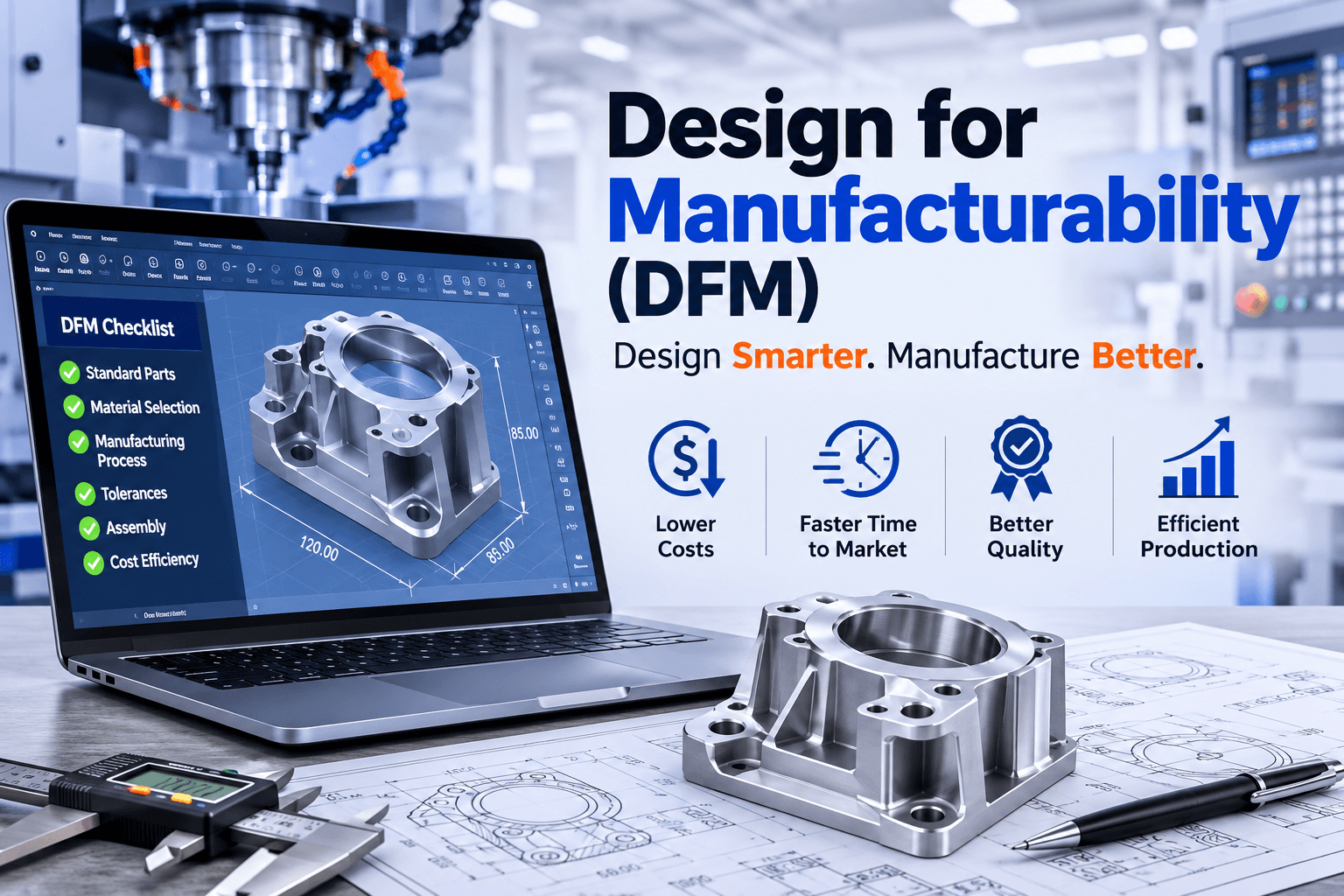
Design for Manufacturing
Design for Manufacturing (DFM) is one of the most important steps before mass production.
DFM evaluates whether the product can be manufactured efficiently using the selected processes.
For example, engineers may examine:
- Wall thickness
- Draft angles
- Part tolerances
- Fastener locations
- Assembly methods
- Material selection
- Injection-molding requirements
- Sheet-metal bends
- PCB assembly constraints
Identifying these issues before tooling can save significant time and money.
3. Prototype Development
Typical timeline: 2–6 weeks
The first physical prototype allows the development team to evaluate whether the product works as intended.
Depending on the product, prototypes may be produced using:
- 3D printing
- CNC machining
- Laser cutting
- Vacuum casting
- Soft tooling
- PCB prototyping
- Rapid injection molding
- Hand assembly
At this stage, speed is usually more important than achieving the lowest possible unit cost.
What Prototypes Validate
A prototype can reveal problems that may not be obvious in CAD models.
Teams can evaluate:
- Product dimensions
- Ergonomics
- Fit and finish
- Mechanical movement
- Electronics functionality
- Heat generation
- Assembly sequence
- Component compatibility
- User experience
Multiple prototype iterations are normal.
4. Testing and Design Validation
Typical timeline: 2–8 weeks
After prototype development, the product undergoes testing.
Testing depends heavily on the product category.
A consumer electronic device, for example, may require electrical, thermal, battery, electromagnetic compatibility, and safety testing.
Testing can include:
- Functional testing
- Durability testing
- Drop testing
- Temperature testing
- Environmental testing
- Electrical testing
- Battery testing
- Safety testing
- Regulatory testing
- User testing
The goal is to identify design weaknesses before investing heavily in production tooling.
Prototype Failure Is Not Necessarily Bad
Finding a problem during prototyping is considerably cheaper than discovering it after thousands of units have been manufactured.
The best manufacturing workflows deliberately use early prototypes and testing to reduce production risk.
5. Supplier and Manufacturer Selection
Typical timeline: 2–6 weeks
Once the design is sufficiently mature, the company can begin evaluating manufacturing suppliers.
Supplier selection should go beyond comparing unit prices.
Important criteria include:
- Manufacturing capabilities
- Production capacity
- Quality systems
- Previous experience
- Tooling capabilities
- Material sourcing
- Lead times
- Minimum order quantities
- Quality-control processes
- Communication
- Geographic location
- Supply-chain reliability
- Cost structure
A low-cost supplier is not necessarily the lowest-cost manufacturing partner if poor quality, delays, or high rejection rates create additional expenses.
6. Design for Manufacturing and Cost Optimization
Typical timeline: 1–4 weeks
Before production tooling begins, the supplier and engineering team typically conduct another detailed DFM review.
This stage connects product engineering with factory capabilities.
The supplier may recommend changes such as:
- Simplifying components
- Reducing part count
- Changing materials
- Adjusting tolerances
- Improving mold design
- Modifying assembly methods
- Reducing machining operations
- Combining components
- Improving packaging
Even small design changes can significantly affect production costs at high volumes.
For example, reducing assembly time by just a few seconds per unit can create substantial savings when manufacturing hundreds of thousands of products.
7. Production Tooling
Typical timeline: 4–12 weeks
For many consumer products, tooling is one of the biggest milestones between prototype and mass production.
Common production tooling includes:
- Injection molds
- Die-casting molds
- Stamping dies
- Forming tools
- CNC fixtures
- Assembly fixtures
- Testing fixtures
Injection molding is particularly common for consumer products with plastic housings and components.
Why Tooling Takes Time
Tooling may require:
- Tool design
- Tool manufacturing
- Initial sampling
- Dimensional inspection
- Trial production
- Mold modifications
- Final approval
If the first trial reveals defects such as warping, sink marks, flash, poor fit, or dimensional problems, the tool may require modifications.
This is why tooling should not begin until the product design is sufficiently stable.
8. Engineering Validation and Tool Trials
Typical timeline: 1–3 weeks
Once production tooling is available, manufacturers produce initial samples.
These samples are inspected against the approved product specifications.
Teams may evaluate:
- Dimensions
- Appearance
- Material properties
- Assembly
- Functional performance
- Surface finish
- Color consistency
- Packaging fit
- Production cycle time
This stage helps determine whether the production process can consistently produce acceptable units.
9. Pilot Production
Typical timeline: 1–3 weeks
Pilot production is a limited manufacturing run before full-scale production.
Instead of immediately manufacturing tens of thousands of units, the factory produces a smaller batch.
The purpose is to validate the complete manufacturing process.
Pilot production can identify problems involving:
- Assembly time
- Worker instructions
- Component availability
- Production yield
- Equipment settings
- Quality inspection
- Packaging
- Logistics
- Manufacturing capacity
A successful pilot run provides confidence that the factory can transition to mass production.
10. Quality Approval and Production Readiness
Before mass production begins, the manufacturer and product company establish final quality standards.
These may include:
- Approved product samples
- Technical drawings
- Inspection criteria
- Acceptable Quality Limits (AQL)
- Functional test procedures
- Packaging specifications
- Labeling requirements
- Material specifications
A clear quality-control plan helps ensure that the factory knows exactly what constitutes an acceptable product.
11. Mass Production
Typical timeline: 2–12+ weeks
Once the product, tooling, suppliers, and production process have been approved, mass production can begin.
The factory moves from small-scale pilot production to the required production volume.
Production typically involves:
Material Procurement → Component Manufacturing → Sub-Assembly → Final Assembly → Testing → Quality Inspection → Packaging → Shipping
Production speed depends on:
- Factory capacity
- Order quantity
- Number of production lines
- Product complexity
- Component availability
- Automation
- Production yield
- Quality requirements
Large orders may be produced in batches rather than all at once.
12. Quality Control During Mass Production
Quality control should not stop after the first production approval.
Manufacturers typically perform inspections at multiple points.
These can include:
Incoming Quality Control
Materials and components are inspected when they arrive at the factory.
In-Process Quality Control
Products are checked during assembly and manufacturing.
Final Quality Control
Finished products are inspected before packaging and shipment.
Typical inspections include:
- Visual inspection
- Dimensional inspection
- Functional testing
- Electrical testing
- Mechanical testing
- Packaging inspection
Continuous quality monitoring helps prevent small manufacturing problems from becoming large-scale production issues.
Factors That Can Delay a Consumer Product Manufacturing Timeline
Manufacturing timelines are rarely linear. Several factors can introduce delays.
1. Design Changes
Late engineering changes can require new prototypes, tooling modifications, and additional testing.
2. Tooling Problems
Mold or die defects can delay production and require additional tool iterations.
3. Component Shortages
Electronic components, batteries, motors, sensors, and specialty materials can have long lead times.
4. Regulatory Testing
Products requiring certification may need additional testing and documentation before launch.
5. Poor Supplier Communication
Unclear drawings, specifications, or quality requirements can create repeated production issues.
6. Low Production Yield
If a large percentage of manufactured units fail inspection, production capacity effectively falls.
7. Packaging Changes
Packaging is often overlooked but can affect product dimensions, shipping costs, labeling, and launch schedules.
How to Reduce Time to Market
Companies can shorten the consumer product manufacturing timeline without compromising product quality by improving planning at every stage.
Start DFM Early
Involve manufacturing engineers and suppliers before finalizing the design.
Use Rapid Prototyping
Rapid prototyping allows teams to identify design issues earlier.
Freeze the Design Before Tooling
Avoid unnecessary engineering changes after production tooling begins.
Qualify Multiple Suppliers
For critical components, having alternative suppliers can reduce supply-chain risk.
Build a Detailed Production Schedule
Track tooling, components, testing, pilot production, quality approval, and shipping separately.
Use Clear Quality Standards
Approved samples and detailed inspection criteria reduce disputes and rework.
Plan Component Procurement Early
Long-lead components should be identified during the engineering phase rather than after tooling is complete.
Example Consumer Product Manufacturing Timeline
Consider a relatively complex consumer electronic product.
A possible development schedule could look like this:
Weeks 1–3: Product requirements and industrial design
Weeks 4–9: Engineering and CAD development
Weeks 10–13: Functional prototypes
Weeks 14–18: Testing and design revisions
Weeks 16–21: Supplier qualification and DFM
Weeks 20–30: Production tooling
Weeks 29–32: Tool trials and engineering validation
Weeks 33–35: Pilot production
Weeks 36–37: Final quality approval
Weeks 38–46: Mass production
This represents approximately 9–11 months from initial development to significant production volume.
A simpler product may reach production much faster, while products involving batteries, complex electronics, certifications, precision components, or highly customized tooling may require substantially more time.
Prototype vs. Mass Production: What’s Different?
One of the biggest mistakes new product companies make is assuming that a successful prototype automatically means the product is ready for mass production.
It doesn’t.
A prototype primarily answers:
“Can we build this product?”
Mass production must answer:
“Can we build thousands or millions of these products consistently, economically, and at the required quality?”
The manufacturing process must therefore be optimized for:
- Repeatability
- Cost
- Production speed
- Quality
- Scalability
- Supply-chain reliability
- Worker efficiency
- Automated testing
- Material availability
This transition from prototype manufacturing to scalable production is often where the most important engineering and sourcing decisions are made.
Final Checklist Before Mass Production
Before giving the factory a production order, companies should confirm:
- Product design is finalized
- Engineering drawings are approved
- Materials are specified
- BOM is finalized
- DFM review is complete
- Suppliers are qualified
- Production tooling is approved
- Tool trials are completed
- Product testing is complete
- Required certifications are obtained
- Pilot production is approved
- Quality standards are documented
- Packaging is finalized
- Component inventory is available
- Production capacity is confirmed
- Shipping and logistics are planned
Conclusion
The journey from prototyping to mass production is a structured process involving design, engineering, testing, sourcing, tooling, quality control, and production planning.
While the exact timeline varies by product, manufacturers and consumer brands can significantly reduce delays by planning for manufacturing from the beginning.
The most successful products are not simply designed for functionality—they are designed for repeatable, scalable, and cost-effective manufacturing.
By combining rapid prototyping, early DFM reviews, qualified suppliers, robust testing, production tooling, pilot runs, and continuous quality control, companies can move from product concept to mass production with fewer surprises and a more predictable launch timeline.
The key takeaway: mass production should not be treated as the final step of product development. Manufacturing strategy should influence the product from the earliest design stages.