
PLI Scheme for Electronics Manufacturing in India: How It Works and Who Qualifies
Introduction
India’s Production Linked Incentive (PLI) scheme for electronics is the most significant government intervention in Indian manufacturing in a generation. It has already attracted Apple’s supply chain to India, driven Samsung’s Noida expansion, and turned India into the world’s second-largest mobile phone manufacturer. For companies considering India electronics manufacturing, understanding PLI is not optional – it directly affects total cost economics.
What Is PLI?
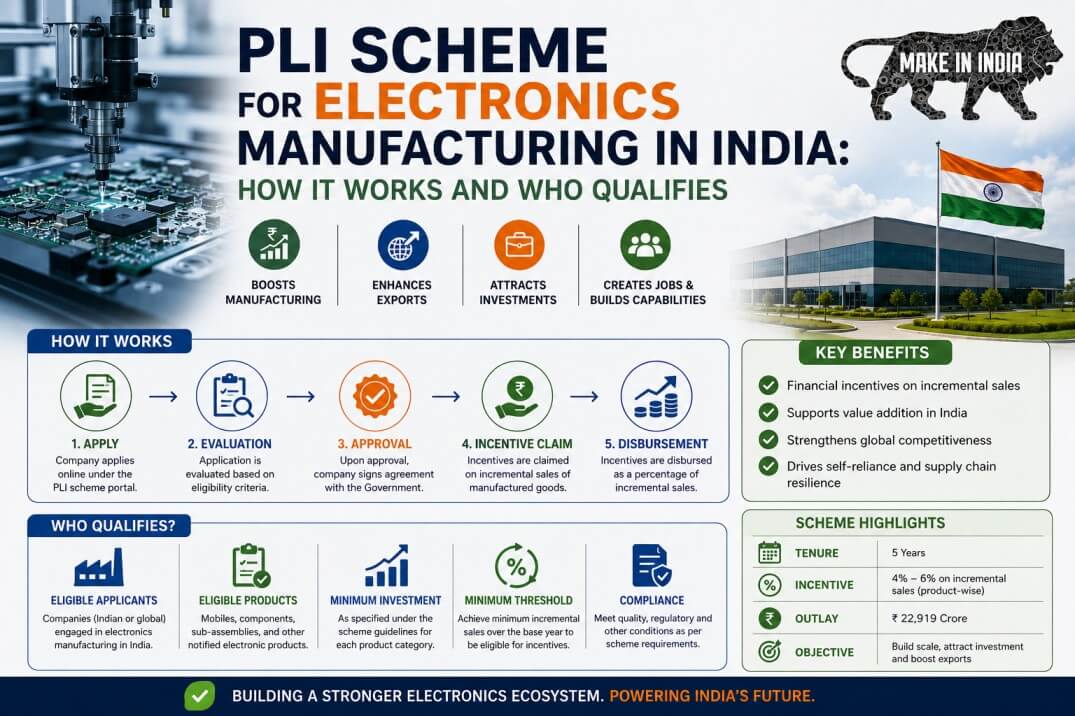
Production Linked Incentives are cash disbursements from the Indian government to qualifying manufacturers, calculated as a percentage of incremental sales above a base year. The government pays you to produce more in India – the incentive is performance-linked, not upfront.
The PLI scheme for Large Scale Electronics Manufacturing was announced in April 2020 with a total outlay of Rs 40,951 Cr over five years.
PLI Electronics: The Incentive Structure
Target Segment 1: Mobile Phones (Global Players – more than Rs 15,000 invoice value)
- Incentive: 4-6% of incremental net sales
- Year 1: 6%, declining to 4% by Year 5
- Minimum investment threshold: Rs 1,000 Cr in manufacturing assets over 4 years
- Approved companies: Apple (via Foxconn India, Wistron, Pegatron), Samsung
Target Segment 2: Mobile Phones (Domestic Companies)
- Incentive: 4-6% on incremental sales
- Lower investment thresholds
- Approved companies: Lava, Micromax, Optiemus, Padget Electronics
Target Segment 3: Electronic Components and Semiconductors
- Incentive: 3-6% on incremental sales depending on sub-category
- Sub-categories: display modules, camera modules, connector assemblies, PCBA, lithium-ion cells, semiconductors
Total committed production under PLI (as of 2024): Rs 4.5 lakh crore over the scheme period.
ECMS 2025: The Next Chapter
The Electronics Component Manufacturing Scheme (ECMS), announced in 2025 with Rs 22,919 Cr outlay, addresses the gap PLI’s success exposed: India assembles phones but still imports most components.
ECMS target components:
- Multi-layer PCBs and HDI boards
- Camera modules and actuators
- Display touch assemblies
- Lithium-ion cells and battery packs
- Connectors and cables
- Passive components (resistors, capacitors – targeting selective categories)
ECMS incentive structure: 5-10% on qualifying production for 5-8 years, with higher incentives for capital-intensive, high-difficulty components.
Strategic implication: ECMS is building the supply chain under the assembly capacity PLI created. For global electronics supply chain players, ECMS is the more interesting opportunity – lower competition, longer incentive windows, and strategic alignment with India’s component indigenisation goal.
Who Should Apply for PLI / ECMS?
Strong fit:
- Electronics OEMs or EMS companies with committed India production volumes
- Foreign companies willing to establish India manufacturing entities (WOS or JV)
- Companies targeting incremental India production of Rs 500 Cr+ over 4-5 years
Not a fit:
- Companies using India only as a pass-through below scheme thresholds
- Companies without committed production investment
- MSMEs below investment/production thresholds (separate MSME schemes exist)
The Application Process
- Identify the right PLI scheme – DPIIT manages electronics PLI; MeitY manages ECMS
- Submit Expression of Interest – during open application windows announced 3-6 months in advance
- Provide investment and production commitments – detailed business plan, investment schedule, and production projections
- Receive provisional approval – government reserves incentive envelope
- Begin production – base year is established; incremental production above base qualifies
- Annual incentive claim – submit audited production and sales data; government disburses incentive
Timeline from application to first incentive disbursement: 18-30 months.
Key Takeaways
- PLI electronics (Rs 40,951 Cr) has driven $14B+ of electronics manufacturing investment into India since 2020.
- Incentives of 4-6% on incremental sales materially change India manufacturing economics.
- ECMS 2025 (Rs 22,919 Cr) extends PLI logic to components – the strategic frontier for supply chain depth.
- Application requires establishment of an India entity, committed investment, and production scale.
- For companies sourcing from Indian CMs rather than investing directly, PLI benefits flow to the CM – buyer benefits indirectly through more competitive CM pricing.
FAQs
Q: Can a foreign company directly apply for PLI?
A: Yes – through a wholly-owned subsidiary incorporated in India. 100% foreign-owned Indian entities are eligible for PLI schemes.
Q: Is PLI available in all states or only certain industrial zones?
A: PLI is a central government scheme and applies nationally. SEZ-based production has different incentive interaction – seek specialist tax advice for SEZ plus PLI combinations.
Q: What happens if production targets are not met?
A: Incentives are not disbursed for underperformance. There are no penalties for underperformance in most scheme structures, but the incentive envelope may be reallocated.