

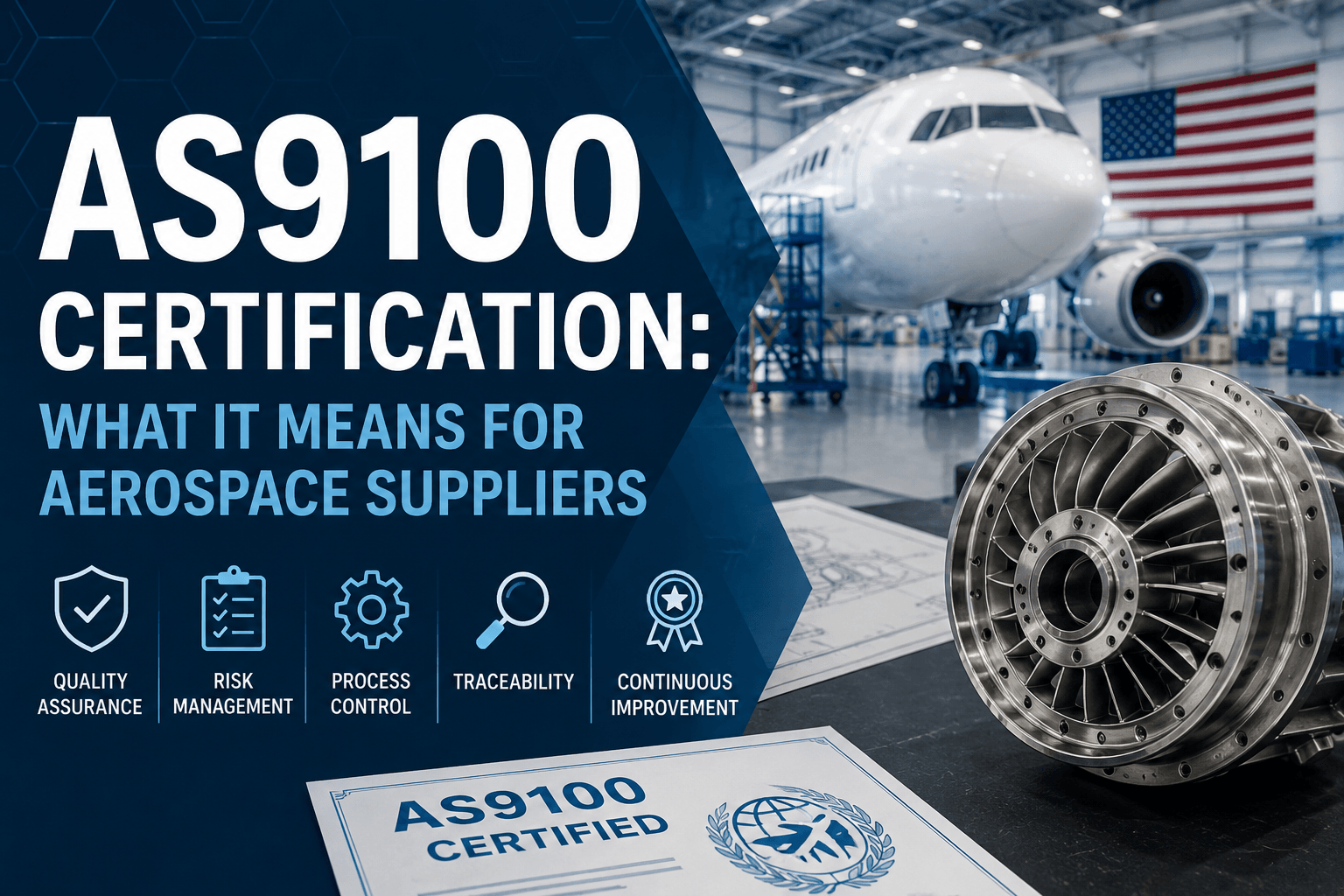
AS9100 Certification: What It Means for Aerospace Suppliers
Quality is non-negotiable in the aerospace industry. A single manufacturing error can affect safety, performance, and regulatory compliance across an entire supply chain. That’s why many aerospace manufacturers require their suppliers to hold AS9100 certification before they can bid on contracts or become approved vendors.
Whether you’re a machine shop, electronics manufacturer, component supplier, or precision engineering company, understanding AS9100 can help you compete for more business while improving your internal processes.
What Is AS9100 Certification?
AS9100 is an internationally recognized Quality Management System (QMS) standard developed specifically for the aerospace, aviation, and defense industries. It builds on ISO 9001 by adding industry-specific requirements that address product safety, risk management, configuration management, counterfeit parts prevention, and regulatory compliance.
The standard was created by the International Aerospace Quality Group (IAQG) to establish consistent quality expectations across global aerospace supply chains.
Companies that achieve AS9100 certification have demonstrated that their quality management system meets rigorous industry requirements and is capable of consistently delivering safe, reliable, and compliant products.
Why AS9100 Matters for Aerospace Suppliers
Many aerospace manufacturers only work with suppliers that are AS9100 certified. Certification demonstrates that a supplier has implemented standardized processes to reduce defects, improve traceability, and maintain consistent product quality.
For suppliers, certification offers more than regulatory compliance. It provides a competitive advantage when pursuing contracts with aerospace original equipment manufacturers (OEMs), defense contractors, and Tier 1 suppliers.
It also gives customers greater confidence that products will meet strict quality and safety requirements throughout production.
Key Requirements of AS9100
AS9100 includes all ISO 9001 requirements while introducing additional controls designed for aerospace manufacturing.
Some of the most important requirements include:
Risk-Based Thinking
Organizations must identify, evaluate, and manage risks throughout design, production, and delivery. This proactive approach helps reduce quality issues before they affect customers.
Product Safety
Companies must establish documented processes that protect product integrity throughout manufacturing, handling, storage, and delivery.
Configuration Management
Manufacturers must control product configurations to ensure every design change is documented, approved, and traceable throughout the product lifecycle.
Counterfeit Parts Prevention
Suppliers must implement procedures to prevent counterfeit or suspect components from entering production.
Traceability
Materials, components, inspections, and production records must be traceable from raw material through finished product.
Operational Planning
Organizations must define controlled manufacturing processes, inspection activities, quality objectives, and acceptance criteria before production begins.
Benefits of AS9100 Certification
Certification can deliver measurable improvements across both operations and business development.
Improved Product Quality
Documented processes reduce variation, improve consistency, and minimize manufacturing defects.
Increased Customer Confidence
Customers know certified suppliers follow internationally recognized quality standards and undergo regular independent audits.
Better Risk Management
Organizations identify potential failures earlier, reducing costly rework, delays, and quality escapes.
Access to New Business Opportunities
Many aerospace contracts require AS9100 certification as a prerequisite for supplier approval.
Greater Operational Efficiency
Standardized procedures reduce waste, improve communication, and support continuous improvement initiatives.
Stronger Regulatory Compliance
AS9100 helps organizations align with aviation regulations and customer-specific quality requirements.
Who Needs AS9100 Certification?
AS9100 is intended for organizations that manufacture products or provide services within the aerospace supply chain.
Examples include:
- Precision machining companies
- Aerospace component manufacturers
- Electronics suppliers
- Composite material manufacturers
- Metal fabrication companies
- Assembly and integration providers
- Maintenance, repair, and overhaul (MRO) organizations
- Aerospace distributors with value-added processes
- Defense contractors
- Special process providers
Even companies that supply indirect products or services may benefit if certification is expected by major customers.
Steps to Become AS9100 Certified
Certification is achieved through a structured implementation and audit process.
1. Understand the Standard
Review AS9100 requirements and compare them with your existing quality management system.
2. Perform a Gap Analysis
Identify areas where current processes do not meet certification requirements.
3. Develop or Update Your Quality Management System
Document procedures, define responsibilities, establish quality objectives, and implement required controls.
4. Train Employees
Ensure employees understand documented procedures and their responsibilities within the quality management system.
5. Conduct Internal Audits
Verify that processes are working effectively and identify opportunities for improvement before the certification audit.
6. Hold a Management Review
Leadership should evaluate quality performance, audit results, risks, and improvement initiatives.
7. Complete the Certification Audit
An accredited certification body performs a two-stage audit to evaluate compliance with AS9100 requirements.
8. Maintain Certification
Organizations must complete regular surveillance audits and continually improve their quality management system.
Common Challenges During Implementation
Many organizations encounter similar obstacles when preparing for certification.
These may include:
- Creating complete process documentation
- Managing extensive records
- Meeting traceability requirements
- Integrating risk management into daily operations
- Training employees across departments
- Maintaining consistent supplier controls
- Preparing for external audits
A phased implementation plan and strong management support can help overcome these challenges.
AS9100 vs. ISO 9001
Although AS9100 is based on ISO 9001, it includes additional requirements specifically for aerospace organizations.
| Feature | ISO 9001 | AS9100 |
|---|---|---|
| General quality management | ✓ | ✓ |
| Risk management | Basic | Enhanced |
| Product safety | Limited | Comprehensive |
| Configuration management | No | Yes |
| Counterfeit parts prevention | No | Yes |
| Aerospace regulatory focus | No | Yes |
| Supplier traceability | Limited | Extensive |
Organizations already certified to ISO 9001 often find it easier to transition to AS9100 because many core quality management requirements are already in place.
Best Practices for Maintaining AS9100 Compliance
Certification should be viewed as an ongoing commitment rather than a one-time achievement.
Organizations that maintain compliance successfully often:
- Review quality objectives regularly.
- Conduct scheduled internal audits.
- Monitor supplier performance.
- Analyze customer feedback and nonconformities.
- Update risk assessments as operations evolve.
- Train employees continuously.
- Use corrective actions to prevent recurring issues.
These practices help sustain certification while supporting long-term operational excellence.
Frequently Asked Questions
Q. Is AS9100 mandatory?
No. However, many aerospace manufacturers and defense contractors require suppliers to be AS9100 certified before awarding contracts.
Q. How long does AS9100 certification take?
Implementation typically takes between six and twelve months, depending on the organization’s size, existing quality management system, and operational complexity.
Q. Does AS9100 replace ISO 9001?
No. AS9100 includes all ISO 9001 requirements while adding aerospace-specific controls.
Q. How often is AS9100 certification renewed?
Certification is generally valid for three years, with surveillance audits conducted annually to verify continued compliance.
Key Takeaways
AS9100 certification is more than a quality badge. It demonstrates that an aerospace supplier has implemented disciplined processes designed to meet the industry’s demanding expectations for safety, quality, and reliability.
For suppliers looking to grow within the aerospace and defense sectors, certification can open doors to new contracts, strengthen customer relationships, improve operational efficiency, and reduce quality risks. While achieving certification requires time and commitment, the long-term benefits often extend well beyond compliance, helping organizations build a stronger reputation and compete more effectively in a highly regulated market.