
Solid-State Batteries: Will They Ever Reach Grid Storage?
Yes, solid-state batteries could eventually become part of the grid storage market. But they are unlikely to replace today’s lithium iron phosphate (LFP) batteries anytime soon.
The reason is simple: grid storage has very different priorities from electric vehicles. A grid battery does not need to be extremely light or compact. It needs to deliver electricity reliably for years at the lowest possible lifetime cost.
That changes the technology race.
Recent research suggests that all-solid-state batteries still face major challenges in manufacturing scale-up, solid-to-solid interfaces, mechanical pressure, cycle life, and cost. One 2026 review estimates that current solid-state battery costs remain far above the levels needed to compete with established LFP systems.
So the more useful question is not whether solid-state batteries can work on the grid. They can.
The question is whether their advantages will be valuable enough to justify their higher cost.
Why Solid-State Batteries Are Attractive for Grid Storage
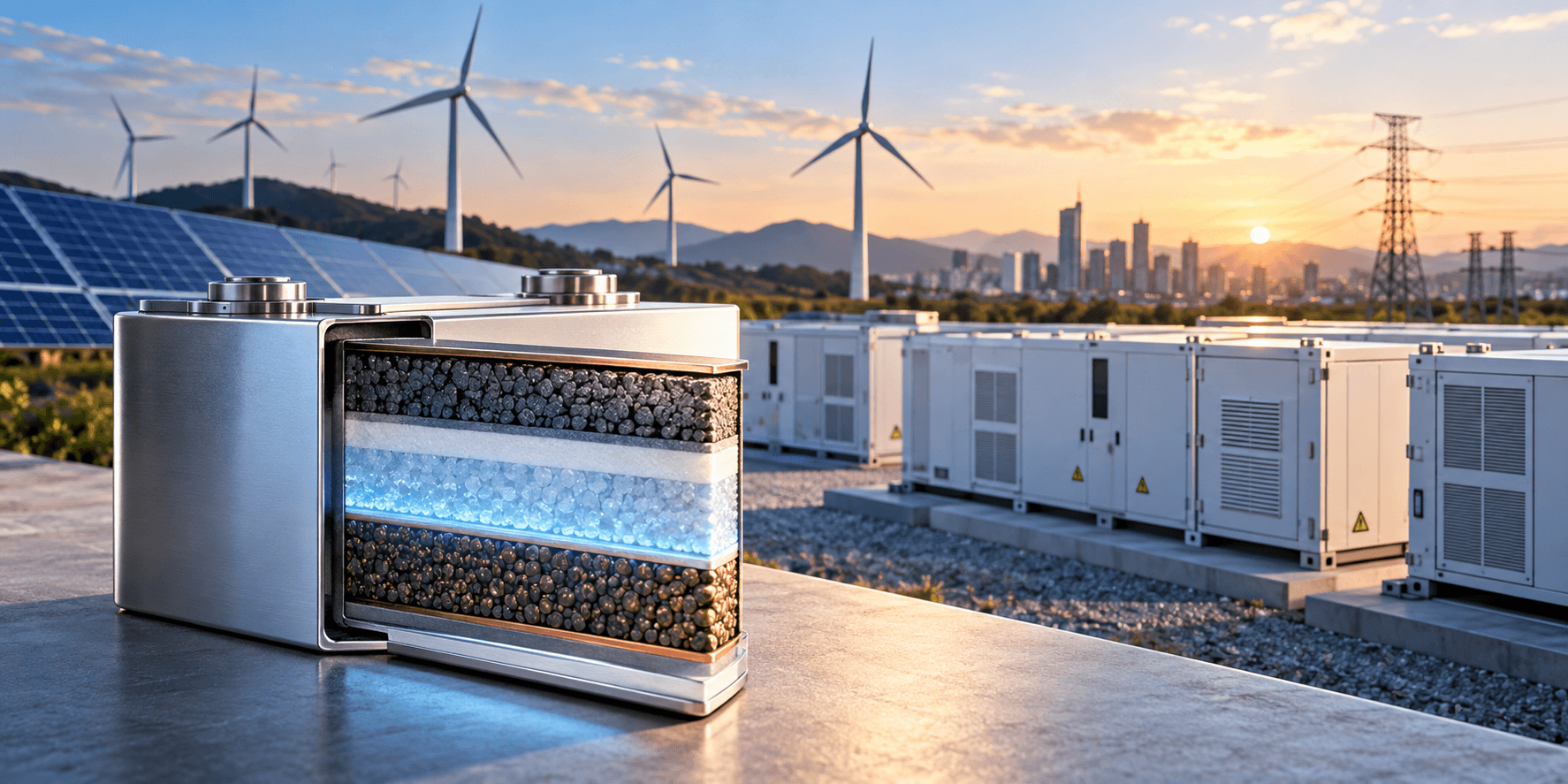
Solid-state batteries replace the conventional liquid electrolyte found in most lithium-ion batteries with a solid electrolyte.
That seemingly straightforward change can affect safety, energy density, durability, and cell design.
For grid operators, three potential advantages stand out.
Improved safety
Conventional lithium-ion batteries use flammable liquid electrolytes. A severe cell failure can trigger thermal runaway, which can spread through a battery system and create difficult fire-safety challenges.
Solid electrolytes can reduce the risk associated with flammable liquids. That does not make solid-state batteries completely risk-free, but it could simplify some aspects of thermal management and system safety.
The U.S. Department of Energy has identified improved safety and energy density as major potential benefits of all-solid-state batteries, while also noting that commercial deployment remains immature.
For large storage installations located near cities, industrial facilities, or critical infrastructure, that safety advantage could eventually have significant economic value.
Longer operating life
Grid batteries may cycle every day for many years.
A storage system supporting solar generation, for example, could charge during the afternoon and discharge during the evening peak. Repeating that process thousands of times puts considerable stress on the battery.
Solid-state designs have the potential to improve durability by eliminating some degradation mechanisms associated with liquid electrolytes. But potential is not the same as proven field performance.
This distinction matters.
Recent research highlights a significant gap between impressive laboratory results and performance in large-format cells. Some solid-state designs that perform well in small laboratory cells experience interface degradation, thermal gradients, and other problems when scaled into larger pouch cells.
For grid storage, proven lifetime performance matters more than an impressive result from a small test cell.
Higher energy density
Energy density is less important for stationary storage than it is for electric vehicles, but it still matters.
A more energy-dense battery can reduce the physical footprint of a storage project. That can be valuable when land is expensive or limited.
However, energy density is not likely to be the main reason grid operators adopt solid-state batteries.
A stationary battery can sit on the ground. It does not need to carry its own weight down a highway.
That is why researchers increasingly argue that solid-state battery development for stationary applications should focus less on maximum energy density and more on lifetime, safety, reliability, and levelized cost of storage.
The Biggest Problem Is Cost
This is where the case for solid-state batteries becomes much harder.
Grid storage is an extremely cost-sensitive business.
Developers do not simply ask how much energy a battery can store. They look at the total cost of buying, installing, operating, maintaining, replacing, and eventually retiring the system.
This is commonly captured through levelized cost of storage (LCOS).
A battery that costs twice as much but lasts twice as long may be competitive. A battery that costs several times more without providing a corresponding improvement in lifetime or performance is much harder to justify.
A 2026 review of solid-state batteries for grid applications estimates current solid-state costs at roughly $800 to $1,500 per kWh, compared with approximately $70 to $100 per kWh at the cell level for current LFP systems. The exact figures vary by technology and system boundary, but the gap illustrates the scale of the challenge.
Solid-state batteries therefore need more than better performance.
They need a major manufacturing cost breakthrough.
Manufacturing Is a Bigger Challenge Than the Chemistry
Producing a promising laboratory cell is one thing. Producing millions of reliable cells at competitive cost is another.
Solid-state batteries introduce difficult manufacturing requirements around electrolyte layers, interfaces, electrode loading, pressure, moisture sensitivity, and defect control.
Some solid electrolytes also create demanding manufacturing environments.
The problem becomes more severe as cells get larger.
Research published in 2026 describes a “scale-up gap” between laboratory cells and grid-relevant large-format cells. Larger cells can experience mechanical and thermal problems that are less visible in small laboratory prototypes.
That means manufacturers need to solve two problems at once:
- Make the battery work.
- Make it work consistently at industrial scale.
The second problem can take years.
Grid Storage Has Different Requirements Than EV Batteries
Much of the excitement around solid-state batteries has been driven by electric vehicles.
That makes sense. EV manufacturers care deeply about energy density, charging speed, weight, and driving range.
Grid operators have a different scorecard.
| Metric | EV priority | Grid storage priority |
|---|---|---|
| Energy density | Very high | Moderate |
| Weight | Critical | Low |
| Fast charging | Important | Application-dependent |
| Cycle life | Important | Critical |
| Calendar life | Important | Critical |
| Safety | Very important | Critical |
| Cost per stored kWh | Important | Extremely important |
| Land footprint | Important | Important |
| Maintenance | Important | Critical |
This difference could change which solid-state technologies ultimately succeed.
A chemistry that makes little sense for an electric car could still be useful for stationary storage if it offers exceptional durability and low operating costs.
Conversely, a technology designed primarily to maximize EV range may not make economic sense for a solar-plus-storage project.
LFP Has a Major Head Start
The biggest obstacle facing solid-state batteries is not that the technology is impossible.
It is that today’s alternatives are getting better.
LFP batteries already offer a strong combination of cost, safety, cycle life, supply-chain maturity, and manufacturing scale.
Grid storage deployments are expanding rapidly, with LFP playing a dominant role in current systems.
That creates a difficult target for solid-state batteries.
They are not competing against an outdated technology waiting to be replaced. They are competing against a mature technology that continues to improve.
China’s battery industry, in particular, has achieved enormous scale in grid storage manufacturing, further reinforcing the cost advantage of established lithium-ion technologies.
For solid-state batteries to break through, their advantages will need to outweigh not only their own manufacturing costs but also the learning curve and supply-chain advantages of conventional batteries.
Could Solid-State Batteries Be Better for Long-Duration Storage?
This is where the opportunity becomes more interesting.
Grid operators increasingly need storage that can deliver electricity for several hours and, in some applications, much longer.
Solar power creates a particularly obvious use case. Electricity generation peaks during the day, while demand can remain high into the evening.
A storage system can shift that electricity from one period to another.
But four-hour storage is only part of the market. Some grids will eventually require storage capable of covering longer periods of renewable generation shortages.
Solid-state batteries could potentially serve some of these applications if manufacturers can deliver long calendar life, high cycle durability, and competitive LCOS.
They will still face competition from other technologies, including flow batteries, sodium-ion systems, pumped hydro, compressed-air storage, thermal storage, and other long-duration approaches.
There will probably not be one battery technology that wins every storage application.
The Pressure Problem
One of the less obvious challenges with solid-state batteries is mechanical pressure.
Some solid-state designs rely on pressure to maintain good contact between solid materials inside the cell.
That creates a major engineering question for stationary storage.
If a battery requires substantial pressure throughout its operating life, the system needs mechanical components capable of maintaining that pressure reliably for years.
That adds cost, complexity, and potential failure points.
Recent research specifically identifies the development of pressure-less architectures as an important step toward making all-solid-state batteries practical for grid applications.
This is a good example of why commercializing solid-state batteries is not simply a matter of finding a better electrolyte.
The entire system may need to be redesigned.
Solid-State Batteries May Need a Different Design Philosophy
The winning grid battery may not look like an oversized EV battery.
Instead, developers could optimize solid-state cells around the needs of stationary applications.
That could mean:
- Lower energy density in exchange for cheaper materials
- Thicker electrodes to increase usable capacity
- Designs that operate without continuous external pressure
- Longer calendar life rather than maximum power
- Simpler thermal management
- Mechanical health monitoring
- Manufacturing processes optimized for stationary cells
- Battery management systems designed around long-term degradation
This application-specific approach is increasingly emphasized in research on grid-scale solid-state batteries.
In other words, the grid may eventually get a version of solid-state technology that looks very different from the battery developed for premium electric vehicles.
When Could Solid-State Batteries Reach the Grid?
There is no reliable single date.
The technology is still moving from laboratory and pilot-scale development toward commercial manufacturing. A 2026 review places true all-solid-state batteries around technology readiness levels 4 to 5 for grid deployment, while noting that semi-solid and hybrid architectures are further along.
That suggests a gradual path rather than a sudden market takeover.
Near term: 2026 to 2030
Conventional lithium-ion batteries, particularly LFP, are likely to remain the dominant choice for mainstream grid storage.
Solid-state technology will continue to focus heavily on manufacturing scale-up, pilot projects, materials development, and applications where safety or durability can justify higher costs.
Early 2030s
If manufacturing improves substantially, early commercial stationary deployments could become more credible.
These may initially target specialized applications rather than the lowest-cost bulk storage market.
Mid-2030s and beyond
If solid-state manufacturers can achieve competitive LCOS while maintaining long life and safety advantages, the technology could become a meaningful part of grid storage.
But this is an outcome, not a certainty.
The technology must clear several economic and engineering hurdles first.
What Would Make Solid-State Batteries Competitive?
Five developments would materially improve the outlook.
1. Lower manufacturing costs
The cost gap with LFP needs to shrink dramatically.
Laboratory breakthroughs are useful, but automated, high-yield manufacturing will ultimately determine commercial viability.
2. Stable solid-solid interfaces
Interfaces between solid materials can develop resistance, cracks, and mechanical problems during repeated cycling.
Solving these issues is central to achieving long service life.
3. Pressure-free operation
If cells can maintain reliable performance without expensive mechanical compression systems, the system architecture becomes much more attractive.
4. Proven long-term durability
Grid developers need evidence from large-format cells operating under realistic conditions.
A 20-year warranty cannot be based solely on short laboratory tests.
5. Application-specific designs
The industry needs to stop assuming that the best solid-state battery is simply the one with the highest energy density.
For grid storage, the winning design may instead be the one that delivers reliable electricity for decades at the lowest LCOS.
Will Solid-State Batteries Replace LFP?
Probably not.
At least, there is no strong reason to expect a complete replacement.
The grid is likely to become more technologically diverse.
LFP could continue serving mainstream two- to four-hour storage. Sodium-ion batteries could gain share where low cost and material availability are particularly important. Flow batteries and other technologies could compete for longer-duration applications.
Solid-state batteries could occupy a narrower but valuable segment where safety, durability, footprint, or specific operating requirements justify their economics.
That is a more realistic outcome than a single technology winning the entire market.
The Bigger Question Is Cost Per Lifetime Cycle
The most important mistake when evaluating solid-state batteries for the grid is focusing on energy density alone.
A grid operator does not buy battery chemistry.
They buy an asset that must deliver predictable electricity for years.
That means the important calculation looks more like this:
Total lifetime cost ÷ total useful energy delivered
A battery that costs more upfront can still win if it delivers substantially more usable energy over its lifetime.
This is why solid-state technology remains interesting despite its current cost disadvantage.
If researchers can combine long life, high safety, reliable large-format operation, and dramatically lower manufacturing costs, the economics could change.
But until that happens, LFP and other mature storage technologies have the advantage.
So, Will Solid-State Batteries Reach the Grid?
Yes, probably, but not everywhere and not soon enough to displace today’s dominant technologies.
The technology has genuine advantages, particularly around safety and potentially long-term durability. But grid storage is an unforgiving market. It rewards technologies that can deliver dependable electricity at very low lifetime cost.
As of 2026, solid-state batteries have not yet demonstrated that combination at commercial grid scale. Recent research continues to identify cost, manufacturing scale-up, interface stability, mechanical pressure, and large-format durability as major barriers.
The likely future is therefore not a solid-state takeover.
It is a more diverse storage market in which solid-state batteries earn a place when their specific advantages translate into better economics for particular grid applications.
For the next several years, established lithium-ion systems are likely to remain the practical choice.
For the decade after that, solid-state batteries are worth watching closely.
Frequently Asked Questions
Are solid-state batteries good for grid storage?
They could be, particularly if their safety, durability, and long-term reliability advantages can be delivered at a competitive lifetime cost. However, commercial grid-scale deployment remains immature.
Are solid-state batteries safer than lithium-ion batteries?
They can reduce risks associated with flammable liquid electrolytes, but solid-state batteries are not automatically risk-free. Cell materials, interfaces, manufacturing defects, and system design still influence safety.
Why are solid-state batteries expensive?
Manufacturing remains difficult and less mature than conventional lithium-ion production. Solid-state cells can also require specialized materials, processing, interface engineering, and mechanical control.
Will solid-state batteries replace LFP?
There is little reason to expect a complete replacement. LFP is already highly competitive for stationary storage, and different battery technologies are likely to serve different grid applications.
When will solid-state batteries be commercially available for grid storage?
Early deployments could emerge as manufacturing matures, but widespread, cost-competitive grid deployment is more likely to require significant progress through the late 2020s and into the 2030s.
What is the biggest barrier to solid-state grid batteries?
Cost is the biggest commercial barrier, but it is connected to several technical problems, including manufacturing scale, interface stability, mechanical pressure, and long-term performance in large-format cells.