
What Is Contract Manufacturing? The Complete Guide for OEMs and Product Companies
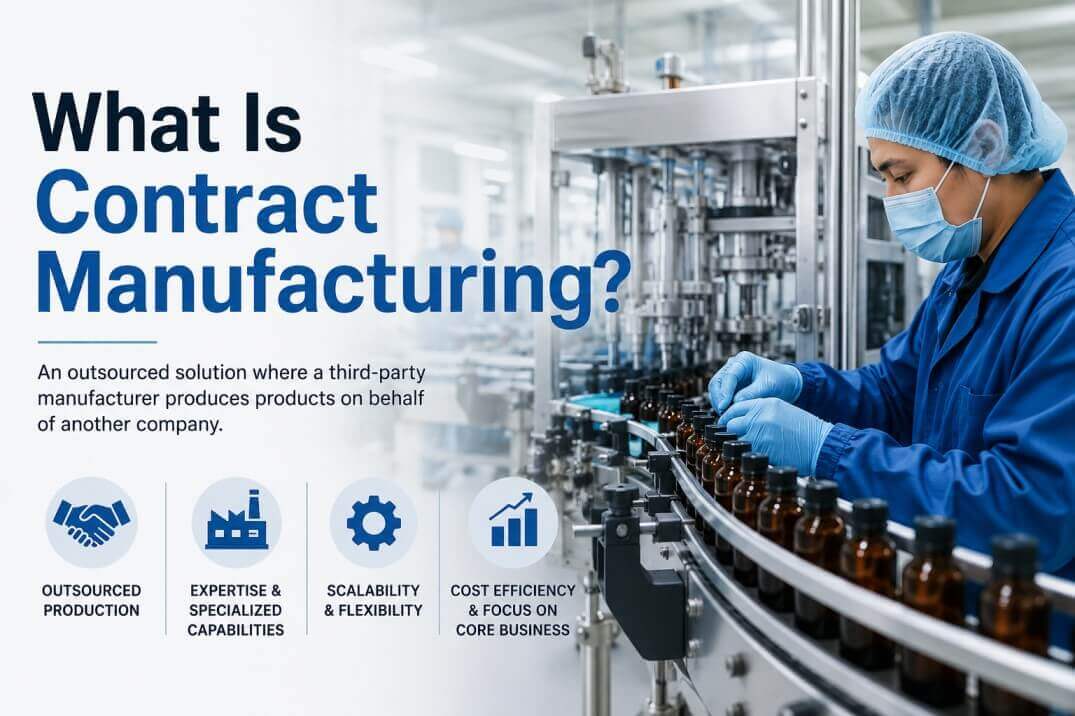
Every physical product you have ever used was made somewhere – in a factory, by people or machines, using processes refined over decades. But the company whose name is on the box often had nothing to do with that factory. They designed the product, built the brand, and handed manufacturing to a specialist. That arrangement is contract manufacturing – and it is how the world’s most efficient supply chains operate.
This guide covers everything an OEM, product company, or procurement leader needs to know: what contract manufacturing actually is, how it works, the different types, the genuine benefits, the risks to manage, and how the model has evolved with digital manufacturing platforms.
What Is Contract Manufacturing?
Contract manufacturing is a business model in which a company – the client – outsources the production of its goods to a third-party manufacturer. The client retains ownership of the product design, intellectual property, and brand. The contract manufacturer provides the facilities, equipment, raw materials, labour, and process expertise to build the product to the client’s specifications.
The word “contract” matters here. The relationship is governed by a formal agreement that defines product specifications, quality standards, pricing, lead times, IP ownership, confidentiality, and compliance requirements. Neither party is improvising.
Contract Manufacturing vs. Outsourcing: What’s the Difference
Outsourcing is the broad practice of delegating a business function to an external party – which could include IT, accounting, logistics, or manufacturing. Contract manufacturing is specifically the outsourcing of production. All contract manufacturing is outsourcing; not all outsourcing is contract manufacturing.
Who Owns the Design and IP in a CM Arrangement
The client does. This is the defining characteristic that separates contract manufacturing from OEM or ODM arrangements. The contract manufacturer builds to your drawings, your bill of materials, and your specifications. They are not co-creating the product – they are executing your design with their production capability.
The 4 Main Types of Contract Manufacturing
Not all CM arrangements look alike. The model you choose depends on how much of the production process you want to hand over.
Turnkey Manufacturing
The contract manufacturer handles everything end-to-end: raw material sourcing, component procurement, production, quality inspection, packaging, and delivery. The client provides the design and purchase order; the manufacturer delivers finished goods. This is the highest-leverage model for product companies that want to stay asset-light and focused on growth.
Component / Part Manufacturing
The manufacturer produces a specific sub-assembly or component – a machined housing, a die-cast bracket, a stamped chassis – that the client integrates into a larger system. This model is common in aerospace, capital goods, and precision engineering, where different specialists contribute to a finished product.
Private Label Manufacturing
The manufacturer produces a complete, finished product that the client sells under its own brand. The client may have specified the product requirements or may be selecting from the manufacturer’s existing catalogue. Common in consumer goods, supplements, and apparel.
Electronics Manufacturing Services (EMS)
EMS is a specialised form of contract manufacturing for electronic products. EMS providers handle PCB assembly, component sourcing, box build, functional testing, and distribution for OEMs in industries ranging from consumer electronics to aerospace. India’s EMS sector is growing rapidly, driven by PLI scheme incentives and a deepening component ecosystem.
How the Contract Manufacturing Process Works
Understanding the process end-to-end is the difference between a smooth launch and an expensive rework cycle.
Step 1 – Design Transfer and NDA
Before any manufacturing begins, both parties execute a non-disclosure agreement covering designs, specifications, and any proprietary process information. The client shares CAD files, drawings, BOM, and quality requirements. The manufacturer reviews for manufacturability – this Design for Manufacturability (DfM) review catches design issues before tooling is cut.
Step 2 – Supplier Qualification and Selection
If you are working with a manufacturing platform like Zetwerk, pre-vetted suppliers matching your capability requirements are presented with transparent pricing. If you are sourcing independently, this step involves RFQ, factory audits, and reference checks.
Step 3 – Prototyping and First Article Inspection
Before committing to a production run, a first article is manufactured and submitted to First Article Inspection (FAI) or PPAP. Every critical dimension, material property, and functional parameter is measured and documented. Deviations are resolved before volume production begins.
Step 4 – Production, QA, and Delivery
Production runs against approved drawings and quality control plans. In-process inspection, final inspection, and packaging happen at the factory. Real-time tracking on platforms like Zetwerk OS gives clients visibility into production progress without requiring boots on the ground.
Step 5 – Ongoing Supplier Management
A CM relationship is not a set-and-forget arrangement. Scheduled reviews, supplier scorecards, corrective action processes, and continuous improvement plans keep quality and delivery performance on track over time.
7 Proven Benefits of Contract Manufacturing
Eliminate Capex and Reduce Fixed Costs
Building and equipping a factory to produce a single product line is one of the most capital-intensive decisions a company can make. Contract manufacturing converts that fixed cost into a variable one – you pay per unit produced, not per square metre of factory floor. That capital stays available for R&D, marketing, and market expansion.
Scale Production Up or Down Without Risk
Demand rarely cooperates with forecasts. Contract manufacturing gives you the ability to ramp production for a product launch and pull back after peak season without carrying the overhead of idle machinery and underutilised labour. This flexibility is structurally impossible with owned facilities.
Access Specialised Equipment and Expertise
CNC machining centres, high-pressure die casting lines, SMT pick-and-place lines, and investment casting facilities each require years of process expertise to operate at quality. Contract manufacturers have invested that time. Accessing their capability costs you nothing beyond the unit price.
Faster Time-to-Market
An experienced contract manufacturer has already solved the production engineering problems you would spend months working through from scratch. They have the tooling, the processes, the quality plans, and the supply chain relationships. That translates directly into a faster path from approved design to first shipment.
Focus Internal Resources on Core Business
Every hour your engineering team spends managing production problems is an hour not spent designing the next product. Every rupee your operations team spends managing factory operations is a rupee not going into sales or customer success. Contract manufacturing frees internal resources to concentrate on the activities that differentiate you in the market.
Built-in Quality Systems and Certifications
Reputable contract manufacturers carry ISO 9001, and sector-specific certifications such as IATF 16949 for automotive, AS9100 for aerospace, or IPC-A-610 for electronics. You inherit those quality systems without building them yourself.
Global Sourcing Flexibility
The right contract manufacturing network gives you access to production in India, Southeast Asia, Mexico, and Europe simultaneously – allowing you to optimise for cost, lead time, tariff exposure, and customer proximity on a product-by-product basis.
Common Challenges – and How to Manage Them
Contract manufacturing is not without complexity. The companies that manage it well go in with clear eyes about the challenges.
IP Protection and Confidentiality
Your design is your competitive advantage. Before sharing any technical documents, execute a detailed NDA covering designs, tooling, processes, and any customer data embedded in specifications. In higher-risk geographies, consider filing patents before production begins. Work with manufacturers who have documented IP security procedures.
Quality Control Across Distance
When your factory is 1,000 kilometres away, quality problems can compound before you hear about them. Mitigate this with First Article Inspection before every new part or revision, in-process inspection at key milestones, and – where possible – real-time production visibility through a digital manufacturing platform.
Communication and Lead Time Risk
Misaligned expectations on engineering changes, material substitutions, or delivery schedules are the root cause of most CM disputes. Establish a clear engineering change order (ECO) process, require written confirmation of any schedule changes, and build realistic buffer into your demand planning.
Single-Supplier Dependency
Concentrating all production at a single contract manufacturer is a resilience risk. A fire, a capacity constraint, a quality issue – any of these can halt your supply. Where volumes and part complexity allow, qualify a second source for critical components.
Industries That Rely on Contract Manufacturing
Electronics and EMS
Consumer electronics, wearables, IoT devices, telecom equipment, and industrial controls are built almost exclusively through EMS contract manufacturers. The speed of product cycles and the complexity of global component supply chains make in-house EMS impractical for all but the largest OEMs.
Aerospace and Defence
Precision components for aircraft, defence platforms, and space systems are produced by qualified contract manufacturers operating under AS9100 and NADCAP certifications. The cost of maintaining specialist machining, casting, and testing capability in-house is prohibitive for any but the largest primes.
Capital Goods and Industrial Equipment
Structural steel assemblies, heavy fabrications, and industrial machinery components are routinely manufactured by specialist contract manufacturers whose expertise, equipment, and supply chain relationships take decades to build.
Precision Engineering
High-tolerance components for medical devices, automotive, and semiconductor equipment demand process mastery that contract manufacturers with decades of investment in CNC machining, metrology, and SPC can deliver more reliably than most OEMs could build internally.
Contract Manufacturing vs. In-House Production: Quick Comparison
| Dimension | Contract Manufacturing | In-House |
|---|---|---|
| Upfront capital | Low (variable cost) | High (capex) |
| Scalability | High | Low |
| Speed to market | Faster | Slower |
| Quality control | Process-dependent | Direct control |
| IP risk | Managed via contract | None |
| Fixed overhead | None | Significant |
| Best for | Growth, variable demand, new products | Ultra-high volume, proprietary process |
When CM Makes Sense
CM is the right model when you are launching a new product, scaling a business without locking in capex, entering a new geography, or producing at volumes that don’t justify owned facility investment.
When In-House Makes Sense
In-house production makes sense when your manufacturing process is itself your competitive moat, when volumes are extremely high and predictable, or when regulatory requirements demand a level of direct oversight that the CM model cannot provide.
The Rise of Digital Manufacturing Platforms
Traditional contract manufacturing required you to find manufacturers yourself, negotiate blind, and manage quality from a distance with limited visibility. Digital manufacturing platforms have changed this model fundamentally.
How Platform-Based CM Gives You Multi-Supplier Access
Platforms like Zetwerk connect clients with a pre-vetted, multi-supplier network spanning dozens of processes, materials, and geographies. Instead of a single-supplier dependency, you get parallel execution across multiple qualified manufacturers – reducing lead time and concentration risk simultaneously.
Real-Time Quality Visibility and Supplier Analytics
Zetwerk OS provides clients with real-time production tracking, in-process quality checkpoints, and supplier performance dashboards – the visibility of an in-house operation without the overhead. Engineering changes, delivery updates, and quality dispositions are managed through a single digital interface.
Zetwerk OS as a Case Study in Platform Manufacturing
Where conventional CM requires you to manage each supplier relationship independently, Zetwerk’s platform orchestrates the entire supply chain – supplier qualification, production planning, QA, logistics, and invoicing – through a single operating system. For OEMs managing complex, multi-component assemblies across multiple geographies, this represents a step-change in operational leverage.
Why India Is the World’s Fastest-Growing CM Destination
India’s contract manufacturing market stood at USD 19.6 billion in 2023 and is projected to reach USD 38.9 billion by 2028 – a near-doubling in five years.
Cost Advantages at Scale
Indian manufacturing labour averages USD 3/hour compared to USD 5.80/hour in China, translating to meaningful cost advantages on labour-intensive assemblies. Combined with PLI incentives of 4–6% on incremental production, the total cost case for India-based CM is strong.
PLI Incentives and Government Support
India’s Production Linked Incentive schemes across 14 sectors – electronics, capital goods, aerospace, and more – provide direct financial incentives for production within India. For OEMs sourcing from India, this subsidy is partially reflected in unit pricing.
Sectors Where India Leads
India has particular depth in electronics EMS, precision castings and forgings, structural steel fabrication, and aerospace and defence components. A supplier network spanning 5,400+ manufacturers across 25 countries – with manufacturing facilities in India, the US, Mexico, and Europe – gives global OEMs access to this depth without managing it directly.
How to Choose the Right Contract Manufacturer
9-Point Evaluation Checklist
- Do their technical capabilities match your product requirements exactly?
- Do they hold the certifications your industry and customers require?
- Can they demonstrate experience with similar part complexity and materials?
- Do they have sufficient capacity headroom for your volume – today and at 3× growth?
- Is their IP security policy documented and enforceable?
- Are they compliant with regulations in your target markets?
- Can they meet your lead time requirements with appropriate buffer?
- Are their communication and documentation processes compatible with yours?
- Do they offer real-time production visibility or digital reporting?
Red Flags to Watch For
- Reluctance to sign a detailed NDA before receiving drawings
- No documented quality management system or lapsed certifications
- Inability to provide customer references in your industry
- Vague pricing with no line-item breakdown
- No escalation path for quality non-conformances
Key Takeaways
- Contract manufacturing is the outsourcing of production to a third party while retaining ownership of design and IP
- The four main types are turnkey, component, private label, and EMS
- The core benefits are capex elimination, scalability, speed to market, and access to specialist expertise
- Key risks – IP exposure, quality control, and single-supplier dependency – are manageable with the right contract and processes
- Digital manufacturing platforms have transformed CM from a transactional arrangement into a real-time, multi-supplier operating model
- India is the world’s fastest-growing CM destination, combining cost advantage with PLI incentives and a deepening manufacturing ecosystem
Frequently Asked Questions
Q. What is the difference between a contract manufacturer and an OEM?
An OEM (Original Equipment Manufacturer) designs and often manufactures products. A contract manufacturer builds products designed by the client. In practice, many OEMs use contract manufacturers to produce their products.
Q. Is contract manufacturing the same as outsourcing?
Contract manufacturing is a type of outsourcing – specifically the outsourcing of production. Outsourcing is a broader term that can apply to any business function.
Q. What industries use contract manufacturing most?
Electronics (EMS), aerospace and defence, precision engineering, capital goods, pharmaceuticals, and consumer goods are the heaviest users of contract manufacturing.
Q. How do I protect my IP when using a contract manufacturer?
Execute a comprehensive NDA before sharing any technical documentation. Include clauses covering design ownership, tooling ownership, confidentiality obligations, and data security. File patents in relevant jurisdictions before production begins where IP risk is high.
Q. What is a digital manufacturing platform and how does it differ from a traditional CM?
A digital manufacturing platform connects you to a network of pre-vetted contract manufacturers, provides real-time production visibility, manages quality and logistics, and aggregates pricing and performance data – all through a single interface. A traditional CM relationship is bilateral and managed through email, spreadsheets, and periodic site visits.