BESS Business Models in India: Capacity Tariffs, Energy Arbitrage and Ancillary Revenue
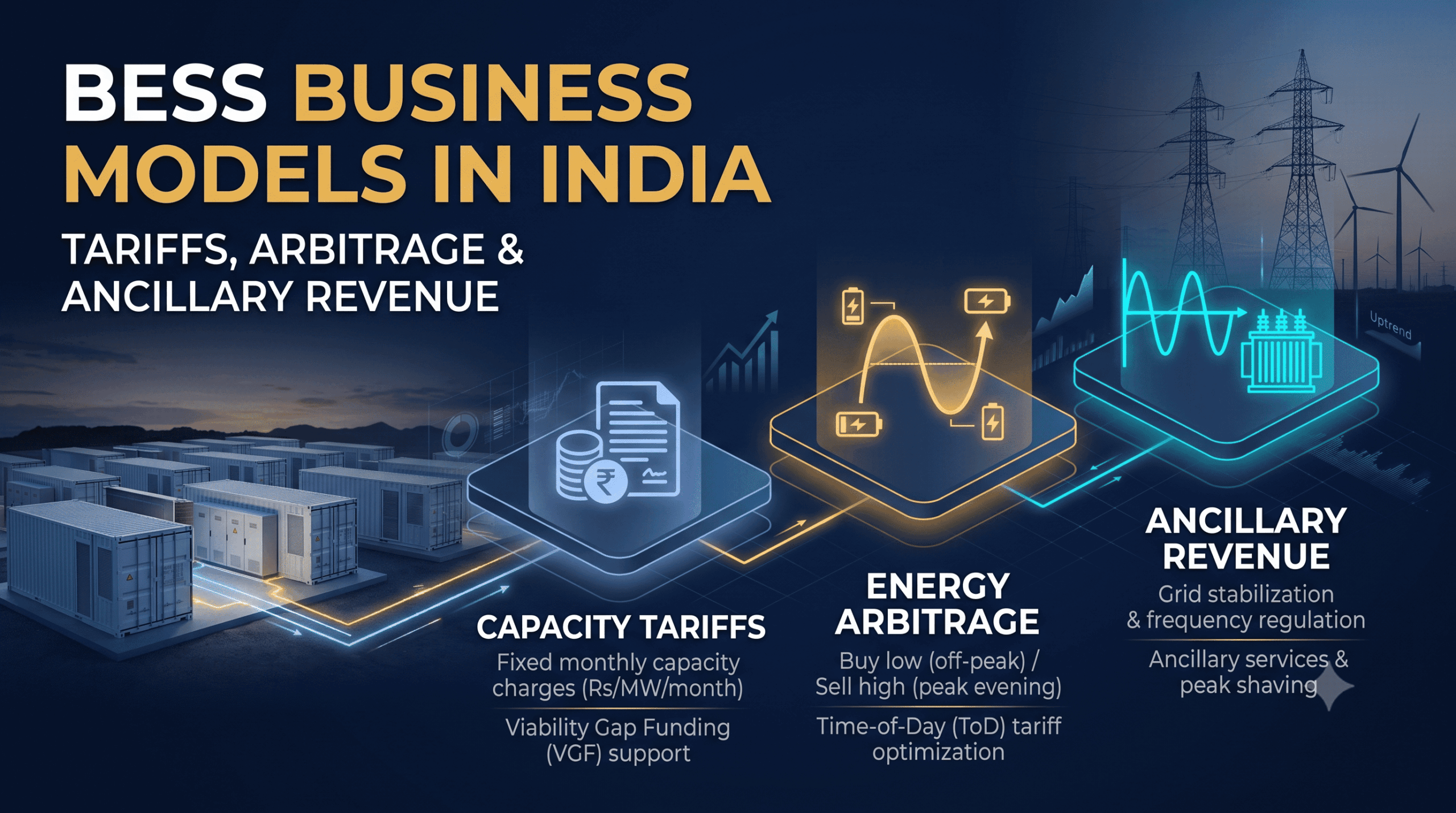
India’s battery energy storage market is moving beyond the question of how much storage the grid needs to a more important commercial question: how does a BESS project make money?
The answer is increasingly based on multiple revenue streams rather than a single use case. Developers can earn predictable capacity payments through long-term contracts, capture electricity price spreads through energy arbitrage, provide ancillary services, or combine storage with renewable generation and C&I demand management.
India’s installed battery storage capacity reached about 9.3 GWh by June 2026, while standalone BESS accounted for 83% of cumulative installations. Procurement is also accelerating, with 28 GW tendered during the first half of 2026.
For investors and developers, the opportunity is attractive, but the business model matters as much as the battery itself.
How BESS Creates Economic Value
A battery can provide several distinct services:
- Capacity: being available when the grid needs power
- Energy: buying or storing electricity when it is cheaper and discharging when it is more valuable
- Ancillary services: responding rapidly to frequency and grid-balancing requirements
- Renewable firming: converting variable solar and wind output into more predictable supply
- C&I optimization: reducing peak demand, managing time-of-day tariffs and improving backup resilience
The Ministry of Power’s national framework explicitly identifies spot energy markets, capacity and energy arbitrage, ancillary services, renewable firming and diesel-generator replacement as potential commercial applications for energy storage.
This creates the foundation for value stacking, where one BESS asset generates revenue from more than one service.
1. Capacity Tariff Model: Selling Availability
The most straightforward utility-scale model is a capacity-based contract.
Instead of paying primarily for every unit of electricity the battery sells, the buyer pays the BESS developer for making a specified amount of storage capacity available during defined periods.
A typical structure might look like:
BESS developer → DISCOM / generator / procurer
The contract specifies:
- Power capacity, such as 100 MW
- Energy capacity, such as 200 MWh
- Availability requirements
- Charging and discharging windows
- Response time
- Round-trip efficiency requirements
- Performance guarantees
- Fixed capacity payment
- Variable energy or dispatch payment, where applicable
This model is attractive to project financiers because revenue can be much more predictable than relying entirely on volatile power-market spreads.
India has already used tariff-based competitive bidding for standalone BESS. In one major SECI procurement, the project structure covered 500 MW / 1,000 MWh of standalone BESS.
Why capacity payments matter
Battery projects have substantial upfront capital costs. Debt providers therefore prefer contracted cash flows over uncertain merchant revenues.
A long-term capacity contract can provide:
Revenue visibility → better bankability → easier project financing
The trade-off is that the developer may give up some upside from merchant market opportunities.
If the contract requires the battery to remain available during peak periods, that capacity cannot necessarily be used for another lucrative transaction at the same time.
Where this model works best
Capacity contracts are particularly suited to:
- DISCOM procurement
- Renewable-plus-storage projects
- Peak power supply
- Resource adequacy requirements
- Transmission and distribution applications
- Long-term grid reliability contracts
India’s policy direction increasingly recognizes storage as a capacity resource rather than simply an electricity-delivery asset. The draft National Electricity Policy 2026 also proposes market-based mechanisms and capacity procurement frameworks for energy storage.
2. Energy Arbitrage: Making Money From Price Spreads
Energy arbitrage is conceptually simple:
Charge when electricity is cheap. Discharge when electricity is expensive.
For example, assume a battery buys electricity at ₹3/kWh and eventually sells the discharged electricity at ₹8/kWh.
The gross spread appears to be:
₹8 – ₹3 = ₹5/kWh
But that is not the actual margin.
The battery loses energy during charging and discharging, and the project also incurs operating costs and battery degradation.
A simplified arbitrage calculation is:
Net arbitrage margin = discharge revenue – charging cost – losses – variable operating costs – degradation cost
If the battery has 85% round-trip efficiency, delivering 1 MWh may require roughly 1.18 MWh of charging energy.
At a charging price of ₹3/kWh:
Charging cost ≈ 1.18 × ₹3 = ₹3.54/kWh delivered
If the discharge price is ₹8/kWh:
Gross energy spread ≈ ₹8 – ₹3.54 = ₹4.46/kWh delivered
The remaining margin must cover degradation, operating expenses, market charges and capital recovery.
Why arbitrage is not automatically profitable
A common mistake is to look only at the difference between peak and off-peak prices.
A BESS operator also needs to consider:
- Round-trip efficiency
- Battery degradation
- Cycle limits
- Auxiliary consumption
- Transmission and market charges
- Charging restrictions
- Market liquidity
- Forecasting errors
- Opportunity cost of reserving capacity
- Battery augmentation requirements
This is why a battery with a technically excellent specification can still produce weak investment returns.
The Ministry of Power specifically identifies energy arbitrage as a use case where electricity is purchased during low-price periods and stored energy is used or sold during high-price periods.
3. Ancillary Services: Monetizing Fast Response
Ancillary services are particularly interesting for batteries because BESS can respond extremely quickly compared with many conventional generators.
India already has an established framework for ancillary services. Automatic Generation Control has been recognized as an ancillary service, and Secondary Reserve Ancillary Service has been operational since December 2022. The Ministry of Power reported that 85 generating stations representing approximately 82.8 GW were operating under SRAS as of its 2025-26 annual report.
Battery participation is also moving from theory toward practical deployment. GRID-INDIA conducted AGC pilots involving BESS, including a 20 MW/40 MWh system at BRPL Kilokari, in 2025.
How the revenue model works
Instead of primarily selling energy, a BESS can be compensated for being available to respond when the grid requires balancing.
Potential value comes from:
- Capacity or availability payments
- Activation payments
- Frequency response
- Reserve provision
- Grid balancing
The economics can be attractive because some ancillary services require power capability rather than large amounts of stored energy.
A battery does not necessarily need to discharge hundreds of megawatt-hours to provide valuable grid services.
The challenge
Ancillary-service revenues are still developing as a mature standalone commercial market in India.
That means developers should be cautious about building a financial model that assumes today’s ancillary-service opportunity will remain unchanged for 15 years.
Regulation, market design and procurement mechanisms can materially change project economics.
4. Renewable Energy Firming
Another important business model is pairing BESS with solar or wind.
The basic problem is familiar:
Solar generation does not necessarily match evening demand.
A battery allows a project to shift some generation from the middle of the day toward higher-value periods.
This can turn:
Solar generation → solar + storage → dispatchable renewable supply
The commercial value may come from:
- Meeting peak demand
- Improving renewable scheduling
- Reducing deviation exposure
- Delivering firm power
- Meeting round-the-clock power requirements
- Improving the value of existing renewable assets
India’s current policy framework explicitly supports storage for renewable integration, and government procurement is increasingly structured around renewable power combined with storage.
5. C&I BESS: Demand Management and Resilience
Not every BESS opportunity requires a grid-scale project.
Commercial and industrial customers can use batteries to manage their own electricity consumption.
Potential customers include:
- Data centers
- Manufacturing facilities
- Warehouses
- Hospitals
- Commercial buildings
- Telecom infrastructure
- Industrial campuses
The business case can combine several benefits:
Peak demand reduction + time-of-day optimization + renewable integration + backup power
For a C&I customer, the battery may not need to earn money from wholesale electricity markets at all.
Instead, its value comes from reducing the customer’s electricity bill and improving power resilience.
Recent industry analysis in India points to peak-demand management, tariff optimization, renewable integration, diesel-generator optimization and resilience as emerging C&I storage value streams.
This is particularly relevant for customers where interruptions are expensive.
6. Value Stacking: The Most Important Model
The strongest BESS projects may not rely on one revenue stream.
Consider a hypothetical 100 MW / 200 MWh battery.
During the day it could:
- Charge using low-cost electricity.
- Provide reserve capacity for the grid.
- Discharge during the evening peak.
- Participate in ancillary services when energy arbitrage is unattractive.
- Support renewable power delivery under a contracted arrangement.
The commercial objective is to maximize the value of each MW and MWh without violating contractual or technical constraints.
This is value stacking.
The difficulty is that revenue streams compete for the same battery.
If 50 MW is reserved for ancillary services, that capacity may not be available for energy arbitrage. If a long-term contract requires the battery to discharge at a specific time, the operator cannot freely optimize it in the merchant market.
The real optimization problem therefore becomes:
Which revenue stream creates the highest risk-adjusted value for each available MW and MWh?
Comparing India’s BESS Business Models
| Business model | Revenue visibility | Market risk | Main value driver | Typical buyer |
|---|---|---|---|---|
| Capacity tariff | High | Low to medium | Availability | DISCOM / procurer |
| Energy arbitrage | Low | High | Price spread | Market / trader |
| Ancillary services | Medium | Medium | Fast response | System operator |
| Renewable firming | Medium to high | Medium | Dispatchability | DISCOM / C&I / procurer |
| C&I optimization | Medium | Medium | Bill savings + resilience | Industrial customer |
| Value stacking | Medium | Medium to high | Multiple services | Multiple |
For infrastructure investors, the capacity-contract model generally offers the clearest route to predictable cash flows.
For merchant operators, arbitrage and ancillary services can create greater upside, but they also introduce more market risk.
For C&I developers, the opportunity is often strongest when several customer benefits are combined into one project.
What Determines BESS Project Returns?
The headline battery cost is only one part of the investment equation.
A proper BESS financial model should include:
Capital expenditure
Key variables include:
- Battery cells
- Power conversion systems
- Transformers and switchgear
- HVAC and fire protection
- Civil works
- EPC costs
- Grid interconnection
- EMS and controls
- Development costs
Operating costs
These include:
- O&M
- Insurance
- Land or site costs
- Software and energy-management systems
- Market participation costs
- Auxiliary electricity consumption
Battery degradation
This is one of the most important variables.
Every cycle consumes some of the battery’s useful life. Aggressive merchant operation may increase revenue while simultaneously accelerating degradation.
The correct question is therefore not:
“How much revenue can this battery generate?”
It is:
“How much risk-adjusted revenue can it generate over its useful operating life?”
Augmentation
Some projects may need additional battery capacity during the operating period to maintain contracted performance as the original cells degrade.
That creates another capital expenditure that should be included in the financial model from day one.
The Role of Government Policy
India is actively building the policy framework required for storage to become a mainstream part of the power system.
Government measures have included BESS viability-gap funding, procurement guidelines and transmission-related incentives.
The CEA is also maintaining a dedicated Energy Storage & System Division covering storage policy, standards, VGF implementation, project data and storage planning.
At the same time, the market is becoming more competitive. Recent procurement activity has produced aggressive bidding, creating concerns about whether discovered tariffs adequately reflect long-term project economics.
That creates an important distinction between winning a BESS tender and building a financially durable BESS business.
What BESS Investors Should Watch
For investors, developers and lenders, five questions matter most:
1. Who pays?
A contracted DISCOM or government-backed procurement mechanism can create a very different risk profile from merchant market revenues.
2. What exactly is being sold?
Is the project selling:
- MW of capacity?
- MWh of energy?
- Availability?
- Frequency response?
- Firm renewable power?
- Customer bill savings?
The answer determines the revenue model.
3. How often will the battery cycle?
More cycles can mean more revenue, but potentially faster degradation.
4. Can revenues be stacked?
A project that can legally and technically participate in multiple markets may generate more value than a battery locked into a single application.
5. What happens when market conditions change?
A robust model should test:
- Lower peak/off-peak spreads
- Higher degradation
- Lower ancillary revenue
- Delayed commissioning
- Higher financing costs
- Battery replacement or augmentation
- Changes to market rules
The Future of BESS Economics in India
India’s BESS market is moving toward a model where storage is treated as infrastructure with multiple possible services, rather than simply a battery that buys and sells electricity.
The near-term opportunity is likely to remain strongest in contracted capacity, renewable firming and utility procurement, while energy arbitrage and ancillary services become increasingly important as electricity-market design develops.
The long-term winners will not necessarily be the developers with the cheapest batteries. They will be the ones that can secure reliable revenue, optimize battery dispatch, manage degradation and stack multiple sources of value without double-counting the same MW or MWh.
That is the central commercial challenge for India’s BESS sector: turning a technically flexible asset into a predictable, financeable business.
Key Takeaways
- Capacity tariffs provide predictable revenue and can improve project bankability.
- Energy arbitrage creates merchant upside but depends heavily on price spreads, efficiency and degradation.
- Ancillary services are attractive because batteries can respond rapidly, but India’s market is still developing.
- Renewable firming gives storage value beyond simple electricity trading.
- C&I BESS can monetize demand reduction, tariff optimization, resilience and renewable integration.
- Value stacking may ultimately deliver the strongest economics, provided contracts and market rules allow multiple uses.
- Investors should evaluate lifetime risk-adjusted cash flow, not simply battery CAPEX or headline tariff.