Flow Batteries in India: Vanadium Redox and Where They Fit
India’s Energy Storage Market Is Moving Beyond Lithium-Ion
India’s renewable energy buildout is creating a storage problem that cannot be solved by generation capacity alone.
Solar power is abundant during the day, while electricity demand often remains high after sunset. Wind generation can also vary significantly over the course of a day. As renewable penetration increases, India needs storage systems that can shift electricity across several hours, manage grid congestion, support peak demand, and provide flexibility when renewable output falls.
Lithium-ion batteries are currently the dominant battery technology for these applications. But they are not the only option.
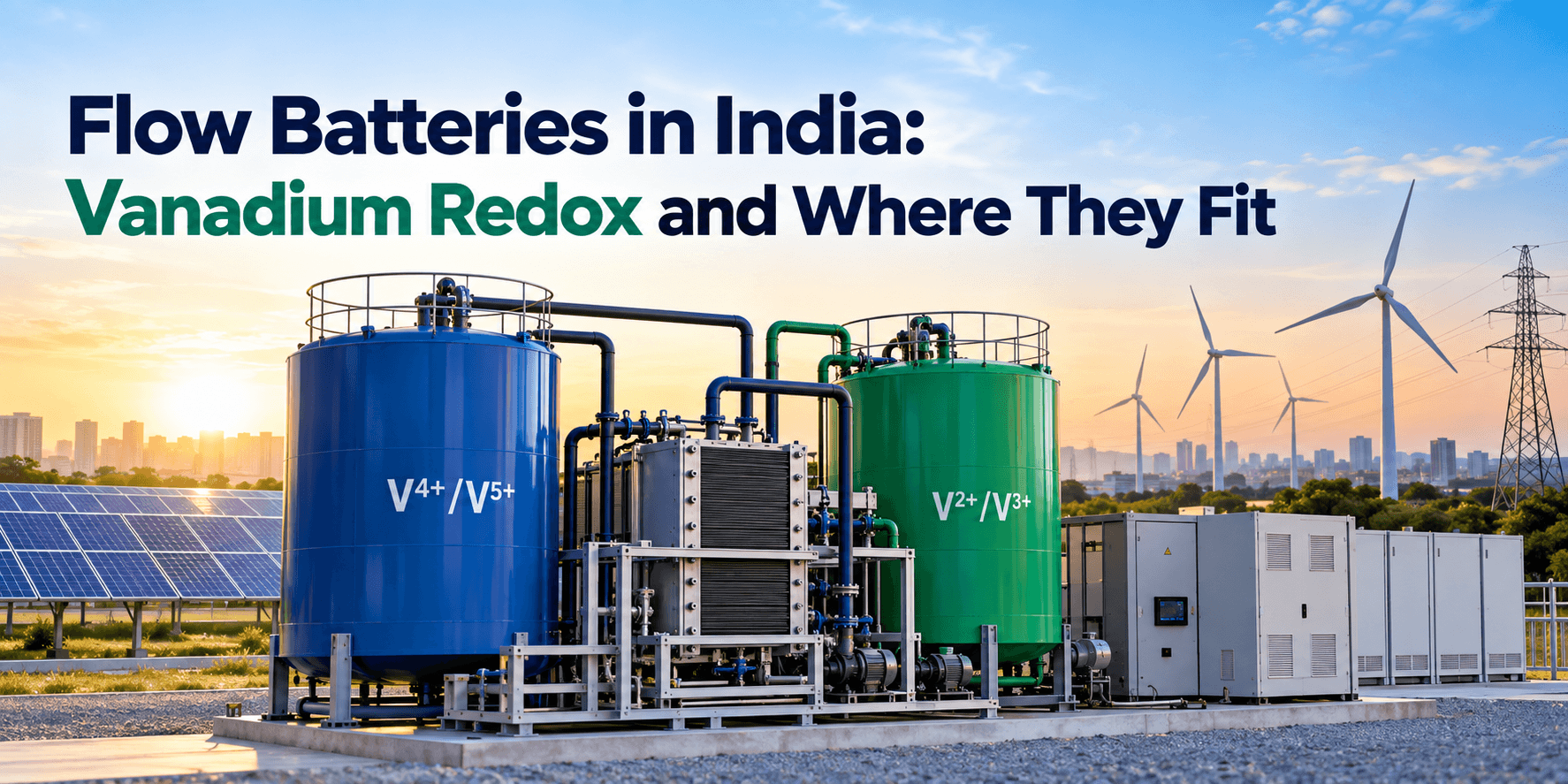
Vanadium redox flow batteries, or VRFBs, are attracting attention as a potential long-duration energy storage technology. Their architecture is fundamentally different from lithium-ion batteries. Instead of storing energy primarily within solid electrodes, VRFBs store energy in liquid vanadium electrolytes held in external tanks.
That difference gives flow batteries several characteristics that can be valuable for large stationary storage projects, particularly where systems need to operate for many hours and cycle frequently.
India is already moving from research toward commercial demonstration. In November 2025, NTPC commissioned a 600 kW / 3 MWh vanadium redox flow battery at its NETRA facility in Greater Noida, described by the government as India’s first MWh-scale VRFB installation.
In September 2026, a much larger 16.7 MW / 100 MWh vanadium flow battery project was awarded for NTPC Renewable Energy’s Khavda project in Gujarat. The system is expected to provide roughly 5.9 hours of storage and is scheduled for commissioning in the second half of 2027.
These projects do not mean flow batteries are about to replace lithium-ion technology. They point to something more useful: India’s storage market is beginning to differentiate between applications.
What Is a Vanadium Redox Flow Battery?
A vanadium redox flow battery stores electrical energy in two liquid electrolytes containing vanadium ions in different oxidation states.
During charging and discharging, the electrolytes circulate through a cell stack. An ion-exchange membrane separates the two sides while allowing the electrochemical reactions needed to move energy through the system.
The basic architecture has four important components:
- Two electrolyte tanks
- Pumps and circulation systems
- An electrochemical cell stack
- Power electronics and control systems
The most important design feature is that power and energy are largely decoupled.
The cell stack determines how much power the system can deliver. The amount of electrolyte determines how much energy it can store.
This means a project can increase its storage duration by adding larger electrolyte tanks without proportionally increasing the size of the electrochemical stack.
For stationary applications, that is a meaningful advantage.
Why Does the Separation of Power and Energy Matter?
Consider two storage projects that both need to deliver 100 MW.
One might need two hours of storage, giving it a 200 MWh capacity.
Another might need eight hours, requiring 800 MWh.
With a conventional battery system, increasing duration generally means adding more battery cells and associated equipment. With a flow battery, the system can be designed around the required power capacity and then expanded with additional electrolyte and tank capacity.
This makes flow batteries particularly interesting for projects where storage duration is more important than compactness.
It also changes how developers should think about battery economics.
For a short-duration application, the additional equipment associated with a flow battery can make it difficult to compete with lithium-ion. As duration increases, however, the economics can become more favorable because energy capacity can be expanded independently of power capacity.
The exact crossover point depends on electrolyte costs, system design, financing, efficiency, project utilization, and local supply chains. There is no universal duration at which flow batteries automatically become cheaper.
Where Vanadium Flow Batteries Have an Advantage
Long-duration storage
VRFBs are particularly suited to applications requiring several hours of discharge.
Researchers at IIT Madras have identified six to eight hours or longer as an important potential application for vanadium flow batteries as India adds more solar and wind generation.
This makes them relevant to applications such as shifting afternoon solar generation into evening demand periods.
Frequent cycling
Flow batteries can be designed for frequent charge and discharge cycles with relatively low degradation.
NTPC’s 3 MWh VRFB installation lists a cycle life of more than 20,000 cycles and describes cyclic degradation as almost negligible.
For projects that cycle regularly over many years, lifetime performance can matter as much as the initial capital cost.
Low fire risk
VRFBs use aqueous electrolytes rather than the flammable organic electrolytes found in many lithium-ion systems.
That substantially changes the fire-risk profile. NTPC highlights the absence of thermal runaway as one of the technology’s advantages.
This does not mean flow batteries have no safety considerations. Pumps, electrical equipment, tanks, piping and chemical handling still need appropriate engineering and controls.
Deep discharge
Flow batteries can operate at high depths of discharge without the same type of degradation concerns associated with some conventional battery chemistries.
NTPC’s system specifies approximately 95% depth of discharge.
For large stationary systems, being able to use more of the installed energy capacity can improve asset utilization.
Recyclability
Vanadium electrolyte can potentially be recovered and reused rather than treated as a disposable component.
NTPC cites more than 99% recyclability for its VRFB system, although real-world recycling economics depend on system design, electrolyte ownership and recovery infrastructure.
Where Flow Batteries Face Challenges
The technology also has clear limitations.
Higher upfront complexity
A flow battery requires tanks, pumps, piping, controls and a cell stack. That makes the system mechanically more complex than a battery cabinet filled with lithium-ion cells.
The additional balance-of-system equipment can increase upfront capital requirements.
Lower energy density
Flow batteries generally require substantially more physical space than lithium-ion systems for the same amount of stored energy.
That makes them less attractive for applications where land is scarce or the battery must be compact.
For a utility-scale renewable energy project with available land, this may be manageable. For a commercial building or urban installation, it can be a major consideration.
Vanadium supply and pricing
Vanadium is central to the VRFB value proposition, but it also creates a supply-chain challenge.
India needs a reliable and economically viable source of vanadium if domestic flow-battery manufacturing is to scale significantly.
NITI Aayog’s long-term scenarios anticipate vanadium redox flow batteries growing from around 1.5% of stationary battery storage technology share in 2030 to 4% by 2070. Its assessment also expects vanadium demand to rise as flow-battery deployment accelerates.
That suggests vanadium could become an increasingly important part of India’s stationary storage supply chain, even if VRFBs remain a minority technology.
Efficiency
Flow batteries generally have lower round-trip efficiency than the best lithium-ion systems.
For applications where every percentage point of efficiency matters, this can affect operating economics.
But efficiency should not be evaluated in isolation. A project with slightly lower efficiency but very high cycle life, long duration and low degradation may still make economic sense.
How Do Flow Batteries Compare With Lithium-Ion?
The question is not whether VRFBs are better than lithium-ion batteries in general.
The better question is: which technology fits the application?
| Factor | Lithium-ion | Vanadium redox flow |
|---|---|---|
| Typical strength | Short to medium duration | Medium to long duration |
| Energy density | High | Relatively low |
| Power and energy scaling | More closely linked | Largely decoupled |
| Cycling | Strong | Strong |
| Long-term degradation | Chemistry dependent | Generally low |
| Fire risk | Requires thermal management | Lower thermal runaway risk |
| Physical footprint | Smaller | Larger |
| Response time | Very fast | Fast |
| Long-duration expansion | Adds more battery cells | Add electrolyte/tank capacity |
| Maturity in India | High and rapidly scaling | Emerging |
| Best fit | Broad range of BESS applications | Long-duration stationary storage |
Lithium-ion therefore remains the natural choice for many projects, especially where space, efficiency, fast deployment and established supply chains are priorities.
Flow batteries become more interesting when the project needs long discharge durations, frequent cycling and predictable long-term operation.
Where Do Flow Batteries Fit in India’s Energy System?
India’s storage requirement is large enough that there is unlikely to be a single winning technology.
The Ministry of New and Renewable Energy cites CEA estimates of 41.65 GW of battery energy storage system capacity requirements by 2029-30, alongside 18.98 GW from pumped storage projects. The broader storage requirement is expected to increase substantially as renewable deployment grows.
The government’s more recent Green Energy Corridor Phase III plans reinforce this direction. Approved in September 2026, the scheme includes deployment of 50 GWh of BESS alongside infrastructure intended to evacuate up to 135 GW of renewable energy.
That creates several potential niches for flow batteries.
Solar shifting
One of the clearest applications is storing solar power during the middle of the day and releasing it during evening demand.
A four-hour lithium-ion system may work well for some projects. A six-hour, eight-hour or longer requirement can create a stronger case for evaluating flow batteries.
Renewable energy firming
Wind and solar projects can use storage to reduce the impact of variable generation.
A flow battery could absorb surplus generation and discharge it when renewable output falls, particularly when the project requires repeated cycling.
Grid support
Large batteries can provide services such as frequency regulation, ramp-rate management and congestion management.
Flow batteries can participate in these services, although their economic value depends on market rules and project configuration.
Renewable energy plus storage projects
India is increasingly designing renewable projects around storage rather than treating storage as an optional add-on.
This could create opportunities for technology-neutral procurement where lithium-ion, flow batteries, pumped storage and other technologies compete based on the required service.
Microgrids and critical infrastructure
Flow batteries may also have a role in applications where safety, long operating life and frequent cycling matter more than compactness.
Potential examples include industrial facilities, renewable-powered microgrids and critical infrastructure with sufficient space for tanks and supporting equipment.
India’s Early VRFB Projects Matter More Than Their Size
India’s current flow-battery deployments are still small compared with the country’s overall energy storage requirement.
But they are useful because they move the technology from laboratory research toward real operating conditions.
NTPC’s 3 MWh system at NETRA provides an operational reference point for the technology. The planned 100 MWh Khavda project represents a much more significant step toward utility-scale deployment.
The IIT Madras and High Energy Batteries collaboration is another important development. The technology has progressed from research toward a larger pilot, with the team expecting broader deployment within the next several years.
The next question is therefore not whether India can build a VRFB.
It can.
The bigger question is whether India can build the supply chain and project economics needed to deploy the technology at scale.
Can India Build a Domestic Flow-Battery Industry?
Potentially, yes, but several pieces need to develop together.
A domestic industry would require more than assembling battery systems.
It would need capabilities across:
- Vanadium electrolyte production and processing
- Membranes and electrodes
- Cell stacks
- Pumps and fluid-handling systems
- Power electronics
- Battery management and control systems
- System integration
- Testing and certification
- Recycling and electrolyte recovery
India already has research and industrial activity in flow-battery technology. The IIT Madras and High Energy Batteries collaboration demonstrates one route from academic research to commercial development.
The larger opportunity is to build an ecosystem rather than simply import complete systems.
That could also reduce exposure to international battery supply-chain volatility, which is becoming increasingly important as India’s storage market expands.
What India’s Policy Environment Means for Flow Batteries
India’s storage policy is becoming increasingly technology-neutral and deployment-focused.
The government has introduced a national framework for energy storage, BESS procurement guidelines, and viability gap funding mechanisms. MNRE’s current policy repository includes support measures covering BESS development, transmission-charge treatment and related storage infrastructure.
The Union Cabinet has also approved a BESS viability gap funding scheme supporting 4,000 MWh of projects by 2030-31, with financial support of up to 40% of capital cost under the scheme.
For flow batteries, this matters because technology adoption does not depend only on battery cost.
Project developers also need predictable revenue models.
If a storage asset can earn revenue from energy arbitrage, capacity availability, ancillary services and grid support, a long-duration technology may have more opportunities to demonstrate its value.
Flow Batteries Are Not a Replacement for Pumped Hydro Either
India has another major long-duration storage option: pumped hydro.
Pumped storage projects can provide very large amounts of energy storage and long operating lives. India has significant potential for developing them, particularly where suitable geography and transmission access exist.
Flow batteries offer a different proposition.
They can be deployed in locations without the same geographical requirements as pumped hydro and can be developed in modular increments.
That makes the three technologies potentially complementary:
Lithium-ion: compact, efficient and versatile battery storage.
Vanadium flow: long-duration, frequently cycled stationary storage where space is available.
Pumped hydro: large-scale, long-life storage where suitable sites and infrastructure exist.
The future Indian grid is likely to use some combination of all three.
What Should Developers Look at Before Choosing a Flow Battery?
A technology decision should begin with the project requirement, not the battery chemistry.
Developers should evaluate:
Required discharge duration
If the project only needs one or two hours of storage, lithium-ion may have a strong advantage.
If the requirement extends toward six, eight or more hours, VRFBs deserve a more detailed economic assessment.
Cycling frequency
A battery that cycles once every few days has a different economic profile from one that cycles every day.
Frequent cycling can improve the case for technologies designed for high cycle life and low degradation.
Available land
Flow batteries require more physical space.
A site with inexpensive and readily available land is better suited to the technology than a constrained urban site.
Lifetime economics
The relevant comparison is not simply rupees per kWh of installed capacity.
Developers should model:
- Capital expenditure
- Round-trip efficiency
- Annual cycles
- Degradation
- Replacement requirements
- Financing costs
- Operations and maintenance
- Electrolyte costs
- Residual value
- End-of-life recovery
Revenue stack
The storage system’s value depends on how it will earn money.
A project designed only for energy arbitrage may produce a different result from one combining arbitrage, capacity services and grid support.
What Comes Next for Vanadium Flow Batteries in India?
The next few years should provide a much clearer picture of where VRFBs can compete.
India already has a policy-driven expansion in energy storage. CEA’s projections point to rapidly increasing storage requirements, while new government programmes are supporting both renewable integration and BESS deployment.
At the same time, India’s flow-battery ecosystem is moving beyond laboratory research.
The 3 MWh NTPC installation established an early operating reference. The 100 MWh Khavda project, if commissioned as planned, will provide a much larger test of the technology under utility-scale conditions.
The outcome will depend on more than technical performance. Developers will be watching delivered cost, efficiency, availability, maintenance requirements, electrolyte economics and financing.
If those factors line up, vanadium flow batteries could establish a meaningful position in India’s long-duration storage market.
The Bottom Line
Vanadium redox flow batteries are unlikely to replace lithium-ion batteries across India’s energy storage market.
They do not need to.
Their opportunity lies in applications where long duration, frequent cycling, low degradation, safety and independent power and energy scaling are valuable.
India’s rapidly expanding renewable fleet creates exactly the kind of grid environment where those characteristics can matter.
The technology is still early in its commercial journey, but the direction is becoming clearer. India now has MWh-scale operating experience, a 100 MWh utility-scale project in development, active domestic research and an increasingly supportive energy-storage policy framework.
The likely future is not a choice between lithium-ion and flow batteries.
It is a more diverse storage market where each technology is matched to the duration, cycling profile, location and economics of the job it needs to perform.