RoHS and REACH Compliance for Electronics Exporters
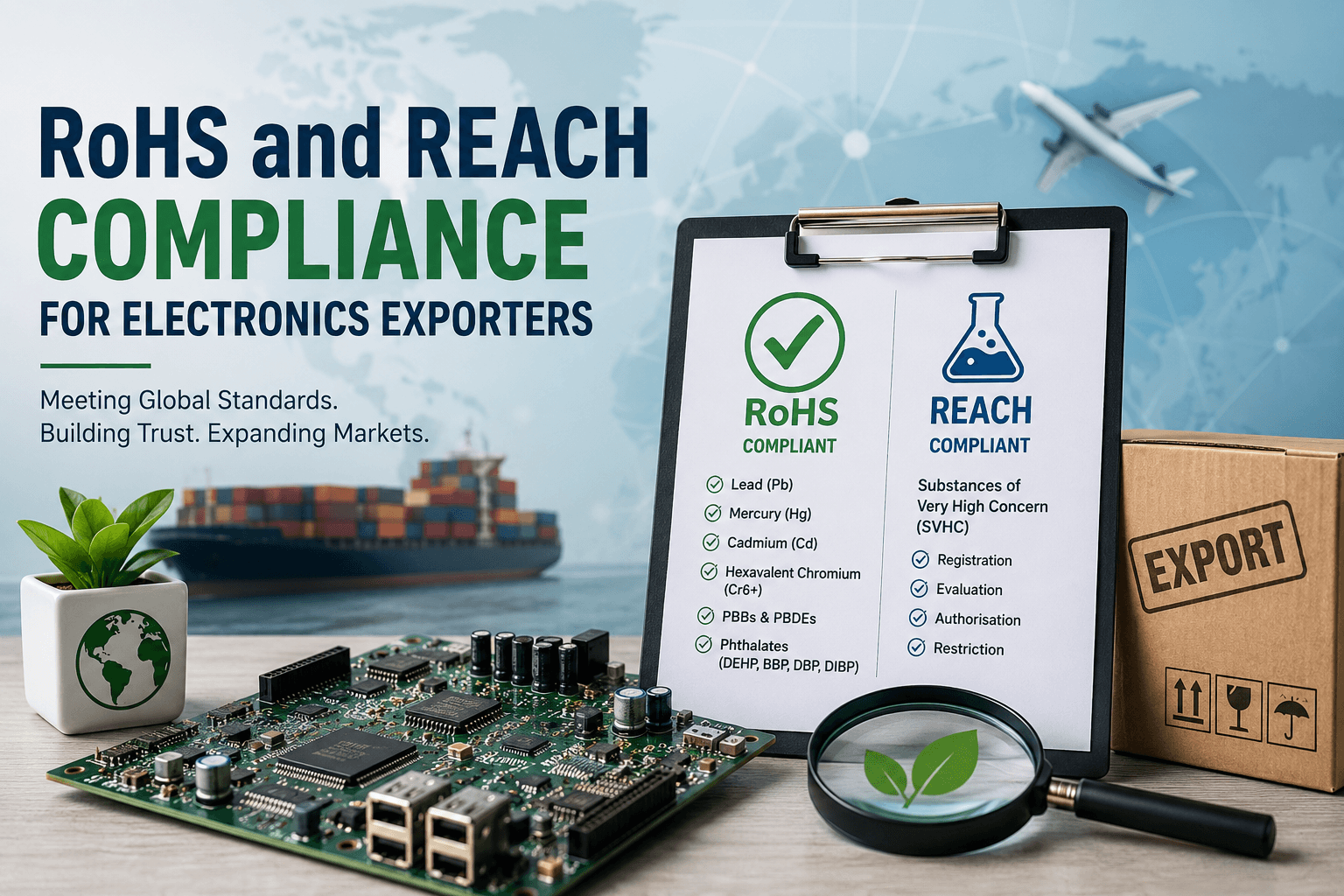
Exporting electronic products to international markets involves more than meeting technical performance standards. Manufacturers and exporters must also comply with environmental regulations that restrict hazardous substances and improve chemical safety throughout the supply chain.
Two of the most important regulations are RoHS (Restriction of Hazardous Substances) and REACH (Registration, Evaluation, Authorisation and Restriction of Chemicals). While both originated in the European Union, their impact extends far beyond Europe because many global manufacturers and buyers expect compliance regardless of the destination.
Understanding the differences between RoHS and REACH helps electronics exporters avoid shipment delays, product recalls, penalties, and lost business opportunities.
What Is RoHS?
RoHS is an EU directive that restricts the use of specific hazardous substances in electrical and electronic equipment (EEE). The goal is to reduce environmental pollution and improve the recyclability of electronic products.
RoHS applies to a wide range of products, including:
- Consumer electronics
- Industrial control equipment
- Medical devices
- Telecommunications equipment
- Lighting products
- Household appliances
- Electrical tools
- Monitoring instruments
Restricted Substances Under RoHS
Current RoHS regulations restrict the following substances above specified concentration limits:
- Lead (Pb)
- Mercury (Hg)
- Cadmium (Cd)
- Hexavalent Chromium (Cr6+)
- Polybrominated Biphenyls (PBB)
- Polybrominated Diphenyl Ethers (PBDE)
- Bis(2-ethylhexyl) phthalate (DEHP)
- Butyl benzyl phthalate (BBP)
- Dibutyl phthalate (DBP)
- Diisobutyl phthalate (DIBP)
These restrictions apply to homogeneous materials rather than the finished product as a whole.
What Is REACH?
REACH is the European Union’s comprehensive chemicals regulation. Unlike RoHS, which restricts specific hazardous substances in electronics, REACH governs the manufacture, import, and use of chemicals across nearly all industries.
For electronics exporters, REACH primarily focuses on substances contained in products, especially Substances of Very High Concern (SVHCs).
Manufacturers must determine whether their products contain SVHCs above regulatory thresholds and meet any required communication or notification obligations.
RoHS vs. REACH: Understanding the Difference
Although both regulations address chemical safety, they serve different purposes.
| RoHS | REACH |
|---|---|
| Focuses on electrical and electronic equipment | Covers chemicals used in all industries |
| Restricts a fixed list of hazardous substances | Regulates thousands of chemical substances |
| Product-specific regulation | Chemical-specific regulation |
| Concentration limits apply to homogeneous materials | Requirements often depend on article composition and SVHC content |
| Primarily addresses manufacturing compliance | Covers the entire chemical supply chain |
Many electronics products must comply with both regulations simultaneously.
Why Compliance Matters for Electronics Exporters
Failure to comply can have serious commercial consequences.
Potential risks include:
- Customs clearance delays
- Product recalls
- Import restrictions
- Financial penalties
- Contract cancellations
- Loss of customer trust
- Damage to brand reputation
Many original equipment manufacturers (OEMs) also require suppliers to provide RoHS and REACH declarations before approving products.
Products Commonly Affected
RoHS and REACH apply to many electronic components, including:
- Printed circuit boards (PCBs)
- Connectors
- Integrated circuits
- Semiconductors
- Cables and wiring
- Plastic housings
- Power supplies
- Batteries (subject to additional regulations)
- Sensors
- Displays
- Industrial automation equipment
Even seemingly minor components such as adhesives, coatings, solder, inks, and plastic additives may affect compliance.
Documentation Required
Most importers request documentation demonstrating compliance before accepting shipments.
Typical documents include:
- RoHS Declaration of Conformity (DoC)
- REACH Declaration
- Material Declaration
- Test reports from accredited laboratories
- Supplier declarations
- Bill of Materials (BOM)
- Technical documentation
- Certificates of Analysis (where applicable)
Maintaining complete records simplifies audits and customer reviews.
Material Testing and Verification
Testing plays an important role in verifying compliance, particularly when suppliers cannot provide sufficient documentation.
Common testing methods include:
X-Ray Fluorescence (XRF)
Used as a rapid screening method to detect restricted metals such as lead, mercury, and cadmium.
ICP-OES and ICP-MS
Laboratory methods that accurately measure metal concentrations.
GC-MS
Often used to identify phthalates and brominated flame retardants.
Testing is generally performed by ISO/IEC 17025-accredited laboratories to ensure reliable and internationally recognized results.
Supply Chain Challenges
Compliance depends on the entire supply chain rather than the final assembly process alone.
Common challenges include:
- Incomplete supplier declarations
- Frequent updates to REACH SVHC lists
- Material substitutions without notification
- Limited visibility into lower-tier suppliers
- Inconsistent documentation formats
- Managing products sourced from multiple countries
A structured supplier compliance program helps reduce these risks.
Best Practices for Maintaining Compliance
Electronics exporters can strengthen compliance by building robust internal processes.
Key practices include:
- Collect compliance declarations from every supplier.
- Maintain an up-to-date material database.
- Review REACH SVHC updates regularly.
- Conduct periodic risk-based testing.
- Keep technical documentation organized.
- Train procurement and quality teams on regulatory requirements.
- Audit high-risk suppliers.
- Include compliance clauses in supplier agreements.
These practices reduce the likelihood of non-compliant materials entering production.
Common Mistakes to Avoid
Many compliance issues result from preventable process gaps.
Examples include:
- Assuming supplier certificates never expire
- Using outdated REACH SVHC lists
- Testing only finished products instead of critical materials
- Missing documentation for replacement components
- Failing to verify subcontractor materials
- Overlooking packaging materials that may have separate compliance requirements
Regular reviews help identify issues before products reach customers.
Future Trends
Environmental regulations continue to evolve.
Electronics exporters should expect:
- Expansion of restricted substances
- More frequent updates to SVHC lists
- Increased digital product compliance documentation
- Greater supply chain transparency requirements
- Stronger sustainability reporting expectations
- Enhanced due diligence requirements for global supply chains
Companies that invest in proactive compliance systems are generally better positioned to adapt to future regulatory changes.
Frequently Asked Questions
Q. Is RoHS mandatory for all electronics exports?
No. RoHS is mandatory in jurisdictions that have adopted RoHS regulations, such as the European Union and several other countries. However, many international buyers require RoHS compliance regardless of destination.
Q. Does REACH apply to products manufactured outside Europe?
Yes. REACH obligations can apply to products imported into the European Union, regardless of where they were manufactured.
Q. Is third-party testing always required?
Not always. Many manufacturers rely on supplier declarations and material documentation. However, independent testing is often used to verify compliance or satisfy customer requirements.
Q. How often should REACH compliance be reviewed?
Because the list of Substances of Very High Concern (SVHCs) is updated periodically, exporters should review compliance whenever the list changes and whenever product materials or suppliers change.
Key Takeaways
RoHS and REACH compliance has become a standard expectation for electronics exporters serving global markets. While RoHS restricts specific hazardous substances in electrical and electronic equipment, REACH addresses the broader management of chemicals throughout the supply chain.
Maintaining accurate documentation, working closely with suppliers, monitoring regulatory updates, and implementing risk-based testing can help manufacturers reduce compliance risks, improve customer confidence, and support uninterrupted access to international markets.