Pumped Hydro vs Battery Storage: Which Is Right for India’s Grid?
India’s electricity grid needs more than new power generation. It needs reliable ways to store surplus electricity and deliver it when demand rises, solar output falls, or wind generation fluctuates.
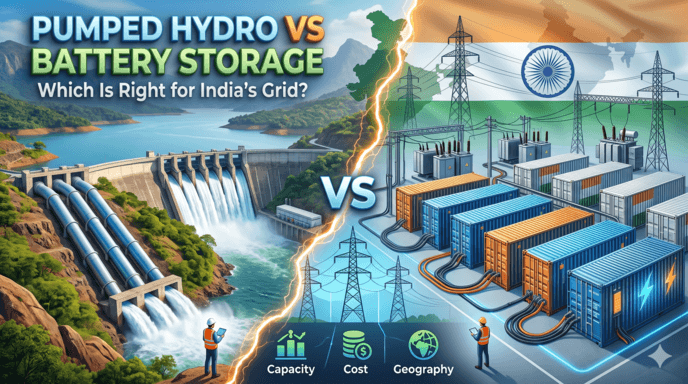
Two technologies are central to this challenge: pumped hydro energy storage (PHES) and battery energy storage systems (BESS). Both can balance supply and demand, but they differ in cost, deployment time, storage duration, land requirements, and long-term performance.
For India, the choice is not simply between pumped hydro and batteries. Pumped hydro is well suited to large-scale, long-duration storage where geography permits, while batteries offer faster deployment and greater flexibility for short-duration grid services. A combination of both is likely to provide the most practical path to a more reliable, renewable-powered grid.
Why Energy Storage Matters for India’s Power Grid
India’s rapid expansion of solar and wind power is changing how electricity must be managed. Solar generation peaks during the day, while household and commercial demand often rises in the evening. Wind output can also change with weather conditions.
Without enough storage, the grid may have to curtail surplus renewable electricity during periods of high generation and rely more heavily on coal or gas generation when renewable output drops.
Energy storage helps bridge this gap. It can absorb electricity when supply exceeds demand and release it when the grid needs additional power. It can also support frequency regulation, manage peak loads, and reduce pressure on transmission infrastructure. India’s Ministry of New and Renewable Energy identifies these as key benefits of energy storage systems.
Two technologies stand out for grid-scale applications:
- Pumped hydro storage: Uses electricity to pump water to an elevated reservoir, then generates electricity by releasing it through turbines.
- Battery energy storage: Stores electricity electrochemically and releases it through an inverter when required.
The right technology depends on the problem being solved. A distribution utility managing a short evening peak has different needs from a regional grid preparing for prolonged periods of low wind and solar generation.
What Is Pumped Hydro Energy Storage?
Pumped hydro energy storage, often called PHES or pumped storage hydropower (PSP), works like a large rechargeable water battery.
A typical plant uses two reservoirs at different elevations. When electricity is inexpensive or renewable generation is abundant, pumps move water from the lower reservoir to the upper reservoir. When demand increases, water flows downhill through turbines, generating electricity.
How pumped hydro works
- Charging: Pumps use electricity to move water uphill.
- Storing: The elevated water holds potential energy until it is needed.
- Discharging: Water flows downhill through turbines to generate electricity.
- Recharging: The process repeats when surplus electricity becomes available.
Pumped hydro is particularly attractive for large-scale storage because reservoirs can hold substantial amounts of energy, and well-maintained plants can operate for several decades.
Advantages of pumped hydro
- Long storage duration: Suitable for delivering power over many hours, depending on reservoir size and plant design.
- Long operating life: Civil infrastructure and major equipment can serve for decades with appropriate maintenance.
- Large-scale capacity: Can support regional grids and large renewable energy projects.
- Established technology: Offers proven performance for energy shifting, peak supply, and grid balancing.
Challenges of pumped hydro in India
The biggest constraint is project development. Pumped hydro plants require suitable topography, water management, civil engineering, and grid connections. Construction can take years, and costs can rise if geological conditions or clearances create delays.
Environmental and social impacts also need careful assessment. Reservoir development may affect land use, ecosystems, water resources, and nearby communities. Closed-loop projects, which primarily circulate water between dedicated reservoirs, can reduce some interactions with natural river systems, although they still require site-specific environmental review.
Pumped hydro is therefore not a universal solution. Its economics depend heavily on location, construction cost, financing, operating patterns, and the amount of energy the plant needs to store.
What Is Battery Energy Storage?
Battery energy storage systems store electricity in rechargeable batteries, commonly lithium-ion batteries for current grid-scale projects. The stored energy is converted back into electricity through power conversion equipment when the grid needs it.
Unlike pumped hydro, batteries do not need reservoirs or a significant difference in elevation. They can be installed near solar farms, wind projects, substations, industrial facilities, and urban load centres.
How battery storage works
- Charging: Electricity flows into the battery from the grid or a renewable energy source.
- Storage: Electrochemical reactions store energy inside the cells.
- Discharging: The battery releases electricity through an inverter.
- Control: Software and power electronics manage charging, discharging, and grid response.
Battery systems can respond very quickly to changing grid conditions. Their modular design also makes it easier to expand capacity in stages or deploy storage where it is needed most.
Advantages of battery storage
- Fast deployment: Projects can generally be built more quickly than large pumped hydro plants.
- Flexible siting: Batteries can be located near generation or electricity demand.
- Rapid response: Useful for frequency regulation, short-duration balancing, and fast changes in net demand.
- Modular expansion: Capacity can be added as electricity demand and renewable generation grow.
- Renewable energy integration: Batteries can store midday solar output and release it during evening peaks.
Challenges of battery storage in India
Battery projects face their own limitations. Lithium-ion cells degrade with use and time, and performance depends on temperature, charging patterns, and operating conditions. Systems need thermal management, monitoring, and eventual cell replacement.
Battery manufacturing and recycling also raise questions about mineral supply chains, resource recovery, and end-of-life management.
Longer storage durations require more battery capacity, which can increase upfront costs. Developers must account for degradation, replacement expenses, efficiency losses, and the cost of charging electricity when comparing batteries with other storage options.
Pumped Hydro vs Battery Storage: Key Differences
The table below summarises the main trade-offs for grid-scale projects in India. Actual performance and economics depend on project design, location, operating conditions, and the technology selected.
| Factor | Pumped hydro | Battery storage |
|---|---|---|
| Storage duration | Well suited to long-duration storage | Particularly flexible for short- and medium-duration storage |
| Response time | Fast, but depends on plant configuration and operating state | Very fast |
| Project development | Often takes several years | Generally faster to deploy |
| Location | Requires suitable sites and elevation differences | Can be installed in many locations |
| Operating life | Often several decades | Requires management of degradation and possible cell replacement |
| Efficiency | Depends on pumping and generation equipment | Depends on battery chemistry and power conversion equipment |
| Expansion | Major civil works may be needed | Modular additions are generally easier |
| Environmental considerations | Land, water, geology, and ecosystem impacts | Mineral supply, manufacturing, fire safety, and recycling |
| Best-fit applications | Bulk energy shifting and sustained peak supply | Fast grid services, solar shifting, and local flexibility |
Which technology is more efficient?
Round-trip efficiency measures how much electricity is recovered after accounting for the energy used to store it.
Modern lithium-ion battery systems often achieve higher round-trip efficiency than pumped hydro, although results vary by system design and operating conditions. Pumped hydro loses energy through pumping, water flow, turbines, and generators.
However, efficiency alone does not determine which technology is cheaper. A pumped hydro plant with a long operating life and many hours of storage may be attractive even if it returns a smaller percentage of the energy used to charge it. Batteries may offer better economics when quick response, modular deployment, and shorter discharge periods are more valuable.
Cost Comparison: Which Is Cheaper for India?
Cost is one of the most important factors in deciding between pumped hydro and batteries. But comparing only the initial investment can lead to the wrong conclusion.
A fair comparison should consider the cost of storing and delivering electricity over the project’s lifetime, including financing, construction, maintenance, energy losses, battery replacement, and the number of cycles completed each year.
The cost of battery storage is falling
India’s battery storage market has seen substantial reductions in competitively bid prices. In December 2025, the Ministry of Power reported a sharp decline in the estimated storage cost associated with recent BESS tenders. It also highlighted government support for battery projects through viability gap funding.
Lower battery costs make it easier to deploy storage near solar parks, substations, and demand centres. However, tender prices are not directly comparable across projects unless the storage duration, utilisation, charging costs, and contractual obligations are similar.
Pumped hydro can benefit from a long operating life
Pumped hydro has high upfront construction costs, but its long service life can spread those costs over many years. It may be particularly competitive when a plant delivers large amounts of electricity regularly and can operate at high utilisation.
Its financial performance depends on site conditions, construction schedules, interest rates, electricity prices, and the cost of pumping water.
A Berkeley India Energy and Climate Center study found that the relative economics of pumped hydro and batteries depend on capital costs, storage duration, and deployment assumptions. Its modelling also shows why neither technology should be declared the universal low-cost winner.
The practical takeaway: Batteries are attractive for shorter-duration applications and projects that need to be deployed quickly. Pumped hydro deserves serious consideration for large, long-lived storage assets where site conditions and sustained utilisation support the investment.
India’s Energy Storage Targets: What the Numbers Tell Us
India’s National Electricity Plan provides a useful indication of how the country expects the storage mix to evolve.
Projected storage capacity by 2031-32
175 GWh
Pumped hydro
About 26.7 GW of power capacity
236 GWh
Battery storage
About 47.2 GW of power capacity
Source: Central Electricity Authority’s National Electricity Plan projections, as reported by the Ministry of Power. These are planning projections, not confirmed installed capacity.
The projections are revealing. India expects to need both technologies, with batteries accounting for a larger share of projected storage energy by 2031-32.
That does not mean batteries are necessarily better for every application. The technologies serve overlapping but distinct needs, and the final mix will depend on costs, construction progress, renewable energy deployment, and grid requirements.
India is also supporting battery deployment through viability gap funding and procurement frameworks, while the Central Electricity Authority has published a roadmap for expanding pumped storage development.
Why policy support matters
Energy storage projects often struggle when revenues are uncertain. A plant may provide valuable services to the grid, but those benefits do not automatically translate into predictable cash flow for the developer.
Competitive bidding, clear contracts, ancillary service markets, and appropriate financial support can help make projects bankable. India has introduced measures for both battery and pumped storage development, although the specific incentives and eligibility conditions vary by project and commissioning timeline.
Where Should India Use Pumped Hydro?
Pumped hydro is a strong option when the grid needs large amounts of energy over extended periods and a suitable site is available.
1. Large-scale renewable energy integration
Solar and wind projects can produce more electricity than the grid needs at certain times. Pumped hydro can absorb some of that surplus and return it during periods of higher demand.
This is particularly useful when renewable generation and demand do not align.
2. Sustained evening and peak demand
A pumped hydro plant can deliver power over several hours, subject to its reservoir capacity and operating design. This can reduce reliance on more expensive generation during peak demand periods.
3. Long-term grid infrastructure
For projects expected to operate for decades, pumped hydro can provide a durable storage asset. Its economics become more attractive when the plant is used regularly and the site avoids excessive construction or environmental costs.
Where Should India Use Battery Storage?
Battery storage is especially useful when flexibility, rapid response, and proximity to electricity demand matter.
1. Solar parks and renewable energy hubs
Batteries can store midday solar generation and release it in the evening. Co-location can also reduce some infrastructure costs, depending on the project design and grid connection.
2. Urban distribution networks
Batteries near substations can help manage local peaks, provide fast grid support, and potentially defer some network upgrades where congestion or capacity constraints exist.
3. Short-duration grid balancing
Battery systems can respond rapidly to changes in supply and demand. They are useful for frequency support, short-term balancing, and other grid services, subject to applicable technical and market rules.
4. Projects that need to be built quickly
Because batteries are modular and do not require major reservoir construction, they can often be deployed faster than pumped hydro. This can be important when grid needs emerge sooner than large infrastructure projects can be completed.
Can Pumped Hydro and Batteries Work Together?
Yes. In fact, using both technologies can be more effective than relying on either one alone.
Consider a simplified example of a renewable-heavy grid in India:
Surplus solar and wind
Renewable generation exceeds immediate demand
Battery storage
Fast response, short-term balancing, and evening peak support.
Pumped hydro
Bulk storage and sustained power delivery over longer periods.
More flexible, reliable electricity supply
Better alignment between renewable generation and electricity demand
In this arrangement, batteries handle fast changes in grid conditions and shorter discharge requirements. Pumped hydro provides larger-scale energy shifting when the grid needs sustained output.
The combination can reduce the pressure on individual storage technologies to meet every requirement. It can also give grid operators more flexibility when managing renewable generation, peak demand, and transmission constraints.
The actual division of work should be determined through grid modelling, project economics, and the expected hourly pattern of electricity demand.
How Utilities Should Choose Between Pumped Hydro and Batteries
Utilities, renewable energy developers, and policymakers should evaluate storage projects against the service they need, rather than selecting a technology based on headline capacity or price alone.
Step 1: Define the storage requirement
Determine how much power the grid needs, how much energy must be stored, and how long the system must discharge.
A 100 MW system designed to discharge for two hours stores 200 MWh. A 100 MW system designed for eight hours stores 800 MWh. The power capacity is identical, but the energy capacity is four times larger in the second case.
Step 2: Estimate total lifetime cost
Include capital expenditure, financing, charging electricity, operating costs, efficiency losses, replacement costs, and expected operating life.
Step 3: Assess the location
Check land availability, geology, water requirements, transmission access, proximity to renewable generation, and proximity to demand.
Step 4: Match the technology to grid services
Identify whether the priority is fast frequency response, daily solar shifting, long-duration energy delivery, congestion management, or several services at once.
Step 5: Test the business case
Model revenues from energy arbitrage, capacity contracts, ancillary services, and other permitted revenue streams. Include realistic assumptions about how often the system will operate.
A 2025 study of storage profitability in India found that energy arbitrage alone was insufficient to meet a typical 10% return hurdle for many of the options and historical periods it examined. Including ancillary services and contractual hedging improved the business case. The results reinforce the importance of revenue design alongside technology selection.
FAQs
Is pumped hydro better than battery storage for India?
Neither is universally better. Pumped hydro can be attractive for large-scale, long-duration storage, while batteries are well suited to fast response, shorter-duration storage, and flexible siting. India’s grid will benefit from both.
Which has a longer lifespan, pumped hydro or batteries?
Pumped hydro infrastructure can operate for several decades with appropriate maintenance. Battery systems also have long service lives, but their cells degrade over time and may require replacement during the life of the project.
Is battery storage cheaper than pumped hydro?
It depends on storage duration, project location, utilisation, financing, and lifetime costs. Batteries can be cost-effective for shorter-duration applications, while pumped hydro may offer advantages for large, frequently used, long-lived storage projects.
Can batteries replace pumped hydro completely?
Not necessarily. Batteries can serve many of the same grid functions, but large-scale, long-duration storage needs may be better served by pumped hydro at suitable sites. The most economical mix depends on India’s future demand and generation patterns.
What is India’s energy storage target for 2031-32?
The Central Electricity Authority’s National Electricity Plan projects approximately 411.4 GWh of total storage, including around 175.2 GWh from pumped hydro and 236.2 GWh from battery storage. These figures are planning projections, not a statement of capacity already installed.
Conclusion: India’s Grid Needs Both Technologies
Pumped hydro and battery storage solve related but different problems.
Pumped hydro offers long-lived infrastructure for large-scale energy shifting, provided suitable sites can be developed at reasonable cost. Battery storage offers fast response, modular deployment, and flexibility close to renewable generation and electricity demand.
For India, the strongest strategy is to deploy batteries where speed and flexibility matter most, develop pumped hydro where geography and lifetime economics support it, and plan both as part of an integrated power system.
The real measure of success is not how much storage capacity India builds, but whether that capacity delivers affordable, reliable electricity when the grid needs it most.