
Lean Manufacturing and Six Sigma: A Better Way to Reduce Shop Floor Waste
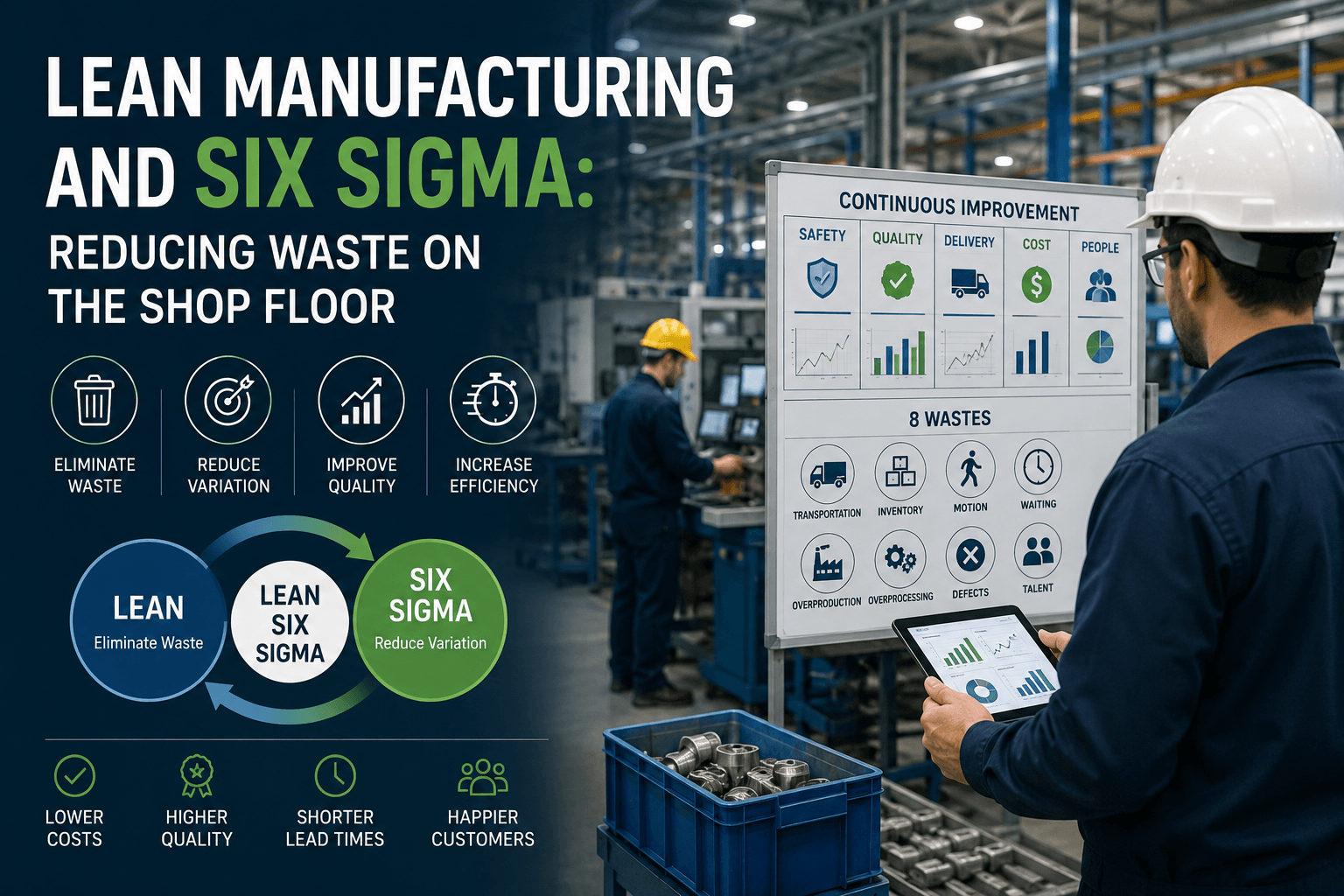
Every manufacturer faces the same challenge: producing high-quality products while controlling costs and meeting customer demand. Waste, whether it’s excess inventory, unnecessary movement, defects, or production delays, directly affects profitability.
Lean Manufacturing and Six Sigma are two of the most widely adopted improvement methodologies for solving these problems. While each has its own focus, they are often used together to help manufacturers improve efficiency, reduce defects, and create more consistent production processes.
This guide explains how Lean Manufacturing and Six Sigma work, how they differ, and how manufacturers can combine both approaches to reduce waste on the shop floor.
What Is Lean Manufacturing?
Lean Manufacturing is a continuous improvement philosophy focused on delivering maximum value to customers while eliminating activities that do not add value.
Originally developed through the Toyota Production System, Lean encourages organizations to streamline workflows, improve productivity, and make better use of available resources.
Rather than working harder, Lean helps manufacturers work smarter by identifying and removing waste throughout production.
The Eight Types of Waste
Lean identifies eight common forms of waste that reduce operational efficiency.
1. Transportation
Moving materials or products more than necessary increases handling costs and creates opportunities for damage.
Example:
- Moving components between multiple storage locations before assembly
- Long travel distances between workstations
2. Inventory
Holding excess raw materials, work-in-progress, or finished goods ties up capital and increases storage costs.
Signs include:
- Overstocked warehouses
- Slow-moving inventory
- Excess safety stock
3. Motion
Unnecessary movement by employees reduces productivity and increases fatigue.
Examples include:
- Walking long distances for tools
- Reaching awkwardly during assembly
- Searching for equipment
4. Waiting
Idle time occurs whenever workers, machines, or materials wait for the next production step.
Common causes include:
- Equipment downtime
- Material shortages
- Approval delays
5. Overproduction
Producing more products than customers require often leads to excess inventory and additional storage costs.
Overproduction frequently creates other forms of waste throughout the manufacturing process.
6. Overprocessing
Performing unnecessary work or using more complex processes than required increases production costs without improving customer value.
Examples include:
- Excessive inspections
- Unnecessary machining operations
- Duplicate data entry
7. Defects
Defective products require rework, replacement, or disposal, all of which increase manufacturing costs.
Reducing defects improves customer satisfaction while lowering scrap rates.
8. Underutilized Talent
Employees often identify improvement opportunities before management does.
Organizations that encourage employee involvement typically discover more efficient ways of working and build stronger cultures of continuous improvement.
What Is Six Sigma?
Six Sigma is a structured, data-driven methodology designed to reduce process variation and improve product quality.
Instead of focusing primarily on waste, Six Sigma aims to eliminate the root causes of defects through statistical analysis and disciplined problem solving.
Organizations use Six Sigma to improve consistency, reduce errors, and make processes more predictable.
Understanding DMAIC
Six Sigma projects typically follow the DMAIC framework.
Define
Clearly identify the business problem, project goals, and customer requirements.
Measure
Collect reliable data to understand current process performance.
Analyze
Determine the root causes of defects and process variation.
Common tools include:
- Fishbone diagrams
- Pareto charts
- Process mapping
- Failure Mode and Effects Analysis (FMEA)
Improve
Develop and implement solutions that eliminate identified problems.
Examples include:
- Standardizing work procedures
- Redesigning workflows
- Optimizing machine settings
- Improving equipment maintenance
Control
Monitor the improved process to ensure gains are maintained over time.
Control methods often include:
- Control charts
- Standard operating procedures
- Visual management
- Employee training
Lean vs. Six Sigma
Although they are frequently mentioned together, Lean Manufacturing and Six Sigma solve different types of problems.
| Lean Manufacturing | Six Sigma |
|---|---|
| Eliminates waste | Reduces defects |
| Improves workflow | Improves consistency |
| Focuses on speed | Focuses on quality |
| Removes non-value-added activities | Reduces process variation |
| Simplifies operations | Uses statistical analysis |
Lean improves flow, while Six Sigma improves accuracy. Together, they create faster, more reliable production systems.
What Is Lean Six Sigma?
Lean Six Sigma combines Lean’s focus on waste elimination with Six Sigma’s emphasis on quality improvement.
Instead of treating speed and quality as separate goals, Lean Six Sigma improves both simultaneously.
Manufacturers commonly use Lean Six Sigma to:
- Reduce production costs
- Improve product quality
- Shorten lead times
- Increase equipment utilization
- Reduce scrap and rework
- Improve customer satisfaction
- Increase production capacity
Practical Ways to Reduce Waste on the Shop Floor
Standardize Work Processes
Clearly documented work instructions help employees perform tasks consistently.
Standardization reduces variation, improves training, and minimizes errors.
Use Visual Management
Visual controls allow employees to identify problems quickly.
Examples include:
- Color-coded inventory locations
- Production status boards
- Andon systems
- Floor markings
- Shadow boards for tools
Implement 5S
The 5S methodology creates organized, efficient workplaces.
The five steps are:
- Sort
- Set in Order
- Shine
- Standardize
- Sustain
An organized workspace reduces search time, improves safety, and supports consistent production.
Improve Equipment Reliability
Unexpected equipment failures are a major source of waste.
Preventive and predictive maintenance programs reduce downtime while improving production reliability.
Use Value Stream Mapping
Value Stream Mapping helps manufacturers visualize the entire production process.
It identifies:
- Bottlenecks
- Delays
- Excess inventory
- Unnecessary transportation
- Non-value-added activities
This provides a clear roadmap for improvement.
Measure Performance
Continuous improvement depends on reliable performance data.
Common manufacturing KPIs include:
- Overall Equipment Effectiveness (OEE)
- Scrap rate
- First Pass Yield
- Cycle time
- Downtime
- On-time delivery
- Inventory turnover
Tracking these metrics helps teams identify trends and prioritize improvement projects.
Common Challenges During Implementation
Lean Manufacturing and Six Sigma require more than new tools. Successful implementation often involves cultural change.
Common challenges include:
- Resistance to change
- Limited leadership support
- Poor data quality
- Inadequate employee training
- Lack of continuous follow-up
- Focusing on isolated improvements instead of system-wide optimization
Organizations that invest in leadership commitment, employee engagement, and continuous learning generally achieve more sustainable results.
Best Practices for Long-Term Success
Manufacturers can improve the success of Lean Six Sigma initiatives by following several proven practices:
- Start with clearly defined business objectives.
- Involve employees at every level.
- Base decisions on accurate operational data.
- Standardize successful improvements.
- Review KPIs regularly.
- Celebrate improvement milestones.
- Treat continuous improvement as an ongoing process rather than a one-time project.
Small improvements made consistently often deliver greater long-term value than occasional large-scale initiatives.
Conclusion
Lean Manufacturing and Six Sigma are complementary approaches that help manufacturers reduce waste, improve quality, and increase operational efficiency. Lean focuses on eliminating activities that do not add value, while Six Sigma reduces defects by improving process consistency.
When combined, these methodologies enable organizations to streamline production, lower operating costs, improve customer satisfaction, and build a culture of continuous improvement. Manufacturers that commit to ongoing measurement, employee involvement, and disciplined problem solving are better positioned to remain competitive in an increasingly demanding marketplace.
Key Takeaways
- Lean Manufacturing eliminates waste across production processes.
- Six Sigma reduces defects by minimizing process variation.
- Lean Six Sigma combines efficiency and quality improvement.
- Identifying the eight types of waste helps prioritize improvement efforts.
- DMAIC provides a structured framework for solving process problems.
- Continuous measurement and employee engagement are essential for lasting success.
Frequently Asked Questions
Q. Is Lean Manufacturing the same as Six Sigma?
No. Lean Manufacturing focuses on eliminating waste and improving workflow, while Six Sigma focuses on reducing defects and process variation. Many organizations combine both approaches through Lean Six Sigma.
Q. Which industries use Lean Six Sigma?
Although it began in manufacturing, Lean Six Sigma is widely used in healthcare, logistics, retail, construction, finance, government, and service industries.
Q. What are the biggest benefits of Lean Six Sigma?
Organizations often achieve lower operating costs, improved product quality, shorter lead times, higher customer satisfaction, increased productivity, and better use of resources.
Q. Does Lean Six Sigma require expensive technology?
No. Many improvements begin with better process design, standardized work, employee involvement, and effective use of existing data. Technology can support improvement efforts but is not always required.