Consumer Appliance Manufacturing: Trends and Sourcing Options
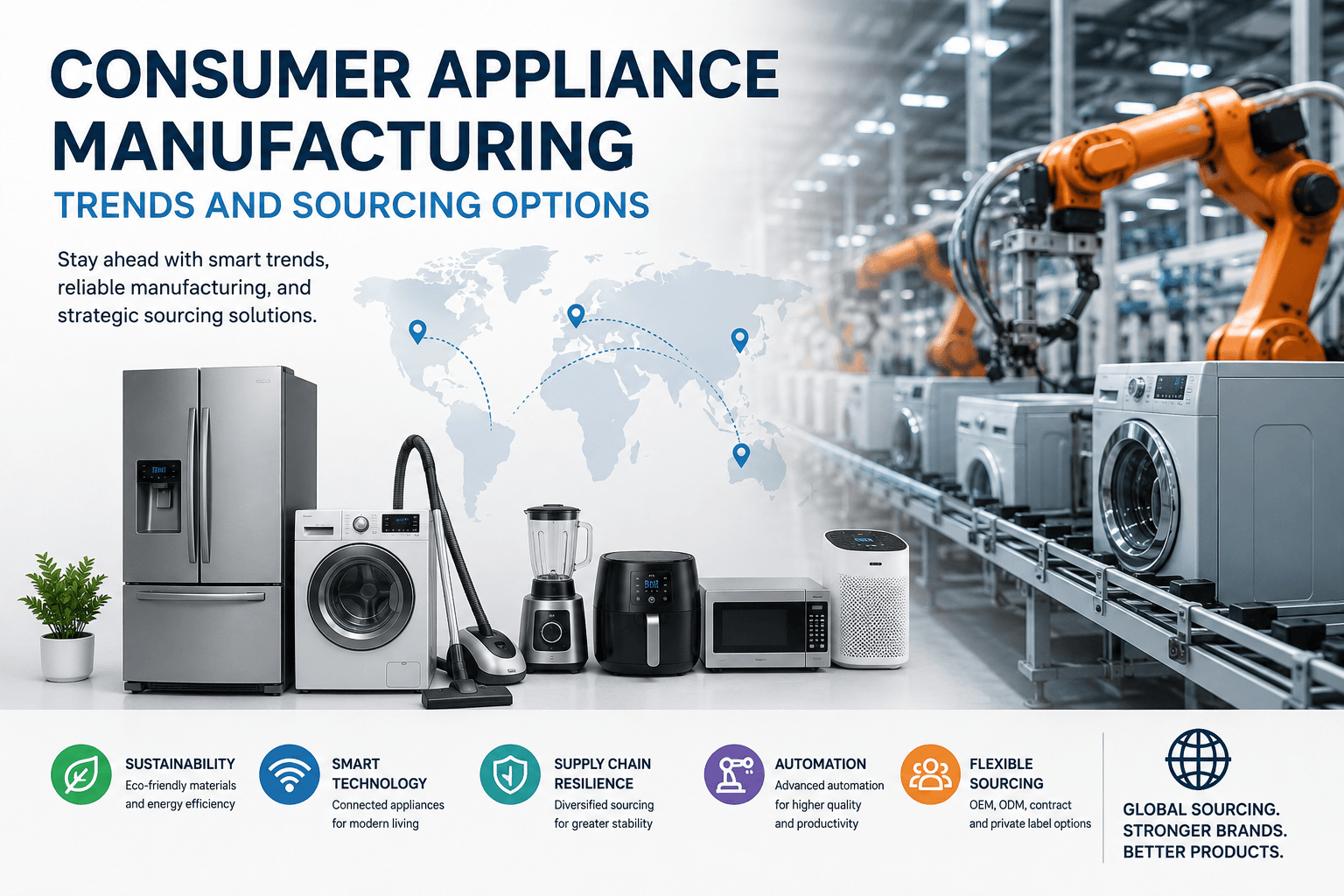
Consumer appliance manufacturers are navigating a rapidly changing market. Rising customer expectations, supply chain disruptions, sustainability requirements, and smart technology adoption are reshaping how products are designed, produced, and sourced.
For brands launching new products or expanding production, selecting the right manufacturing and sourcing strategy has become just as important as product innovation. The right approach can reduce costs, improve product quality, shorten lead times, and strengthen long-term competitiveness.
This guide explores the latest trends in consumer appliance manufacturing and the sourcing options available to companies looking to scale efficiently.
What Is Consumer Appliance Manufacturing?
Consumer appliance manufacturing involves designing, producing, assembling, and testing products used in homes and everyday life. These products range from small countertop devices to large household appliances.
Common product categories include:
- Kitchen appliances such as coffee makers, blenders, microwaves, and air fryers
- Home cleaning equipment including vacuum cleaners and robotic cleaners
- Climate control products such as fans, heaters, and air purifiers
- Laundry appliances including washing machines and dryers
- Personal care devices like hair dryers and electric shavers
- Smart home appliances connected through mobile apps or voice assistants
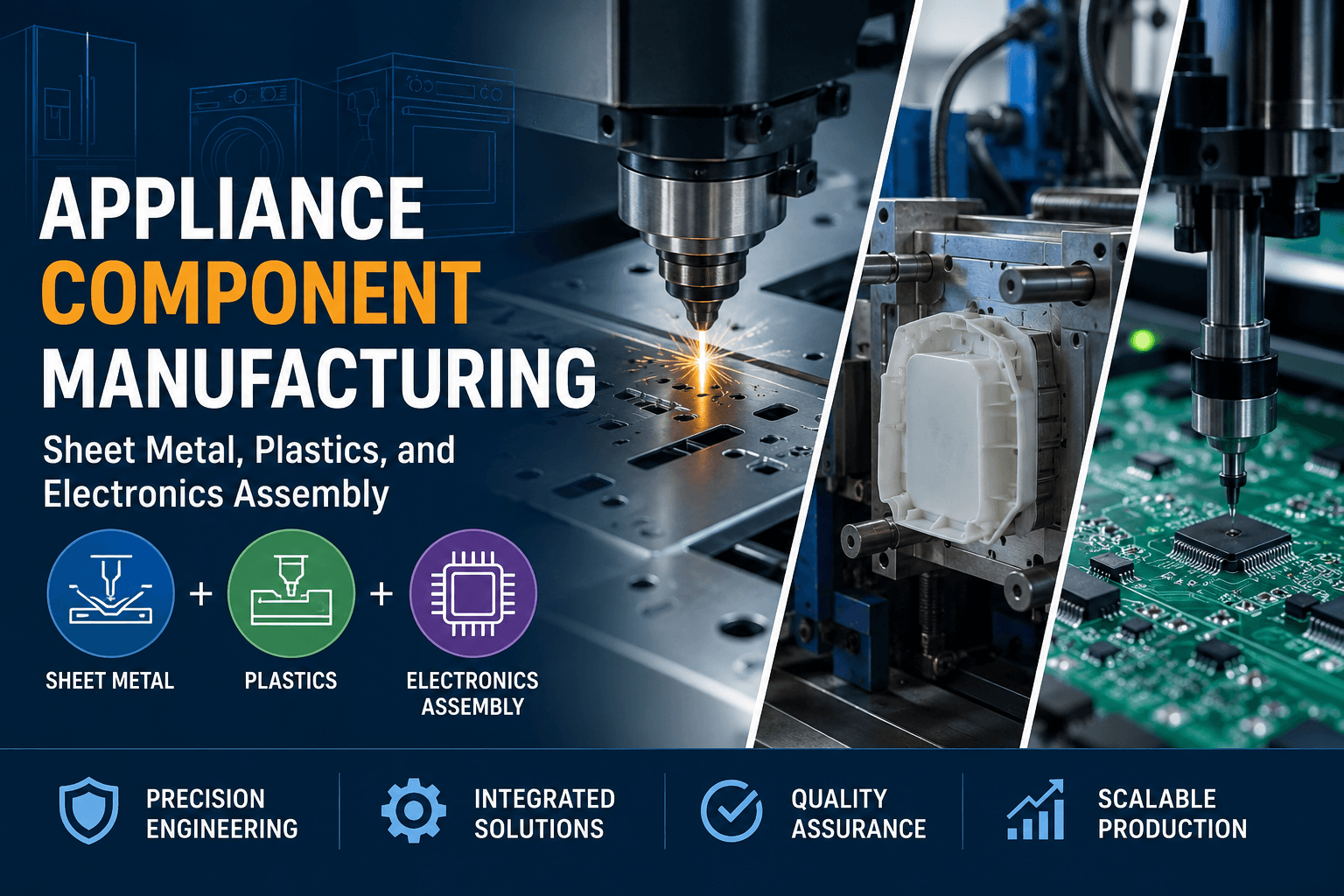
Manufacturing often combines multiple disciplines, including electronics, plastics, metal fabrication, software development, quality testing, and final assembly.
Key Trends Shaping Consumer Appliance Manufacturing
Smart and Connected Products
Consumers increasingly expect appliances to connect with smartphones, voice assistants, and home automation platforms. Manufacturers are integrating Wi-Fi, Bluetooth, cloud connectivity, and mobile applications into everyday products.
Key priorities include:
- Remote monitoring and control
- Predictive maintenance
- Energy usage tracking
- Software updates over the air
- Integration with smart home ecosystems
These capabilities create ongoing customer value while enabling manufacturers to introduce new digital services after the initial sale.
Sustainability and Energy Efficiency
Environmental performance has become a major purchasing factor. Manufacturers are investing in:
- Energy-efficient motors and electronics
- Recyclable materials
- Reduced packaging waste
- Lower carbon manufacturing processes
- Longer product lifecycles
- Easier repair and component replacement
Regulatory requirements in many markets are also encouraging higher efficiency standards and improved environmental reporting.
Supply Chain Diversification
Many companies are reducing dependence on a single manufacturing region. Instead, they are adopting multi-country sourcing strategies to improve resilience against disruptions, tariffs, and logistics challenges.
Popular approaches include:
- Multi-country supplier networks
- Regional manufacturing hubs
- Nearshoring for faster delivery
- Dual sourcing of critical components
- Strategic inventory planning
A diversified supply chain helps minimize operational risk while improving flexibility during periods of market uncertainty.
Automation and Smart Factories
Manufacturers continue investing in automation to improve productivity and product consistency.
Examples include:
- Robotic assembly
- Automated inspection systems
- AI-powered quality control
- Digital production monitoring
- Predictive equipment maintenance
- Automated material handling
Automation reduces production errors while supporting higher manufacturing volumes.
Product Customization
Consumers increasingly expect products tailored to their preferences. Manufacturers are responding by designing flexible production systems that support:
- Multiple color options
- Regional product variations
- Private label manufacturing
- Custom packaging
- Configurable product features
Flexible manufacturing enables brands to serve different markets without maintaining completely separate production lines.
Common Sourcing Models
Choosing the right sourcing model depends on production volume, engineering complexity, budget, and speed-to-market requirements.
Original Equipment Manufacturer (OEM)
OEM manufacturing allows brands to develop proprietary product designs while outsourcing production to an experienced manufacturer.
Advantages include:
- Full control over product specifications
- Strong brand differentiation
- Intellectual property ownership
- Greater flexibility for future product updates
This model is well suited for companies with established product development capabilities.
Original Design Manufacturer (ODM)
ODM suppliers provide pre-developed products that can be customized with branding, cosmetic changes, or selected feature modifications.
Benefits include:
- Faster product launches
- Lower development costs
- Reduced engineering investment
- Proven manufacturing processes
ODM sourcing is often attractive for startups and brands entering new product categories.
Contract Manufacturing
Contract manufacturers produce products based on detailed customer specifications while the brand manages product design and engineering.
This approach offers:
- Scalable production capacity
- Manufacturing expertise
- Flexible production volumes
- Lower capital investment
It is commonly used by companies seeking operational flexibility without building their own factories.
Private Label Manufacturing
Private label manufacturing enables businesses to sell existing products under their own brand.
It offers:
- Quick market entry
- Lower upfront investment
- Simplified product development
- Reduced technical risk
Private labeling is especially popular among retailers and e-commerce brands.
Factors to Consider When Selecting a Manufacturing Partner
Selecting a supplier involves more than comparing production costs.
Important evaluation criteria include:
Manufacturing Capabilities
Assess whether the supplier can support:
- Plastic injection molding
- Metal fabrication
- PCB assembly
- Software integration
- Product testing
- Final assembly
- Packaging
A supplier with broad capabilities can simplify coordination and reduce lead times.
Quality Management
Strong quality systems help minimize defects and warranty claims.
Look for:
- Documented quality procedures
- Incoming material inspection
- In-process quality control
- Functional product testing
- Final inspection processes
- Continuous improvement programs
Consistent quality is especially important for products with electronic components and safety requirements.
Compliance and Certifications
Consumer appliances must often comply with market-specific regulations.
Depending on the target market, suppliers may need experience with certifications related to:
- Electrical safety
- Electromagnetic compatibility
- Energy efficiency
- Environmental compliance
- Hazardous substance restrictions
Early compliance planning reduces delays during product launches.
Supply Chain Stability
Evaluate the supplier’s sourcing network and inventory management practices.
Questions to ask include:
- Are critical components dual sourced?
- How are supply disruptions managed?
- What are average lead times?
- How are material shortages handled?
- Are strategic safety stocks maintained?
Reliable supply chains improve production continuity and customer satisfaction.
Engineering Support
Manufacturers offering engineering services can contribute throughout the product lifecycle.
Services may include:
- Design for manufacturing
- Prototype development
- Cost optimization
- Tooling support
- Reliability testing
- Product improvements
Engineering collaboration often leads to lower production costs and faster commercialization.
Regional Sourcing Options
China
China remains one of the world’s largest consumer appliance manufacturing hubs, offering extensive supplier ecosystems, mature infrastructure, and strong production capacity across virtually every appliance category.
Best suited for:
- High-volume production
- Complex assemblies
- Established supply chains
- Broad component availability
Vietnam
Vietnam continues to attract manufacturers seeking competitive labor costs and growing export capabilities.
Strengths include:
- Expanding electronics manufacturing
- Competitive operating costs
- Strong trade agreements
- Growing investment in industrial infrastructure
India
India is becoming an increasingly attractive manufacturing destination due to government incentives, a large engineering workforce, and a rapidly developing supplier base.
Advantages include:
- Growing domestic market
- Competitive manufacturing costs
- Increasing electronics production
- Long-term investment opportunities
Mexico
Mexico offers proximity to North American markets, making it an attractive option for companies serving customers in the United States and Canada.
Benefits include:
- Shorter shipping times
- Lower logistics costs
- Regional trade advantages
- Faster replenishment cycles
Best Practices for Successful Sourcing
Companies often achieve better results by following a structured sourcing process.
Recommended practices include:
- Define detailed product specifications before supplier selection.
- Evaluate multiple suppliers rather than relying on a single quote.
- Request production samples before placing large orders.
- Conduct factory audits when appropriate.
- Establish clear quality standards and inspection procedures.
- Negotiate production timelines and communication expectations.
- Monitor supplier performance using measurable KPIs.
- Build long-term supplier relationships instead of focusing only on short-term pricing.
A disciplined sourcing process reduces risk while improving product consistency.
Future Outlook
Consumer appliance manufacturing will continue evolving as connected technologies, automation, and sustainability become standard expectations. Manufacturers that invest in resilient supply chains, flexible production capabilities, and digital technologies will be better positioned to respond to changing consumer demand.
At the same time, sourcing strategies are becoming more diversified. Rather than relying on a single manufacturing location, many companies are building regional supplier networks that balance cost, quality, speed, and resilience.
Businesses that treat manufacturing partners as strategic collaborators, rather than simply production vendors, are more likely to accelerate innovation, maintain consistent quality, and adapt successfully to future market changes.
Key Takeaways
- Smart appliances and connected technologies continue to drive product innovation.
- Sustainability and energy efficiency are becoming essential competitive factors.
- Multi-region sourcing strategies help improve supply chain resilience.
- OEM, ODM, contract manufacturing, and private label models each serve different business needs.
- Supplier selection should balance quality, engineering capability, compliance, scalability, and long-term partnership potential.
- A structured sourcing process helps reduce operational risk and supports consistent product quality.
FAQs
Q. What is the difference between OEM and ODM manufacturing?
OEM manufacturing is based on a brand’s proprietary product design, while ODM manufacturing uses a supplier’s existing design that can be customized for branding or selected features.
Q. Which country is best for sourcing consumer appliances?
The ideal sourcing location depends on production volume, target market, product complexity, cost objectives, and logistics requirements. China, Vietnam, India, and Mexico each offer different advantages.
Q. How can companies reduce supply chain risk?
Diversifying suppliers across multiple regions, qualifying backup vendors, maintaining safety stock for critical components, and improving demand forecasting all help reduce supply chain risk.
Q. What should businesses look for in an appliance manufacturing partner?
Key considerations include manufacturing expertise, quality management systems, engineering support, regulatory compliance, production capacity, communication practices, and supply chain reliability.
Q. Is contract manufacturing suitable for startups?
Yes. Contract manufacturing allows startups to access experienced production capabilities without investing heavily in factories or manufacturing equipment, making it easier to scale as demand grows.