BESS Container Design and Manufacturing: Enclosures, Cooling and Compliance
What Is a BESS Container?
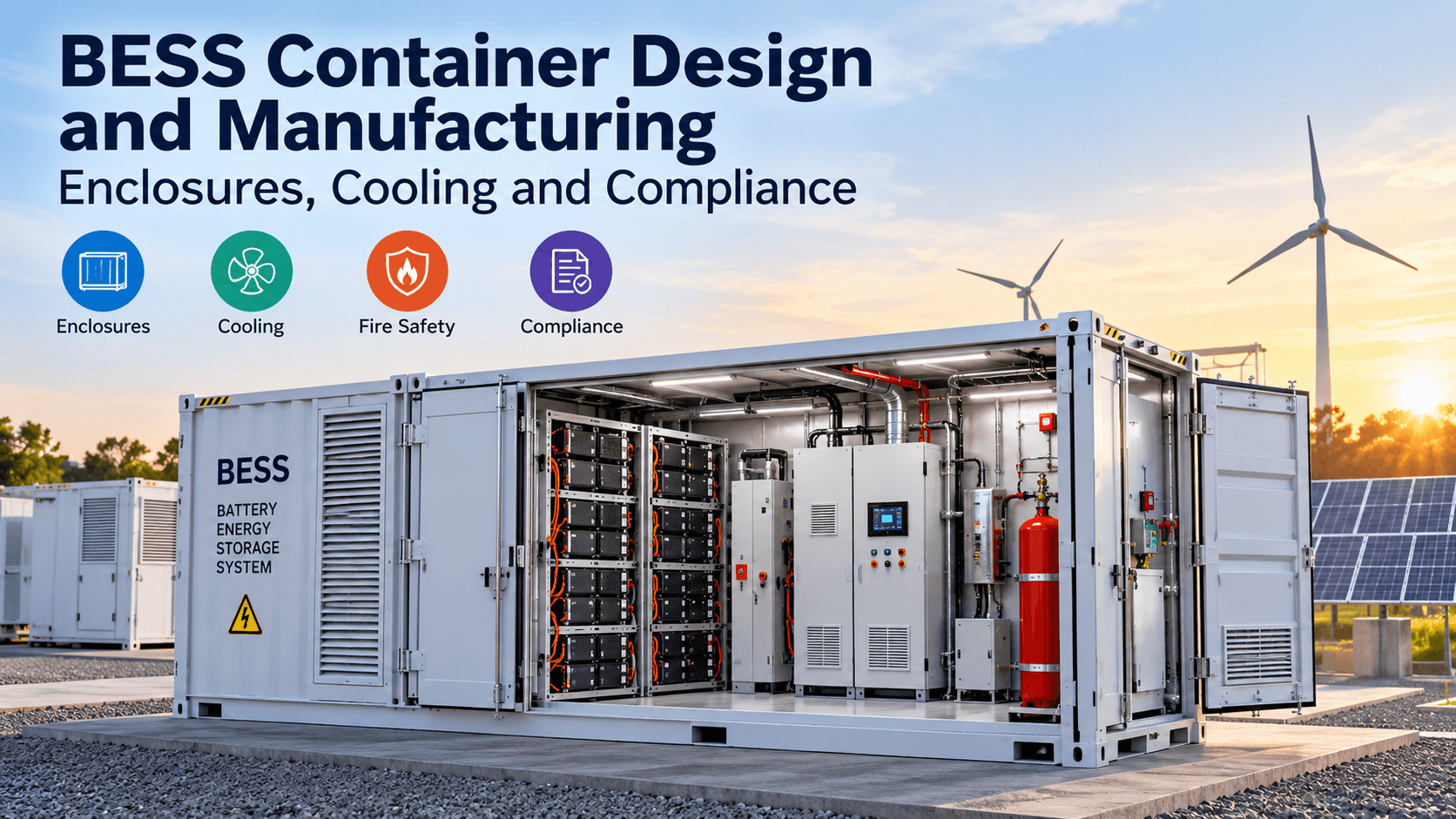
A battery energy storage system (BESS) container is a purpose-built enclosure that houses batteries, power conversion equipment, thermal management systems, fire protection equipment, controls, and other electrical components.
Unlike a standard shipping container, a BESS enclosure must be engineered around the requirements of the battery chemistry, electrical architecture, operating environment, safety strategy, and applicable regulations.
For system integrators, utilities, renewable energy developers, and commercial and industrial customers, container design directly affects system reliability, installation time, maintenance requirements, safety, and lifecycle cost.
A well-designed BESS container brings these elements together as one integrated system rather than treating the enclosure as a simple housing.
Key Elements of BESS Container Design
BESS container manufacturing typically involves several interconnected design areas.
Battery Rack Integration
Battery racks need to be positioned to provide adequate mechanical support, service access, cable routing, ventilation, and thermal management.
The layout should also account for:
- Battery module dimensions and weight
- Rack clearances
- DC cable routing
- Maintenance access
- Isolation and protection equipment
- Fire detection and suppression requirements
- Weight distribution within the enclosure
Good rack placement makes the system easier to install and service while reducing unnecessary internal complexity.
Electrical Equipment
A BESS container can include considerably more than battery racks. Depending on the system architecture, it may house:
- Battery management systems
- Power conversion systems
- DC protection equipment
- AC switchgear
- Transformers or auxiliary equipment
- Energy management controls
- Monitoring equipment
- Communication systems
- Emergency shutdown components
Electrical equipment should be arranged to separate high-power components from sensitive control and communication equipment where practical.
Cable routes also need to be planned early. Poor cable management can complicate commissioning, increase installation time, and make maintenance more difficult.
BESS Enclosure Design
The enclosure protects internal equipment from environmental conditions while supporting safe operation and maintenance.
Structural Design
The container structure needs to accommodate the weight of batteries and electrical equipment while remaining suitable for transportation and installation.
Important considerations include:
- Structural loading
- Equipment mounting
- Lifting points
- Transportation loads
- Foundation interfaces
- Corrosion protection
- Door and access arrangements
For outdoor installations, enclosure materials and protective coatings should also reflect the site’s environmental conditions.
A project near the coast, for example, may require a different corrosion protection strategy than a project in a dry inland environment.
Weather Protection
Outdoor BESS containers may be exposed to rain, dust, humidity, temperature extremes, and solar radiation.
The enclosure therefore needs appropriate protection against environmental exposure without compromising ventilation or thermal management.
Door seals, cable entries, vents, drainage, and equipment interfaces all matter. Small weaknesses in enclosure design can create long-term reliability problems.
Thermal Management and Cooling
Cooling is one of the most important parts of BESS container design.
Battery performance, degradation, charging capability, and safety can all be affected by temperature. A thermal management system must therefore maintain operating conditions within the battery manufacturer’s specified limits.
Air Cooling vs. Liquid Cooling
Two common approaches are air cooling and liquid cooling.
Air cooling uses fans and conditioned air to remove heat from the battery system. It can be relatively straightforward to maintain and may work well for certain system configurations.
Liquid cooling uses a coolant loop to transfer heat away from battery cells or modules. It can provide more controlled and uniform thermal management, particularly for high-density systems.
The right approach depends on factors such as:
- Battery chemistry
- Energy density
- Container size
- Ambient conditions
- Required charge and discharge rates
- System duty cycle
- Project economics
- Manufacturer requirements
Cooling should not be treated as an isolated component. The HVAC or liquid cooling system needs to work with the enclosure, battery racks, controls, sensors, and auxiliary power architecture.
Temperature Uniformity
Maintaining an acceptable average temperature is not enough. Temperature differences between battery modules or cells can also affect system performance and aging.
A well-engineered BESS cooling system therefore considers airflow distribution or coolant distribution throughout the container.
Thermal modeling and validation can help identify hot spots before production.
Fire Detection and Protection
Fire safety is a critical consideration in lithium-ion BESS design.
A comprehensive safety strategy may combine multiple layers, including:
- Battery management system monitoring
- Temperature and smoke detection
- Gas detection
- Alarm systems
- Emergency shutdown
- Ventilation
- Fire suppression
- Thermal event isolation
- Appropriate spacing and compartmentalization
The specific configuration depends on the battery technology, system design, local regulations, and applicable testing requirements.
The goal is not simply to install a suppression system. Effective BESS safety requires identifying potential failure modes and designing multiple layers of protection around them.
BESS Container Manufacturing Process
Once the engineering design is approved, manufacturing converts the design into a tested physical system.
A typical process includes:
- Engineering and design
- Structural enclosure fabrication
- Surface treatment and corrosion protection
- HVAC or liquid cooling installation
- Electrical equipment installation
- Battery rack installation
- Cable routing and termination
- Fire and safety system installation
- Control and communication integration
- Factory testing
- Final inspection and documentation
Manufacturing quality is especially important because many BESS projects are deployed in remote locations. Problems discovered after delivery can lead to expensive site work and project delays.
Factory Acceptance Testing
Factory acceptance testing, or FAT, provides an opportunity to verify the container before shipment.
Depending on the project requirements, testing may cover:
- Electrical connections
- Insulation and continuity
- Control systems
- Communications
- HVAC operation
- Temperature monitoring
- Fire detection
- Alarm functions
- Emergency shutdown
- Battery management system interfaces
- Power conversion system interfaces
Testing requirements should be defined during the engineering phase rather than added at the end of manufacturing.
BESS Compliance and Standards
BESS compliance depends on the project location, system configuration, battery technology, and applicable authority requirements.
Commonly referenced standards and frameworks can include UL 9540, UL 9540A, NFPA 855, IEC standards, local electrical codes, fire codes, and grid interconnection requirements.
The exact requirements vary by jurisdiction, so manufacturers and project developers should establish the applicable compliance framework early in the project.
UL 9540 and UL 9540A
In the United States, UL 9540 addresses energy storage systems, while UL 9540A provides a test method for evaluating the thermal runaway fire propagation characteristics of battery energy storage systems.
These standards can influence system architecture, enclosure design, testing, fire protection, and permitting.
NFPA 855
NFPA 855 provides installation requirements for stationary energy storage systems in the United States.
Its requirements can affect issues such as system placement, separation, fire protection, and installation practices.
IEC and Regional Requirements
Projects outside the United States may need to comply with relevant IEC standards and national or regional regulations.
For international projects, manufacturers should identify compliance requirements before finalizing the container design. Retrofitting a system to satisfy regulatory requirements late in the project can be expensive and disruptive.
Designing for Different Climates
BESS containers rarely operate in ideal environmental conditions.
A system installed in a hot desert environment faces different challenges from one installed in a cold northern climate or a humid coastal region.
Hot Climates
High ambient temperatures increase the cooling load and can affect battery performance and equipment life.
Design considerations may include:
- Higher-capacity cooling
- Solar heat mitigation
- Enclosure insulation
- HVAC redundancy
- Temperature monitoring
Cold Climates
Cold environments can affect battery charging and startup behavior.
The system may require heating in addition to cooling, with controls designed to prevent charging outside the battery manufacturer’s permitted temperature range.
Humid and Coastal Environments
High humidity and salt exposure can accelerate corrosion.
Enclosure materials, coatings, HVAC systems, filtration, and condensation control should therefore be selected based on the installation environment.
Designing BESS Containers for Maintainability
A container that performs well but is difficult to service can create significant lifecycle costs.
Maintenance access should be considered from the beginning of the design process.
Technicians may need access to:
- Battery modules
- HVAC components
- Filters
- Pumps
- Electrical protection devices
- Control panels
- Communication equipment
- Fire protection equipment
Clear access paths and logical component placement can reduce service time and improve technician safety.
Why Modular BESS Container Design Matters
Modular design allows manufacturers and system integrators to standardize components while adapting the system to different project requirements.
For example, a common enclosure platform can potentially support different battery capacities, cooling configurations, or electrical architectures.
This can help simplify:
- Engineering
- Procurement
- Manufacturing
- Testing
- Spare parts management
- Field servicing
However, modularity should not come at the expense of thermal performance, safety, or maintainability.
How to Choose a BESS Container Manufacturer
When evaluating BESS container manufacturers, buyers should look beyond fabrication capability.
Important questions include:
- Can the manufacturer handle mechanical and electrical integration?
- What battery technologies and system sizes can they support?
- How do they approach thermal management?
- What testing capabilities do they have?
- Which standards and certifications do they support?
- Can they provide engineering documentation?
- How do they manage factory acceptance testing?
- Can they support site installation and commissioning?
- What environmental conditions can their containers accommodate?
- How do they handle maintenance and replacement access?
A strong manufacturing partner should be able to explain not only how the container is built, but why each major design decision was made.
BESS Container Design Is an Integrated Engineering Challenge
The enclosure, battery system, cooling architecture, electrical equipment, fire protection, controls, and compliance requirements all influence one another.
A change to one part of the design can affect the others. Increasing battery density, for example, can change cooling requirements and may also affect fire safety, service access, and enclosure layout.
That is why successful BESS container manufacturing starts with system-level engineering rather than simply modifying a standard shipping container.
For developers and system integrators, the best design is not necessarily the one with the highest energy density. It is the one that balances safety, thermal performance, reliability, maintainability, compliance, manufacturing efficiency, and total lifecycle cost.
Frequently Asked Questions
What is a BESS container?
A BESS container is an engineered enclosure that integrates battery energy storage equipment with electrical, thermal management, safety, monitoring, and control systems.
What cooling system is used in a BESS container?
BESS containers commonly use air cooling or liquid cooling. The appropriate technology depends on battery chemistry, energy density, operating conditions, power requirements, and system architecture.
Why is BESS enclosure design important?
The enclosure protects batteries and electrical equipment from environmental conditions while providing structural support, thermal management, safe access, and integration for electrical and fire protection systems.
What standards apply to BESS containers?
Requirements depend on the project location and system configuration. Common references include UL 9540, UL 9540A, NFPA 855, IEC standards, local electrical codes, and applicable fire and grid requirements.
What should be tested before a BESS container leaves the factory?
Factory testing can include electrical checks, controls, communications, HVAC operation, alarms, fire detection, emergency shutdown functions, and interfaces between major system components. The exact FAT scope should be defined by the project requirements.
How long does it take to manufacture a BESS container?
Manufacturing time varies significantly depending on system size, customization, battery availability, electrical equipment, testing requirements, and production capacity. The engineering and procurement schedule often has a major influence on the overall project timeline.