
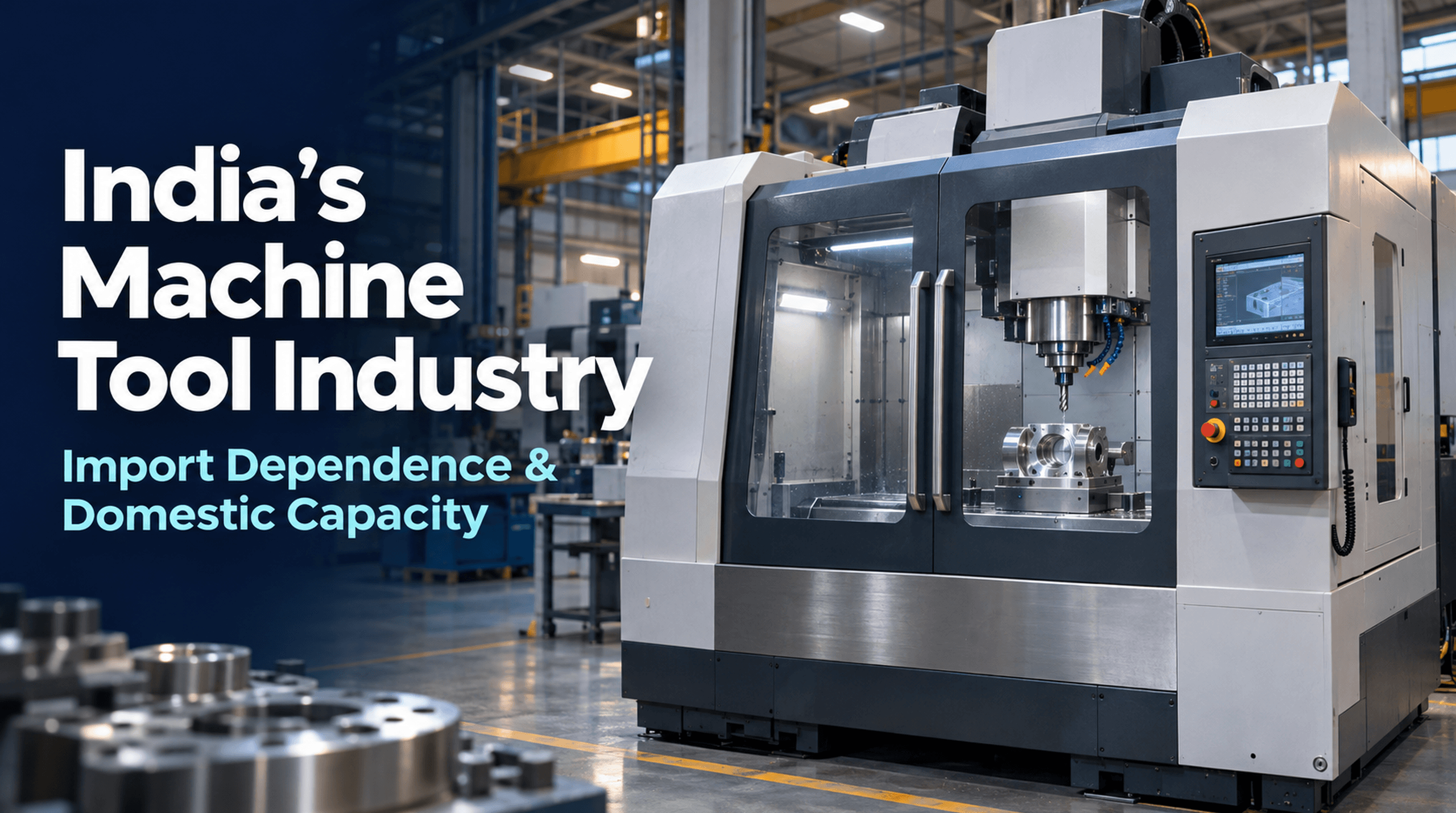
India’s Machine Tool Industry: Import Dependence & the Push for Domestic Capacity, 2026
An impressive machine list can get a supplier onto your shortlist. It cannot tell you whether the supplier will deliver the same accurate part through the next production run, a tooling change, or an unexpected breakdown.
That distinction matters when reading about India’s machine tool industry. More domestic machines can strengthen the manufacturing base. Imported machines can also help Indian factories produce sophisticated components. Neither development, by itself, settles a buyer’s questions about quality, delivery, or continuity.
This article examines India’s import dependence, the push for domestic machine-building capacity, and what both mean for sourcing decisions. It is written primarily for Indian OEM procurement, supplier-development, and quality teams buying machined parts, with practical checks that also help international buyers qualify Indian suppliers.
India’s Machine Tool Industry: Market Size and Global Position
A machine tool shapes a workpiece through a controlled manufacturing process. Metal-cutting equipment includes lathes, milling machines, and grinders; metal-forming equipment includes presses and bending machines. Computer numerical control, or CNC, describes how equipment is controlled, rather than a separate manufacturing process.
The IMTMA Annual Report 2024–25 estimates FY 2024–25 production at ₹14,566 crore and consumption at ₹31,781 crore. Imports were ₹18,686 crore. It places India ninth in production and fourth in consumption for the calendar year 2024, citing Gardner Intelligence.
Imports therefore represented approximately 58.8% of reported consumption by value. This is not the percentage of installed machines that are imported.
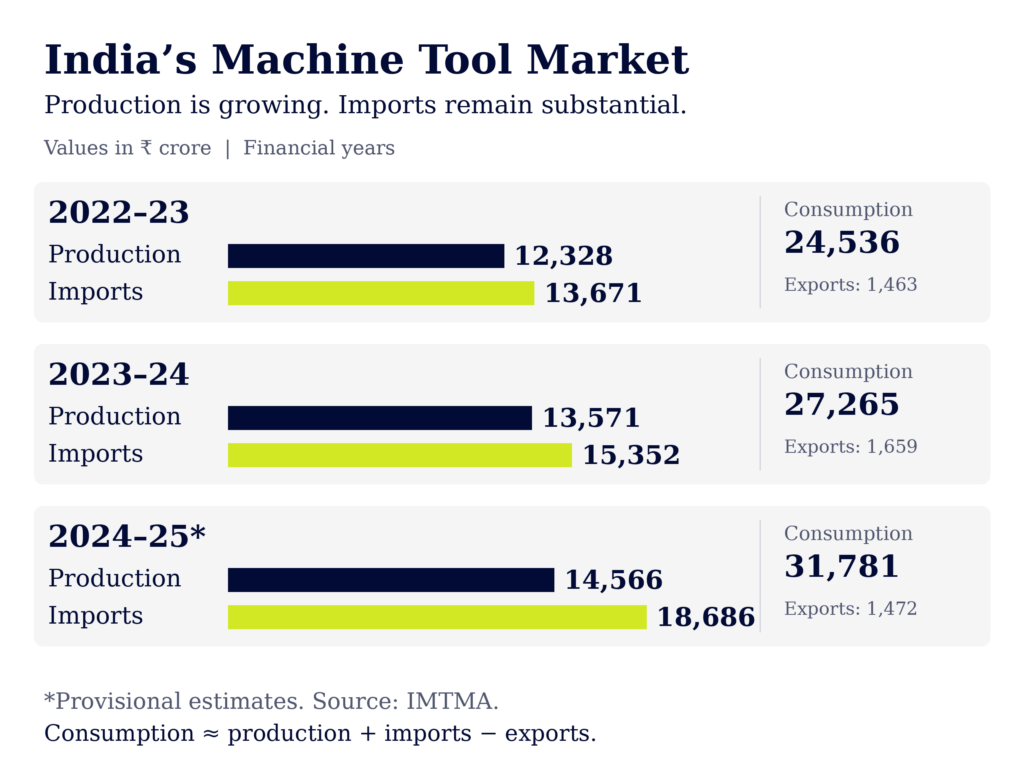
Source: IMTMA Annual Report 2024–25. FY 2024–25 figures are provisional estimates. Rounded components can differ from published consumption by ₹1 crore.
For a more recent indication, IMTMA’s June 2026 regional-council account reports FY 2025–26 production turnover of approximately ₹16,478 crore, consumption above ₹35,000 crore, and imports representing roughly 60–65% of consumption. These are industry-reported figures, not a replacement for a fully reconciled annual statistical series.
The practical implication is that local production can grow while import dependence remains substantial. Buyers should examine the mix of equipment and applications, rather than reading production growth as proof that every domestic capability gap has closed.
Where Import Dependence Remains Significant
“CNC” is too broad a label to explain where localisation is difficult. A standard turning application and simultaneous five-axis machining can have entirely unique requirements, even though both use computer-controlled equipment.
Import dependence needs to be examined against the required workpiece size, material, accuracy, production rate, and support arrangements. A single national percentage cannot establish whether a suitable domestic machine exists for a particular job.
Advanced CNC and five-axis applications
Five-axis capability should prompt more detailed questions about the application. Does the part require simultaneous movement, or could a suitable indexed process work? What access is needed around the component? How will the supplier demonstrate that the selected approach meets the drawing?
India has domestic manufacturers offering five-axis equipment. The useful distinction is between available models and a proven production solution for the required part. A procurement decision should connect the machine specification to actual machining trials and inspection results.
Precision grinding and finishing
For grinding, ask which operation is required, what material condition enters the process, and how the finished geometry and surface will be measured. “Grinding available” is an incomplete answer when the drawing calls for a particular combination of size, form, and finish.
Request evidence for the relevant operation rather than assuming that ownership of one type of grinder establishes every finishing capability. Where a process is subcontracted, include that operation in supplier qualification and continuity planning.
No machine-specific import percentages are presented here: a broad CNC category or customs heading cannot, on its own, establish import dependence for every technical application within it.
Why Closing the Gap Takes More Than Factory Capacity
Building more machines and deepening machine-building capabilities are related tasks. They are not identical. A larger assembly facility does not automatically resolve every dependency in its equipment, engineering, or service network.
Technology and critical components
For a machine builder, the relevant questions include where critical systems come from, how they are integrated, and who can support them over the equipment’s life. For the component buyer, those questions become practical: which failure could interrupt production, and what would restore the process?
Avoid treating imported content as a simple pass-or-fail test. Instead, identify the components that matter most to availability, the support arrangements behind them, and whether credible alternatives have been validated.
Application engineering and skills
A machine specification still needs to become a workable production process. The supplier must select tooling, hold the component securely, prepare the programme, and inspect the result.
When evaluating a new supplier, ask who owns those decisions. Establish how engineering changes are approved, how programmes are controlled, and how operators recognise a process that is moving away from its intended condition. These questions reveal more than a catalogue photograph.
Scale, financing, and lifetime support
Equipment investment also has to fit the business receiving it. Ask a machining supplier how the proposed production arrangement will be funded, maintained, and staffed. Check whether spare capacity is genuinely available for your programme or is already committed elsewhere.
For a business buying a machine, compare the full operating proposition: commissioning, tooling, training, maintenance, spares, and expected utilisation. A lower purchase price is useful only in the context of the production plan it is meant to support.
Policy Support for Domestic Machine Tool Capability
Policy should be assessed through what it funds, who is eligible, and what has actually been delivered. A strategy announcement, a sanctioned project, and a commissioned facility represent different stages.
Capital-goods technology support
The Ministry of Heavy Industries’ Capital Goods Scheme Phase II was notified in January 2022 with an outlay of ₹1,207 crore. Its components include centres of excellence, common engineering facilities, testing infrastructure, and skills-related support.
These interventions address shared technology and capability needs. They should not be described as an automatic subsidy available to every buyer of a locally manufactured machine. A business considering participation must examine the relevant component, project arrangements, and eligibility conditions.
At the state level, IMTMA identifies Karnataka’s Tumakuru Machine Tool Park as a state initiative supported by the central ministry. For a prospective investor, the next step is to verify the current infrastructure, allotment terms, and applicable state incentives against the actual project.
PLI-related demand and proposed policies
The government’s November 2026 PLI overview describes support across 14 sectors, including industries that use manufacturing equipment. This creates a reason to examine downstream equipment demand; it does not establish that every machine-tool manufacturer or purchaser qualifies for PLI benefits.
Before incorporating any incentive into an investment case, check the notified scheme, eligible products, qualifying entity, and application window. A proposal for sector-specific support should remain labelled as a proposal until the relevant instrument is issued.
For buyers of machined parts, the most useful evidence is whether support has translated into a commissioned process, trained people, and validated production. Policy momentum is context for supplier assessment, not a substitute for it.
Domestic Manufacturers and Capacity Expansion
Domestic capacity announcements need to be assessed in stages: planned investment, commissioned installed capacity, actual output, and demonstrated performance on the required application. A factory’s stated annual capacity does not establish how many machines it currently produces or which machining requirements those machines can meet.
For buyers, the useful question is what an expansion adds: standard equipment, advanced machining capability, critical-component manufacturing, or application and service support. Assess commissioning evidence, the relevant product range, and support arrangements before treating an announced expansion as a sourcing option.
What This Means for Buyers of Machined Parts
Domestic machine-tool capacity and a supplier’s ability to produce your part reliably are different measures.
An Indian supplier using imported equipment may still be a suitable domestic source of finished parts. A supplier using locally built machines may also be suitable. In both cases, the decision needs evidence linking the proposed process to your drawing, volume, and delivery requirements.
Use the following checks to make that link explicit.
| Buyer Check | Evidence to Request | Decision It Supports |
| Part and process fit | Drawing review, proposed operation sequence, material condition, and workholding approach | Whether the proposed manufacturing route addresses the actual part |
| Demonstrated quality | Trial-part inspection results, measurement methods, and agreed production-validation evidence | Whether requirements can be measured and met consistently |
| Available production capacity | Machine allocation, staffing assumptions, planned cycle times, and existing commitments | Whether the quoted schedule has a credible production basis |
| Equipment continuity | Preventive-maintenance arrangements, service contacts, and critical-spares planning | How equipment interruptions will be managed |
| Outsourced operations | Named process stages, approval arrangements, and inspection responsibilities | Whether important dependencies are visible |
| Change and delivery control | Programme revision controls, escalation contacts, and recovery arrangements | How deviations and schedule changes will be handled |
The table is a qualification framework, not a universal acceptance specification. Agree the required evidence for the component’s risk, industry, and customer requirements.
Compare suppliers on a common basis
For example, consider a hypothetical housing that needs machining, heat treatment, and final inspection. One bidder may quote the complete route, while another includes machining alone and expects the buyer to arrange the remaining stages.
Comparing those prices without reconciling scope would obscure the sourcing decision. Request the same material basis, process scope, inspection requirements, delivery terms, and responsibility for rejected parts. Then examine where each supplier’s equipment and partner network support that scope.
Validate any proposed backup route
Where continuity matters, discuss the alternative production route before a breakdown. Ask which machine or supplier could take over, what preparation would be required, and which approvals would need repeating.
Do not assume that a second machine with a similar description is an approved substitute. Establish the validation needed for the actual component. International buyers can use the same approach while adding their destination-market and contractual requirements.
Final Thoughts: Assess Capability Before Capacity
India’s expanding machine-building base creates more options for manufacturers and buyers. Yet import shares, factory announcements, and machine counts describe different parts of the picture. Read each figure with its period, scope, and stage of delivery clearly identified.
For sourcing decisions, assign greater weight to a validated production process than to a capacity headline. Partner with ZETWERK for your precision-manufacturing requirements. Contact its manufacturing experts to explore support for your production needs, from component manufacturing and secondary processing to assembly, packaging, and distribution.
Frequently Asked Questions (FAQs)
What is a machine tool?
A machine tool shapes a workpiece through a controlled process, such as turning, milling, grinding, pressing, or bending. It differs from the individual cutting tool or insert that may be fitted to the machine.
How large is India’s machine tool industry?
IMTMA’s June 2026 regional council account reports FY 2025–26 consumption above ₹35,000 crore and production turnover of approximately ₹16,478 crore. Consumption measures the domestic market; production measures output, so the figures answer different questions.
Why does India import machine tools despite domestic production?
Domestic production does not necessarily cover every required application, specification, or delivery need. To understand an individual purchase, examine the equipment’s technical fit, commercial terms, and support arrangements rather than inferring the reason from the national import share.
Are CNC and five-axis machines manufactured in India?
Yes. Indian manufacturers offer CNC equipment, including five-axis solutions. Buyers should still verify the exact model, configuration, manufacturing scope, and evidence for their intended application.
Does higher domestic production necessarily reduce import dependence?
No. Imports can remain substantial if demand grows or buyers require equipment that domestic output does not replace. A production-growth percentage alone cannot show how the import share has changed.
Is there a dedicated PLI scheme for machine tools?
PLI support for industries that use machine tools does not automatically extend to machine-tool manufacturers. Before including incentives in a project budget, confirm that a notified scheme covers your product and that your business meets its eligibility conditions.
What should buyers check when choosing an Indian machining supplier?
Check the proposed process against the drawing, material, volume, and inspection requirements. Request relevant trial and production evidence, confirm available capacity, and examine maintenance, subcontracting, and continuity arrangements. Assess the complete production route, including how changes and rejected parts will be managed.