

Export Compliance and Customs for Manufacturers Shipping from India
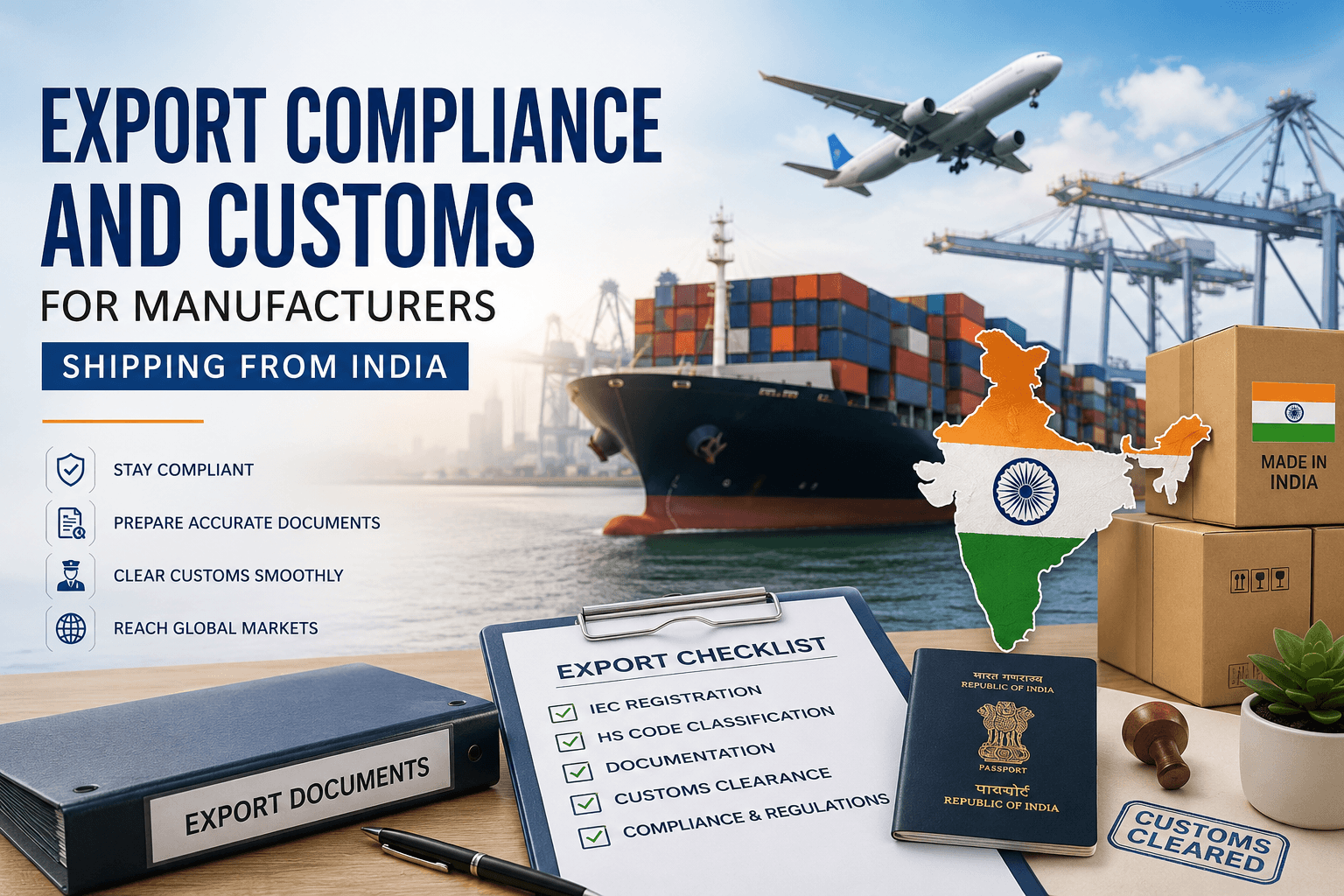
Exporting products from India opens access to global markets, but it also brings regulatory responsibilities. Manufacturers must comply with Indian export laws, customs procedures, and destination country requirements to avoid shipment delays, penalties, and unexpected costs.
Understanding how export compliance works helps businesses move goods efficiently while building trust with international customers.
What Is Export Compliance?
Export compliance is the process of following all laws, regulations, and documentation requirements governing international shipments. In India, this includes obtaining the necessary registrations, accurately declaring exported goods, complying with foreign trade policies, and ensuring shipments meet customs requirements.
Compliance also extends to the importing country’s regulations, which may include product certifications, safety standards, labeling rules, and import licensing.
Why Export Compliance Matters
Strong export compliance practices help manufacturers:
- Prevent customs delays
- Avoid fines and penalties
- Reduce shipment rejections
- Improve customer satisfaction
- Maintain eligibility for export incentives
- Build credibility with overseas buyers
Even small documentation errors can delay shipments for days or weeks.
Key Registrations Required Before Exporting
Before shipping internationally, manufacturers should ensure they have the required registrations.
Import Export Code (IEC)
The Import Export Code issued by the Directorate General of Foreign Trade (DGFT) is mandatory for almost all commercial exports from India.
GST Registration
GST registration is generally required for exporters. Exporters may export under bond or Letter of Undertaking (LUT) without paying Integrated GST (IGST), or export on payment of IGST and later claim a refund, depending on the applicable provisions.
Authorized Dealer (AD) Bank Account
Export proceeds must be routed through an Authorized Dealer bank, which handles foreign exchange transactions and export realization under Reserve Bank of India (RBI) regulations.
Essential Export Documents
Accurate documentation is the foundation of successful exports.
Common export documents include:
- Commercial Invoice
- Packing List
- Shipping Bill
- Bill of Lading or Air Waybill
- Certificate of Origin
- Export Declaration
- Insurance Certificate (when applicable)
- Inspection Certificate (if required)
- Purchase Order or Letter of Credit
- Product-specific certifications
Some industries may require additional documents depending on the product category and destination country.
Understanding HS Codes
Every exported product must be classified using the Harmonized System (HS) code.
The HS code determines:
- Customs duty
- Export incentives
- Trade restrictions
- Statistical reporting
- Product eligibility under trade agreements
Incorrect classification can lead to customs disputes and financial penalties.
Indian Customs Export Process
The export process generally follows these steps:
1. Prepare Export Documentation
Verify invoices, packing lists, product descriptions, and shipment details before filing customs documents.
2. File the Shipping Bill
The Shipping Bill is submitted electronically through the Indian Customs Electronic Gateway (ICEGATE) system.
3. Customs Assessment
Customs authorities review the shipment details and supporting documents.
4. Cargo Examination
Selected shipments may undergo physical inspection based on risk assessment.
5. Let Export Order (LEO)
Once customs clears the shipment, a Let Export Order (LEO) is issued, allowing goods to leave India.
6. Shipment Departure
Goods are loaded onto the vessel or aircraft for international transport.
Product-Specific Export Controls
Certain products require additional approvals before export.
Examples include:
- Chemicals
- Pharmaceuticals
- Defense equipment
- Medical devices
- Agricultural products
- Food products
- Hazardous materials
- Wildlife-related goods
- Dual-use technologies
Manufacturers should verify whether their products require licenses, permits, or certifications before accepting export orders.
Destination Country Requirements
Export compliance does not end once goods leave India.
Importing countries may require:
- Product testing
- Safety certifications
- Product labeling
- Language-specific packaging
- Environmental compliance
- Restricted substance declarations
- Country of origin marking
Manufacturers should confirm these requirements with buyers before production begins.
Incoterms and Responsibility
Incoterms define how responsibilities are divided between buyers and sellers.
Common Incoterms include:
- EXW (Ex Works)
- FOB (Free on Board)
- CIF (Cost, Insurance, and Freight)
- CFR (Cost and Freight)
- DDP (Delivered Duty Paid)
- DAP (Delivered at Place)
Selecting the appropriate Incoterm determines who is responsible for transportation, insurance, customs clearance, and risk during transit.
Common Customs Challenges
Manufacturers often encounter avoidable customs issues, including:
- Incorrect HS code classification
- Missing documentation
- Invoice discrepancies
- Inaccurate product descriptions
- Valuation errors
- Export licensing issues
- Packaging non-compliance
- Certificate mismatches
Implementing standardized documentation procedures helps reduce these risks.
Best Practices for Export Compliance
A proactive compliance program should include:
- Maintain accurate product classifications.
- Keep documentation consistent across all export records.
- Stay updated on changes to export regulations.
- Screen customers and destinations against applicable sanctions and restricted party requirements.
- Train staff involved in export documentation.
- Conduct periodic internal compliance reviews.
- Work with experienced customs brokers and freight forwarders.
- Retain export records as required by law.
Using Digital Tools for Export Documentation
Many manufacturers use digital systems to streamline export operations.
These tools can help:
- Generate shipping documents
- Track shipments
- Store compliance records
- Automate invoice creation
- Manage certificates
- Integrate with ERP systems
- Improve audit readiness
Automation reduces manual errors while improving shipment visibility across departments.
Conclusion
Export compliance is an essential part of international manufacturing operations. From obtaining the correct registrations and preparing accurate documentation to meeting destination country requirements, every step plays a role in ensuring goods move smoothly across borders.
Manufacturers that invest in strong compliance processes reduce delays, lower operational risk, and strengthen relationships with global customers. As export regulations continue to evolve, maintaining accurate records, staying informed about policy changes, and adopting digital tools can help businesses scale international operations with greater confidence.
Frequently Asked Questions
Q. Is an Import Export Code mandatory for exporters in India?
Yes. Most businesses engaged in commercial exports from India must obtain an Import Export Code (IEC) from the Directorate General of Foreign Trade before exporting goods.
Q. What is the purpose of a Shipping Bill?
A Shipping Bill is the primary customs document used to obtain export clearance for goods leaving India.
Q. Why are HS codes important?
HS codes classify products for customs purposes. They influence duties, trade restrictions, documentation requirements, and eligibility under trade agreements.
Q. Can exporters claim GST benefits?
Eligible exporters may export under a Letter of Undertaking (LUT) without paying IGST or export on payment of IGST and claim a refund, subject to applicable GST provisions.
Q. How can manufacturers reduce customs delays?
Maintaining accurate documentation, using the correct HS codes, complying with product-specific regulations, and coordinating with customs brokers and freight forwarders can significantly reduce delays.