
Energy Storage Systems: Types, Applications and How to Choose
Energy storage systems (ESS) help businesses, utilities, and households store energy for use when it is needed most. They can reduce electricity costs, improve power reliability, support renewable energy, and help manage fluctuations in electricity demand.
Choosing the right energy storage system depends on several factors, including how much energy you need to store, how quickly you need to deliver it, how long the system must operate, and the total cost over its lifetime.
This guide explains the main types of energy storage systems, where they are used, and how to choose a solution that fits your operational and financial goals.
What Is an Energy Storage System?
An energy storage system captures energy produced at one time and makes it available for use later. Depending on the technology, it can store energy as electricity, chemical energy, mechanical energy, thermal energy, or potential energy.
For example, a commercial building with rooftop solar panels may produce more electricity during the day than it consumes. An energy storage system can store some of that surplus electricity and supply it in the evening, when solar production falls and electricity demand remains high.
Modern energy storage systems often combine several components:
- Storage medium: The battery, thermal material, water reservoir, or other medium that holds energy.
- Power conversion system: Equipment that converts electricity between AC and DC when required.
- Energy management system: Software and controls that determine when to charge, discharge, and reserve stored energy.
- Safety and monitoring systems: Components that monitor temperature, electrical conditions, and system performance.
- Integration equipment: Connections to the electrical grid, renewable energy sources, generators, or building systems.
The exact configuration depends on the storage technology and its intended application.
Why Energy Storage Systems Matter
Energy storage helps solve a basic challenge in modern energy management: energy supply and demand do not always occur at the same time.
Solar panels generate electricity during daylight hours, while many businesses use substantial power in the evening. Wind generation can vary with weather conditions, and industrial facilities may experience sudden increases in electricity demand.
Energy storage helps bridge these gaps.
Key benefits include:
- Lower electricity costs: Store energy when it is cheaper and use it during expensive periods, where tariffs allow.
- Backup power: Keep critical equipment running during grid interruptions when the system is designed for backup operation.
- Renewable energy integration: Use more locally generated solar and wind energy instead of exporting surplus electricity.
- Peak demand management: Reduce short periods of high electricity consumption that can increase demand charges.
- Grid stability: Help balance electricity supply and demand and support grid services.
- Operational flexibility: Give facilities more control over when they draw electricity from the grid.
Not every system delivers all these benefits. The results depend on local electricity tariffs, grid conditions, equipment design, and how the system is operated.
Types of Energy Storage Systems
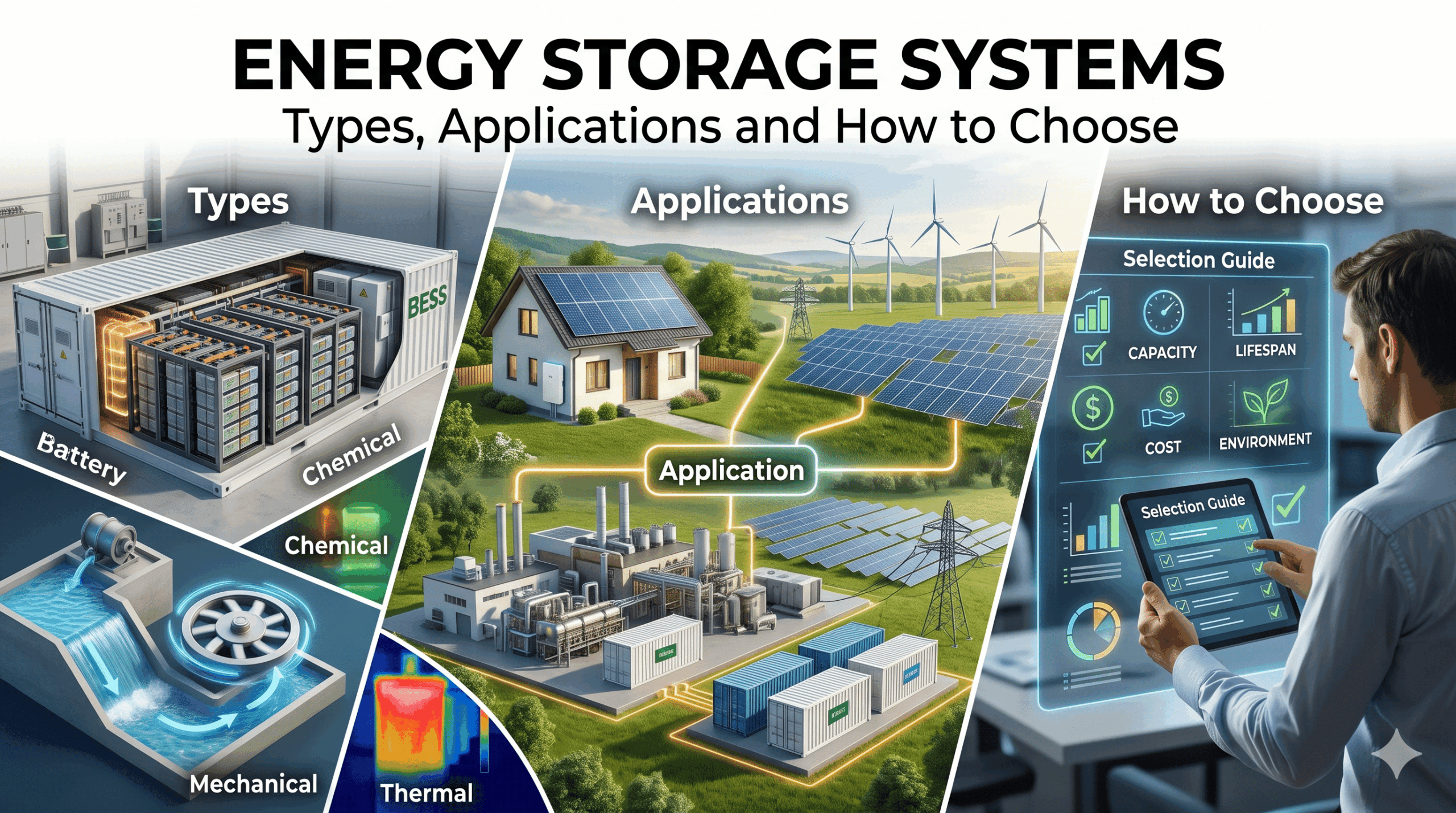
Energy storage technologies differ in how they store energy, how quickly they release it, how much energy they can hold, and how much they cost to operate. The main categories are electrochemical, mechanical, thermal, electrical, and chemical storage.
1. Battery Energy Storage Systems (BESS)
Battery energy storage systems store energy through electrochemical reactions and release it as electricity when required. They are widely used in commercial buildings, renewable energy projects, industrial facilities, and utility-scale installations.
Common battery technologies include:
- Lithium-ion batteries: Widely used for their energy density, efficiency, and flexible installation options.
- Lithium iron phosphate (LFP): A lithium-ion chemistry commonly used in stationary storage because of its thermal stability and cycle-life characteristics.
- Nickel manganese cobalt (NMC): Another lithium-ion chemistry that offers high energy density.
- Lead-acid batteries: An established option for certain backup power applications, although they generally have shorter cycle life than many modern lithium-ion systems.
- Sodium-ion batteries: An emerging alternative with potential advantages in material availability and specific operating conditions.
- Flow batteries: Store energy in liquid electrolytes and can be suitable for applications that require longer discharge durations.
Applications: Solar energy storage, backup power, peak shaving, load shifting, and grid support.
Key consideration: Battery chemistry, usable capacity, cycle life, thermal management, degradation, and safety requirements all affect lifetime cost.
2. Mechanical Energy Storage
Mechanical systems store energy through physical movement, pressure, or elevation. They are particularly relevant to large-scale electricity systems and applications that need substantial storage capacity.
Common technologies include:
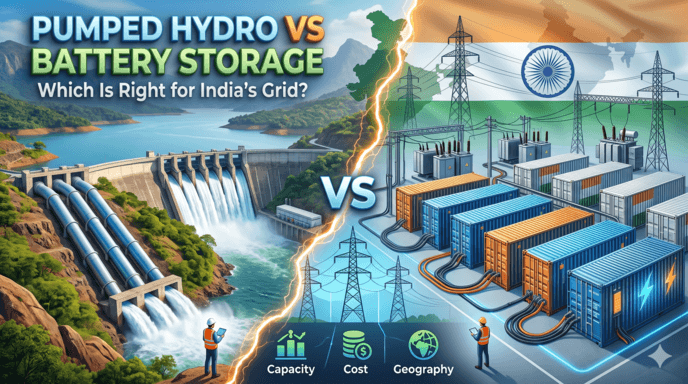
- Pumped hydro storage: Uses electricity to pump water uphill, then generates power as the water flows back down.
- Compressed air energy storage (CAES): Stores energy by compressing air for later use in a power generation process.
- Flywheel storage: Stores energy in a rotating mass and releases it rapidly when needed.
Applications: Grid balancing, frequency regulation, renewable energy integration, and large-scale energy shifting.
Key consideration: Site requirements, project scale, discharge duration, efficiency, and installation complexity.
3. Thermal Energy Storage
Thermal energy storage holds heat or cold for later use. Instead of always converting stored energy back into electricity, these systems can deliver heating or cooling directly.
Common technologies include:
- Chilled water storage: Stores cooling capacity in water for later use.
- Ice storage: Produces ice during periods of lower electricity demand and uses it for cooling when demand rises.
- Hot water storage: Stores thermal energy for heating and hot water applications.
- Molten salt storage: Holds heat for use in concentrated solar power plants and industrial applications.
- Phase-change materials: Absorb or release heat as they change between physical states.
Applications: Commercial HVAC, district cooling, industrial process heat, and solar thermal power plants.
Key consideration: Required temperature range, insulation, heat loss, available space, and compatibility with existing heating or cooling equipment.
4. Electrical Energy Storage
Electrical storage technologies can absorb or deliver power extremely quickly. Supercapacitors store energy in an electric field, while superconducting magnetic energy storage (SMES) stores energy in a magnetic field.
These technologies are often designed for rapid response rather than storing large amounts of energy for many hours.
Applications: Short-duration power support, voltage stabilization, power quality improvement, and systems that require frequent, rapid charge and discharge cycles.
Key consideration: Power requirements, discharge duration, operating conditions, and total system cost.
5. Chemical Energy Storage
Chemical storage converts electricity into a chemical fuel, such as hydrogen, which can be stored and used later. Hydrogen can be converted back into electricity using a fuel cell or turbine, or used directly in suitable industrial processes.
Other chemical storage approaches include synthetic fuels produced using electricity and suitable feedstocks.
Applications: Long-duration or seasonal storage, industrial feedstocks, and applications that need energy stored for extended periods.
Key consideration: Conversion losses, storage infrastructure, safety, fuel availability, and the cost of converting the stored fuel back into electricity.
These categories are not interchangeable. A battery may be practical for a building that needs several hours of backup, while thermal storage may be more economical for shifting a large cooling load. Hydrogen or other long-duration options may suit needs that extend beyond a typical daily battery cycle.
Common Applications of Energy Storage Systems
The best storage technology depends on the problem you are trying to solve. A system designed to reduce electricity bills may have very different requirements from one designed to keep critical equipment running during a power outage.
1. Commercial and Industrial Energy Management
Factories, warehouses, office buildings, shopping centres, and data centres can use energy storage to manage electricity consumption more effectively.
Typical applications include:
- Peak shaving: Discharge stored energy when a facility’s electricity demand reaches a costly peak.
- Load shifting: Charge during lower-cost periods and discharge during higher-cost periods.
- Backup power: Supply critical loads during outages when the system supports islanded operation.
- Power quality: Help manage short-duration disturbances when the system is designed for the required response.
- Solar self-consumption: Store excess rooftop solar energy for use later in the day.
For example, a manufacturing plant that experiences a brief but expensive demand peak may use a battery to supply part of that peak instead of drawing all the power from the grid.
The financial benefit depends on the facility’s load profile, tariff structure, battery efficiency, and degradation costs.
2. Solar and Wind Energy Storage
Renewable energy production varies with weather and time of day. Energy storage helps align that production with when electricity is needed.
A solar-plus-storage system can store excess daytime generation and use it after sunset. Wind farms can use storage to help smooth output fluctuations or deliver electricity at more useful times.
Storage can also reduce renewable energy curtailment, which happens when available generation cannot be used or exported.
However, storage does not automatically eliminate renewable energy variability. The required capacity depends on how much generation must be shifted and how long the supply gap lasts.
3. Utility-Scale Grid Storage
Electric utilities use storage to balance supply and demand, respond to changes in grid frequency, support voltage management, and shift electricity from periods of lower demand to periods of higher demand.
Large battery installations can respond quickly to grid conditions. Pumped hydro and other long-duration technologies can provide larger amounts of stored energy over extended periods, depending on their design.
The right system depends on whether the primary need is rapid response, several hours of energy delivery, or longer-duration supply.
4. Residential Energy Storage
Homeowners can combine batteries with rooftop solar to increase solar self-consumption, maintain selected household loads during outages, or reduce electricity purchases during expensive periods.
Before selecting a home battery, consider:
- Essential appliances and their combined power demand.
- Expected backup duration.
- Solar generation and evening consumption.
- Whether the inverter supports backup or islanded operation.
- Available installation space and safety requirements.
A battery sized only for daily energy savings may not be large enough to power every household appliance during an extended outage.
5. Data Centres and Critical Infrastructure
Data centres, hospitals, telecom facilities, and other critical operations need reliable power.
Energy storage may support uninterrupted power supplies, bridge short interruptions, or work with generators and other backup resources. Larger battery systems can also help manage peak demand.
These applications require careful planning around redundancy, fault protection, thermal management, maintenance, and the distinction between short-duration ride-through and long-duration backup.
6. Electric Vehicle Charging
Battery storage can help electric vehicle charging sites manage demand when multiple vehicles charge at once. It can store electricity in advance and supply part of the load during busy periods.
This can be useful where grid capacity is limited or connection upgrades are expensive. The economics depend on charging patterns, charger power ratings, available storage capacity, and electricity tariffs.
How to Choose the Right Energy Storage System
Selecting an energy storage system requires more than comparing battery prices or advertised capacities. The right solution must match your energy needs, operating conditions, safety requirements, and expected financial returns.
Use the following steps to evaluate your options.
1. Define Your Primary Objective
Start by identifying the main problem you want the system to solve.
| Primary objective | Suitable options to evaluate |
|---|---|
| Reduce electricity bills | Battery storage, thermal storage |
| Store excess solar power | Battery storage, pumped hydro |
| Provide backup electricity | Battery storage, UPS systems |
| Support large-scale grid operations | Batteries, pumped hydro, compressed air |
| Deliver rapid power response | Flywheels, supercapacitors, batteries |
| Store heat or cooling capacity | Thermal energy storage |
| Store energy for extended periods | Pumped hydro, flow batteries, hydrogen, other long-duration systems |
These are starting points, not universal recommendations. Site conditions, discharge requirements, efficiency, and project economics determine which technology is most suitable.
2. Calculate Power and Energy Requirements
Two specifications are especially important: power capacity and energy capacity.
- Power capacity (kW or MW): How much power the system can deliver at a given moment.
- Energy capacity (kWh or MWh): How much energy the system can store and supply over time.
For example, a system rated at 100 kW with 400 kWh of usable energy can theoretically deliver 100 kW for four hours, assuming the rated power is continuously available and losses and other operating limits are ignored.
A useful starting formula is:
Energy required (kWh) = Load (kW) × Duration (hours)
If a facility needs 50 kW for four hours, it requires 200 kWh of delivered energy. The installed capacity may need to be higher to account for conversion losses, reserve capacity, operating limits, and battery degradation.
3. Compare Efficiency and Lifetime
A system’s purchase price does not tell you how much usable energy it will deliver over its life.
Compare the following metrics:
- Round-trip efficiency: The percentage of charging energy recovered during discharge.
- Cycle life: The number of charge and discharge cycles a system can complete under specified conditions.
- Calendar life: How long the system is expected to last, including periods when it is not cycled.
- Degradation: How storage capacity and performance decline over time.
- Maintenance requirements: The ongoing work and cost needed to keep the system operating.
- Operating temperature: The conditions required for safe and efficient performance.
For batteries, compare warranties using the same assumptions about operating temperature, depth of discharge, daily cycling, and end-of-life capacity. Published cycle-life figures are only meaningful when the underlying test conditions are understood.
4. Evaluate Total Cost of Ownership
Look beyond the initial equipment cost. The total cost of an energy storage system may include:
- Equipment and installation.
- Inverters and electrical integration.
- Site preparation and civil works.
- Cooling, ventilation, and fire protection.
- Monitoring software and maintenance.
- Electricity lost during charging and discharging.
- Battery replacement or augmentation.
- Financing, insurance, and end-of-life handling.
For commercial projects, compare the expected savings and revenues against these costs over the system’s useful life.
A lower-cost system may not be the best investment if it requires frequent replacement or loses more energy during operation.
5. Assess Safety and Installation Requirements
Safety requirements vary by storage technology, system size, and installation environment.
For battery energy storage, review:
- Battery chemistry and thermal stability.
- Battery management and fault detection.
- Fire detection, suppression, and emergency response provisions.
- Ventilation and thermal management.
- Electrical isolation and protective devices.
- Applicable local codes, certifications, and installation standards.
- Safe access for inspection and maintenance.
Also confirm whether the system can operate during a grid outage. A grid-connected solar and battery installation does not necessarily provide backup power unless its inverter, controls, and electrical configuration support that function.
6. Check Integration and Scalability
The storage system should work with your existing electrical infrastructure and energy management software.
For a commercial or industrial installation, check compatibility with:
- Solar photovoltaic systems.
- Existing inverters and switchgear.
- Building management systems.
- Energy meters and utility connections.
- Backup generators and UPS equipment.
- Demand-response or energy trading platforms, where applicable.
If your energy needs may grow, ask whether additional storage modules can be added without replacing major components.
Battery Energy Storage vs. Other Storage Technologies
The following comparison provides a practical starting point for evaluating the main options.
| Technology | Key advantage | Main limitation | Typical fit |
|---|---|---|---|
| Lithium-ion batteries | Fast response and compact installation | Degradation and thermal safety requirements | Commercial, residential, and grid storage |
| Flow batteries | Energy capacity can be scaled separately from power in many designs | Larger footprint and system complexity | Longer-duration stationary storage |
| Pumped hydro | Large-scale, established technology | Significant site and construction requirements | Utility-scale storage |
| Compressed air | Potential for large-scale storage | Site dependence and conversion complexity | Grid-scale and long-duration projects |
| Thermal storage | Can directly supply heating or cooling | Usually suited to thermal rather than general electrical loads | Buildings and industrial processes |
| Flywheels | Rapid response and frequent cycling | Limited energy storage duration | Power quality and short-duration support |
| Hydrogen | Potential for long-duration and seasonal storage | Conversion losses and infrastructure costs | Industrial and long-duration applications |
Technology performance varies by design and project. Evaluate comparable systems using the same power rating, usable energy, discharge duration, efficiency boundary, and lifetime assumptions.
Cost and Return on Investment: What Should You Measure?
The economics of energy storage depend on how often the system operates and what value each discharge provides.
For a commercial facility, a financial assessment should consider:
- Annual electricity bill savings from peak shaving and load shifting.
- Value of additional solar energy consumed on-site.
- Cost avoided from outages, where a credible estimate is possible.
- Potential grid-service or market revenue, if the project is eligible.
- Charging costs, conversion losses, maintenance, and degradation.
- Initial capital investment and future replacement costs.
A simple payback estimate is:
Payback period = Initial investment ÷ Annual net savings
For example, if a system costs ₹40 lakh and generates ₹10 lakh in annual net savings, its simple payback period is four years.
This is an illustrative calculation, not a market price or a forecast. Simple payback does not account for financing, discount rates, changing electricity tariffs, or future replacement costs. A discounted cash flow analysis provides a stronger basis for investment decisions.
Energy Storage Systems in India
Energy storage is becoming increasingly important in India as solar and wind capacity expands and the electricity system needs greater flexibility.
For Indian businesses and project developers, the following factors deserve particular attention:
- Electricity tariffs: Review time-based tariffs, demand charges, and the rules governing energy export.
- Power reliability: Determine whether the system is intended for savings, backup, or both.
- Solar integration: Match storage capacity to generation patterns and actual consumption.
- Climate and site conditions: Consider high ambient temperatures, ventilation, and cooling needs.
- Local regulations: Check applicable electrical safety rules, grid interconnection requirements, and state-specific policies.
- Project financing: Evaluate current incentives and funding schemes against the project’s eligibility criteria rather than assuming benefits are available.
The best system for a factory in a location with frequent outages may differ significantly from the best system for a solar-powered commercial building with reliable grid access.
Common Mistakes to Avoid When Selecting an Energy Storage System
Several mistakes can reduce the financial and operational value of a storage investment.
- Sizing only by battery capacity: A large battery cannot deliver the required load if its power rating is too low.
- Ignoring the actual load profile: Daily consumption totals do not show when peak demand occurs or how long backup is needed.
- Focusing only on upfront price: Efficiency, maintenance, degradation, and replacement costs affect lifetime economics.
- Assuming all solar batteries provide backup: Islanding capability and backup wiring must be verified.
- Overlooking safety and space: Installation requirements can affect both project cost and feasibility.
- Assuming savings without tariff analysis: Peak shaving and load shifting are valuable only when the applicable tariff and operating pattern support them.
- Choosing without a defined operating strategy: Charging and discharging controls influence performance, savings, and system life.
Frequently Asked Questions
What is the most common type of energy storage system?
Battery energy storage systems are widely used in residential, commercial, industrial, and grid applications. Pumped hydro is also a major established technology for utility-scale storage. The best option depends on the required capacity, duration, site, and application.
How long can an energy storage system provide power?
Operating duration depends on usable energy capacity and the connected load. A system with 200 kWh of usable energy supplying a constant 50 kW load would theoretically run for four hours before accounting for additional losses or operating constraints.
Which battery chemistry is suitable for commercial energy storage?
Lithium iron phosphate (LFP) is a common option for stationary storage because of its characteristics, including thermal stability and cycle-life potential. Other chemistries may suit different cost, performance, or operating requirements. Compare complete system specifications rather than choosing on chemistry alone.
Can energy storage systems reduce electricity bills?
Yes. Depending on local tariffs and system design, storage can reduce peak demand charges, shift consumption to lower-cost periods, and increase the use of self-generated solar electricity. Actual savings should be estimated from interval consumption data and the relevant tariff.
What is the difference between power capacity and energy capacity?
Power capacity describes how much electricity a system can deliver at a time, measured in kW or MW. Energy capacity describes how much electricity it can store or deliver over time, measured in kWh or MWh.
Is energy storage worth the investment for a business?
It can be, especially when the business has high demand charges, suitable electricity price differences, substantial solar generation, or costly power interruptions. A feasibility study should assess the operating profile, project costs, safety requirements, and expected lifetime savings before making a decision.
Conclusion
Energy storage systems give businesses, utilities, and households more control over when energy is stored and used. Battery storage is a strong candidate for many applications that require flexible electrical storage, while mechanical, thermal, electrical, and chemical technologies can offer better fits for specific needs.
The most effective selection process starts with the application, not the technology. Define the required power and duration, evaluate safety and integration needs, and compare total lifetime costs against measurable benefits.
For businesses planning an installation, a load-profile analysis and a site-specific feasibility study are sensible first steps toward choosing a reliable and cost-effective solution.